Questions · Page 2 of 8

M.C.Q (1 Marks)

MCQ 511 Mark
The three natural processes that form the basis for evolution are
  • A
    Fossils, natural selection and adaptation
  • Mutation, genetic variation and adaptation
  • C
    Adaptation, natural selection and inheritance
  • D
    Predation, genetic variation and natural selection
Answer
Correct option: B.
Mutation, genetic variation and adaptation
b
It's Obvious
View full question & answer
MCQ 521 Mark
Which of the following fact is not true for Homo habilis?
  • They had a brain capacity of $1400\;cc$
  • B
    They were the first human-like being
  • C
    They showed the hominid features
  • D
    They probably did not eat meat
Answer
Correct option: A.
They had a brain capacity of $1400\;cc$
a
Homo habilis $\rightarrow 650-800\; cc$
View full question & answer
MCQ 531 Mark
Which of the following was discovered in Ethiopia and Tanzania?
  • A
    Fossils of dinosaurs
  • Few fossils of man-like bones
  • C
    Alive coelacanth
  • D
    Fossils of Archaeopteryx
Answer
Correct option: B.
Few fossils of man-like bones
b
Fact.
View full question & answer
MCQ 541 Mark
Among following, the most recent is
  • Homo sapiens
  • B
    Australopithecines
  • C
    Homo habilis
  • D
    Dryopithecus
Answer
Correct option: A.
Homo sapiens
a
Dryopithecus $\rightarrow$ Australopithecus $\rightarrow$ Homo habilis $\rightarrow$ Homo erectus $\rightarrow$ Homo sapiens.
View full question & answer
MCQ 551 Mark
Australopithecines probably lived in the
  • East African grasslands
  • B
    West African grasslands
  • C
    North American grasslands
  • D
    South American grasslands
Answer
Correct option: A.
East African grasslands
a
Fact.
View full question & answer
MCQ 561 Mark
The primates nearest to humans in the evolutionary line is
  • A
    New world monkeys
  • Apes
  • C
    Lemurs
  • D
    Echidna
Answer
Correct option: B.
Apes
b
Humans blood group are as $A, AB, B, O.$ Blood groups $A$ and $B$ are also found in apes, but not in monkeys. This indicates that human beings are more closely related to apes than to monkeys
View full question & answer
MCQ 571 Mark
The brain capacity of Homoerectus was about
  • A
    $650\, cc$
  • $900 \,cc$
  • C
    $1200 \,cc$
  • D
    $1400 \,cc$
Answer
Correct option: B.
$900 \,cc$
b
Homo erectus had a large brain having cranial capacity $900 \,cc$.
View full question & answer
MCQ 581 Mark
Amoug the human ancestors, the brain size was more than $1000\, cc$ in
  • Homo neanderthalensis
  • B
    Homoerectus
  • C
    Ramapithecus
  • D
    Homo habilis
Answer
Correct option: A.
Homo neanderthalensis
a
The cranial capacity of Homoneanderthalensis was about $1450 \,cc$. roughly equal to that of Modern man.
View full question & answer
MCQ 591 Mark
First human like hominid is known as
  • A
    Neanderthal man
  • Homo habilis
  • C
    Dryopithecus
  • D
    Homo erectus
Answer
Correct option: B.
Homo habilis
b
Homo habilis; (homo $=$ human; habilis $=$ able) $2-1.5$ mya. Brain of Homo habilis was one half the size of a modern human. They were more sophisticated with rudimentary speech
View full question & answer
MCQ 601 Mark
Homo erectus lived about
  • A
    $2$ million years ago
  • $1.5$ million years ago
  • C
    $1$ million years ago
  • D
    $5$ million years ago
Answer
Correct option: B.
$1.5$ million years ago
b
A new study finds that the last known appearance of Homo erectus, at Java's Ngandong site, dates to between $117,000$ and $108,000$ years ago. $A H$. erectus skullcap previously found at the site is shown
View full question & answer
MCQ 611 Mark
This creature was called the first human - likebeing the hominid, their brain capacities
  • A
    Homo eractus, $1400\, CC - 1500\, CC$
  • B
    Neanderthal man - $900\, CC – 1000\, CC$
  • Homo habilis - $650\, CC - 800 \,CC$
  • D
    Homo sapicns - $700 \,CC -900 \,CC $
Answer
Correct option: C.
Homo habilis - $650\, CC - 800 \,CC$
c
View full question & answer
MCQ 621 Mark
Their Brain capacity was $650 – 800$ CC
  • Homb habilis
  • B
    Neanderthal man
  • C
    Homo sapiens sapiens
  • D
    Australo pithecus
Answer
Correct option: A.
Homb habilis
a
View full question & answer
MCQ 631 Mark
They probably live in east Africa grass landtwo mya.
  • A
    Dryopithecus
  • B
    Ramapithecus
  • C
    Homo erectus
  • Australopithecus
Answer
Correct option: D.
Australopithecus
d
View full question & answer
MCQ 641 Mark
Choose incorrect sentence.
  • A
    The Neanderthal man lived near east andcentral Asia between $1,00,000 - 40,000$ years back.
  • B
    During ice age between $75,000 - 10,000$ years ago modern homo sapiens arose.
  • Fossils of homo erectus discovered in Javain $1891$ that was about $1$ mya.
  • D
    Agriculture came around $10,000$ years backand human settlements started.
Answer
Correct option: C.
Fossils of homo erectus discovered in Javain $1891$ that was about $1$ mya.
c
View full question & answer
MCQ 651 Mark
When Dryopithecus and ramapithecus wereexisting ?
  • A
    About $5$ mya
  • B
    About $30$ mya
  • About $15$ mya
  • D
    About $4$ mya
Answer
Correct option: C.
About $15$ mya
c
View full question & answer
MCQ 661 Mark
About $15$ mya primates......... was more man-like while ............. was more ape like.
  • Ramapithecus, Dryopithecus
  • B
    Dryopithecus, Ramapithecus
  • C
    Homoerectus, Ramapithecus
  • D
    Dryopithecus, Neanderthal man
Answer
Correct option: A.
Ramapithecus, Dryopithecus
a
View full question & answer
MCQ 671 Mark
What is the correct chronological sequence of human evolution
  • Ramapithecus $ \to $ Australopithecus $ \to $ Homo erectus$ \to $ Neanderthal $ \to $ Homo sapiens sapiens
  • B
    Ramapithecus $ \to $ Homo habilis $ \to $ Homo sapiens sapiens $ \to $ Homo erectus
  • C
    Australopithecus$ \to $ Ramapithecus$ \to $Homo habilis $ \to $ Homo sapiens sapiens
  • D
    Homo habilis $ \to $ Australopithecus $ \to $ Homo erectus $ \to $ Homo sapiens sapiens
Answer
Correct option: A.
Ramapithecus $ \to $ Australopithecus $ \to $ Homo erectus$ \to $ Neanderthal $ \to $ Homo sapiens sapiens
a
It's Obvious
View full question & answer
MCQ 681 Mark
Fossils of Australopithecus were first found is
  • A
    America
  • B
    Australia
  • S. Africa
  • D
    E. Africa
Answer
Correct option: C.
S. Africa
c
(c) Australopithecus fossils were discovered in $1920$ by Prof. Raymond from taunqs in South Africa.
View full question & answer
MCQ 691 Mark
Which of the following is more close man
  • A
    Pro-consul
  • Dryopithicus
  • C
    Gibbon
  • D
    Orangutan
Answer
Correct option: B.
Dryopithicus
b
It's Obvious
View full question & answer
MCQ 701 Mark
Cranial capacity of Neanderthal man is
  • A
    $1350 - 1500\,\,c{m^2}$
  • $1400 - 1450\,\,c{m^2}$
  • C
    $915 - 1250\,\,c{m^3}$
  • D
    $750 - 900\,\,c{m^3}$
Answer
Correct option: B.
$1400 - 1450\,\,c{m^2}$
b
It's Obvious
View full question & answer
MCQ 711 Mark
The closest relative of modern day man is considered to be
  • A
    Chimpanzee
  • B
    Orangutan
  • Apes
  • D
    Gibbon
Answer
Correct option: C.
Apes
c
It's Obvious
View full question & answer
MCQ 721 Mark
Pithecanthropus erectus fossil was found in
  • A
    China
  • B
    Japan
  • Java
  • D
    Texas
Answer
Correct option: C.
Java
c
It's Obvious
View full question & answer
MCQ 731 Mark
Earliest evidences of social life are attributed to
  • A
    Cro-Magnon man
  • Neanderthal man
  • C
    Peking man
  • D
    Java man
Answer
Correct option: B.
Neanderthal man
b
(b)They lived in tribes. They performed religious and burrial ceremonies.
View full question & answer
MCQ 741 Mark
Island (continent) where largest number of human fossils have been discovered
  • A
    Europe
  • Africa
  • C
    America
  • D
    Asia
Answer
Correct option: B.
Africa
b
It's Obvious
View full question & answer
MCQ 751 Mark
The ancestors of ape and human both are
  • A
    Australopithecus
  • Dryopithecus
  • C
    Homo habilis
  • D
    Ramapithecus
Answer
Correct option: B.
Dryopithecus
b
It's Obvious
View full question & answer
MCQ 761 Mark
The specific characters of human are
  • A
    Intelligence
  • B
    Erect body
  • C
    Sensibility
  • All of the above
Answer
Correct option: D.
All of the above
d
It's Obvious
View full question & answer
MCQ 771 Mark
In the evolution from Homo erectus to Homo sapiens one of the following has played a significant role
  • A
    Binocular vision
  • B
    Cultural evolution
  • C
    Evolution of expression
  • Evolution of brain
Answer
Correct option: D.
Evolution of brain
d
It's Obvious
View full question & answer
MCQ 781 Mark
The lowest capacity of cranium was found in the
  • A
    Neanderthal man
  • Australopithecus
  • C
    Cro-Magnon man
  • D
    Java man
Answer
Correct option: B.
Australopithecus
b
(b) Their brain capacity ranged from $450-600 \,c.c$ or slightly above.
View full question & answer
MCQ 791 Mark
The ancestors of ape and man began to evolve in
  • A
    $10$ to $15 $ million years ago
  • B
    $15$ to $20$ million years ago
  • $25$ to $30$ million years ago
  • D
    $20$ to $25$ million years ago
Answer
Correct option: C.
$25$ to $30$ million years ago
c
It's Obvious
View full question & answer
MCQ 801 Mark
Which one of the following is highly evolved
  • A
    Homo habilis
  • Homo erectus
  • C
    Ramapithecus
  • D
    Australopithecus
Answer
Correct option: B.
Homo erectus
b
It's Obvious
View full question & answer
MCQ 811 Mark
Which of the fossil man possessed a cranial capacity almost equal to that of modern man
  • Neanderthal man
  • B
    Peking man
  • C
    Java ape man
  • D
    Australopithecus africanus
Answer
Correct option: A.
Neanderthal man
a
It's Obvious
View full question & answer
MCQ 821 Mark
The modern man evolved
  • $10,000$ years ago
  • B
    $25,000$ years ago
  • C
    $2,50,000$ years ago
  • D
    $5,00,000$ years ago
Answer
Correct option: A.
$10,000$ years ago
a
It's Obvious
View full question & answer
MCQ 831 Mark
Which of the following stood erect first
  • A
    Java man
  • B
    Peking man
  • Australopithecus
  • D
    Cro-Magnon man
Answer
Correct option: C.
Australopithecus
c
It's Obvious
View full question & answer
MCQ 841 Mark
The earliest fossil of human ancestors from India is
  • A
    Australopithecus
  • Ramapithecus
  • C
    Oreopithecus
  • D
    None
Answer
Correct option: B.
Ramapithecus
b
(b) Its fossils have been discovered from Sivalika hills in India and date back $14-15$ million years ago.
View full question & answer
MCQ 851 Mark
Which of the following fossil men had religious feelings of worship and used burial customs
  • Neanderthal men
  • B
    Peking men
  • C
    Java men
  • D
    African ape men
Answer
Correct option: A.
Neanderthal men
a
It's Obvious
View full question & answer
MCQ 861 Mark
The first probable fossil of man was
  • Australopithecus
  • B
    Zinjanthropus
  • C
    Pithecanthropus
  • D
    Plesianthropus
Answer
Correct option: A.
Australopithecus
a
It's Obvious
View full question & answer
MCQ 871 Mark
Java ape man is considered to have existed in
  • A
    Java only
  • B
    China only
  • C
    Africa only
  • Java, China and Africa
Answer
Correct option: D.
Java, China and Africa
d
It's Obvious
View full question & answer
MCQ 881 Mark
Dubois in $1891$  found the fossil of Java ape man. It is
  • A
    Sinanthropus pekinensis
  • Homo erectus
  • C
    Homo rhodesiensis
  • D
    Homo sapiens
Answer
Correct option: B.
Homo erectus
b
(b)Actual name of this fossil was Pithecanthropus erectus. This was classified under Homo erectus.
View full question & answer
MCQ 891 Mark
According to Darwinism fossils of organisms found in south America resembles most, the fossils of
  • A
    North America
  • B
    Africa
  • Australia
  • D
    Both $(a)$ and $(b)$
Answer
Correct option: C.
Australia
c
It's Obvious
View full question & answer
MCQ 901 Mark
Geological evidence for most primitive mammal is found in
  • Central Africa
  • B
    China
  • C
    India $(Shivalik hills)$
  • D
    Australia
Answer
Correct option: A.
Central Africa
a
It's Obvious
View full question & answer
MCQ 911 Mark
The theory of evolution indicates that
  • A
    Man evolved from monkeys
  • B
    Monkey evolved from man
  • C
    Man evolved from dinosaurs
  • Man and apes had a common ancestors
Answer
Correct option: D.
Man and apes had a common ancestors
d
It's Obvious
View full question & answer
MCQ 921 Mark
$A$ : Tyrannosaurus rex had fearsome dagger like teeth.
$R$ : Tyrannosaurus was largest dinosaur depending upon herbs and shrubs.
  • A
    Assertion and Reason both are correct and also correct explanation.
  • B
    Assertion and Reason both are correct but not explanation of assertion.
  • Assertion is correct, but Reason is incorrect.
  • D
    Both Assertion and Reason are incorrect.
Answer
Correct option: C.
Assertion is correct, but Reason is incorrect.
c
Tryannosaurus is carnivorous. It is biggest flesh eating dinosaur.
View full question & answer
MCQ 931 Mark
$A$ : Mesozoic is the era of dinosaurs but they suddenly disappeared from the earth.
$R$ : Dinosaurs may have changed into birds or climatic changes killed them
  • Assertion and Reason both are correct and also correct explanation.
  • B
    Assertion and Reason both are correct but not explanation of assertion.
  • C
    Assertion is correct, but Reason is incorrect.
  • D
    Both Assertion and Reason are incorrect.
Answer
Correct option: A.
Assertion and Reason both are correct and also correct explanation.
a
Dinosaur's extinction $\rightarrow$ possibly due to climatic change.
View full question & answer
MCQ 941 Mark
Origin of mammal-like reptiles occurred in
  • A
    Triassic period
  • Permian period
  • C
    Jurassic period
  • D
    Tertiary period
Answer
Correct option: B.
Permian period
b
Fact.
View full question & answer
MCQ 951 Mark
Seed ferns originated in
  • Carboniferous period
  • B
    Devonian period
  • C
    Silurian period
  • D
    Cretaceous period
Answer
Correct option: A.
Carboniferous period
a
Fact.
View full question & answer
MCQ 961 Mark
The wrongly matched pair w.r.t. the organisms and their probable time of evolution is
  • A
    Jawless fish -around $350$ mya
  • B
    Lobefins -around $350$ mya
  • Fish-like giant reptiles -around $320$ mya
  • D
    Sea weeds -around $320$ mya
Answer
Correct option: C.
Fish-like giant reptiles -around $320$ mya
c
Fish like giant reptiles $=I c h t h y o s a u r s \rightarrow$ evolved around $200\; million$ years ago.
View full question & answer
MCQ 971 Mark
The fish-like giant reptile which existed $200$ mya was
  • A
    Pteranodon
  • Ichthyosaur
  • C
    Triceratops
  • D
    Tyrannosaurus
Answer
Correct option: B.
Ichthyosaur
b
Some of the land reptiles went back into the water $200\; million$ years ago and converted into fish like reptiles
View full question & answer
MCQ 981 Mark
Which of the following is correctly matched w.r.t. era and its period?
  • A
    Paleozoic -Cretaceous
  • B
    Mesozoic -Devonian
  • C
    Cenozoic -Permian
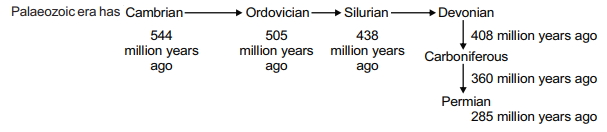
  • Paleozoic -Carboniferous
Answer
Correct option: D.
Paleozoic -Carboniferous
d
Eras $\quad$Periods
Paleozoic $\quad$- Pernian, Carboniferous, Devonian, Silurian, Ordovician, Cambrian.
Mesozoic $\quad$- Cretaceous, Triassic, Jurassic
Cenozoic $\quad$- Tertiary, Quaternary
View full question & answer
MCQ 991 Mark
The last major evolutionary advancement among the vascular plants was the emergence of flowering plants (angiosperms) about
  • A
    $350\; million$ years ago
  • $140 \;million$ years ago
  • C
    $16,00 \;million$ years ago
  • D
    $220\; million$ years ago
Answer
Correct option: B.
$140 \;million$ years ago
b
In cretaceous period, angiosperms appeared
View full question & answer
MCQ 1001 Mark
The Permian period, during which the first most modern orders of insects appeared, occurred approximately
  • A
    $80\; million$ years ago
  • B
    $150\; million$ years ago
  • $280\; million$ years ago
  • D
    $550\; million$ years ago
Answer
Correct option: C.
$280\; million$ years ago
c

View full question & answer