Question
Decrease in concentration of reactant or increase in concentration of product per unit time is called rate of reaction. lt is of two types:

  1. Instantaneous rate of reaction: Rate of change of concentration of reactant or product at a particular time is called instantaneous rate of reaction.

$\text{r}_\text{inst.}=\frac{\text{dC}}{\text{dt}}$

where, dC = infinitely small change in concentration

dt = infinitely small change in time.

  1. Average rate of reaction: Ratio of change in concentration and time required for the change is average rate of reaction.

$\text{r}_\text{av}=\frac{\triangle\text{x}}{\triangle\text{t}}=\frac{\text{Change in concentration}}{\text{Time required for the change}}$

For a reaction of the type, m1A + m2B → n1C + n2D

Rate of reaction is given as

$\frac{1}{\text{m}_1}\frac{\text{d[A]}}{\text{dt}}=-\frac{1}{\text{m}_2}\frac{\text{d[B]}}{\text{dt}}=+\frac{1}{\text{n}_1}\frac{\text{d[C]}}{\text{dt}}=+\frac{1}{\text{n}_2}\frac{\text{d[D]}}{\text{dt}}$

In these questions (Q. No. i-iv), a statement of assertion followed by a statement ofreason is given. Choose the correct answer out of the following choices.

  1. Assertion and reason both are correct statements and reason is correct explanation for assertion.
  2. Assertion and reason both are correct statements but reason is not correct explanation for assertion.
  3. Assertion is correct statement but reason is wrong statement.
  4. Assertion is wrong statement but reason is correct statement.
  1. Assertion: The kinetics of the reaction, $\text{mA}+\text{nB}+\text{pC}\rightarrow\text{m}'\text{ X}+\text{n}'\text{ Y}+\text{p}'\text{ Z}$ obey the rate expression as $\frac{\text{dx}}{\text{dt}}=\text{k}[\text{A}]^\text{m}[\text{B}]^\text{n}.$

Reason: The rate of the reaction does not depend upon the concentration of C.

  1. Assertion: Instantaneous rate of reaction is equal to $\frac{\text{dx}}{\text{dt}}.$

Reason: lt is the rate of reaction at any particular instant of time.

  1. Assertion: For the reaction, $\text{RCl}+\text{NaOH}\rightarrow\text{ROH}+\text{NaCl},$ the rate of reaction is reduced to half on reducing the concentration of RCl to half.

Reason: The rate of reaction is represented by k[RCl].

  1. Assertion: ln rate law, unlike in the expression for equilibrium constants, the exponents for concentrations do not necessarily match the stoichiometric coefficients.

Reason: It is the mechanism and not the balanced chemical equation for the overall change that governs the reaction rate.

  1. Assertion: ln a reaction, 2A + B → A2B, the reactant B will disappear at twice the rate as A will decrease.

Reason: The rate of disappearance of reactant will be $-\frac{1}{2}\frac{\text{d[A]}}{\text{dt}}=-\frac{\text{d[B]}}{\text{dt}}$
Answer

  1. (a) Assertion and reason both are correct statements and reason is correct explanation for assertion.

Explanation:

Rate expression $\frac{\text{dx}}{\text{dt}}=\text{k}[\text{A}]^\text{m}[\text{B}]^\text{n}$

shows that the total order of reactions is m + n + 0 = m + n, as the rate of reaction is independent of concentration of C, i.e., the order with respect to C is zero. This is the reason that C does not figure in the rate expression.

  1. (b) Assertion and reason both are correct statements but reason is not correct explanation for assertion.

Explanation:

Instantaneous rate of a reaction is equal to small change in concentration (dx) during a small interval of time (dt) at that particular instant of time divided by the time interval.

  1. (a) Assertion and reason both are correct statements and reason is correct explanation for assertion.

Explanation:

For the given reaction, rate of reaction (r) = k[RCl] (where k is rate constant). Therefore if the concentration of [RCl] is reduced to half, then new rate $(\text{r}')=\frac{\text{k}}{2}[\text{RCl}].$

  1. (a) Assertion and reason both are correct statements and reason is correct explanation for assertion.
  1. (d) Assertion is wrong statement but reason is correct statement.

Explanation:

2A + B → A2B

The rate of disappearance of reactant will be

$-\frac{1}{2}\frac{\text{d[A]}}{\text{dt}}=\frac{\text{d[B]}}{\text{dt}}=\frac{\text{d}[\text{A}_2\text{B}]}{\text{dt}}$

Therefore, the reactant B will disappear at half the rate as A will decrease.

Need a full question paper?

Generate a complete, print-ready paper with questions like this in minutes — across 16+ boards, with answer keys.

Start Generating Free

Similar questions

Read the passage given below and answer the following questions:

Proteins are high molecular mass complex biomolecules of amino acids. The important proteins required for our body are enzymes, hormones, antibodies, transport proteins, structural proteins, contractile proteins etc. Except for glycine, all $\alpha$-amino acids have chiral carbon atom and most of them have L-configuration. The amino acids exists as dipolar ion called zwitter ion, in which a proton goes from the carboxyl group to the amino group. A large number of $\alpha$-amino acids are joined by peptide bonds forming polypeptides. The peptides having very large molecular mass (more than 10,000) are called proteins. The structure of proteins is described as primary structure giving sequence of linking of amino acids; secondary structure giving manner in which polypeptide chains are arranged and folded; tertiary structure giving folding, coiling or bonding polypeptide chains producing three dimensional structures and quaternary structure giving arrangement of sub-units in an aggregate protein molecule.

A statement of assertion followed by a statement of reason is given. Choose the correct answer out of the following choices.

  1. Assertion and reason both are correct statements and reason is correct explanation for assertion.
  2. Assertion and reason both are correct statements but reason is not correct explanation for assertion.
  3. Assertion is correct statement but reason is wrong statement.
  4. Assertion is wrong statement but reason is correct statement.
  1. Assertion: Except glycine, all naturally occurring CL-amino acids are optically active.

Reason: All naturally occurring CL-amino acids, except glycine, has at least one asymmetric carbon.

  1. Assertion: All amino acids are optically active.

Reason: Amino acids contain asymmetric carbon atoms.

  1. Assertion: In $\alpha$-helix structure, intramolecular H-bonding takes place whereas in $\beta$-pleated structure, intermolecular H-bonding takes place.

Reason: An egg contains a soluble globular protein called albumin which is present in the white part.

  1. Assertion: Secondary structure of protein refers to regular folding patterns of continuos portions of the polypeptide chain.

Reason: Out of 20 amino acids, only 12 amino acids can be synthesised by human body.

  1. Assertion: The helical structure of protein is stabilised by intramolecular hydrogen bond between -NH and carbonyl oxygen.

Reason: Sanger's reagent is used for the identification of N-tenninal amino acid of peptide chain.

Read the passage given below and answer the following questions:

The phenomenon of the flow of solvent through a semipermeable membrane from pure solvent to the solution is called osmosis.

Sometimes a pressure is applied to stop the process of osmosis, this is known as osmotic pressure. It is denoted by $\pi.$ Osmotic pressure is expressed as : $\pi=\text{CRT}$

Since, osmotic pressure depends upon the molar concentration of solution, therefore it is a colligative property.

A statement of assertion followed by a statement of reason is given. Choose the correct answer out of the following choices.

  1. Assertion and reason both are correct statements and reason is correct explanation for assertion.
  2. Assertion and reason both are correct statements but reason is not correct explanation for assertion.
  3. Assertion is correct statement but reason is wrong statement.
  4. Assertion is wrong statement but reason is correct statement.
  1. Assertion: If red blood cells were removed from the body and placed in pure water, pressure inside the cells increases.

Reason: The concentration of salt content in the cells increases.

  1. Assertion: The osmotic pressure of a solution obtained by mixing 100mL of 3.4% solution of urea and 100mL of 1.6% solution of cane sugar at 293K is 7.46 bar.

Reason: The total osmotic pressure will be equal to the sum of partial osmotic pressures.

  1. Assertion: When a solution is separated from the pure solvent by a semipermeable membrane, the solvent molecules pass through it from pure solvent side to the solution side.

Reason: Diffusion of solvent occurs from a region of high concentration to a region of low concentration solution.

  1. Assertion: Two solutions having same osmotic pressure at a given temperature are called isotonic solutions.

Reason: Osmotic pressure is not a colligative property.

  1. Assertion: The preservation of meat by salting and fruits by adding sugar protects against bacterial action.

Reason: A bacterium on salted meat or candid fruit loses water due to osmosis shrivels and ultimately dies.

Read the passage given below and answer the following questions:

Werner, a Swiss chemist in 1892 prepared and characterised a large number of coordination compounds and studied their physical and chemical behaviour. He proposed that, in coordination compounds, metals possess two types of valencies, viz. primary valencies, which are normally ionisable and secondary valencies which are non-ionisable. ln a series of compounds of cobalt (III) chloride with ammonia, it was found that some of the chloride ions could be precipitated as AgCl on adding excess of AgNO3 solution in cold, but some remained in solution. The number ofions furnished by a complex in a solution can be determined by precipitation reactions. The measurement of molar conductance of solutions of coordination compounds helps to estimate the number of ions furnished by the compound in solution.

In these questions (Q. No. i-iv), a statement of assertion followed by a statement ofreason is given. Choose the correct answer out of the following choices.

  1. Assertion and reason both are correct statements and reason is correct explanation for assertion.
  2. Assertion and reason both are correct statements but reason is not correct explanation for assertion.
  3. Assertion is correct statement but reason is wrong statement.
  4. Assertion is wrong statement but reason is correct statement.
The following questions are multiple choice questions. Choose the most appropriate answer:

  1. Assertion: The complex [Co(NH3)3Cl3] does not give precipitate with silver nitrate solution.

Reason: The given complex is non-ionisable.

  1. Assertion: The complex [Co(NH3)4Cl2]Cl gives precipitate corresponding to 2 mol of AgCl with AgNO3 solution.

Reason: It ionises as [Co(NH3)4Cl2]+ + Cl-.

  1. Assertion: CoCl3. 4NH3 gives 1 mol of AgCl on reacting with AgNO3, its secondary valency is 6.

Reason: Secondary valency corresponds to coordination number.

  1. Assertion: 1 mol of [CrCl2(H2O)4]Cl· 2H2O will give 1 mol of AgCl on treating with AgNO3.

Reason: Cl- ions satisfying secondary valanceis will not be precipitated.

  1. Assertion: CoCl3. 3NH3 is not conducting while CoCl3. 5NH3 is conducting.

Reason: The complex of CoCl3. 3NHis [CoCl3(NH3)3] while that of CoCl3· 5NH3 is [CoCl(NH3)5]Cl3.

Read the passage given below and answer the following questions:
The unique behaviour of Cu, having a positive E° accounts for its inability to liberate H2 from acids. Only oxidising acids (nitric and hot concentrated sulphuric acid) react with Cu, the acids being reduced. The stability of the half-filled (d5) subshell in Mn2+ and the completely filled (d10) configuration in Zn2+ are related to their $\text{E}^\circ\frac{\text{M}^{3+}}{\text{M}^{2+}}$ values. The low value for Sc reflects the stability of Sc3+ which has a noble gas configuration. The comparatively high value for Mn shows that Mn2+(d5) is particularly stable, whereas a comparatively low value for Fe shows the extra stability of Fe3+(d5). The comparatively low value for Vis related to the stability of v2+ (half-filled t2g level).
The following questions are multiple choice questions. Choose the most appropriate answer:
  1. Standard reduction electrode potential of $\frac{\text{Zn}^{2+}}{\text{Zn}}$ is 0.76V. This means
  1. ZnO cannot be reduced to Zn by H2 under standard conditions.
  2. Zn cannot liberate H2 with concentrated acids.
  3. Zn is generally the anode in an electrochemical cell.
  4. Zn is generally the cathode in an electrochemical cell.
  1. $\text{E}^\circ$ values for the couples $\frac{\text{Cr}^{3+}}{\text{Cr}^{2+}}$ and $\frac{\text{Mn}^{3+}}{\text{Mn}^{2+}}$ are -0.41 and +1.51 volts respectively. These values suggest that.
  1. Cr2+ acts as a reducing agent whereas Mn3+ acts as an oxidizing agent.
  2. Cr2+ is more stable th an Cr3+ state.
  3. Mn3+ is more stable than Mn2+.
  4. Cr2+ acts as an oxidizing agent whereas Mn3+ acts as a reducing agent..
  1. The reduction potential values of M, N and O are +2.46, -1.13 and -3.13V respectively. Which of the following order is correct regarding their reducing property?
  1. O > N > M
  2. O > M > N
  3. M > N > O
  4. M > O > N
  1. Which of the following statements are true?
  1. Mn2+ compounds are more stable than Fe2+ towards oxidation to +3 state.
  2. Titanium and copper both in the first series of transition metals exhibits +1 oxidation state most frequently.
  3. Cu+ ion is stable in aqueous solutions.
  4. The $\text{E}^\circ$ value for the $\frac{\text{Mn}^{3+}}{\text{Mn}^{2+}}$ couple is much more positive than that for $\frac{\text{Cr}^{3+}}{\text{Cr}^{2+}}$ or $\frac{\text{Fe}^{3+}}{\text{Fe}^{2+}}.$.
  1. (II) and (III)
  2. (I) and (IV)
  3. (I) and (III)
  4. (II) and (IV)
  1. The stability of $\text{Cu}^{2+}_\text{(aq)}$ rather than $\text{Cu}^{+}_\text{(aq)}$ is due to.
  1. More negative $\Delta_\text{hyd}\text{H}^\circ$ of $\text{Cu}^{2+}_\text{(aq)}.$
  2. Less negative $\Delta_\text{hyd}\text{H}^\circ$ of $\text{Cu}^{2+}_\text{(aq)}.$
  3. More positive $\Delta_\text{hyd}\text{H}^\circ$ of $\text{Cu}^{2+}_\text{(aq)}.$
  4. Less positive $\Delta_\text{hyd}\text{H}^\circ$ of $\text{Cu}^{2+}_\text{(aq)}.$
The electrochemical cell shown below is concentration cell.

M|M2+ (saturated solution of a sparingly soluble salt, MX2) || M2+ (0.001 mol dm-3) |M The emfof the cell depends on the difference in concentrations of M2+ ions at the two electrodes. The emf of the cell at 298 K is 0.059V.

The following questions are multiple choice questions. Choose the most appropriate answer:

  1. The solubility product (Ksp' mol3 dm-9) of MX2 at 298 K based on the information available for the given concentration cell is $(\text{take }2.303 \times \text{R}\times \frac{298}{\text{F}} = 0.059)$
  1. 2 × 10-15
  2. 4 × 10-15
  3. 3 × 10-12
  4. 1 × 10-12
  1. The value of $\triangle\text{G}$ (in kJ mol-1) for the given cell is (take 1 F = 96500 C mol-1)

  1. 3.7
  2. -3.7
  3. 10.5
  4. -11.4
  1. The equilibrium constant for the foUowing reaction is:

$\text{Fe}^{2+}+\text{Ce}^{4+}\rightleftharpoons\text{Ce}^{3+}+\text{Fe}^{3+}$

(Given, $\text{E}^\circ_\frac{\text{Ce}^{4+}}{\text{Ce}^{3+}}=1.44\text{V}$ and $\text{E}^\circ_\frac{\text{Fe}^{3+}}{\text{Fe}^{2+}}=0.68\text{V}$)

  1. 7.6 × 10¹²
  2. 6.5 × 1010
  3. 5.2 × 109
  4. 3.4 × 1012
  1. The solubility product of a saturated solution of Ag2CrO4 in water at 298 K if the emf of the cell

Ag|Ag+ (satd. Ag2CrO4 soln) || Ag+ (0.1 M) | Ag

is 0.164V at 298 K, is:

  1. 3.359 × 10⁻¹² mol3 L-3
  2. 2.287 × 10⁻¹² mol3 L-3
  3. 1.158 × 10⁻¹² mol3 L-3
  4. 4.135 × 10⁻¹² mol3 L-3
  1. To calculate the emf of the cell, which of the foUowing options is correct?
  1. emf = Ecathode - Eanode
  2. emf = Eanode - Ecathode
  3. emf = Eanode + Ecathode
  4. None of these.
Read the passage given below and answer the following questions:
A compound (X) containing C, H and O is unreactive towards sodium. It also does not react with Schiff s reagent. On refluxing with an excess of hydroiodic acid, (X) yields only one organic product ( Y). On hydrolysis, (Y) yields a new compound (Z) which can be converted into (Y) by reaction with red phosphorus and iodine. The compound (Z) on oxidation with potassium permanganate gives a carboxylic acid. The equivalent weight of this acid is 60.
The following questions are multiple choice questions. Choose the most appropriate answer:
  1. The compound (X) is an:
  1. Acid.
  2. Aldehyde.
  3. Alcohol.
  4. Ether.
  1. The IUPAC name of the acid formed is:
  1. Methanoic acid.
  2. Ethanoic acid.
  3. Propanoic acid.
  4. Butanoic acid.
  1. Compound (Y) is:
  1. Ethyl iodide.
  2. Methyl iodide.
  3. Propyl iodide.
  4. Mixture of (a) and (b).
  1. Compound (Z) is:
  1. Methanol.
  2. Ethanol.
  3. Propanol.
  4. Butanol.
  1. Compound (X) on treatment with excess of Cl2 in presence of tight gives:
  1. $\propto-$ Chlorodiethyl ether.
  2. $\propto,\propto'-$ Dichlorodiethyl ether.
  3. Perchlorodiethyl ether.
  4. None of these.

Read the passage given below and answer the following questions:

A primary alkyl halide (A) C4H9Br reacted with akoholic KOH to give compound (B). Compound (B) is reacted with HBr to give compound (C) which is an isomer of (A). When (A) reacted with sodium metal, it gave a compound (D) C8H18 that is different than the compound obtained when n-butyl bromide reacted with sodium metal.

The following questions are multiple choice questions. Choose the most appropriate answer:

  1. Compound (A) is:
  1. CH3CH2CH2CH2Br

  2. $\text{CH}_3\text{CH}-\text{CH}_2\text{Br}\\\ \ \ \ \ \ \ \ \ |\\\ \ \ \ \ \ \ \ \text{CH}_3$

  3. $\ \ \ \ \ \ \ \ \ \ \ \ \ \ \text{CH}_3\\\ \ \ \ \ \ \ \ \ \ \ \ \ \ \ |\\\text{CH}_3-\text{C}-\text{Br} \\\ \ \ \ \ \ \ \ \ \ \ \ \ \ \ \ |\\\ \ \ \ \ \ \ \ \ \ \ \ \ \ \ \text{CH}_3$

  4. CH3CH2CH2Br

  1. Which type of isomerism is present in compound (A) and (C)?
  1. Positional
  2. Functional
  3. Chain
  4. Both (a) and (c)
  1. Identify compound (B).
  1. $\text{CH}_3-\text{C}=\text{CH}_2 \ \ \\ \ \ \ \ \ \ \ \ \ \ \ \ \ \mid \\ \ \ \ \ \ \ \ \ \ \ \ \text{CH}_3$
  2. CH3 – CH = CH – CH3
  3. CH3 – CH2 – CH = CH2
  4. None of these.
  1. IUPAC name of compound (D) is:
  1. N - octane
  2. 2, 5 - dimethylhexane
  3. 2 - methylheptane
  4. 3, 4 - dimethyl hexane.
  1. When compoound (C) is treated with ale. KOH and then treated with presence of peroxide, the compound obtained is:
  1. $\ \ \ \ \ \ \ \ \ \ \ \ \ \ \text{CH}_3\\\ \ \ \ \ \ \ \ \ \ \ \ \ \ \ |\\\text{CH}_3-\text{C}-\text{Br} \\\ \ \ \ \ \ \ \ \ \ \ \ \ \ \ \ |\\\ \ \ \ \ \ \ \ \ \ \ \ \ \ \ \text{CH}_3$

  2. $\ \ \ \ \ \ \ \ \ \ \ \ \ \ \text{CH}_3\\\ \ \ \ \ \ \ \ \ \ \ \ \ \ \ |\\\text{CH}_3-\text{CH}-\text{CH}_2-\text{Br}$

  3. $\text{CH}_3\text{CH}_2\text{CH}_2\text{CH}_2\text{Br}$

  4. $$$\text{CH}_3\text{CH}_2\text{CH}_2\text{CH}-\text{Br}\\\ \ \ \ \ \ \ \ \ \ \ \ \ \ \ \ \ \ \ \ \ \ \ \ \ |\\\ \ \ \ \ \ \ \ \ \ \ \ \ \ \ \ \ \ \ \ \ \ \ \ \text{CH}_3$

ln a reaction, the rates of disappearance of different reactants or rates of formation of different products may not be equal but rate of reaction at any instant of time has the same value expressed in terms of any reactant or product. Further, the rate of reaction may not depend upon the stoichiometric coefficients of the balanced chemical equation. The exact powers of molar concentrations of reactants on which rate depends are found experimentally and expressed in terms of 'order of reaction'. Each reaction has a characteristic rate constant depends upon temperature. The units of the rate constant depend upon the order of reaction.
The following questions are multiple choice questions. Choose the most appropriate answer:
  1. The rate constant of a reaction is found to be 3 × 10-3 mol-2 L2 sec-1. The order of the reaction is:
  1. 0.5
  2. 2
  3. 3
  4. 1
  1. ln the reaction, A + 3B → 2C, the rate of formation of C is:
  1. The same as rate of consumption of A.
  2. The same as the rate of consumption of B.
  3. Twice the rate of consumption of A.
  4. $\frac{3}{2}$ times the rate of consumption of B.
  1. Rate of a reaction can be expressed by following rate expression, Rate = k[A]2 [B], if concentration of A is increased by 3 times and concentration of B is increased by 2 times, how many times rate of reaction increases?
  1. 9 times
  2. 27 times
  3. 18 times
  4. 8 times
  1. The rate of a certain reaction is given by, rate = k[H+]n.The rate increases 100 times when the pH changes from 3 to 1. The order (n) of the reaction is:
  1. 2
  2. 0
  3. 1
  4. 1.5
  1. ln a chemical reaction A + 2B → products, when concentration of A is doubled, rate of the reaction increases 4 times and when concentration of B alone is doubled rate continues to be the same. The order of the reaction is:
  1. 1
  2. 2
  3. 3
  4. 4
Read the passage given below and answer the following questions:
An organic compound (A) having molecular formula C6H6O gives a characteristic colour with aqueous FeCl3 solution. (A) on treatment with CO2 and NaOH at 400K under pressure gives (B), which on acidification gives a compound (C). The compound (C) reacts with acetyl chloride to give (D) which is a popular pain killer.
The following questions are multiple choice questions. Choose the most appropriate answer:
  1. Compound (A) is:
  1. 2-Hexanol.
  2. Dimethyl ether.
  3. Phenol.
  4. 2-Methyl pentanol.
  1. Compound (C) is:
  1. Salicylic acid.
  2. Salicyladehyde.
  3. Benzoic acid.
  4. Benzaldehyde.
  1. Number of carbon atoms in compound (D) is:
  1. 7
  2. 6
  3. 8
  4. 9
  1. The conversion of compound (A) to (C) is known as:
  1. Reimer-Tiemann reaction.
  2. Kolbe's reaction.
  3. Schimdt reaction.
  4. Swarts reaction.
  1. Compound (A) on heating with compound (C) in presence of POCl3 gives a compound (D) which is used:
  1. In perfumery as a ftavouring agent
  2. As an antipyretic
  3. As an analgesic
  4. As an intestinal antiseptic.
Read the passage given below and answer the following questions:

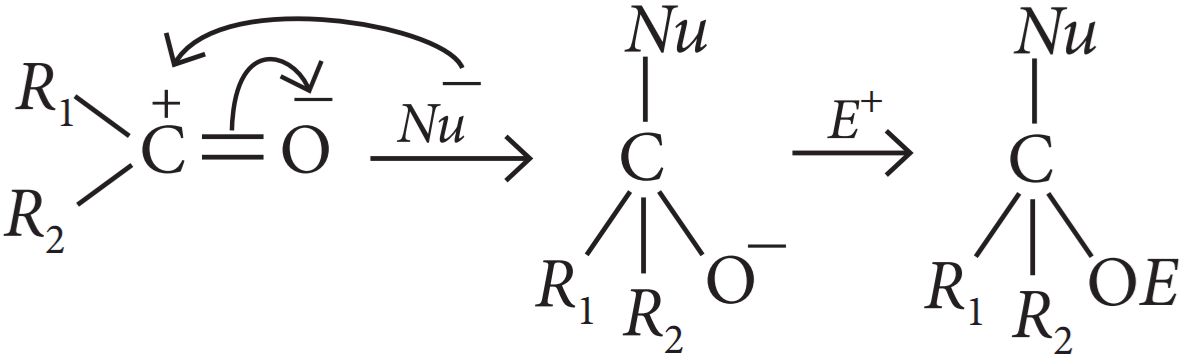
Aldehydes and ketones undergo nucleophilic addition reactions.

Carbonyl carbon is electron deficient hence acts as an electrophi le. Nucleophile attacks on the electrophili c carbon atom of the carbonyl group from a direction perpendicular to the plane of the molecule.
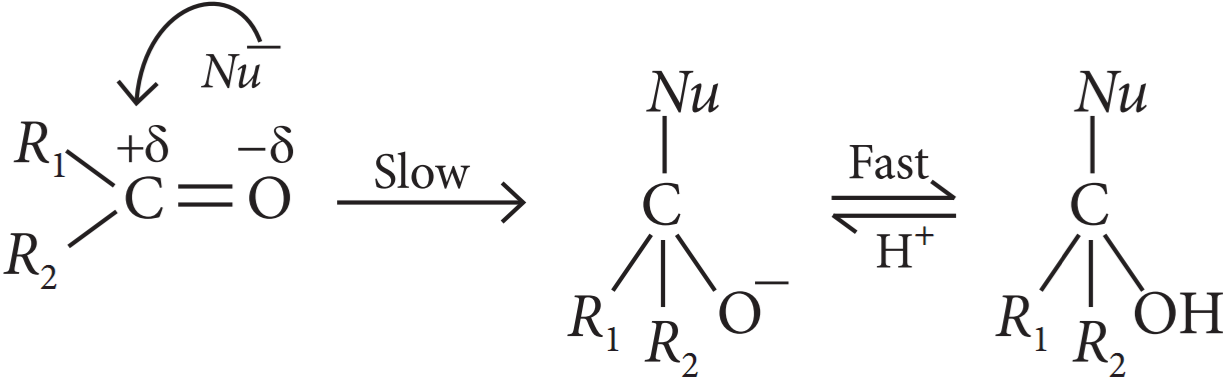
ln this process, hybridisation of carbon atom changes from sp2 to sp3 and a tetrahedral alkoxide ion is formed as intermediate. This intermediate captures proton from the reaction medium to give the neutral product. Aldehydes are generally more reactive than ketones in nucleophilic addition reactions.

In these questions (Q. No. l-iv), a statement of assertion followed by a statement ofreason is given. Choose the correct answer out of the following choices.

  1. Assertion and reason both are correct statements and reason is correct explanation for assertion.
  2. Assertion and reason both are correct statements but reason is not correct explanation for assertion.
  3. Assertion is correct statement but reason is wrong statement.
  4. Assertion is wrong statement but reason is correct statement.
  1. Assertion: Benzaldehyde is more reactive than ethanal towards nucleophitic attack.

Reason: The overall effect of -I and +R effect of phenyl group decreases the electron density on the carbon atom of >c=o group in benzaldehyde.

  1. Assertion: (CH3)3CCOC(CH3)3 and acetone can be distinguished by the reaction with NaHSO3.

Reason: HSO3 is the nucleophile in bisulphite addition.

  1. Assertion: Ease of nucleophilic addition of the compounds (I). CH3CHO(II) and CH3COCH3(III) is I > II > III.
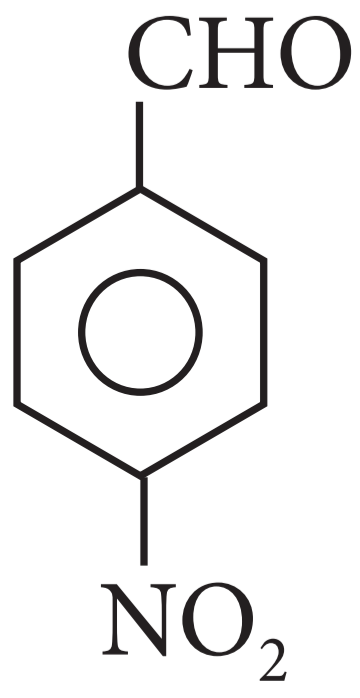
Reason: Aldehydes and ketones undergo nucleophilic addition reactions.

  1. Assertion: The formation of cyanohydrin from an aldehyde or ketone occurs very slowly with pure HCN. The is reaction is catalysed by a base.

Reason: Base generates CN- ion which is a stronger nucleophile.

  1. Assertion:  is more reactive towards nucleophilic addition reaction than .
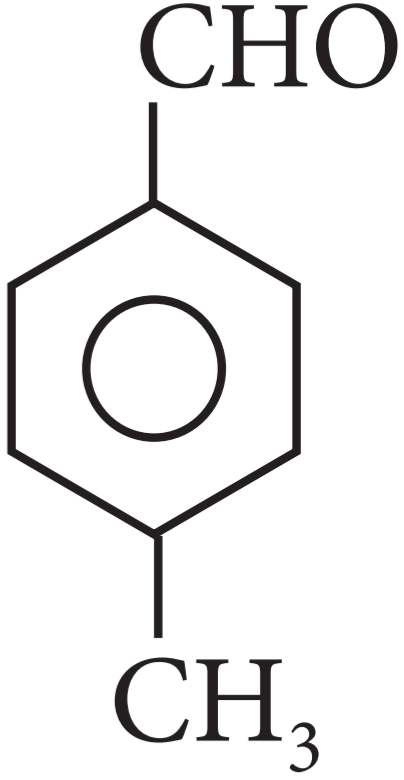
Reason: Reactivity of carbonyl group is due to electrophilic nature of carbonyl carbon.