Questions

3 Marks Question

🎯

Test yourself on this topic

9 questions · timed · auto-graded

Question 13 Marks
Explain reaction of nitrous acid with primary aliphatic Amine and Primary aromatic amine.
Answer
(i) Primary aliphatic amines react with nitrous acid to form aliphatic diazonium salts, which are unstable and quantitatively liberate nitrogen gas along with alcohols. Quantitative evolution of nitrogen is used in estimation of amino acids and proteins.
$R - NH _2+ HNO _2 \xrightarrow{ NaNO _2+ HCI }\left[ R - N _2^{+} CI \right] \xrightarrow{ H _2 O } ROH + N _2+ HCl$
(ii) Aromatic amines react with nitrous acid at low temperatures to form diazonium salts.
→ A very important class of compounds used for synthesis of a variety of aromatic compounds.

Image
View full question & answer
Question 23 Marks
Explain Gabriel pthalimide synthesis.
Answer
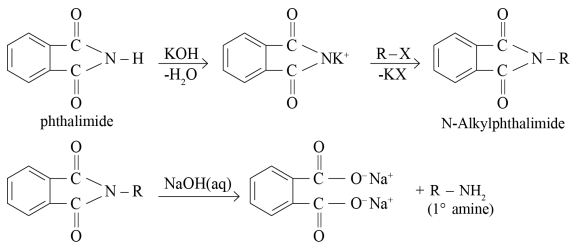
Gabriel synthesis is used for the preparation of primary amines. Phthalimide on treatment with ethanolic potassium hydroxide forms potassium salt of phthalimide which on heating with alkyl halide followed by alkaline hydrolysis produces the corresponding primary amine. Aromatic primary amines can not be prepared by this method because aryl halides do not undergo nucleophilic substitution with the anion formed by phthalimide.
Image
View full question & answer
Question 33 Marks
What is Cross aldol condensation. Write structural formula and name of four possible aldol condensation products from Propanal and Ethanol.
Answer
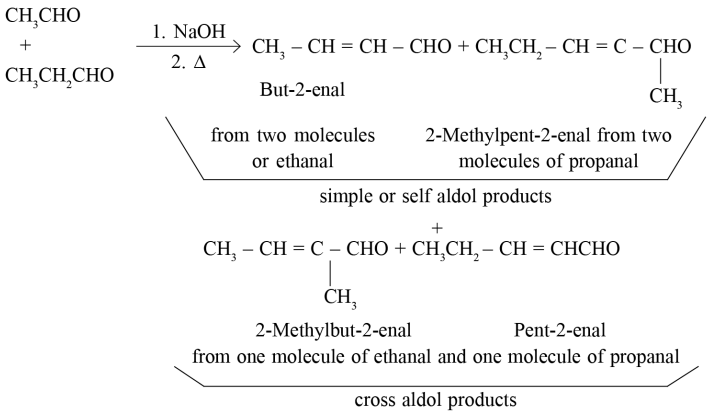
Cross aldol condensation: "When aldol condensation is carried out between two different aldehydes and / or ketones, it is called cross aldol condensation." If both of them contain $\alpha$-hydrogen atoms, it gives a mixture of four products. This is illustrated below by aldol reaction of a mixture of ethanal and propanal.
Image
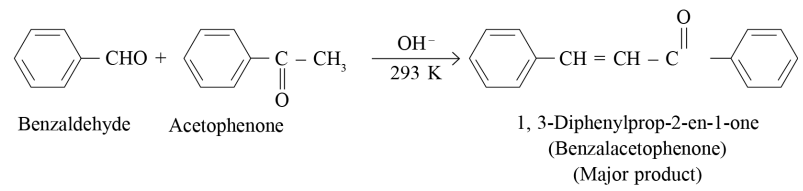
Ketones can also be used as one component in the cross aldol reactions.
Image
View full question & answer
Question 43 Marks
Write only chemical equation of method of preparation of $1^{\circ}, 2^{\circ}$ and $3^{\circ}$ alcohol from Grignard reagent.
Answer
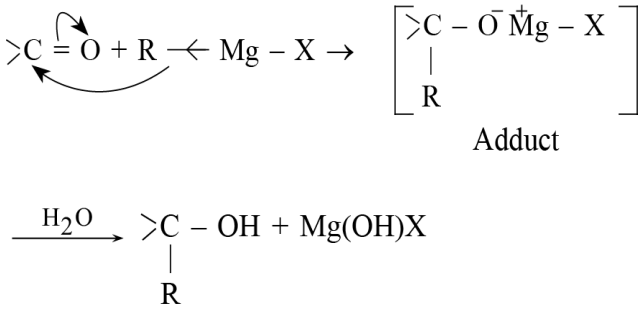
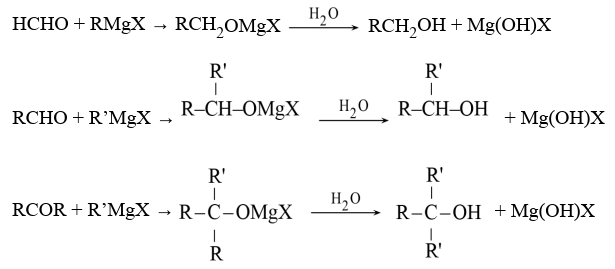
Alcohols are produced by the reaction of Grignard reagents with aldehydes and ketones.
The first step of the reaction is the nucleophilic addition of Grignard reagent to the carbonyl group to form an adduct. Hydrolysis of the adduct yields an alcohol.
Image
The overall reactions using different aldehydes and ketones are as follows :
Image
You will notice that the reaction produces a primary alcohol with methanal, a secondary alcohol with other aldehydes and tertiary alcohol with ketones.
View full question & answer
Question 53 Marks
Primary alkyl halide C4H9Br(A) reacted with alcoholic KOH to give compound (B). Compound (B) is reacted with HBr to give (C) which is an isomer of (A). When (A) is reacted with sodium metal, it gives compound (D), C8H18which is different from the compound formed when n-butyl bromide is reacted with sodium. Give the structural formula of (A) and write the equations for all the reactions.
View full question & answer
Question 63 Marks
Describe the preparation of potassium dichromate from iron chromite ore. What is the effect of increasing pH on a solution of potassium dichromate.
Answer
⇒ Dichromates are generally prepared from chromate. which in turn are obtained by the fusion of chromite ore (FeCr2O4) with sodium or potassium carbonate in free access of air.
⇒ The reaction with sodium carbonate occurs as follows
$4 FeCr _2 O _4+8 Na _2 CO _3+7 O _2 \rightarrow 8 Na _2 CrO _4+2 Fe _2 O _3+8 CO _2$
⇒ The yellow solution of sodium chromate is filtered and acidified with sulphuric acid to give a solution from which orange sodium dichromate, Na2Cr2O7. 2H2O can be crystallised.
$2 Na _2 CrO _4+2 H ^{+} \rightarrow Na _2 Cr _2 O _7+2 Na ^{+}+ H _2 O$
⇒ Sodium dichromate is more soluble than potassium dichromate. The latter is therefore, prepared by treating the solution of sodium dichromate with potassium chloride.
$Na _2 Cr _2 O _7+2 KCl \rightarrow K _2 Cr _2 O _7+2 NaCl$
⇒ Orange crystals of potassium dichromate crystallise out.
⇒ The chromates and dichromates are interconvertible in aqueous solution depending upon pH of the solution.
$\begin{array}{l}2 CrO _4^{2-}+2 H ^{+} \rightarrow Cr _2 O _7^{2-}+ H _2 O \\ Cr _2 O _7^{2-}+2 OH ^{-} \rightarrow 2 CrO _4^{2-}+ H _2 O \end{array}$

View full question & answer
Question 73 Marks
The rate constants of a reaction at 500K and 700K are 0.02 S-1 and 0.07S-1 respectively. Calculate the values of E_{s} and A.
$\left[ R =8.314 JK ^{-1} mol^{-1}\right]$
Answer

$\begin{array}{l}\frac{ k _2}{ k _1}=\frac{ E _{ a }}{2.303 R }\left[\frac{ T _2- T _1}{T_1 T_2}\right] \\ \log \frac{0.07}{0.02}=\left(\frac{ E _{ a }}{2.303 \times 8.314 JK ^{-1} mol^{-1}}\right)\left[\frac{700-500}{700 \times 500}\right] \\ 0.544= E _{ a } \times 5.714 \times 10^{-4} / 19.15 \\ E _{ a }=0.544 \times 19.15 / 5.714 \times 10^{-4}=18230.8 J / mol \\ \text { Since } k = Ae ^{-\frac{ E _{ a }}{ RT }} \\ 0.02= Ae ^{-\frac{18230.8}{8.314}} \times 500 \\ A=0.2 / 0.012=1.61\end{array}$
View full question & answer
Question 93 Marks
Derive equation of Raoult's law for vapour pressure of liquid-liquid solution and give its conclusion.
Answer
→ Let us consider a binary solution of two volatile liquids and denote the two components as 1 and 2.
→ When taken in a closed vessel, both the components would evaporate and eventually an equilibrium would be established between vapour phase and the liquid phase.
→ Suppose p1 and p2 partial vapour pressure of component 1 and 2 and x1and x2 are Mole-Fraction of component 1 and 2 respectively.
→ The French chemist, Francois Marte Raoult gave the quantitative relationship between them. The relationship is known as the Raoult's law
→ "For a solution of volatile liquids the partial vapour pressure of each component of the solution is directly proportional to its mole fraction present in solution."
→ For component-1.
$\begin{array}{l} p_1 \propto x_1 \\ \therefore p_1=p_1^o \cdot x_1 \end{array}$
where $p_1^o$ is the vapour pressure of pure component 1
→ Similarly for component -2
$\begin{array}{l} p_2 \propto x_2 \\ \therefore p_2=p_2^o \cdot x_2 \end{array}$
where $p_2^o$ is the vapour pressure of pure component 2
→ According to Dalton’s law of partial pressures
→ Total pressure over the solution phase in the container will be the sum of the partial pressures of the components of the solution
$\begin{array}{l}p_{\text {Total }}=p_1+p_2 \\ =p_1^o \cdot x_1+p_2^o \cdot x_2 \\ =p_1^o\left(1-x_2\right)+p_2^o \cdot x_2 \\ =p_1^o- p _1^o \cdot x_2+p_2^o \cdot x_2 \\ p_{\text {Total }}=p_1^o+x_2\left(p_2^o-p_1^o\right)\end{array}$
→ Following conclusions can be drawn from above equation
(i) Total vapour pressure over the solution can be related to the mole fraction of any one component.
(ii) Total vapour pressure over the solution varies linearly with the mole fraction of component 2.
(iii) Depending on the vapour pressures of the pure components 1 and 2, total vapour pressure over the solution decreases or increases with the increase of the mole fraction of component 1.
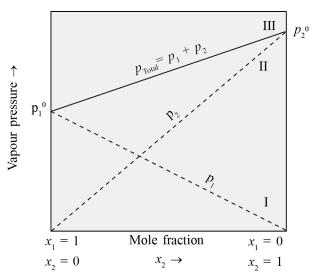
→ A plot of p₁ or p₂ versus the mole fractions x₁ and x₂ for a solution gives a linear plot as shown in Fig.
Image
→ These lines (I and II) pass through the points for which x₁ and x2 are equal to unity.
→ Similarly the plot (line III) of $p_{\text {total }}$ versus $x_2$ is also linear Fig.
→ The minimum value of $p_{\text {Total }}$ is $p_1^o$ and the maximum value is $p_2^o$, assuming that component -1 is less volatile than component $-2\left(p_1^o < p_2^o\right)$
→ The composition of vapour phase in equilibrium with the solution is determined by the partial pressures of the components.
→ If $y_1$ and $y_2$ are the mole-fraction of the component 1 and 2 respectively in vapour phase then,
→ Using Dalton's Law of partial pressure
$\begin{array}{l}p_1=y_1 \cdot p_{\text {Total }} \\ p_2=y_2 \cdot p_{\text {Total }}\end{array}$
→ In general
$p_i=y_i p _{\text {Total }}$

View full question & answer