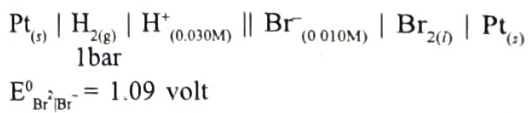
Question

Image

Answer

Get the step-by-step solution for this question inside the Vidyadip app.

Get the answer in the app

Need a full question paper?

Generate a complete, print-ready paper with questions like this in minutes — across 16+ boards, with answer keys.

Start Generating Free

Similar questions

The emf of a cell corresponding to the reaction.
$\text{Zn(s)}+2\text{H}^+(\text{aq})\xrightarrow{ \ \ \ \ \ }\text{Zn}^{2+}(0.1\text{M})+\text{H}_2(\text{g 1 atm} )$ is 0.28 volt at 25°C.
Write the half-cell reactions and calculate the pH of the solution at the hydrogen electrode.
$\text{E}^{\circ}_{\text{Zn}^{2+}/\text{Zn}}=-0.76\text{V},\text{E}^{\circ}_{\text{H}^+/\text{H}_2}=0\text{V}$
Which aqueous solution has higher concentration-1 molar or 1 molal solution of the same solute? Give reason.
Write down the IUPAC name for the following complex and indicate the oxidation state, electronic configuration and coordination number. Also give stereochemistry and magnetic moment of the complex:
K4[Mn(CN)6]
What is the significance of Henry's Law constant KH?
  1. Draw the geometrical isomers of complex [Pt(NH3)2Cl2].
  2. On the basis of crystal field theory, write the electronic configuration for d4 ion if $\Delta$0< P.
  3. Write the hybridization and magnetic behaviour of the complex [Ni(CO)4].

(At. no. of Ni = 28)

  1. The cell in which the following reaction occurs:

2 Fe3+ (aq) + 2 I- (aq) $\longrightarrow$ 2 Fe2+ (aq) + I2(s)

has $\text{E}^0_{\text{cell}}$ = 0·236 V at 298 K. Calculate the standard Gibbs energy of the cell reaction. (Given : 1 F = 96,500 C mol-1)

  1. How many electrons flow through a metallic wire if a current of 0·5 A is passed for 2 hours? (Given : 1 F = 96,500 C mol-1)
For the first order thermal decomposition reaction, following data were obtained:
C2H5Cl(g) $\xrightarrow{\text{ }\text{ }\text{ }\text{ }\text{ }\text{ }\text{ }\text{ }\text{ }}$  C2H4(g) + HCl(g)
Time/sec   Total pressure/atm
0   0.30
300   0.50
Calculate the rate constant.
(Given : log 2 = 0.301, log 3 = 0.4771, log 4 = 0.6021)
Give reasons for the following:
  1. Ethyl iodide undergoes SN2 reaction faster than ethyl bromide.
  2. $(\pm)$ 2-Butanol is optically inactive.
  3. C-X bond length in halobenzene is smaller than C-X bond length in CH3-X.
Complete the following chemical reaction equations:
$\text{Cr}_2\text{O}^{2-}_7(\text{aq})+\text{Fe}^{2+}(\text{aq})+\text{H}^+(\text{aq})\xrightarrow{\ \ \ \ \ \ \ \ \ }$
Calculate the standard cell potentials of galvanic cell in which the following reactions take place:
Fe2+(aq) + Ag+ (aq) → Fe3+(aq) + Ag(s)
Calculate the $\triangle_\text{r}\text{G}^\ominus$ and equilibrium constant of the reactions.