Questions · Page 2 of 4

M.C.Q (1 Marks)

MCQ 511 Mark
Sodium chloride crystal has a $.....$ shape:
  • Definite
  • B
    Regular
  • C
    Irregular
  • D
    None of these
Answer
Correct option: A.
Definite
In $\text{NaCl}$ crystal, there exists strong ionic bonding between $\mathrm{Na}^{+}$ and $\mathrm{Cl}^{-}$ions. Because of stronger forces of attraction between $\mathrm{Na}^{+}$ and $\mathrm{Cl}^{-}$, they remain fixed at their positions, thus, arranging in a definite pattern to give a definite shape.
View full question & answer
MCQ 521 Mark
Amorphous solids are:
  • A
    Solid substances in real sense
  • B
    Liquids in real sense
  • Supercooled liquids
  • D
    Substances with definite melting point
Answer
Correct option: C.
Supercooled liquids
Amorphous solids are supercooled liquids and they are irregularly arranged in nature of their structure. They never possess a definite melting point.
View full question & answer
MCQ 531 Mark
To get a $n-$type semiconductor from silicon, it should be doped with a substance with valence $......$
  • A
    $2$
  • B
    $1$
  • C
    $3$
  • $5$
Answer
Correct option: D.
$5$
Impurity of higher group is doped to get $n-$type semiconductor. Thus, silicon $($valency $= 4)$ should be doped with the element with valency equal to $5.$
View full question & answer
MCQ 541 Mark
Which of the following crystal lattice has the minimum empty space ?
  • A
    Simple cubic
  • B
    Body centered cubic
  • Face centered cubic
  • D
    Simple tetragonal
Answer
Correct option: C.
Face centered cubic
View full question & answer
MCQ 551 Mark
Which of the following has a regular repeated molecular pattern in three dimensional space?
  • A
    Solids and liquids
  • B
    Liquids and gases
  • Solids
  • D
    Gases
Answer
Correct option: C.
Solids
Solids have a regular repeated molecular pattern in three dimensional space and this is due to their property of high intermolecular forces. But in liquids and gases the arrangement of molecular pattern it is irregular.
View full question & answer
MCQ 561 Mark
Percentage of free space in a body centre cubic unit cell is:
  • A
    $30\%$
  • $32\%$
  • C
    $34\%$
  • D
    $28\%$
Answer
Correct option: B.
$32\%$
Percentage of free space in a body centered cubic unit cell is $32\%.$
Percentage of occupied space in a body centered cubic unit cell is $68\%.$
Note: Percentage of free space in a simple cubic unit cell is $47.6\%.$
Percentage of free space in a face centered cubic unit cell is $26\%.$
View full question & answer
MCQ 571 Mark
In $\text{fcc},$ a tetrahedral void is formed by atoms at:
  • A
    $3$ corners and $1$ face centre
  • $3$ face centres and $1$ corner
  • C
    $2$ face centres and $2$ corners
  • D
    $2$ face centres$, 1$ corner and $1$ body centre
Answer
Correct option: B.
$3$ face centres and $1$ corner
$1$ from corner and $3$ adjacent face centres form tetrahedral void.
View full question & answer
MCQ 581 Mark
What is not a type of crystal?
  • A
    Ionic
  • B
    Metallic
  • C
    Covalent molecular
  • Amorphous
Answer
Correct option: D.
Amorphous
Explanation: (D) Amorphous
Crystals tend to have relatively sharp, well-defined melting points because all the component atoms, molecules, or ions are the same distance from the same number and type of neighbours; that is, the regularity of the crystalline lattice creates local environments that are the same.
Thus the intermolecular forces holding the solid together are uniform, and the same amount of thermal energy is needed to break every interaction simultaneously.
Amorphous has different property to crystal.
View full question & answer
MCQ 591 Mark
Stacking $($a pile$)$ of square close packed layer gives rise to:
  • A
    $\text{BCC}$ structure
  • B
    $\text{FCC}$ strncture
  • $SC$ structure
  • D
    none of the above
Answer
Correct option: C.
$SC$ structure
View full question & answer
MCQ 601 Mark
In $\text{AgBr}$ crystal, the ion size lies in the order $Ag^+<−:\ $The $\text{AgBr}$ crystal should have:
  • A
    Defectless $($perfect$)$ crystal
  • B
    Schottky defect only
  • Frenkel defect only
  • D
    Both Schottky and Frenkel defects
Answer
Correct option: C.
Frenkel defect only
$\text{AgBr}$ exhibits Frenkel defect due to large difference in the size of $Ag^+$ and $Br^-$ ions.
View full question & answer
MCQ 611 Mark
Rhe rank of atoms in the hexagonal until cell is:
  • A
    $4$
  • B
    $3$
  • C
    $5$
  • $6$
Answer
Correct option: D.
$6$
Rank of atom is another term for effective number of atoms for a unit cell, i.e., $Z_\ce{effective}$.
Therefore, For $\text{HCP}$ structure rank is $6.$
View full question & answer
MCQ 621 Mark
Which of the following is an amorphous substance?
  • A
    Zinc
  • Clay
  • C
    Salt
  • D
    Sugar
Answer
Correct option: B.
Clay
Amorphous solids are a type of solids that lacks definition in shape, pattern and long range order as well as do not have a well defined melting point.
View full question & answer
MCQ 631 Mark
In a cube$, X$ atoms are present at corners and $Y$ atoms are at face centres of a cube. The number of $X$ and $Y$ are:
  • A
    $8, 8$
  • B
    $6, 8$
  • $8, 6$
  • D
    $6, 6$
Answer
Correct option: C.
$8, 6$
No. of corner position in a cube $= 8$
No. of face centres present in a cube $= 6$
$X = 8, Y = 6$
View full question & answer
MCQ 641 Mark
Potassium crystallizes in a:
  • A
    Face$-$centred cubic lattice
  • Body$-$centred cubic lattice
  • C
    Simple cubic lattice
  • D
    Orthorhombic lattice
Answer
Correct option: B.
Body$-$centred cubic lattice
Potassium $($alkali metal$)$ and iron are examples of metals that arrange themselves in $\text{bcc}\ ($body$-$centered cubic lattice$).$
View full question & answer
MCQ 651 Mark
If the ratio of the coordination number of $A$ to that of $B$ is $x:y,$ then the ratio of number of atoms of $A$ to that of $B$ in the unit cell is:
  • A
    $x : y$
  • $y : x$
  • C
    $x^2 : y$
  • D
    $y : x^2$
Answer
Correct option: B.
$y : x$
Coordination number of $A =$ Number of atoms of $B$
Coordination number of $B =$ Number of atoms of $A$
So, The Formula is $A_y​B_x$​ and the ratio of number of atoms is $y : x$
View full question & answer
MCQ 661 Mark
Which of the following oxides shows electrical properties like metals?
  • A
    $\text{SiO}_2$.
  • B
    $\text{MgO}.$
  • C
    $SO_2(s)$.
  • $\text{CrO}_2$.
Answer
Correct option: D.
$\text{CrO}_2$.
$\text{CrO}_2, \text{TiO}$ and $\text{ReO}_3$ are some typical metal oxides which show electrical conductivity similar to metal. While $SO_2, \text{MgO}$ and $SO_2$ are oxides of metal, semimetal and non$-$metal which do not show electrical properties.
View full question & answer
MCQ 671 Mark
Which of the following is a non$-$crystalline solid?
  • A
    $\text{CsCl}$
  • B
    $\text{NaCl}$
  • C
    $\text{CaF}_2$
  • Glass
Answer
Correct option: D.
Glass
$\text{CsCl, NaCl}$ and $\text{CaF}_2$​ are crystalline solids whereas glass is an amorphous solid as it does not has well developed perfectly ordered crystalline structure.
Other amorphous solids include tar, rubber, plastic, butter etc.
View full question & answer
MCQ 681 Mark
Glass is:
  • A
    Supercooled liquid
  • Crystalline solid
  • C
    Liquid crystal
  • D
    Amorphous solid
Answer
Correct option: B.
Crystalline solid
Amorphous solids neither have ordered arrangement $($i.e. no definite shape$)$ nor have sharp melting point like crystals, but when heated, they become pliable until they assume the properties usually related to liquids. It is therefore they are regarded as super$-$cooled liquids.
View full question & answer
MCQ 691 Mark
A tetrahedral void in a crystal implies that:
  • A
    The shape of the void is tetrahedral
  • B
    Molecules forming the void are tetrahedral in shape
  • The void is surrounded tetrahedrally by four spheres
  • D
    The void is surrounded by six spheres
Answer
Correct option: C.
The void is surrounded tetrahedrally by four spheres
A tetrahedral void in a crystal implies that the void is surrounded tetrahedrally by four spheres. The four spheres are located at the four corners of the tetrahedron.
View full question & answer
MCQ 701 Mark
The lattice site in a pure crystal cannot be occupied by $.......:$
  • A
    Molecule
  • B
    Ion
  • Electron
  • D
    Atom
Answer
Correct option: C.
Electron
A pure crystal consists of either atoms, molecules or ions at lattice sites. Electrons can only occupy the lattice sites when there is any vacancy at that site which means it is not a pure crystal.
View full question & answer
MCQ 711 Mark
The flame colours of metal ions are due to:
  • Metal excess defect
  • B
    Metal deficiency defect
  • C
    Schottky defect
  • D
    Frenkel defect
Answer
Correct option: A.
Metal excess defect
The flame colours of metal ions are due to metal excess defect.
The free electrons can be excited to higher energy levels giving absorption spectra and as a consequence their compounds are coloured.
View full question & answer
MCQ 721 Mark
The physical dimension of unit cells in a crystal lattice:
  • lattice parameter
  • B
    packing factor
  • C
    atomic radius
  • D
    number of constituent particles
Answer
Correct option: A.
lattice parameter
Lattice parameter which refers to the physical dimension of unit cells in a crystal lattice. Lattices in three dimensions generally have three lattice constants, referred to as $a, b$ and $c.$
View full question & answer
MCQ 731 Mark
The process of converting alkyl halides into alcohols involves $......$
  • A
    Addition reaction.
  • Substitution reaction.
  • C
    Dehydrohalogenation reaction.
  • D
    Rearrangement reaction.
Answer
Correct option: B.
Substitution reaction.
The reaction is a type of nucleophilic substitution reaction in which $-Cl$ group is replaced by $-OH.$
View full question & answer
MCQ 751 Mark
Amorphous solids:
  • possess sharp melting points.
  • B
    undergo clean cleavage when cut with a knife.
  • C
    do not undergo clean cleavage when cut with a knife.
  • D
    possess orderly arrangement over long distances.
Answer
Correct option: A.
possess sharp melting points.
Amorphous solids do not have a regular pattern of arrangement and hence, cannot be cut with knife for a clean cleavage.
View full question & answer
MCQ 761 Mark
Which one of the following schemes of ordering closed packed sheets of equal sized spheres do not generate close packed lattice?
  • A
    $\text{ABCABC}$
  • B
    $\text{ABACABAC}$
  • $\text{ABBAABBA}$
  • D
    $\text{ABCBCACBC}$
Answer
Correct option: C.
$\text{ABBAABBA}$
In option $C,$ the scheme $\text{ABBAABBA}$ of ordering closed packed sheets of equal$-$sized spheres do not generate close$-$packed lattice as $BB, AA$ and $BB$ represent same layers of sheets placed together.
View full question & answer
MCQ 771 Mark
In a multi layered close$-$packed structure:
  • there are twice as many tetrahedral holes as many close-packed atoms
  • B
    there are as many tetrahedral holes as many closed packed atoms
  • C
    there are twice as many octahedral holes as many close-packed atoms
  • D
    there are as many tetrahedral holes as many octahedral holes
Answer
Correct option: A.
there are twice as many tetrahedral holes as many close-packed atoms
No. of octahedral holes $=$ No. of close packed atoms.
No. of Tetrahedral holes $= 2\times $ No. of close packed atoms.
Hence, in a multi$-$layered close$-$packed structure, there are twice as many tetrahedral holes as many close$-$packed atoms.
View full question & answer
MCQ 781 Mark
Which of the following is an amorphous solid?
  • A
    Graphite $(C).$
  • Quartz glass $(\text{SiO}_2).$
  • C
    Chrome alum.
  • D
    Silicon carbide $(\text{SiC}).$
Answer
Correct option: B.
Quartz glass $(\text{SiO}_2).$
Quartz glass $(\text{SiO}_2)$ is an amorphous solid because their is no long range ordered arrangement of the constituent particles present in it.
View full question & answer
MCQ 791 Mark
Crystals can be classified into $.......$ basic crystal habits:
  • $7$
  • B
    $4$
  • C
    $14$
  • D
    $3$
Answer
Correct option: A.
$7$
The structures of all crystals can be classified according to the symmetry of the unit cells. There are in total $7$ groups, collectively called Crystal Systems: Tricinic, Monoclinic, Orthorhombic, Tetragonal, Trigonal, Hexagonal, and Cubic.
View full question & answer
MCQ 801 Mark
Certain crystals produce electric signals on application of pressure. This phenomenon is called:
  • A
    Ferroelectricity
  • B
    Ferrielectricity
  • C
    Pyroelectricity
  • Piezoelectricity
Answer
Correct option: D.
Piezoelectricity
When a polar crystal is subjected to a mechanical stress, electricity is produced a case of piezoelectricity. Reversely, if an electric field is applied, then a mechanical stress is developed. Piezoelectric crystal acts as a mechanical$-$electrical transductor.
View full question & answer
MCQ 811 Mark
The ratio of a number of rectangular planes and diagonal plane in a cubic unit cell is $.....:$
  • $1 : 2$
  • B
    $3 : 1$
  • C
    $2 : 3$
  • D
    $3 : 4$
Answer
Correct option: A.
$1 : 2$
The ratio of rectangular plane and diagonal plane in cubic unit cell is $3 : 6$ i.e$, 1 : 2$
There are $3$ planes that lie parallel to the side of the cube,that these are rectangular planes.while $6$ planes goes through opposite edges. And also there are diagonal planes.
And Hence, the ratio of rectangular plane and diagonal plane in cubic unit cell is $3 : 6$ i.e$, 1 : 2.$
View full question & answer
MCQ 821 Mark
Which one of the following is purely a crystalline compound?
  • Rock Salt
  • B
    Ice
  • C
    Quartz silica
  • D
    Dry Ice
Answer
Correct option: A.
Rock Salt
View full question & answer
MCQ 831 Mark
Which of the following conditions favours the existence of a substance in the solid state?
  • A
    High temperature.
  • Low temperature.
  • C
    High thermal energy.
  • D
    Weak cohesive forces.
Answer
Correct option: B.
Low temperature.
At sufficiently low temperature the thermal energy is low and the intermolecular forces bring the molecules of a substance so close that they cling to one another and occupy fixed positions. They can, however, have oscillating motion about their fixed positions. Under such condition the substance exists in solid state.
View full question & answer
MCQ 841 Mark
Empty space in $\text{ccp}$ lattice is:
  • $26\%$
  • B
    $45\%$
  • C
    $90\%$
  • D
    $30\%$
Answer
Correct option: A.
$26\%$
In $\text{ccp}$ lattice $74\%$ of the space is occupied by spheres and $26\%$ is empty.
View full question & answer
MCQ 851 Mark
In the cubic close packing, this unit cell has:
  • A
    $4$ tetrahedral voids each of which is shared by four adjacent unit cells.
  • B
    $4$ tetrahedral voids within the unit cell.
  • C
    $8$ tetrahedral voids each of which is shared by four adjacent unit cell.
  • $8$ tetrahedral voids within the unit cells.
Answer
Correct option: D.
$8$ tetrahedral voids within the unit cells.
Since, cube close packing is analogous to face$-$centered cubic $(\text{fcc})$ structure and number of atoms in a $\text{fcc}$ crystal is $4$ per unit cell.
So, number of tetrahedral voids $= 2\times$ Number of atoms in unit cell
$= 2 \times 4 = 8$
View full question & answer
MCQ 861 Mark
Which of the following is an example of metallic crystal solid?
  • A
    $C$
  • B
    $Si$
  • $W$
  • D
    $\text{AgCl}$
Answer
Correct option: C.
$W$
Metalic crystals consists of metal cations surrounded by large number of mobile valence electrons, these electrons are also known as delocalised electrons, which do not belong to any one atom, but are capable of moving through the crystal. As a result metallic crystals are good conductors of electricity.
Example: gold$-Au,$ tungsten$-W$
View full question & answer
MCQ 871 Mark
The interstital hole is called tetrahedral because ?
  • A
    it is formed by four spheres
  • B
    partly same and partly different
  • it is formed by four spheres, the centres of which form a regular tetrahedron
  • D
    none of the above
Answer
Correct option: C.
it is formed by four spheres, the centres of which form a regular tetrahedron
A tetrahedral site is surrounded by four spheres and hence an interstitial hole is called tetrahedral.
View full question & answer
MCQ 881 Mark
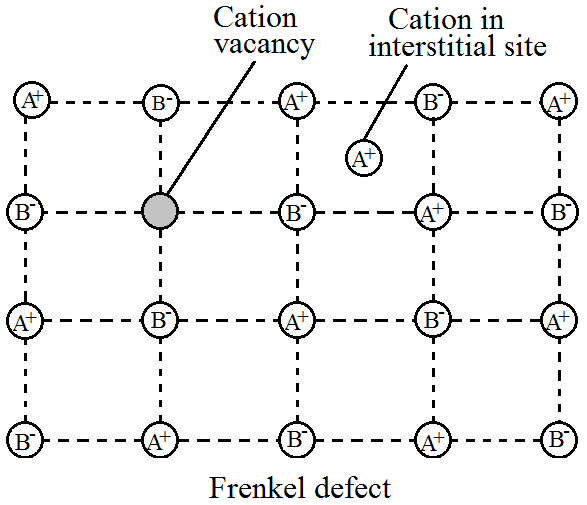
Cations are present in the interstitial sites in $......$
  • Frenkel defect.
  • B
    Schottky defect.
  • C
    Vacancy defect.
  • D
    Metal deficiency defect.
Answer
Correct option: A.
Frenkel defect.
 
Defect
Definition
Type of solid
Effect of defect on density of substance
Structure fo crystal $($with defect$)$
Frenkel Defect or dis$-$location defect
A crystal is said to have Frenkel defect if cation is missing from the normal lattice position and is occupying interstitial site.
Ionic solid
Remain same
View full question & answer
MCQ 891 Mark
Hydrogen occupies the $......$ holes, while carbon and nitrogen occupy $......$ holes:
  • Tetrahedral and octahedral
  • B
    Octahedral and tetrahedral
  • C
    Octahedral and octahedral
  • D
    Tetrahedral and tetrahedral
Answer
Correct option: A.
Tetrahedral and octahedral
The size of the hole in tetrahedral voids is smaller than the size of the hole in octahedral voids. The size of the $H$ atom is smaller than the size of $C$ and $N$ atoms. Hence, hydrogen occupies tetrahedral voids and carbon and nitrogen occupy octahedral voids.
View full question & answer
MCQ 901 Mark
The space occupied in $\text{bcc}$ arrangement is $.....:$
  • A
    $74\%$
  • B
    $70\%$
  • $68\%$
  • D
    $60\%$
Answer
Correct option: C.
$68\%$
The space occupied in $\text{sc, bcc}$ and $\text{fcc}$ structures are $52\%, 68\%$ and $74\%$ respectively.
View full question & answer
MCQ 911 Mark
Which among the following metals crystallise as a simple cube?
  • Polonium
  • B
    Iron
  • C
    Copper
  • D
    Gold
Answer
Correct option: A.
Polonium
Polonium crystallizes as simple cube. Iron crystallizes as $\text{BCC}$ unit cell. Copper and gold crystallizes as $\text{FCC}$ unit cell.
View full question & answer
MCQ 921 Mark
Identify the crystalline solid among the following:
  • A
    Glass
  • B
    Carbon black
  • C
    Resin
  • Silver
Answer
Correct option: D.
Silver
The solid which have fixed composition and three dimensional structure is called as crystalline solid.
Silver is a crystalline solid because it have fixed composition and structure.
View full question & answer
MCQ 931 Mark
Pick out the crystalline substance from the following:
  • Coal
  • B
    Wax
  • C
    Clay
  • D
    Sugar
Answer
Correct option: A.
Coal
In sugar, the constituent particles are arranged in a specific manner. Hence, it is a crystalline solid.
In coal, wax, and clay the constituent particles are arranged in a random manner. Hence, it is an amorphous solid.
View full question & answer
MCQ 941 Mark
Hexagonal close packing is found in crystal lattice of:
  • A
    $Na$
  • $Mg$
  • C
    $Al$
  • D
    None of these
Answer
Correct option: B.
$Mg$
Co$-$ordination number in $\text{HCP} = 12$
Co$-$ordination number in $Mg = 12.$
View full question & answer
MCQ 951 Mark
In a solid lattice, the cation has left a lattice site and is located at interstitial position, the lattice defect is $.....:$
  • A
    Interstitial defect
  • B
    Vacancy defect
  • Frenkel defect
  • D
    Schottky defect
Answer
Correct option: C.
Frenkel defect
View full question & answer
MCQ 961 Mark
The total number of tetrahedral voids in the face centred unit cell is $......$
  • A
    $6$
  • $8$
  • C
    $10$
  • D
    $12$
Answer
Correct option: B.
$8$
In face centred unit cell the number of atoms per unit cell $= 4$ atoms therefore, the number of tetrahedral voids in fcc unit cell $= 8.$
View full question & answer
MCQ 971 Mark
Which of the following is not the characteristic of ionic solids?
  • Very low value of electrical conductivity in the molten state.
  • B
    Brittle nature.
  • C
    Very strong forces of interactions.
  • D
    Anisotropic nature.
Answer
Correct option: A.
Very low value of electrical conductivity in the molten state.
 
Type of solid
Con$-$stituent particles
Bonding/ attractive forces
Exam$-$ples
Physical nature
Electrical conductivity
Melting Point
Ionic Solids
Ions
Coulom but or electrostatic
$\text{NaCl, MgO, ZnS, CaF2}$
Hard but brittle
Insulators in solid state but conductors in molten state and in aqueous solutions
High
View full question & answer
MCQ 981 Mark
Which of the following is true about the charge acquired by $p-$type semiconductors?
  • A
    Positive.
  • Neutral.
  • C
    Negative.
  • D
    Depends on concentration of p impurity.
Answer
Correct option: B.
Neutral.
$P-$type semiconductor by itself has mainly positively charged carriers $($holes$)$ which are able to move freely. It is, however, still neutral because the fixed acceptor atoms having accepted electrons are negative.
View full question & answer
MCQ 991 Mark
What is the coordination number in a square close packed structure in two dimensions?
  • $4$
  • B
    $3$
  • C
    $2$
  • D
    $6$
Answer
Correct option: A.
$4$
In square closed structure in two dimensions each sphere is in contact with four of its neighbours. Thus the two dimensional coordination number is $4.$
View full question & answer
MCQ 1001 Mark
The sharp melting point of crystalline solids is due to $.......$
  • A
    A regular arrangement of constituent particles observed over a short distance in the crystal lattice.
  • A regular arrangement of constituent particles observed over a long distance in the crystal lattice.
  • C
    Same arrangement of constituent particles in different directions.
  • D
    Different arrangement of constituent particles in different directions.
Answer
Correct option: B.
A regular arrangement of constituent particles observed over a long distance in the crystal lattice.
A solid is said to be crystalline if the various constituent structural units $($atoms, ions or molecules$)$ of which the solid is made, are arranged in a definite geometrical pattern within the solid. The type of forces in crystalline solids are of long range order due to which they have sharp melting point.
View full question & answer
M.C.Q (1 Marks) - Page 2 - Chemistry STD 12 Science Questions - Vidyadip