MCQ 1511 Mark
Let $f(x)$ be a quadratic polynomial such that $f(-2)$ $+f(3)=0$. If one of the roots of $f(x)=0$ is $-1$, then the sum of the roots of $f(x)=0$ is equal to
- ✓
$\frac{11}{3}$
- B
$\frac{7}{3}$
- C
$\frac{13}{3}$
- D
$\frac{14}{3}$
AnswerCorrect option: A. $\frac{11}{3}$
a
$f (-2)+ f (3)=0$
$f ( x )=( x +1)( ax + b )$
$f (-2)+ f (3)=-1(-2 a + b )+4(3 a + b )=0$
$2 a - b +12 a +4 b =0$
$14 a +3 b =0$
$\frac{- b }{ a }=\frac{14}{3}$
Sum of roots $=\left(-1+\frac{-b}{a}\right)=-1+\frac{14}{3}=\frac{11}{3}$
View full question & answer→MCQ 1521 Mark
Let $S=\{1,2,3,4\}$. Then the number of elements in the set $\{f: S \times S \rightarrow S: f$ is onto and $f(a, b)=f(b, a)$ $\geq a; \forall(a, b) \in S \times S\}$ is
Answera
$(1,1),(1,4),(4,1),(2,4),(4,2),(3,4),(4,3)$,
$(4,4)-$ all have one choice for image.
$(2,1),(1,2),(2,2)$ - all have three choices for image
$(3,2),(2,3),(3,1),(1,3),(3,3)-$ all have two choices for image.
So the total functions $=3 \times 3 \times 2 \times 2 \times 2=72$
Case $1$ : None of the pre-images have $3$ as image
Total functions $=2 \times 2 \times 1 \times 1 \times 1=4$
Case $2$ : None of the pre-images have $2$ as image
Total functions $=2 \times 2 \times 2 \times 2 \times 2=32$
Case $3$ : None of the pre-images have either $3$ or $2$
as image
Total functions $=1 \times 1 \times 1 \times 1 \times 1=1$
$\therefore$ Total onto functions $=72-4-32+1=37$
View full question & answer→MCQ 1531 Mark
Tho damnin of tho finction $\cos ^{-1}\left(\frac{2 \sin ^{-1}\left(\frac{1}{4 x^{2}-1}\right)}{\pi}\right)$ is
- A
$R-\left\{-\frac{1}{2}, \frac{1}{2}\right\}$
- B
$(-\infty,-1] \cup[1, \infty) \cup\{0\}$
- C
$\left(-\infty, \frac{-1}{2}\right) \cup\left(\frac{1}{2}, \infty\right) \cup\{0\}$
- ✓
$\left(-\infty, \frac{-1}{\sqrt{2}}\right] \cup\left[\frac{1}{\sqrt{2}}, \infty\right) \cup\{0\}$
AnswerCorrect option: D. $\left(-\infty, \frac{-1}{\sqrt{2}}\right] \cup\left[\frac{1}{\sqrt{2}}, \infty\right) \cup\{0\}$
d
$-1 \leq \frac{2 \sin ^{-1}\left(\frac{1}{4 x^{2}-1}\right)}{\pi} \leq 1$
$-\pi / 2 \leq \sin ^{-1} \frac{1}{4 x^{2}-1} \leq \pi / 2$
Always $-1 \leq \frac{1}{4 x^{2}-1} \leq 1$
$x \in\left(\infty, \frac{1}{\sqrt{2}}\right) \cup\left[\frac{1}{\sqrt{2}}, \infty\right)$
View full question & answer→MCQ 1541 Mark
The number of bijective functions $f :\{1,3,5, 7, \ldots \ldots . .99\} \rightarrow\{2,4,6,8, \ldots \ldots, 100\}$, such that $f(3) \geq f(9) \geq f(15) \geq f(21) \geq \ldots \ldots f(99), \quad$ is
- A
${ }^{50} P _{17}$
- ✓
${ }^{50} P _{33}$
- C
$33 ! \times 17 !$
- D
$\frac{50 !}{2}$
AnswerCorrect option: B. ${ }^{50} P _{33}$
b
As function is one-one and onto, out of 50 elements of domain set 17 elements are following restriction
$f(3)>f(9)>f(15) \ldots . .>f(99)$
So number of ways $={ }^{50} C_{17} \cdot 1 \cdot 33$ !
$={ }^{50} P_{33}$
View full question & answer→MCQ 1551 Mark
The total number of functions,$f:\{1,2,3,4\} \cdot\{1,2,3,4,5,6\}$ such that $f (1)+ f (2)= f (3)$, is equal to .
Answerb
$A =\{1,2,3,4\}$
$B =\{1,2,3,4,5,6\}$
Here $f(3)$ can be $2, 3, 4, 5, 6$
$f (3)=2,( f (1), f (2)) \rightarrow(1,1) \rightarrow 6 \text { cases }$
$f (3)=3,( f (1), f (2)) \rightarrow(1,2),(2,1)$
$\rightarrow 2 \times 6=12 \text { cases }$
$f (3)=4,( f (1), f (2)) \rightarrow(1,3),(3,1),(2,2)$
$\rightarrow 3 \times 6=18 \text { cases }$
$f (3)=5,( f (1), f (2)) \rightarrow(1,4),(4,1),(2,3),(3,2)$
$\rightarrow 4 \times 6=24 \text { cases }$
$f (3)=6,( f (1), f (2)) \rightarrow(1,5),(5,1),(2,4),(4,2),(3,3)$
$\rightarrow 5 \times 6=30 \text { cases }$
Total number of cases $=6+12+18+24+30=90$
View full question & answer→MCQ 1561 Mark
Let $f : R \rightarrow R$ be a continuous function such that $f(3 x)-f(x)=x$. If $f(8)=7$, then $f(14)$ is equal to.
Answerb
$f(x)-f(x / 3)=x / 3$
$f(x / 3)-f\left(x / 3^{2}\right)=x / 3^{2}$
$f(x)-\lim _{n \rightarrow \infty} f\left(\frac{x}{3^{n}}\right)=x\left(\frac{1}{3}+\frac{1}{3^{2}} \ldots \infty\right)$
$f(x)-f(0)=\frac{x}{2}$
$f(8)=7 ; f(0)=3$
$f(x)=x / 2+3$
$f(14)=10$
View full question & answer→MCQ 1571 Mark
Let $f, g: N -\{1\} \rightarrow N$ be functions defined by $f(a)=\alpha$, where $\alpha$ is the maximum of the powers of those primes $p$ such that $p^{\alpha}$ divides $a$, and $g(a)=a+1$, for all $a \in N -\{1\}$. Then, the function $f+ g$ is.
Answerd
$f: N-\{1\} \rightarrow N \quad f(a)=\alpha$
Where $\alpha$ is max of powers of prime $P$ such that $p ^{\alpha}$ divides a. Also $g ( a )= a +1$
$f(2)=1$ $g(2)=3$
$f(3)=1$ $g(3)=4$
$f(4)=2$ $g(4)=5$
$f(5)=1$ $g(5)=6$
$f(2)+g(2)=4$
$(f(3)+g(3))=5$
$f(4)+g(4)=7$
$f(5)+g(5)=7$
$\therefore$ Many one $f(x)+g(x)$ does not cotain 1
into function
Ans.$(D)$ [neither one-one nor onto]
View full question & answer→MCQ 1581 Mark
Let $f(x)=a x^{2}+b x+c$ be such that $f(1)=3, f(-2)$ $=\lambda$ and $f (3)=4$. If $f (0)+ f (1)+ f (-2)+ f (3)=14$, then $\lambda$ is equal to$...$
- A
$-4$
- B
$\frac{13}{2}$
- C
$\frac{23}{2}$
- ✓
$4$
Answerd
$f (0)+3+\lambda+4=14$
$\therefore f (0)=7-\lambda= c$
$f (1)= a + b + c =3$
$f (3)=9 a +3 b + c =4 \quad$...(ii)
$f (-2)=4 a -2 b + c =\lambda \quad$...(iii)
$(ii) - (iii)$
$a+b=\frac{4-\lambda}{5}$ put in equation (i)
$\frac{4-\lambda}{5}+7-\lambda=3$
$6 \lambda=24 ; \quad \lambda=4$
View full question & answer→MCQ 1591 Mark
Let $f: R \rightarrow R$ be a function defined by $f(x)=\left(2\left(1-\frac{x^{25}}{2}\right)\left(2+x^{25}\right)\right)^{\frac{1}{50}}$. If the function $g(x)=f(f(f(x)))+f(f(x))$, the the greatest integer less than or equal to $g (1)$ is
Answerc
$f(x)=\left[2\left(1-\frac{x^{25}}{2}\right)\left(2+x^{25}\right)\right]^{\frac{1}{50}}$
$f(x)=\left[\left(2-x^{25}\right)\left(2+x^{25}\right)\right]^{\frac{1}{50}}$
$\quad=\left(4-x^{50}\right)^{1 / 50}$
$\begin{aligned} f(f(x)) =\left(4-\left(\left(4-x^{50}\right)^{1 / 50}\right)^{50}\right)^{1 / 50}=x \\ g(x)=f(f(f(x)))+f(f(x)) \\ \quad=f(x)+x \\ g(1)=f(1)+1=3^{1 / 50}+1 \\g(1)]=\left[3^{1 / 50}+1\right]=2 \end{aligned}$
View full question & answer→MCQ 1601 Mark
Let $S=\{1,2,3,4,5,6,7,8,9,10\}$. Define $f: S \rightarrow S$ as $f(n)=\left\{\begin{array}{cc}2 n, & \text { if } n=1,2,3,4,5 \\ 2 n-11 & \text { if } n=6,7,8,9,10\end{array}\right.$. Let $g : S \rightarrow S$ be a function such that $f o g(n)=\left\{\begin{array}{ll}n+1 & \text {, if } n \text { is odd } \\ n-1 & \text {, if } n \text { is even }\end{array}\right.$, then $g (10)(( g (1)+ g (2)+ g (3)+ g (4)+ g (5))$ is equal to
- A
$-190$
- B
$180$
- C
$-180$
- ✓
$190$
Answerd
$\quad f ^{-1}( n )=\left\{\begin{array}{cc}\frac{ n }{2} ; & n =2,4,6,8,10 \\ \frac{ n +11}{2} ; & n =1,3,5,7,9\end{array}\right.$
$\therefore \quad f ( g ( n ))=\left\{\begin{array}{lll} n +1 ;& n \in \text { odd } \\ n -1 ; &n \in \text { even } \end{array}\right.$
$\Rightarrow \quad g ( n ) =\left\{\begin{array}{ll} f ^{-1}( n +1) ;& n \in \text { odd } \\ f ^{-1}( n -1) ; &n \in \text { even } \end{array}\right.$
$\therefore \quad g ( n ) =\left\{\begin{array}{ll} \frac{ n +1}{2} ; &n \in \text { odd } \\ \frac{ n +10}{2} ; & n \in \text { even } \end{array}\right.$
$g (10) \cdot[ g (1)+ g (2)+ g (3)+ g (4)+ g (5)]$
$=10 \cdot[1+6+2+7+3]=190$
View full question & answer→MCQ 1611 Mark
The domain of the function
$f(x)=\frac{\cos ^{-1}\left(\frac{x^{2}-5 x+6}{x^{2}-9}\right)}{\log _{e}\left(x^{2}-3 x+2\right)} \text { is }$
- A
$(-\infty, 1) \cup(2, \infty)$
- B
$(2, \infty)$
- C
$\left[-\frac{1}{2}, 1\right) \cup(2, \infty)$
- ✓
$\left[-\frac{1}{2}, 1\right) \cup(2, \infty)-\left\{\frac{3+\sqrt{5}}{2}, \frac{3-\sqrt{5}}{2}\right\}$
AnswerCorrect option: D. $\left[-\frac{1}{2}, 1\right) \cup(2, \infty)-\left\{\frac{3+\sqrt{5}}{2}, \frac{3-\sqrt{5}}{2}\right\}$
d
$-1 \leq \frac{x^{2}-5 x+6}{x^{2}-9} \leq 1$
$\frac{x^{2}-5 x+6}{x^{2}-9}-1 \leq 0$
$\frac{1}{x+3} \geq 0$
$x \in(-3, \infty) \ldots \ldots(1)$
$\frac{x^{2}-5 x+6}{x^{2}-9}+1 \geq 0$
$\frac{2 x+1}{x+3} \geq 0$
$x \in(-\infty,-3) \cup\left[-\frac{1}{2}, \infty\right) \ldots \ldots(2)$
after taking intersection
$x \in\left[-\frac{1}{2}, \infty\right)$
$x^{2}-3 x+2>0$
$x \in(-\infty, 1) \cup(2, \infty)$
$x^{2}-3 x+2 \neq 1$
$x \neq \frac{3 \pm \sqrt{5}}{2}$
after taking intersection of each solution
$\left[-\frac{1}{2}, 1\right) \cup(2, \infty)-\left\{\frac{3+\sqrt{5}}{2}, \frac{3-\sqrt{5}}{2}\right\}$
View full question & answer→MCQ 1621 Mark
Let $c, k \in R$. If $f(x)=(c+1) x^{2}+\left(1-c^{2}\right) x+2 k$ and $f(x+y)=f(x)+f(y)-x y$, for all $x, y \in R$, then the value of $|2( f (1)+ f (2)+ f (3)+\ldots \ldots+ f (20)) \mid$ is equal to
- A
$3365$
- B
$3375$
- C
$3385$
- ✓
$3395$
AnswerCorrect option: D. $3395$
d
$f(x)=(c+1) x^{2}+\left(1-c^{2}\right) x+2 k$ $\dots(1)$
$f(x+y)=f(x)+f(y)-x y \quad \forall x y \in R$
$\lim \limits_{y \rightarrow 0} \frac{f(x+y)-f(x)}{y}=\lim \limits_{y \rightarrow 0} \frac{f(y)-x y}{y}\Rightarrow f^{\prime}(x)=f^{\prime}(0)-x$
$f(x)=-\frac{1}{2} x^{2}+f^{\prime}(0) \cdot x+\lambda \quad \text { but } f(0)=0 \Rightarrow \lambda=0$
$f(x)=-\frac{1}{2} x^{2}+\left(1-c^{2}\right) \cdot x$ $\dots(2)$
$\therefore \quad$ as $f ^{\prime}(0)=1- c ^{2}$
Comparing equation $(1)$ and $(2)$
We obtain, $c =-\frac{3}{2}$
$\therefore \quad f ( x )=-\frac{1}{2} x ^{2}-\frac{5}{4} x$
Now $\left|2 \sum \limits_{x=1}^{20} f(x)\right|=\sum \limits_{x=1}^{20} x^{2}+\frac{5}{2} \cdot \sum \limits_{x=1}^{20} x$
$=2870+525$
$=3395$
View full question & answer→MCQ 1631 Mark
Let $f ( x )$ be a quadratic polynomial with leading coefficient $1$ such that $f(0)=p, p \neq 0$ and $f(1)=\frac{1}{3}$. If the equation $f(x)=0$ and $fofofof (x)=0$ have a common real root, then $f(-3)$ is equal to $........$
Answera
Let $f(x)=(x-\alpha)(x-\beta)$
It is given that $f(0)=p \Rightarrow \alpha \beta=p$
and $f(1)=\frac{1}{3} \Rightarrow(1-\alpha)(1-\beta)=\frac{1}{3}$
Now, let us assume that $\alpha$ is the common root of $f(x)=0$ and $f \circ f \circ f o f(x)=0$
$fofofof(x)=0$
$fofof(0) =0$
$f o f(p)=0$
So, $f(p)$ is either $\alpha$ or $\beta$.
$(p-\alpha)(p-\beta)=\alpha$
$(\alpha \beta-\alpha)(\alpha \beta-\beta)=\alpha \Rightarrow(\beta-1)(\alpha-1) \beta=1$
$(\because \alpha \neq 0)$
So, $\beta=3$
$(1-\alpha)(1-3)=\frac{1}{3}$
$\alpha=\frac{7}{6}$
$f(x)=\left(x-\frac{7}{6}\right)(x-3)$
$f(-3)=\left(-3-\frac{7}{6}\right)(3-3)=25$
View full question & answer→MCQ 1641 Mark
The number of functions $f$, from the set$A=\left\{x \in N: x^{2}-10 x+9 \leq 0\right\}$ to the set $B=\left\{n^{2}: n \in N\right\}$ such that $f(x) \leq(x-3)^{2}+1$, for every $x \in A$, is.
- ✓
$1440$
- B
$1450$
- C
$1460$
- D
$1470$
AnswerCorrect option: A. $1440$
a
$\left( x ^{2}-10 x +9\right) \leq 0 \Rightarrow( x -1)( x -9) \leq 0$
$x \in[1,9] \Rightarrow A =\{1,2,3,4,5,6,7,8,9\}$
$f ( x ) \leq( x -3)^{2}+1$
$x =1: f (1) \leq 5 \Rightarrow 1^{2}, 2^{2}$
$x =2: f (2) \leq 2 \Rightarrow 1^{2}$
$x =3: f (3) \leq 1 \Rightarrow 1^{2}$
$x =4: f (4) \leq 2 \Rightarrow 1^{2}$
$x =5: f (5) \leq 5 \Rightarrow 1^{2}, 2^{2}$
$x =6: f (6) \leq 10 \Rightarrow 1^{2}, 2^{2}, 3^{2}$
$x =7: f (7) \leq 17 \Rightarrow 1^{2}, 2^{2}, 3^{2}, 4^{2}$
$x =8: f (8) \leq 26 \Rightarrow 1^{2}, 2^{2}, 3^{2}, 4^{2}, 5^{2}$
$x =9: f (9) \leq 37 \Rightarrow 1^{2}, 2^{2}, 3^{2}, 4^{2}, 5^{2}, 6^{2}$
Total number of such function
$=2(6 !)=2(720)=1440$
View full question & answer→MCQ 1651 Mark
Let $f(x)=2 x^{2}-x-1$ and $S =\{n \in Z :|f(n)| \leq 800\}$ . Then value of $\sum_{n \in S} f(n)$ is . . . . .
- ✓
$10620$
- B
$10630$
- C
$10640$
- D
$10650$
AnswerCorrect option: A. $10620$
a
$f ( x )=2 x ^{2}- x -1$
$| f ( x )| \leq 800$
$2 n ^{2}- n -801 \leq 0$
$n^{2}-\frac{1}{2} n-\frac{801}{2} \leq 0$
$\left(n-\frac{1}{4}\right)^{2}-\frac{801}{2}-\frac{1}{16} \leq 0$
$\left(n-\frac{1}{4}\right)^{2}-\frac{6409}{16} \leq 0$
$\left(n-\frac{1}{4}-\frac{\sqrt{6409}}{4}\right)\left(n-\frac{1}{4}+\frac{\sqrt{6409}}{16}\right) \leq 0$
$\frac{1-\sqrt{6409}}{4} \leq n \leq \frac{1+\sqrt{6409}}{4}$
$n=\{-19,-18-17, \ldots \ldots 0,1,2, \ldots \ldots, 20\}$
$\sum_{n \in s} f(x)=\sum\left(2 x^{2}-x-1\right)$
$=2\left[19^{2}+18^{2}+\ldots . .+1^{2}+1^{2}+2^{2}+\ldots .+19^{2}+20^{2}\right]$
$=4\left[1^{2}+2^{2}+\ldots . .+19^{2}\right]+2\left[20^{2}\right]-20-40$
$=\frac{4 \times 19 \times 20 \times(2 \times 19+1)}{6}+2 \times 400-60$
$=\frac{4 \times 19 \times 20 \times 39}{6}+800-60-9880+800-60$
$=10620$
View full question & answer→MCQ 1661 Mark
Let $R =\{( P , Q ) \mid P$ and $Q$ are at the same distance from the origin $\}$ be a relation, then the equivalence class of $(1,-1)$ is the set
- A
$S =\left\{( x , y ) \mid x ^{2}+ y ^{2}=4\right\}$
- B
$S =\left\{( x , y ) \mid x ^{2}+ y ^{2}=1\right\}$
- C
$S =\left\{( x , y ) \mid x ^{2}+ y ^{2}=\sqrt{2}\right\}$
- ✓
$S=\left\{(x, y) \mid x^{2}+y^{2}=2\right\}$
AnswerCorrect option: D. $S=\left\{(x, y) \mid x^{2}+y^{2}=2\right\}$
d
Equivalence class of $(1,-1)$ is a circle with centre
at $(0,0)$ and radius $=\sqrt{2}$
$\Rightarrow x^{2}+y^{2}=2$
$S=\left\{(x, y) \mid x^{2}+y^{2}=2\right\}$
View full question & answer→MCQ 1671 Mark
Which of the following is not correct for relation $\mathrm{R}$ on the set of real numbers ?
- A
$(\mathrm{x}, \mathrm{y}) \in \mathrm{R} \Leftrightarrow 0<|\mathrm{x}|-|\mathrm{y}| \leq 1$ is neither transitive nor symmetric.
- ✓
$(x, y) \in R \Leftrightarrow 0<|x-y| \leq 1$ is symmetric and transitive.
- C
$(x, y) \in R \Leftrightarrow|x|-|y| \leq 1$ is reflexive but not symmetric.
- D
$(\mathrm{x}, \mathrm{y}) \in \mathrm{R} \Leftrightarrow|\mathrm{x}-\mathrm{y}| \leq 1$ is reflexive and symmetric.
AnswerCorrect option: B. $(x, y) \in R \Leftrightarrow 0<|x-y| \leq 1$ is symmetric and transitive.
b
Note that $(1,2)$ and $(2,3)$ satisfy $0<|x-y| \leq 1$
but $(1,3)$ does not satisfy it so
$0 \leq|\mathrm{x}-\mathrm{y}| \leq 1$ is symmetric but not transitive
View full question & answer→MCQ 1681 Mark
A function $f(x)$ is given by $f(x)=\frac{5^{x}}{5^{x}+5}$, then the sum of the series
$f\left(\frac{1}{20}\right)+f\left(\frac{2}{20}\right)+f\left(\frac{3}{20}\right)+\ldots \ldots+f\left(\frac{39}{20}\right)$ is equal to ....... .
- A
$\frac{19}{2}$
- B
$\frac{49}{2}$
- C
$\frac{29}{2}$
- ✓
$\frac{39}{2}$
AnswerCorrect option: D. $\frac{39}{2}$
d
$f(x)=\frac{5^{x}}{5^{x}+5} \quad f(2-x)=\frac{5}{5^{x}+5}$
$f(x)+f(2-x)=1$
$\Rightarrow f\left(\frac{1}{20}\right)+f\left(\frac{2}{20}\right)+\ldots+f\left(\frac{39}{20}\right)$
$=\left(f\left(\frac{1}{20}\right)+f\left(\frac{39}{20}\right)\right)+\ldots+\left(f\left(\frac{19}{20}\right)+f\left(\frac{21}{20}\right)+f\left(\frac{20}{20}\right)\right)$
$=19+\frac{1}{2}=\frac{39}{2}$
View full question & answer→MCQ 1691 Mark
Let $x$ denote the total number of one-one functions from a set $A$ with $3$ elements to a set $B$ with $5$ elements and $y$ denote the total number of one-one functions from the set $A$ to the set $A \times B$. Then ...... .
- A
$y=273 x$
- ✓
$2 y=91 x$
- C
$y=91 x$
- D
$2 y=273 x$
AnswerCorrect option: B. $2 y=91 x$
b
$x={ }^{5} C_{3} \times 3 !=60$
$y={ }^{15} C_{3} \times 3 !=15 \times 14 \times 13=30 \times 91$
$\therefore 2 y=91 x$
View full question & answer→MCQ 1701 Mark
Let $f: R \rightarrow R$ be defined as $f( x )=2 x -1$ and $g: R-\{1\} \rightarrow R$ be defined as $g(x)=\frac{x-\frac{1}{2}}{x-1}$ Then the composition function $f(g(x))$ is
Answerc
$f(g(x))=2 g(x)-1=2\left(\frac{2 x-1}{2(x-1)}\right)-1$
$=\frac{x}{x-1}=1+\frac{1}{x-1}$
Range of $f(g(x)= R -\{1\}$
Range of $f(g(x))$ is not onto
$\&$ $f(g(x))$ is one-one
So $f(g(x))$ is one-one but not onto.
View full question & answer→MCQ 1711 Mark
Let $f, g: N \rightarrow N$ such that $f(n+1)=f(n)+f(1)$ $\forall \, n \in N$ and $g$ be any arbitrary function. Which of the following statements is $NOT$ true ?
- A
If $fog$ is one-one, then $g$ is one-one
- B
If $f$ is onto, then $f ( n )= n\, \forall \,n \in N$
- C
$f$ is one-one
- ✓
If $g$ is onto, then $fog$ is one-one
AnswerCorrect option: D. If $g$ is onto, then $fog$ is one-one
d
$f(n+1)-f(n)=f(1)$
$\Rightarrow f(n)=n f(1)$
$\Rightarrow f$ is one-one
Now, Let $f \left( g \left( x _{2}\right)\right)= f \left( g \left( x _{1}\right)\right)$
$\Rightarrow g\left(x_{2}\right)=g\left(x_{1}\right)($ as $f$ is one-one $)$
$\Rightarrow x _{1}= x _{2}$ (as fog is one-one)
$\Rightarrow g$ is one-one
Now, $f(g(n))=g(n) f(1)$
may be many-one if
$g ( n )$ is many-one
View full question & answer→MCQ 1721 Mark
Let $A =\{1,2,3, \ldots, 10\}$ and $f: A \rightarrow A$ be defined as $f( k )=\left\{\begin{array}{cl} k +1 & \text { if } k \text { is odd } \\ k & \text { if } k \text { is even }\end{array}\right.$
Then the number of possible functions $g : A \rightarrow A$ such that $gof=f$ is ...... .
- ✓
$10^{5}$
- B
${ }^{10} C _{5}$
- C
$5^{5}$
- D
$5 !$
AnswerCorrect option: A. $10^{5}$
a
$f(x)=\left\{\begin{array}{cl}x+1, & \text { if } x \text { is odd } \\ x, & \text { if } x \text { is even }\end{array}\right.$
$\because g : A \rightarrow A$ such that $g (f( x ))=f( x )$
$\Rightarrow$ If $x$ is even then $g(x)=x ....(1)$
If $x$ is odd then $g(x+1)=x+1....(2)$
from $(1)$ and $(2)$ we can say that
$g(x)=x$ if $x$ is even
$\Rightarrow$ If $x$ is odd then $g(x)$ can take any value in set $A$
so number of $g(x)=10^{5} \times 1$
View full question & answer→MCQ 1731 Mark
Let $f(x)=\sin ^{-1} x$ and $g(x)=\frac{x^{2}-x-2}{2 x^{2}-x-6} .$ If $g(2)=\lim _{x \rightarrow 2} g(x)$, then the domain of the function $fog$ is .... .
- A
$(-\infty,-2] \cup\left[-\frac{3}{2}, \infty\right)$
- B
$(-\infty,-2] \cup[-1, \infty)$
- ✓
$(-\infty,-2] \cup\left[-\frac{4}{3}, \infty\right)$
- D
$(-\infty,-1] \cup[2, \infty)$
AnswerCorrect option: C. $(-\infty,-2] \cup\left[-\frac{4}{3}, \infty\right)$
c
Domain of $\operatorname{fog}( x )=\sin ^{-1}( g ( x ))$
$\Rightarrow \lg ( x ) l \leq 1 \quad, \quad g (2)=\frac{3}{7}$
$\left|\frac{ x ^{2}- x -2}{2 x ^{2}- x -6}\right| \leq 1$
$\left|\frac{(x+1)(x-2)}{(2 x+3)(x-2)}\right| \leq 1$
$\frac{x+1}{2 x+3} \leq 1$ and $\frac{x+1}{2 x+3} \geq-1$
$\frac{x+1-2 x-3}{2 x+3} \leq 0$ and $\frac{x+1+2 x+3}{2 x+3} \geq 0$
$\frac{x+2}{2 x+3} \geq 0$ and $\frac{3 x+4}{2 x+3} \geq 0$
$x \in(-\infty,-2] \cup\left[-\frac{4}{3}, \infty\right)$
View full question & answer→MCQ 1741 Mark
Let $f: R-\left\{\frac{\alpha}{6}\right\} \rightarrow R$ be defined by $f(x)=\frac{5 x+3}{6 x-\alpha} .$ Then the value of $\alpha$ for which $(fof)(x)=x$, for all $x \in R-\left\{\frac{\alpha}{6}\right\}$, is:
Answerb
$f(x)=\frac{5 x+3}{6 x-\alpha}=y\,....(i)$
$5 x+3=6 x y-\alpha y$
$x(6 y-5)=\alpha y+3$
$x=\frac{\alpha y+3}{6 y-5}$
$f^{-1}(x)=\frac{\alpha x+3}{6 x-5}\,....(ii)$
fo $f(x)=x$
$f(x)=f^{-1}(x)$
From eq $^{n}$ $(i)\, \& \,(ii)$
Clearly $\alpha=5$
View full question & answer→MCQ 1751 Mark
Consider function $f: A \rightarrow B$ and $g: B \rightarrow C(A, B, C \subseteq R)$ such that $(gof) ^{-1}$ exists, then:
- A
$\mathrm{f}$ and $\mathrm{g}$ both are one-one
- B
$\mathrm{f}$ is onto and $\mathrm{g}$ is one-one
- ✓
$\mathrm{f}$ is one-one and $\mathrm{g}$ is onto
- D
$\mathrm{f}$ and $\mathrm{g}$ both are onto
AnswerCorrect option: C. $\mathrm{f}$ is one-one and $\mathrm{g}$ is onto
c
$\therefore(\text { gof })^{-1}$ exist $\Rightarrow$ gof is bijective $\Rightarrow g f(x)$ must be bijective.
$\Rightarrow^{\prime} \mathrm{f}^{\prime}$ must be one-one and $'^{\prime}\mathrm{g}^{\prime}$ must be $ONTO$
View full question & answer→MCQ 1761 Mark
The inverse of $y=5^{\log x}$ is
AnswerCorrect option: C. $x = y ^{\frac{1}{\log 5}}$
c
Given $y=5^{\left(\log _{a} x\right)}=f(x)$
Interchanging $x \& y$ for inverse
$x=5^{\left(\log _{a} y\right)}=y^{\left(\log _{a} 5\right)}$
option $(1)$ or option $(2)$
Further, from given relation
$\log _{5} y =\log _{ a } x$
$\Rightarrow x=a^{\left(\log _{5} y\right)}=y^{\left(\log _{5} a\right)}$
$\Rightarrow x=y^{\left(\frac{1}{\log _{a} 5}\right)}=f^{-1}(y)$
View full question & answer→MCQ 1771 Mark
Let $A =\{2,3,4,5, \ldots ., 30\}$ and $^{\prime} \simeq ^{\prime}$ be an equivalence relation on $A \times A ,$ defined by $(a, b) \simeq (c, d),$ if and only if $a d=b c .$ Then the number of ordered pairs which satisfy this equivalence relation with ordered pair $(4,3)$ is equal to :
Answerd
$A =\{2,3,4,5, \ldots ., 30\}$
$(a, b)=(c, d) \quad \Rightarrow \quad a d=b c$
$(4,3)=( c , d ) \quad \Rightarrow \quad 4 d =3 c$
$\Rightarrow \frac{4}{3}=\frac{c}{d}$
$\frac{c}{d}=\frac{4}{3}$ and $c,d\, \in \, \{2,3, \ldots \ldots, 30\}$
$( c , d )=\{(4,3),(8,6),(12,9),(16,12),(20,15), (24,18),(28,21)\}$
No. of ordered pair $=7$
View full question & answer→MCQ 1781 Mark
Define a relation $R$ over a class of $n \times n$ real matrices $A$ and $B$ as $"ARB$ iff there exists a non-singular matrix $P$ such that $PAP ^{-1}= B "$ Then which of the following is true?
- A
$R$ is symmetric, transitive but not reflexive.
- B
$R$ is reflexive, symmetric but not transitive
- ✓
$R$ is an equivalence relation
- D
$R$ is reflexive, transitive but not symmetric
AnswerCorrect option: C. $R$ is an equivalence relation
c
$A$ and $B$ are matrices of $n \times n$ order ARB iff
there exists a non singular matrix $P (\operatorname{det}( P ) \neq 0)$
such that $PAP ^{-1}= B$
For reflexive
$ARA \Rightarrow PAP ^{-1}= A \quad \ldots(1)$ must be true for $P = I ,$ Eq.(1) is true so $'R'$ is reflexive
For symmetric
$ARB \Leftrightarrow PAP ^{-1}= B \quad \ldots(1)$ is true
for $BRA$ iff $PBP ^{-1}= A \ldots$. (2) must be true
$\because PAP -1= B$
$P ^{-1} PAP ^{-1}= P ^{-1} B$
$IAP ^{-1} P = P ^{-1} BP$
$A = P ^{-1} BP \ldots(3)$
from $(2)$ And $(3) PBP ^{-1}= P ^{-1} BP$
can be true some $P = P ^{-1} \Rightarrow P ^{2}= I (\operatorname{det}( P ) \neq 0)$
So $'R'$ is symmetric
For trnasitive
$ARB \Leftrightarrow PAP ^{-1}= B \ldots$ is true
$BRC \Leftrightarrow PBP ^{-1}= C \ldots$ is true
now $\quad PPAP ^{-1} P ^{-1}= C$
$P ^{2} A \left( P ^{2}\right)^{-1}= C \Rightarrow ARC$
So $'R'$ is transitive relation
$\Rightarrow$ Hence $R$ is equivalence
View full question & answer→MCQ 1791 Mark
Let $N$ be the set of natural numbers and a relation $R$ on $N$ be defined by $R=\left\{(x, y) \in N \times N: x^{3}-3 x^{2} y-x y^{2}+3 y^{3}=0\right\} .$ Then the relation $R$ is:
- A
reflexive and symmetric, but not transitive
- ✓
reflexive but neither symmetric nor transitive
- C
- D
symmetric but neither reflexive nor transitive
AnswerCorrect option: B. reflexive but neither symmetric nor transitive
b
$x^{3}-3 x^{2} y-x y^{2}+3 y^{3}=0$
$\Rightarrow x(x-y)(x+y)-3 y(x-y)(x+y)=0$
$\Rightarrow(x-3 y)(x-y)(x+y)=0$
Now, $x=y \forall(x, y) \in N \times N$ so reflexive
But not symmetric \& transitive
See, $(3,1)$ satisfies but $(1,3)$ does not.
Also $(3,1) \,\&\,(1,-1)$ satisfies but $(3,-1)$ does not
View full question & answer→MCQ 1801 Mark
If $f(x)$ and $g(x)$ are two polynomials such that the polynomial $P ( x )=f\left( x ^{3}\right)+ xg \left( x ^{3}\right)$ is divisible by $x^{2}+x+1,$ then $P(1)$ is equal to ....... .
Answerd
$P(x)=f\left(x^{3}\right)+\operatorname{xg}\left(x^{3}\right)$
$P (1)=f(1)+ g (1) .....(1)$
Now $P ( x )$ is divisible by $x ^{2}+ x +1$
$\Rightarrow P ( x )= Q ( x )\left( x ^{2}+ x +1\right)$
$P ( w )=0= P \left( w ^{2}\right)$ where $w , w ^{2}$ are non-real cube roots of units
$P ( x )=f\left( x ^{3}\right)+ xg \left( x ^{3}\right)$
$P ( w )=f\left( w ^{3}\right)+ wg \left( w ^{3}\right)=0$
$f(1)+\operatorname{wg}(1)=2 .....(2)$
$P \left( w ^{2}\right)=f\left( w ^{6}\right)+ w ^{2} g \left( w ^{6}\right)=0$
$f(1)+w^{2} g(1)=0 .....(3)$
$(2)+(3)$
$\Rightarrow 2 f(1)+\left(w+w^{2}\right) g(1)=0$
$2 f(1)= g (1) .....(4)$
$(2)-(3)$
$\Rightarrow\left( w - w ^{2}\right) g (1)=0$
$g(1)=0=f(1) \quad$ from (4)
from $1) \,P (1)=f(1)+ g (1)=0$
View full question & answer→MCQ 1811 Mark
If $a+\alpha=1, b+\beta=2$ and $\operatorname{af}(x)+\alpha f\left(\frac{1}{x}\right)=b x+\frac{\beta}{x}, x \neq 0,$ then the value of expression $\frac{ f ( x )+ f \left(\frac{1}{ x }\right)}{ x +\frac{1}{ x }}$ is ..... .
Answera
$\operatorname{af}(x)+\alpha f\left(\frac{1}{x}\right)=b x+\frac{\beta}{x}.....(1)$
replace $x$ by $\frac{1}{x}$
af $\left(\frac{1}{x}\right)+\alpha f(x)=\frac{b}{x}+\beta x.....(2)$
$(1)+(2)$
$(a+\alpha) f(x)+(a+\alpha) f\left(\frac{1}{x}\right)=x(b+\beta)+(b+\beta) \frac{1}{x}$
$\frac{f(x)+f\left(\frac{1}{x}\right)}{x+\frac{1}{x}}=\frac{b+\beta}{a+\alpha}=\frac{2}{1}=2$
View full question & answer→MCQ 1821 Mark
Let $\mathrm{f}: N \rightarrow N$ be a function such that $\mathrm{f}(\mathrm{m}+\mathrm{n})=\mathrm{f}(\mathrm{m})+\mathrm{f}(\mathrm{n})$ for every $\mathrm{m}, \mathrm{n} \in N$. If $\mathrm{f}(6)=18$ then $\mathrm{f}(2) \cdot \mathrm{f}(3)$ is equal to :
Answerb
$f(\mathrm{~m}+\mathrm{n})=f(\mathrm{~m})+f(\mathrm{n})$
$\text { Put } \mathrm{m}=1, \mathrm{n}=1$
$f(2)=2 f(1)$
$\text { Put } \mathrm{m}=2, \mathrm{n}=1$
$f(3)=f(2)+f(1)=3 f(1)$
$\text { Put } \mathrm{m}=3, \mathrm{n}=3$
$f(6)=2 f(3) \Rightarrow f(3)=9$
$\Rightarrow f(1)=3, f(2)=6$
$f(2) \cdot f(3)=6 \times 9=54$
View full question & answer→MCQ 1831 Mark
The range of the function,
$\mathrm{f}(\mathrm{x})=\log _{\sqrt{5}}(3+\cos \left(\frac{3 \pi}{4}+\mathrm{x}\right)+\cos \left(\frac{\pi}{4}+\mathrm{x}\right)+\cos \left(\frac{\pi}{4}-\mathrm{x}\right)$
$-\cos \left(\frac{3 \pi}{4}-\mathrm{x}\right))$ is :
AnswerCorrect option: D. $[0,2]$
d
$f(x)=\log _{\sqrt{5}}$
$(3+\cos \left(\frac{3 \pi}{4}+x\right)+\cos \left(\frac{\pi}{4}+x\right)+\cos \left(\frac{\pi}{4}-x\right)$
$-\cos \left(\frac{3 \pi}{4}-x\right))$
$f(x)=\log _{\sqrt{5}}\left[3+2 \cos \left(\frac{\pi}{4}\right) \cos (x)-2 \sin \left(\frac{3 \pi}{4}\right) \sin (x)\right]$
$f(x)=\log _{\sqrt{5}}[3+\sqrt{2}(\cos x-\sin x)]$
$\text { Since }-\sqrt{2} \leq \cos x-\sin x \leq \sqrt{2}$
$\Rightarrow \log _{\sqrt{5}}\left[3+\sqrt{2}(-\sqrt{2}) \leq f(x) \leq \log _{\sqrt{5}}[3+\sqrt{2}(\sqrt{2})]\right]$
$\Rightarrow \log _{\sqrt{5}}(1) \leq f(x) \leq \log _{\sqrt{5}}(5)$
So Range of $f(x)$ is $[0,2]$
View full question & answer→MCQ 1841 Mark
Let $\mathrm{f}(\mathrm{x})$ be a polynomial of degree $3$ such that $\mathrm{f}(\mathrm{k})=-\frac{2}{\mathrm{k}}$ for $\mathrm{k}=2,3,4,5 .$ Then the value of $52-10 \mathrm{f}(10)$ is equal to :
Answera
$\mathrm{k}\, \mathrm{f}(\mathrm{k})+2=\lambda(\mathrm{x}-2)(\mathrm{x}-3)(\mathrm{x}-4)(\mathrm{x}-5) \ldots(1)$
put $\mathrm{x}=0$
we get $\lambda=\frac{1}{60}$
Now put $\lambda$ in equation $(1)$
$\Rightarrow \mathrm{k\,f}(\mathrm{k})+2=\frac{1}{60}(\mathrm{x}-2)(\mathrm{x}-3)(\mathrm{x}-4)(\mathrm{x}-5)$
Put $\mathrm{x}=10$
$\Rightarrow 10 \,\mathrm{f}(10)+2=\frac{1}{60}(8)(7)(6)(5)$
$\Rightarrow 52-10 \,\mathrm{f}(10)=52-26=26$
View full question & answer→MCQ 1851 Mark
Let $[x]$ denote the greatest integer $\leq x$, where $x \in R$. If the domain of the real valued function $\mathrm{f}(\mathrm{x})=\sqrt{\frac{[\mathrm{x}] \mid-2}{\sqrt{[\mathrm{x}] \mid-3}}}$ is $(-\infty, \mathrm{a}) \cup[\mathrm{b}, \mathrm{c}) \cup[4, \infty), \mathrm{a}\,<\,\mathrm{b}\,<\,\mathrm{c}$, then the value of $\mathrm{a}+\mathrm{b}+\mathrm{c}$ is:
Answerc
For domain,
$\frac{|[x]|-2}{|[x]|-3} \geq 0$
Case $I:$ When $|[x]|-2 \geq 0$
and $|[x]|-3\,>\,0$
$\therefore x \in(-\infty,-3) \cup[4, \infty] \ldots . .(1)$
Case $II:$ When $|[x]|-2 \leq 0$
and $|[x]|-3\,<\,0$
$\therefore \mathrm{x} \in[-2,3) \quad \ldots(2)$
So, from $(1)$ and $(2)$
We get
Domain of function
$=(-\infty,-3) \cup[-2,3) \cup[4, \infty)$
$\therefore(a+b+c)=-3+(-2)+3=-2(a\,<\,b\,<\,c)$
View full question & answer→MCQ 1861 Mark
If the domain of the function $f(\mathrm{x})=\frac{\cos ^{-1} \sqrt{x^{2}-x+1}}{\sqrt{\sin ^{-1}\left(\frac{2 x-1}{2}\right)}}$ is the interval $(\alpha, \beta]$, then $\alpha+\beta$ is equal to:
- A
$2$
- ✓
$\frac{3}{2}$
- C
$\frac{1}{2}$
- D
$1$
AnswerCorrect option: B. $\frac{3}{2}$
b
$0 \leq x^{2}-x+1 \leq 1$
$\Rightarrow x^{2}-x \leq 0$
$\Rightarrow x \in[0,1]$
$\text { Also, } 0\,<\,\sin ^{-1}\left(\frac{2 x-1}{2}\right) \leq \frac{\pi}{2}$
$\Rightarrow 0\,<\,\frac{2 x-1}{2} \leq 1$
$\Rightarrow 0\,<\,2 x-1 \leq 2$
$1\,<\,2 x \leq 3$
$\frac{1}{2}\,<\,x \leq \frac{3}{2}$
Taking intersection
$x \in\left(\frac{1}{2}, 1\right]$
$\Rightarrow \alpha=\frac{1}{2}, \beta=1$
$\Rightarrow \alpha=\frac{1}{2}, \beta=1$
View full question & answer→MCQ 1871 Mark
Let $A=\{0,1,2,3,4,5,6,7\} .$ Then the number of bijective functions $f: A \rightarrow A$such that $f(1)+f(2)=3-f(3)$ is equal to $.....$
Answerc
$f(1)+f(2)=3-f(3)$
$\Rightarrow f(1)+f(2)+f(3)=3$
The only possibility is: $0+1+2=3$
$\Rightarrow$ Elements $1,2,3$ in the domain can be mapped with $0,1,2$ only.
So number of bijective functions.
$=\lfloor 3 \times\lfloor 5=720$
View full question & answer→MCQ 1881 Mark
Let $S=\{1,2,3,4,5,6,7\} .$ Then the number of possible functions $f: S \rightarrow S$ such that $f(m \cdot n)=f(m) \cdot f(n)$ for every $m, n \in S$ and $m . n \in S$ is equal to $......$
Answerd
$f(m n)=f(m) \cdot f(n)$
Put $m=1 f(n)=f(1) \cdot f(n) \Rightarrow f(1)=1$
Put $m=n=2$
$f(4)=f(2) \cdot f(2)$
$f(2)=1 \Rightarrow f(4)=1 \text { or } f(2)=2 \Rightarrow f(4)=4$
Put $m=2, n=3$
$f(6)=f(2) \cdot f(3)$
$\text { when } f(2)=1 \Rightarrow f(3)=1 \text { to } 7$
$f(2)=2 \Rightarrow f(3)=1 \text { or } 2 \text { or } 3$
$f(5), f(7)$ can take any value
Total $=(1 \times 1 \times 7 \times 1 \times 7 \times 1 \times 7)$
$+(1 \times 1 \times 3 \times 1 \times 7 \times 1 \times 7)$
$=490$
View full question & answer→MCQ 1891 Mark
Let $\mathrm{f}: \mathrm{R} \rightarrow \mathrm{R}$ be defined as
$f(x+y)+f(x-y)=2 f(x) f(y), f\left(\frac{1}{2}\right)=-1 .$ Then, the value of $\sum_{\mathrm{k}=1}^{20} \frac{1}{\sin (\mathrm{k}) \sin (\mathrm{k}+\mathrm{f}(\mathrm{k}))}$ is equal to:
- ✓
$\operatorname{cosec}^{2}(1) \operatorname{cosec}(21) \sin (20)$
- B
$\sec ^{2}(1) \sec (21) \cos (20)$
- C
$\operatorname{cosec}^{2}(21) \cos (20) \cos (2)$
- D
$\sec ^{2}(21) \sin (20) \sin (2)$
AnswerCorrect option: A. $\operatorname{cosec}^{2}(1) \operatorname{cosec}(21) \sin (20)$
a
$f(x)=\cos a x$
$\because f\left(\frac{1}{2}\right)=-1$
So, $-1=\cos \frac{a}{2}$
$\Rightarrow a=2(2 n+1) \pi$
Thus $f(x)=\cos 2(2 n+1) \pi x$
Now k is natural number
Thus $f(k)=1$
$\sum_{k=1}^{20} \frac{1}{\sin k \sin (k+1)}=\frac{1}{\sin 1} \sum_{k=1}^{20}\left[\frac{\sin ((k+1)-k)}{\sin k \cdot \sin (k+1)}\right]$
$=\frac{1}{\sin 1} \sum_{k=1}^{20}(\cot k-\cot (k+1))$
$=\frac{\cot 1-\cot 21}{\sin 1}=\operatorname{cosec}^{2} 1 \cos \operatorname{ec}(21) \cdot \sin 20$
View full question & answer→MCQ 1901 Mark
Let $f : R \rightarrow R$ and $g : R \rightarrow R$ be defined as $f(x)=\left\{\begin{array}{ll}x+a, & x<0 \\ |x-1|, & x \geq 0\end{array}\right.$ and $g(x)=\left\{\begin{array}{cc}x+1, & x<0 \\ (x-1)^{2}+b, & x \geq 0\end{array}\right.$ where $a , b$ are non-negative real numbers. If $(gof)\,( x )$ is continuous for all $x \in R$, then $a + b$ is equal to ...... .
Answerb
$g[f(x)]=\left[\begin{array}{cc}f(x)+1 & f(x)<0 \\ (f(x)-1)^{2}+b & f(x) \geq 0\end{array}\right.$
$g[f(x)]=\left[\begin{array}{cc}x+a+1 & x+a<0 \;and\; x<0 \\ |x-1|+1 & |x-1|<0 \;and\; x \geq 0 \\ (x+a-1)^{2}+b & x+a \geq 0 \;and\; x<0 \\ (|x-1|-1)^{2}+b & |x-1| \geq 0 \;and\; x \geq 0\end{array}\right.$
$g[f(x)]=\left[\begin{array}{cc}x+a+1 & x \in(-\infty,-a) \;and\; x \in(-\infty, 0) \\ |x-1|+1 & x \in \phi \\ (x+a-1)^{2}+b & x \in[-a, \infty) \;and\; x \in(-\infty, 0) \\ (|x-1|-1)^{2}+b & x \in R \;and\; x \in[0, \infty)\end{array}\right.$
$g[f(x)]=\left[\begin{array}{cc}x+a+1 & x \in(-\infty,-a) \\ (x+a-1)^{2}+b & x \in[-a, 0) \\ (|x-1|-1)^{2}+b & x \in[0, \infty)\end{array}\right.$
$g ( f ( x ))$ is continuous
at $x=-a$ And at $x=0$
$1=b+1$ And $(a-1)^{2}+b=b$
$b =0$ And $a =1$
$\Rightarrow \quad a+b=1$
View full question & answer→MCQ 1911 Mark
Let $\mathrm{g}: \mathrm{N} \rightarrow \mathrm{N}$ be defined as
$g(3 n+1)=3 n+2$
$g(3 n+2)=3 n+3$
$g(3 n+3)=3 n+1, \text { for all } n \geq 0$
Then which of the following statements is true?
- A
$\operatorname{gog} \mathrm{og}=\mathrm{g}$
- ✓
There exists an onto function f: $N \rightarrow N$ such that $fog =f$
- C
There exists a one- one function $f: N \rightarrow N$ such that $f o g=f$
- D
There exists an function $f: N \rightarrow N$ such that $gof =f$
AnswerCorrect option: B. There exists an onto function f: $N \rightarrow N$ such that $fog =f$
b
$g(3 n+1)=3 n+2$
$g(3 n+2)=3 n+3$
$g(3 n+3)=3 n+1, n \geq 0$
For $x=3 n+1$
$(1)$ $\operatorname{gogog}(3 n+1)=\operatorname{gog}(3 n+2)=g(3 n+3)=3 n+1$
Similarly
$\operatorname{gogog}(3 n+2)=3 n+2$
$\operatorname{gogog}(3 n+3)=3 n+3$
So gogog $(x)=x \quad \forall x \in N$
$(2)$ If $\mathrm{f}: \mathrm{N} \rightarrow \mathrm{N}$ and $\mathrm{f}$ is an onto function such that $\mathrm{f}(\mathrm{g}(\mathrm{x}))=\mathrm{f}(\mathrm{x})$ then
One of its possibilities is by taking $f(x)$ as onto function
$f(x)=a \quad x=3 n+1$
$\quad\quad \quad a \quad x=3 n+2, a \in N$
$\quad\quad \quad a \quad x=3 n+3$
$(3)$ If $f: N \rightarrow N$ and $f$ is a one-one function such that $f(g(x))=f(x)$ then
$g(x)=x$ but $g(x) \neq x$
$(4)$ As $f: N \rightarrow N, f=3 n+1$
$\quad\quad\quad\quad\quad\quad\quad\quad\quad=3 \mathrm{n}+2$
So, $g(3 n+1)=3 n+2, g(3 n+2)=3 n+3, g(3 n+3)=3 n+1$
So $g(f(x)) \neq f(x)$
View full question & answer→MCQ 1921 Mark
Let $f: R -\{3\} \rightarrow R -\{1\}$ be defined by $f(x)=\frac{x-2}{x-3} .$ Let $g: R \rightarrow R$ be given as $g ( x )=2 x -3$. Then, the sum of all the values of $x$ for which $f^{-1}( x )+ g ^{-1}( x )=\frac{13}{2}$ is equal to ...... .
Answerc
$f(x)=y=\frac{x-2}{x-3}$
$\therefore x=\frac{3 y-2}{y-1}$
$\therefore f^{-1}(x)=\frac{3 x-2}{x-1}$
$ g(x)=y=2 x-3$
$\therefore x=\frac{y+3}{2}$
$\therefore g^{-1}(x)=\frac{x+3}{2}$
$\because f^{-1}(x)+g^{-1}(x)=\frac{13}{2}$
$\therefore x^{2}-5 x+6=0$
$\therefore$ sum of roots
$x_{1}+x_{2}=5$
View full question & answer→MCQ 1931 Mark
If $\mathrm{R}=\left\{(\mathrm{x}, \mathrm{y}): \mathrm{x}, \mathrm{y} \in \mathrm{Z}, \mathrm{x}^{2}+3 \mathrm{y}^{2} \leq 8\right\}$ is a relation on the set of integers $\mathrm{Z},$ then the domain of $\mathrm{R}^{-1}$ is
- A
$\{-2,-1,1,2\}$
- ✓
$\{-1,0,1\}$
- C
$\{-2,-1,0,1,2\}$
- D
$\{0,1\}$
AnswerCorrect option: B. $\{-1,0,1\}$
b
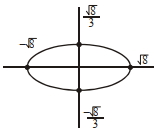
$R=\left\{(x, y): x, y \in z, x^{2}+3 y^{2} \leq 8\right\}$
For domain of $\mathrm{R}^{-1}$
Collection of all integral of y's
For $x=0, \quad 3 y^{2} \leq 8$
$\Rightarrow \mathrm{y} \in\{-1,0,1\}$
View full question & answer→MCQ 1941 Mark
Let $A=\{a, b, c\}$ and $B=\{1,2,3,4\}$ Then the number of elements in the set $C =\{ f : A \rightarrow B \mid 2 \in f ( A )$ and $f$ is not one-one $\}$ is
Answerb
$C =\{ f : A \rightarrow B \mid 2 \in f ( A )$ and $f$ is not one-one $\}$
Case-I : $\quad$ If $f(x)=2 \forall x \in A$ then number of function $=1$
Case-II : $\quad$ If $f(x)=2$ for exactly two elements then total number of many-one function $={ }^{3} C _{2}{ }^{3} C _{1}=9$
Case-III : If $f(x)=2$ for exactly one element then total number of many-one functions $={ }^{3} C _{1}{ }^{3} C _{1}=9$
Total $=19$
View full question & answer→MCQ 1951 Mark
Suppose that a function $f: R \rightarrow R$ satisfies $f(x+y)=f(x) f(y)$ for all $x, y \in R$ and $f(1)=3 .$ If $\sum \limits_{i=1}^{n} f(i)=363,$ then $n$ is equal to
Answerb
$f(x+y)=f(x) f(y)$
put $x = y =1 \quad f(2)=(f(1))^{2}=3^{2}$
put $x=2, y=1 \quad f(3)=(f(1))^{3}=3^{3}$ :
Similarly $f(x)=3^{x}$
$\sum_{i=1}^{n} f(i)=363 \Rightarrow \sum_{i=1}^{n} 3^{i}=363$
$\left(3+3^{2}+\ldots+3^{n}\right)=363$
$\frac{3\left(3^{n}-1\right)}{2}=363$
$3^{n}-1=242 \Rightarrow 3^{n}=243$
$\Rightarrow n =5$
View full question & answer→MCQ 1961 Mark
Let $f:(1,3) \rightarrow \mathrm{R}$ be a function defined by
$f(\mathrm{x})=\frac{\mathrm{x}[\mathrm{x}]}{1+\mathrm{x}^{2}},$ where $[\mathrm{x}]$ denotes the greatest
integer $\leq \mathrm{x} .$ Then the range of $f$ is
- A
$\left(\frac{3}{5}, \frac{4}{5}\right)$
- B
$\left(\frac{2}{5}, \frac{3}{5}\right] \cup\left(\frac{3}{4}, \frac{4}{5}\right)$
- C
$\left(\frac{2}{5}, \frac{4}{5}\right]$
- ✓
$\left(\frac{2}{5}, \frac{1}{2}\right) \cup\left(\frac{3}{5}, \frac{4}{5}\right]$
AnswerCorrect option: D. $\left(\frac{2}{5}, \frac{1}{2}\right) \cup\left(\frac{3}{5}, \frac{4}{5}\right]$
d
$f(\mathrm{x})=\left\{\begin{array}{ll}{\frac{\mathrm{x}}{\mathrm{x}^{2}+1}} & {; \quad \mathrm{x} \in(1,2)} \\ {\frac{2 \mathrm{x}}{\mathrm{x}^{2}+1}} & {; \quad \mathrm{x} \in[2,3)}\end{array}\right.$
$f(\mathrm{x})$ is decreasing function
$f(x) \in\left(\frac{2}{5}, \frac{1}{2}\right) \cup\left(\frac{3}{5}, \frac{4}{5}\right]$
View full question & answer→MCQ 1971 Mark
Let $\mathrm{f}: \mathrm{R} \rightarrow \mathrm{R}$ be a function which satisfies $\mathrm{f}(\mathrm{x}+\mathrm{y})=\mathrm{f}(\mathrm{x})+\mathrm{f}(\mathrm{y}) \forall \mathrm{x}, \mathrm{y} \in \mathrm{R} .$ If $\mathrm{f}(1)=2$ and $g(n)=\sum \limits_{k=1}^{(n-1)} f(k), n \in N$ then the value of $n,$ for which $\mathrm{g}(\mathrm{n})=20,$ is
Answera
$f(x+y)=f(x)+f(y)$
$\Rightarrow f(n)=n f(1)$
$f(n)=2 n$
$g(n)=\sum_{k=1}^{n-1} 2 n=2\left(\frac{(n-1) n}{2}\right)=n(n-1)$
$g(n)=20 \Rightarrow n(n-1)=20$
$n=5$
View full question & answer→MCQ 1981 Mark
Let $R _{1}$ and $R _{2}$ be two relations defined as follows :
$R _{1}=\left\{( a , b ) \in R ^{2}: a ^{2}+ b ^{2} \in Q \right\}$ and $R _{2}=\left\{( a , b ) \in R ^{2}: a ^{2}+ b ^{2} \notin Q \right\}$
where $Q$ is the set of all rational numbers. Then
- A
$R _{2}$ is transitive but $R _{1}$ is not transitive
- B
$R _{1}$ is transitive but $R _{2}$ is not transitive
- C
$R _{1}$ and $R _{2}$ are both transitive
- ✓
Neither $R _{1}$ nor $R _{2}$ is transitive
AnswerCorrect option: D. Neither $R _{1}$ nor $R _{2}$ is transitive
d
Let $a^{2}+b^{2} \in Q \& b^{2}+c^{2} \in Q$
eg. $\quad a =2+\sqrt{3} \& b =2-\sqrt{3}$
$a^{2}+b^{2}=14 \in Q$
Let $\quad c =(1+2 \sqrt{3})$
$b ^{2}+ c ^{2}=20 \in Q$
But $\quad a^{2}+c^{2}=(2+\sqrt{3})^{2}+(1+2 \sqrt{3})^{2} \notin Q$
for $R _{2}$ Let $a ^{2}=1, b ^{2}=\sqrt{3} \& c ^{2}=2$
$a^{2}+b^{2} \notin Q \& b^{2}+c^{2} \notin Q$
But $a^{2}+c^{2} \in Q$
View full question & answer→MCQ 1991 Mark
For a suitably chosen real constant $a$, let a function, $f: R-\{-a\} \rightarrow R$ be defined by $f(x)=\frac{a-x}{a+x} .$ Further suppose that for any real number $x \neq- a$ and $f( x ) \neq- a ,( fof )( x )= x .$ Then $f\left(-\frac{1}{2}\right)$ is equal to
- A
$\frac{1}{3}$
- ✓
$3$
- C
$-3$
- D
$-\frac{1}{3}$
Answerb
$f(x)=\frac{a-x}{a+x} \quad x \in R-\{-a\} \rightarrow R$
$f(f(x))=\frac{a-f(x)}{a+f(x)}=\frac{a-\left(\frac{a-x}{a+x}\right)}{a+\left(\frac{a-x}{a+x}\right)}$
$f(f(x))=\frac{\left(a^{2}-a\right)+x(a+1)}{\left(a^{2}+a\right)+x(a-1)}=x$
$\Rightarrow\left(a^{2}-a\right)+x(a+1)=\left(a^{2}+a\right) x+x^{2}(a-1)$
$\Rightarrow a(a-1)+x\left(1-a^{2}\right)-x^{2}(a-1)=0$
$\Rightarrow a=1$
$f(x)=\frac{1-x}{1+x}$
$f\left(\frac{-1}{2}\right)=\frac{1+\frac{1}{2}}{1-\frac{1}{2}}=3$
View full question & answer→MCQ 2001 Mark
If $f( x + y )=f( x ) f( y )$ and $\sum \limits_{ x =1}^{\infty} f( x )=2, x , y \in N$ where $N$ is the set of all natural numbers, then the value of $\frac{f(4)}{f(2)}$ is
- A
$\frac{1}{9}$
- ✓
$\frac{4}{9}$
- C
$\frac{1}{3}$
- D
$\frac{2}{3}$
AnswerCorrect option: B. $\frac{4}{9}$
b
$f(x+y)=f(x) \cdot f(y)$
$\sum_{x=1}^{\infty} f(x)=2 \quad$ where $x, y \in N$
$f(1)+f(2)+f(3)+\ldots . \infty=2 \ldots .(1)($ Given $)$
Now for $f(2)$ put $x=y=1$
$f(2)=f(1+1)=f(1) \cdot f(1)=(f(1))^{2}$
$f(3)=f(2+1)=f(2) \cdot f(1)=(f(1))^{3}$
Now put these values in equation
$f(1)+(f(1))^{2}+\left[f(1)^{2}+\ldots \infty=2\right]$
$\frac{f(1)}{1-f(1)}=2$
$\Rightarrow f(1)=\frac{2}{3}$
Now $f(2)=\left(\frac{2}{3}\right)^{2}$
$f(4)=\left(\frac{2}{3}\right)^{4}$
then the value of $\frac{f(4)}{f(2)}=\frac{\left(\frac{2}{3}\right)^{4}}{\left(\frac{2}{3}\right)^{2}}=\frac{4}{9}$
View full question & answer→