MCQ 1011 Mark
Let $A=\{1,2,3,5,8,9\}$. Then the number of possible functions $f : A \rightarrow A$ such that $f(m \cdot n)=f(m) \cdot f(n)$ for every $m, n \in A$ with $m \cdot n \in A$ is equal to $...............$.
Answerb
$f (1)=1 ; f (9)= f (3) \times f (3)$
i.e., $f(3)=1$ or $3$
Total function $=1 \times 6 \times 2 \times 6 \times 6 \times 1=432$
View full question & answer→MCQ 1021 Mark
The range of $f(x)=4 \sin ^{-1}\left(\frac{x^2}{x^2+1}\right)$ is
- A
$[0, \pi]$
- ✓
$[0,2 \pi)$
- C
$[0, \pi)$
- D
$[0,2 \pi]$
AnswerCorrect option: B. $[0,2 \pi)$
b
$f(x)=4 \sin ^{-1}\left(\frac{x^2}{x^2+1}\right)$
$\frac{x^2+1-1}{x^2+1}=1-\frac{1}{x^2+1} \Rightarrow[0,1)$
Range of $f(x)=[0,2 \pi)$
View full question & answer→MCQ 1031 Mark
The relation $R =\{( a , b ): \operatorname{gcd}( a , b )=1,2 a \neq b , a , b \in Z \}$ is:
- A
transitive but not reflexive
- B
symmetric but not transitive
- C
reflexive but not symmetric
- ✓
neither symmetric nor transitive
AnswerCorrect option: D. neither symmetric nor transitive
d
Reflexive : $(a, a) \Rightarrow \operatorname{gcd}$ of $(a, a)=1$
Which is not true for every a $\in Z$.
Symmetric:
Take $a =2, b =1 \Rightarrow \operatorname{gcd}(2,1)=1$
Also $2 a=4 \neq b$
Now when $a =1, b =2 \Rightarrow \operatorname{gcd}(1,2)=1$
Also now $2 a =2= b$
Hence $a=2 b$
$\Rightarrow R$ is not Symmetric
Transitive:
Let $a =14, b =19, c =21$
$\operatorname{gcd}( a , b )=1$
$\operatorname{gcd}(b, c)=1$
$\operatorname{gcd}( a , c )=7$
Hence not transitive
$\Rightarrow R$ is neither symmetric nor transitive.
View full question & answer→MCQ 1041 Mark
The minimum number of elements that must be added to the relation $R =\{( a , b ),( b , c )\}$ on the set $\{a, b, c\}$ so that it becomes symmetric and transitive is:
Answerb
For Symmetric $(a, b),(b, c) \in R$
$\Rightarrow(b, a),(c, b) \in R$
For Transitive $(a, b),(b, c) \in R$
$\Rightarrow(a, c) \in R$
Now
$1.$ Symmetric
$\therefore(a, c) \in R \Rightarrow(c, a) \in R$
$2.$ Transitive
$\therefore(a, b),(b, a) \in R$
$\Rightarrow(a, a) \in R \&(b, c),(c, b) \in R$
$\Rightarrow(b, b) \&(c, c) \in R$
$\therefore$ Elements to be added
$\left\{\begin{array}{r}(b, a),(c, b),(a, c),(c, a) \\,(a, a),(b, b),(c, c)\end{array}\right\}$
Number of elements to be added $=7$
View full question & answer→MCQ 1051 Mark
Let $R$ be a relation on $N \times N$ defined by $(a, b) R$ (c, d) if and only if $a d(b-c)=b c(a-d)$. Then $R$ is
- ✓
symmetric but neither reflexive nor transitive
- B
transitive but neither reflexive nor symmetric
- C
reflexive and symmetric but not transitive
- D
symmetric and transitive but not reflexive
AnswerCorrect option: A. symmetric but neither reflexive nor transitive
a
$(a, b) R(c, d) \Rightarrow a d(b-c)=b c(a-d)$
Symmetric:
$(c, d) R(a, b) \Rightarrow c b(d-a)=d a(c-b) \Rightarrow$
Symmetric
Reflexive:
(a, b) R $(a, b) \Rightarrow a b(b-a) \neq b a(a-b) \Rightarrow$
Not reflexive
Transitive: $(2,3) R (3,2)$ and $(3,2) R (5,30)$ but $((2,3),(5,30)) \notin R \Rightarrow \quad$ Not transitive
View full question & answer→MCQ 1061 Mark
Among the relations $S =\left\{( a , b ): a , b \in R -\{0\}, 2+\frac{ a }{ b } > 0\right\}$ And $T =\left\{( a , b ): a , b \in R , a ^2- b ^2 \in Z \right\}$,
- A
$S$ is transitive but $T$ is not
- ✓
$T$ is symmetric but $S$ is not
- C
Neither $S$ nor $T$ is transitive
- D
Both $S$ and $T$ are symmetric
AnswerCorrect option: B. $T$ is symmetric but $S$ is not
b
For relation $T=a^2-b^2=-I$
Then,$(b, a)$ on relation $R$
$\Rightarrow b ^2- a ^2=- I$
$\therefore T \text { is symmetric }$
$S =\left\{( a , b ): a , b \in R -\{0\}, 2+\frac{ a }{ b } > 0\right\}$
$2+\frac{ a }{ b } > 0 \Rightarrow \frac{ a }{ b } > -2, \Rightarrow \frac{ b }{ a } < \frac{-1}{2}$
If $(b, a) \in S$ then
$2+\frac{b}{a}$ not necessarily positive
$\therefore S$ is not symmetric
View full question & answer→MCQ 1071 Mark
Let $R$ be a relation on $R$, given by $R=\{(a, b): 3 a-3 b+\sqrt{7}$ is an irrational number $\}$. Then $R$ is
- ✓
Reflexive but neither symmetric nor transitive
- B
Reflexive and transitive but not symmetric
- C
Reflexive and symmetric but not transitive
- D
AnswerCorrect option: A. Reflexive but neither symmetric nor transitive
a
Check for reflexivity:
As $3(a-a)+\sqrt{7}=\sqrt{7}$ which belongs to relation so relation is reflexive
Check for symmetric:
Take $a=\frac{\sqrt{7}}{3}, b=0$
Now $(a, b) \in R$ but $(b, a) \notin R$
As $3(b-a)+\sqrt{7}=0$ which is rational so relation is not symmetric.
Check for Transitivity:
Take $(a, b)$ as $\left(\frac{\sqrt{7}}{3}, 1\right)$
$\&(b, c)$ as $\left(1, \frac{2 \sqrt{7}}{3}\right)$
So now $( a , b ) \in R \&( b , c ) \in R$ but $( a , c ) \notin R$ which means relation is not transitive
View full question & answer→MCQ 1081 Mark
Let $P ( S )$ denote the power set of $S =\{1,2,3, \ldots, 10\}$. Define the relations $R_1$ and $R_2$ on $P(S)$ as $A R_1 B$ if $\left( A \cap B ^{ c }\right) \cup\left( B \cap A ^{ c }\right)=\varnothing$ and $AR _2 B$ if $A \cup B ^{ c }=$ $B \cup A ^{ c }, \forall A , B \in P ( S )$. Then :
- ✓
both $R_1$ and $R_2$ are equivalence relations
- B
only $R_1$ is an equivalence relation
- C
only $R_2$ is an equivalence relation
- D
both $R_1$ and $R_2$ are not equivalence relations
AnswerCorrect option: A. both $R_1$ and $R_2$ are equivalence relations
a
$S=\{1,2,3, \ldots \ldots .10\}$
$P ( S )=$ power set of $S$
$AR , B \Rightarrow( A \cap \overrightarrow{ B }) \cup(\overrightarrow{ A } \cap B )=\phi$
$R 1$ is reflexive, symmetric
For transitive
$( A \cap \overrightarrow{ B }) \cup(\overrightarrow{ A } \cap B )=\phi ;\{ a \}=\phi=\{ b \} A = B$
$( B \cap \overrightarrow{ C }) \cup(\overrightarrow{ B } \cap C )=\phi \therefore B = C \therefore A = C \text { equivalence. }$
$R _2 \equiv A \cup \overrightarrow{ B }=\overrightarrow{ A } \cup B$
$R _2 \rightarrow \text { Reflexive, symmetric }$
for transitive
$\begin{array}{l} A \cup \overrightarrow{ B }=\overrightarrow{ A } \cup B \Rightarrow\{ a , c , d \}=\{ b , c , d \} \\ \{ a \}=\{ b \} \therefore A = B \\ B \cup \overrightarrow{ C }=\overrightarrow{ B } \cup C \Rightarrow B = C \\ \therefore A = C \quad \therefore A \cup \overrightarrow{ C }=\overrightarrow{ A } \cup C \therefore \text { Equivalence }\end{array}$
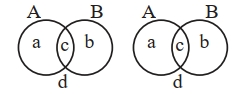
View full question & answer→MCQ 1091 Mark
Let $A =\{1,2,3,4, \ldots .10\}$ and $B =\{0,1,2,3,4\}$ The number of elements in the relation $R =\{( a , b )$ $\left.\in A \times A : 2( a - b )^2+3( a - b ) \in B \right\}$ is $.........$.
Answerd
$A=\{1,2,3, \ldots \ldots 10\}$
$B=\{0,1,2,3,4\}$
$R=\left\{(a, b) \in A \times A: 2(a-b)^2+3(a-b) \in B\right\}$
$\text { Now } 2(a-b)^2+3(a-b)=(a-b)(2(a-b)+3)$
$\Rightarrow a=b \text { or } a-b=-2$
Now $2(a-b)^2+3(a-b)=(a-b)(2(a-b)+3)$
$\Rightarrow a = b \text { or } a - b =-2$
When $a = b \Rightarrow 10$ order pairs
When $a-b=-2 \Rightarrow 8$ order pairs
Total $=18$
View full question & answer→MCQ 1101 Mark
Let $A=\{0,3,4,6,7,8,9,10\} \quad$ and $R$ be the relation defined on A such that $R =\{( x , y ) \in A \times A : x - y \quad$ is odd positive integer or $x-y=2\}$. The minimum number of elements that must be added to the relation $R$, so that it is a symmetric relation, is equal to $...........$.
Answerb
$A =\{0,3,4,6,7,8,9,10\} \quad 3,7,9 \rightarrow \text { odd }$
$R =\{ x - y =\text { odd }+ \text { ve or } x - y =2\} 0,4,6,8,10 \rightarrow \text { even }$
${ }^3 C _1 \cdot{ }^5 C _1=15+(6,4),(8,6),(10,8),(9,7)$
$Min ^{ m }$ ordered pairs to be added must be :
$15+4=19$
View full question & answer→MCQ 1111 Mark
Let $A=\{1,3,4,6,9\}$ and $B=\{2,4,5,8,10\}$. Let $R$ be a relation defined on $A \times B$ such that $R =$ $\left\{\left(\left(a_1, b_1\right),\left(a_2, b_2\right)\right): a_1 \leq b_2\right.$ and $\left.b_1 \leq a_2\right\}$. Then the number of elements in the set $R$ is
Answerb
Let $a_1=1 \Rightarrow 5$ choices of $b _2$
$a_1=3 \Rightarrow 4 \text { choices of } b_2$
$a_1=4 \Rightarrow 4 \text { choices of } b_2$
$a_1=6 \Rightarrow 2 \text { choices of } b_2$
$a_1=9 \Rightarrow 1 \text { choices of } b_2$
For $\left(a_1, b _2\right) 16$ ways .
Similarly, $b_1=2 \Rightarrow 4$ choices of $a_2$
$b _1=4 \Rightarrow 3 \text { choices of } a _2$
$b _1=5 \Rightarrow 2 \text { choices of } a _2$
$b _1=8 \Rightarrow 1 \text { choices of } a _2$
Required elements in $R =160$
View full question & answer→MCQ 1121 Mark
If $f(x)=\frac{2^{2 x}}{2^{2 x}+2}, x \in R$ then $f\left(\frac{1}{2023}\right)+f\left(\frac{2}{2023}\right)+\ldots \ldots . .+f\left(\frac{2022}{2023}\right)$ is equal to
- A
$2011$
- B
$1010$
- C
$2010$
- ✓
$1011$
AnswerCorrect option: D. $1011$
d
$f(x)=\frac{4^x}{4^x+2}$
$f(x)+f(1-x)=\frac{4^x}{4^x+2}+\frac{4^{1-x}}{4^{1-x}+2}$
$=\frac{4^x}{4^x+2}+\frac{4}{4+2\left(4^x\right)}$
$=\frac{4^x}{4^x+2}+\frac{2}{2+4^x}$
$=1$
$\Rightarrow f(x)+f(1-x)=1$
$\text { Now } f \left(\frac{1}{2023}\right)+ f \left(\frac{2}{2023}\right)+ f \left(\frac{3}{2023}\right)+\ldots \ldots .+$
$\ldots \ldots \ldots . .+ f \left(1-\frac{3}{2023}\right)+ f \left(1-\frac{2}{2023}\right)+ f \left(1-\frac{1}{2023}\right)$
Now sum of terms equidistant from beginning and end is 1
$\text { Sum }=1+1+1+\ldots \ldots \ldots+1 \text { (1011 times) }$
$=1011$
View full question & answer→MCQ 1131 Mark
Let $f ( x )=2 x ^{ n }+\lambda, \lambda \in R , n \in N$, and $f (4)=133$, $f(5)=255$. Then the sum of all the positive integer divisors of $( f (3)- f (2))$ is
Answerb
$f(x)=2 x^{ n }+\lambda$
$f(4)=133$
$f(5)=255$
$133=2 \times 4^{ n }+\lambda......(1)$
$255=2 \times 5^{ n }+\lambda......(2)$
$(2) -(1)$
$122=2\left(5^{ n }-4^{ n }\right)$
$\Rightarrow 5^{ n }-4^{ n }=61$
$\therefore n =3\, and\, \lambda=5$
Now, $f(3)-f(2)=2\left(3^3-2^3\right)=38$
Number of Divisors is $1,2,19,38$; and their sum is $60$.
View full question & answer→MCQ 1141 Mark
The number of functions $f :\{1,2,3,4\} \rightarrow\{ a \in Z :| a | \leq 8\}$ satisfying $f ( n )+$ $\frac{1}{ n } f ( n +1)=1, \forall n \in\{1,2,3\}$ is
Answerd
$f:\{1,2,3,4\} \rightarrow\{ a \in Z :| a | \leq 8\}$
$f( n )+\frac{1}{ n } f ( n +1)=1, \forall n \in\{1,2,3\}$
$f( n +1)$ must be divisible by $n$
$f(4) \Rightarrow-6,-3,0,3,6$
$f(3) \Rightarrow-8,-6,-4,-2,0,2,4,6,8$
$f(2) \Rightarrow-8, \ldots \ldots \ldots \ldots \ldots, 8$
$f(1) \Rightarrow-8, \ldots \ldots \ldots \ldots \ldots, 8$
$\frac{f(4)}{3}$ must be odd since $f(3)$ should be even therefore $2$ solution possible.
| $f(4)$ |
$f(3)$ |
$f(2)$ |
$f(1)$ |
| $-3$ |
$2$ |
$0$ |
$1$ |
| $3$ |
$0$ |
$1$ |
$0$ |
View full question & answer→MCQ 1151 Mark
Let $f : R \rightarrow R$ be a function defined by $f ( x )=$ $\log _{\sqrt{m}}\{\sqrt{2}(\sin x-\cos x)+m-2\}$, for some $m$, such that the range of $f$ is $[0,2]$. Then the value of $m$ is $............$
Answera
Since,
$-\sqrt{2} \leq \sin x-\cos x \leq \sqrt{2}$
$\therefore-2 \leq \sqrt{2}(\sin x-\cos x) \leq 2$
$\quad \text { Assume } \sqrt{2}(\sin x-\cos x)=k)$
$-2 \leq k \leq 2 \quad \ldots( i )$
$f(x)=\log _{\sqrt{m}}( k + m -2)$
$\text { Given, }$
$0 \leq f( x ) \leq 2$
$0 \leq \log _{\sqrt{ m }}( k + m -2) \leq 2$
$\leq k + m -2 \leq m$
$- m +3 \leq k \leq 2 \ldots \text { (ii) }$
From eq. $(i)$ and $(ii)$, we get $- m +3=-2$
$\Rightarrow m=5$
View full question & answer→MCQ 1161 Mark
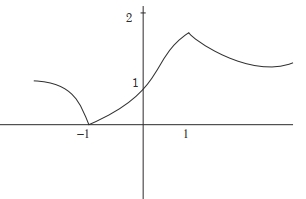
Let $f : R \rightarrow R$ be a function such that $f(x)=\frac{x^2+2 x+1}{x^2+1}$. Then
- A
$f(x)$ is many-one in $(-\infty,-1)$
- B
$f(x)$ is many-one in $(1, \infty)$
- ✓
$f(x)$ is one-one in $[1, \infty)$ but not in $(-\infty, \infty)$
- D
$f ( x )$ is one-one in $(-\infty, \infty)$
AnswerCorrect option: C. $f(x)$ is one-one in $[1, \infty)$ but not in $(-\infty, \infty)$
c
$f(x)=\frac{(x+1)^2}{x^2+1}=1+\frac{2 x}{x^2+1}$
$f(x)=1+\frac{2}{x+\frac{1}{x}}$
View full question & answer→MCQ 1171 Mark
Suppose $f$ is a function satisfying $f ( x + y )= f ( x )+ f ( y )$ for all $x , y \in N$ and $f (1)=\frac{1}{5}$. If $\sum \limits_{n=1}^m \frac{f(n)}{n(n+1)(n+2)}=\frac{1}{12}$, then $m$ is equal to $...............$.
Answerc
$\because f(1)=\frac{1}{5} \therefore f(2)=f(1)+f(1)=\frac{2}{5}$
$f(2)=\frac{2}{5} \quad f(3)=f(2)+f(1)=\frac{3}{5}$
$f(3)=\frac{3}{5}$
$\therefore \sum \limits_{n=1}^m \frac{f(n)}{n(n+1)(n+2)}$
$=\frac{1}{5} \sum \limits_{n=1}^m\left(\frac{1}{n+1}-\frac{1}{n+2}\right)$
$=\frac{1}{5}\left(\frac{1}{2}-\frac{1}{3}+\frac{1}{3}-\frac{1}{4}+\ldots .+\frac{1}{m+1}-\frac{1}{m+2}\right)$
$=\frac{1}{5}\left(\frac{1}{2}-\frac{1}{m+2}\right)=\frac{m}{10(m+2)}=\frac{1}{12}$
$\therefore m=10$
View full question & answer→MCQ 1181 Mark
Consider a function $f : N \rightarrow R$, satisfying $f(1)+2 f(2)+3 f(3)+\ldots+x f(x)=x(x+1) f(x) ; x \geq 2$ with $f(1)=1$. Then $\frac{1}{f(2022)}+\frac{1}{f(2028)}$ is equal to
- A
$8200$
- B
$8000$
- C
$8400$
- ✓
$8100$
AnswerCorrect option: D. $8100$
d
Given for $x \geq 2$
$f(1)+2 f(2)+\ldots \ldots+x f(x)=x(x+1) f(x)$
$\text { replace } x \text { by } x +1$
$\Rightarrow \quad x(x+1) f(x)+(x+1) f(x+1)$
$=(x+1)(x+2) f(x+1)$
$\Rightarrow \quad \frac{x}{f(x+1)}+\frac{1}{f(x)}=\frac{(x+2)}{f(x)}$
$\Rightarrow \quad x f(x)=(x+1) f(x+1)=\frac{1}{2}, x \geq 2$
$f (2)=\frac{1}{4}, f (3)=\frac{1}{6}$
$\text { Now } f (2022)=\frac{1}{4044}$
$f(2028)=\frac{1}{4056}$
So, $\frac{1}{f(2022)}+\frac{1}{f(2028)}=4044+4056=8100$
View full question & answer→MCQ 1191 Mark
Suppose $\quad f : R \rightarrow(0, \infty)$ be a differentiable function such that $5 f ( x + y )= f ( x ) \cdot f ( y ), \forall x , y \in R$. If $f(3)=320$, then $\sum \limits_{n=0}^5 f(n)$ is equal to :
- A
$6875$
- B
$6575$
- ✓
$6825$
- D
$6528$
AnswerCorrect option: C. $6825$
c
$5 f ( x + y )= f ( x ) \cdot f ( y )$
$5 f (0)= f (0)^2 \Rightarrow f (0)=5$
$5 f ( x +1)= f ( x ) \cdot f (1)$
$\frac{ f ( x +1)}{ f ( x )}=\frac{ f (1)}{5}$
$\frac{ f (1)}{ f (0)} \cdot \frac{ f (2)}{ f (1)} \cdot \frac{ f (3)}{ f (2)}=\left(\frac{ f (1)}{5}\right)^3$
$\frac{320}{5}=\frac{( f (1))^3}{5^3} \Rightarrow f (1)=20$
$5 f ( x +1)=20 \cdot f ( x ) \Rightarrow f ( x +1)=4 f ( x )$
$\sum \limits_{ n =0}^5 f ( n )=5+5.4+5.4^2+5.4^3+5.4^4+5.4^5$
$=\frac{5\left[4^6-1\right]}{3}=6825$
View full question & answer→MCQ 1201 Mark
Let $S=\{1,2,3,4,5,6\}$. Then the number of oneone functions $f: S \rightarrow P(S)$, where $P(S)$ denote the power set of $S$, such that $f(n) \subset f(m)$ where $n < m$ is $..................$
- A
$3241$
- B
$3242$
- C
$3243$
- ✓
$3240$
AnswerCorrect option: D. $3240$
d
Let $S=\{1,2,3,4,5,6\}$, then the number of one-one functions, $f : S \cdot P ( S )$, where $P ( S )$ denotes the power set of $S$, such that $f ( n ) < f ( m )$ where $n < m$ is
$n(S)=6$
$P(S)=\left\{\begin{array}{c}\phi,\{1\}, \ldots\{6\},\{1,2\}, \ldots, \\\{5,6\}, \ldots,\{1,2,3,4,5,6\}\end{array}\right\}$
case $-1$
$f(6)=S$ i.e. $1$ option,
$f(5)=$ any $5$ element subset $A$ of $S$ i.e. $6$ options,
$f(4)=$ any $4$ element subset $B$ of $A$ i.e. $5$ options,
$f (3)=$ any $3$ element subset $C$ of $B$ i.e.$4$ options,
$f (2)=$ any $2$ element subset $D$ of $C$ i.e. $3$ options,
$f (1)=$ any $1$ element subset $E$ of $D$ or empty subset i.e. $3$
options,Total functions $=1080$
Case $-2$
$f (6)=$ any $5$ element subset $A$ of $S$ i.e. $6$ options,
$f(5)=$ any $4$ element subset $B$ of $A$ i.e. $5$ options,
$f^{\prime}(4)=$ any $3$ element subset $C$ of $B$ i.e. $4$ options,
$f (3)=$ any $2$ element subset $D$ of $C$ i.e. $3$ options,
$f' (2) =$ any $1$ element subset $E$ of $D$ i.e. $2$ options,
$f(1)=$ empty subset i.e.$1$ option Total functions $=720$
Case $-3$
$f(6)=S$
$f(5)=$ any $4$ element subset $A$ of' $S$ i.e. $15$ options,
$f(4)=$ any $3$ element subset $B$ of $A$ i.e. $4$ options,
$f(3)=$ any $2$ element subset $C$ of B i.e. $3$ options,
$f(2)=$ any $1$ element subset $D$ of $C$ i.e. $2$ options,
$f (1)=$ empty subset i.e. $1$ option
Total functions $=360$
Case $-4$
$f(6)=S$
$f(5)=$ any $5$ element subset $A$ of $S$ i.e. $6$ options,
$f(4)=$ any $3$ element subset $B$ of $A$ i.e. $10$ options,
$f(3)=$ any $2$ element subset $C$ of $B$ i.e. $3$ options,
$f(2)=$ any $1$ element subset $D$ of $C$ i.e. $2$ options,
$f(1)=$ empty subset i.e. $1$ option
Total functions $=360$
Case $-6$
$f (6)= S$
$f (5)=$ any $5$ element subset $A$ of $S$ i.e. $6$ options,
$f (4)=$ any $4$ element subset $B$ of $A$ i.e. $5$ options,
$f (3)=$ any $3$ element subset $C$ of $B$ i.e. $4$ options,
$f (2)=$ any $1$ element subset $D$ of $C$ i.e. $3$ options,
$f (1)=$ empty subset i.e. 1 option
Total functions $=360$
$\therefore$ Number of such functions $=3240$
View full question & answer→MCQ 1211 Mark
Let $f ^1( x )=\frac{3 x +2}{2 x +3}, x \in R -\left\{\frac{-3}{2}\right\}$ For $n \geq 2$, define $f ^{ n }( x )= f ^1 0 f ^{ n -1}( x )$. If $f ^5( x )=\frac{ ax + b }{ bx + a }, \operatorname{gcd}( a , b )=1$, then $a + b$ is equal to $............$.
- A
$3124$
- B
$3123$
- C
$3126$
- ✓
$3125$
AnswerCorrect option: D. $3125$
d
$f^1(x)=\frac{3 x+2}{2 x+3}$
$\Rightarrow f^2(x)=\frac{13 x+12}{12 x+13}$
$\Rightarrow f^3(x)=\frac{63 x+62}{62 x+63}$
$\therefore f^5(x)=\frac{1563 x+1562}{1562 x+1563}$
$a+b=3125$
View full question & answer→MCQ 1221 Mark
Let $f : R -\{0,1\} \rightarrow R$ be a function such that $f(x)+f\left(\frac{1}{1-x}\right)=1+x$. Then $f(2)$ is equal to :
- A
$\frac{9}{2}$
- ✓
$\frac{9}{4}$
- C
$\frac{7}{4}$
- D
$\frac{7}{3}$
AnswerCorrect option: B. $\frac{9}{4}$
b
$f ( x )+ f \left(\frac{1}{1- x }\right)=1+ x$
$x =2 \Rightarrow f (2)+ f (-1)=3$
$x =-1 \Rightarrow f (-1)+ f \left(\frac{1}{2}\right)=0$
$x =\frac{1}{2} \Rightarrow f \left(\frac{1}{2}\right)+ f (2)=\frac{3}{2}$
$(1)+(3)-(2) \Rightarrow 2 f (2)=\frac{9}{2}$
$\therefore f (2)=\frac{9}{4}$
View full question & answer→MCQ 1231 Mark
Let the sets $A$ and $B$ denote the domain and range respectively of the function $f(x)=\frac{1}{\sqrt{\lceil x\rceil-x}}$ where $\lceil x \rceil$ denotes the smallest integer greater than or equal to $x$. Then among the statements
$( S 1): A \cap B =(1, \infty)-N$ and
$( S 2): A \cup B=(1, \infty)$
AnswerCorrect option: A. only $(S1)$ is true
a
$f(x)=\frac{1}{\sqrt{\lceil x\rceil-x}}$
If $x \in I \lceil x \rceil=[ x ]$ (greatest integer function)
If $x \notin I \lceil x \rceil=[ x ]+1$
$\Rightarrow f(x)=\left\{\begin{array}{l}\frac{1}{\sqrt{[x]-x}}, x \in I \frac{1}{\sqrt{[x]+1-x}}, x \notin I\end{array}\right.$
$\begin{aligned} & \Rightarrow f(x)=\left\{\begin{array}{l}\frac{1}{\sqrt{-\{x\}}}, x \in I, \text { (does not exist) } \\ \frac{1}{\sqrt{1-\{x\}}}, x \notin I\end{array}\right. \\ & \Rightarrow \text { domain of } f(x)=R-I\end{aligned}$
$\text { Now, } f(x)=\frac{1}{\sqrt{1-\{x\}}}, x \notin I$
$\Rightarrow 0 < \{x\} < 1$
$\Rightarrow 0 < \sqrt{1-\{x\}} < 1$
$\Rightarrow \frac{1}{\sqrt{1-\{x\}}} > 1$
$\Rightarrow \text { Range }(1, \infty)$
$\Rightarrow A=R-I$
$B=(1, \infty)$
$\text { So, } A \cap B=(1, \infty)-N$
$A \cup B \neq(1, \infty)$
$\Rightarrow S 1 \text { is only correct }$
View full question & answer→MCQ 1241 Mark
If domain of the function $\log _e\left(\frac{6 x^2+5 x+1}{2 x-1}\right)+\cos ^{-1}\left(\frac{2 x^2-3 x+4}{3 x-5}\right)$ is $(\alpha, \beta) \cup(\gamma, \delta]$, then $18\left(\alpha^2+\beta^2+\gamma^2+\delta^2\right)$ is equal to $....$.
Answera
$\frac{6 x^2+5 x+1}{2 x-1} > 0$
$\frac{(3 x+1)(2 x+1)}{2 x-1} > 0$
$-\frac{1}{2}-\frac{1}{3} \quad \frac{1}{2}$
$x \in\left(\frac{-1}{2}, \frac{-1}{3}\right) \cup\left(\frac{1}{2}, \infty\right).....(A)$
$x \in\left[\frac{-1}{\sqrt{2}}, \frac{1}{\sqrt{2}}\right] \cup\left(\frac{5}{3}, \infty\right)..........(B)$
$x < \frac{5}{3}........(C)$
$A \cap B \cap C \equiv\left(\frac{-1}{2}, \frac{-1}{3}\right) \cup\left(\frac{1}{2}, \frac{1}{\sqrt{2}}\right]$
$\text { So } 18\left(\alpha^2+\beta^2+\gamma^2+\delta^2\right)=18\left(\frac{1}{4}+\frac{1}{9}+\frac{1}{4}+\frac{1}{2}\right)$
$=18+2=20$
View full question & answer→MCQ 1251 Mark
Let $R =\{ a , b , c , d , e \}$ and $S =\{1,2,3,4\}$. Total number of onto function $f: R \rightarrow S$ such that $f(a) \neq$ 1 , is equal to $.............$.
Answera
Total onto function
$\frac{[5}{\left\lfloor{3}\lfloor 2\right.} \times\lfloor 4=240$
Now when $f(a)=1$
$\lfloor 4+\frac{\lfloor 4}{\lfloor 2\lfloor 2} \times\lfloor 3=24+36=60$
so required $f ^{ n }=240-60=180$
View full question & answer→MCQ 1261 Mark
If $f(x)=\frac{\left(\tan 1^{\circ}\right) x+\log _{\varepsilon}(123)}{x \log _{\varepsilon}(1234)-\left(\tan 1^{\circ}\right)}, x > 0$, then the least value of $f(f(x))+f\left(f\left(\frac{4}{x}\right)\right)$ is $...........$.
Answerb
Let $f(x)=\frac{A x+B}{C x-A}$
$f(f(x))=\frac{A\left(\frac{A x+B}{C x-A}\right)+B}{C\left(\frac{A x+B}{C x-A}\right)-A}=x$
$f\left(f\left(\frac{4}{x}\right)\right)=\frac{4}{x}f(f(x))+f\left(f\left(\frac{4}{x}\right)\right)=x+\frac{4}{x} \geq 4(b y A M . \geq G . M .)$
View full question & answer→MCQ 1271 Mark
The domain of the function $f(x)=\frac{1}{\sqrt{[x]^2-3[x]-10}}$ is (where $[x]$ denotes the greatest integer less than or equal to $x$ )
- A
$(-\infty,-2) \cup(5, \infty)$
- B
$(-\infty,-3] \cup[6, \infty)$
- ✓
$(-\infty,-2) \cup[6, \infty)$
- D
$(-\infty,-3] \cup(5, \infty)$
AnswerCorrect option: C. $(-\infty,-2) \cup[6, \infty)$
c
$\text { Sol. }[x]^2-3[x]-10 > 0$
${[x] < -2 \text { or }[x] > 5}$
View full question & answer→MCQ 1281 Mark
The number of points, where the curve $f(x)=e^{8 x}-e^{6 x}-3 e^{4 x}-e^{2 x}+1, x \in R$ cuts $x$-axis, is equal to
Answera
Let $e ^{2 x }= t$
$\Rightarrow t^4-t^3-3 t^2-t+1=0$
$\Rightarrow t^2+\frac{1}{t^2}-\left(t+\frac{1}{t}\right)-3=0$
$\Rightarrow\left(t+\frac{1}{t}\right)^2-\left(t+\frac{1}{t}\right)-5=0$
$\Rightarrow t+\frac{1}{t}=\frac{1+\sqrt{21}}{2}$
Two real values of $t$.
View full question & answer→MCQ 1291 Mark
Let $A=\{1,2,3,4,5\}$ and $B=\{1,2,3,4,5,6\}$. Then the number of functions $f: A \rightarrow B$ satisfying $f(1)+f(2)=f(4)-1$ is equal to
Answera
$f(1)+f(2)+1=f(4) \leq 6$
$f(1)+f(2) \leq 5$
Case $(i)$ $f(1)=1 \Rightarrow f(2)=1,2,3,4 \Rightarrow 4$ mappings
Case $(ii)$ $f(1)=2 \Rightarrow f(2)=1,2,3 \Rightarrow 3$ mappings
Case $(iii)$ $f(1)=3 \Rightarrow f(2)=1,2 \Rightarrow 2$ mappings
Case $(iv)$ $f(1)=4 \Rightarrow f(2)=1 \Rightarrow 1$ mapping
$f(5)$ and $f(6)$ both have $6$ mappings each
Number of functions $=(4+3+2+1) \times 6 \times 6=360$
View full question & answer→MCQ 1301 Mark
If the domain of the function $f(x)=\log _e\left(4 x^2+11 x+6\right)+\sin ^{-1}$ $(4 x+3)+\cos ^{-1}\left(\frac{10 x+6}{3}\right) \text { is }(\alpha, \beta]$ Then $36|\alpha+\beta|$ is equal to :
Answerb
$f(x)=\ln \left(4 x^2+11 x+6\right)+\sin ^{-1}(4 x+3)$
$+\cos ^{-1}\left(\frac{10 x+6}{3}\right)$
$\text { (i) } 4 x^2+11 x+6 > 0$
$4 x^2+8 x+3 x+6 > 0$
$(4 x+3)(x+2) > 0$
$x \in(-\infty,-2) \cup\left(-\frac{3}{4}, \infty\right)$
$\text { (ii) } 4 x+3 \in[-1,1]$
$x \in[-1,-1 / 2]$
$\text { (iii) } \frac{10 x+6}{3} \in[-1,1]$
$x \in\left[-\frac{9}{10},-\frac{3}{10}\right]$
$x \in\left(-\frac{3}{4},-\frac{1}{2}\right]$
$\alpha+\beta=-\frac{5}{4}$
$36|\alpha+\beta|=45$
View full question & answer→MCQ 1311 Mark
For some $a, b, c \in N$, let $f(x)=a x-3$ and $g ( x )= x ^{ b }+ c , x \in R$. If $(\text { fog })^{-1}( x )=\left(\frac{ x -7}{2}\right)^{1 / 3}$ then $(fog) (ac) + (gof) (b)$ is equal to $..........$
- A
$2038$
- ✓
$2039$
- C
$2040$
- D
$2058$
AnswerCorrect option: B. $2039$
b
Let $f o g(x)=h(x)$
$\Rightarrow h ^{-1}( x )=\left(\frac{ x -7}{2}\right)^{\frac{1}{3}}$
$\Rightarrow h ( x )= fog ( x )=2 x ^3+7$
$\text { fog }(x)=a\left(x^b+c\right)-3$
$\Rightarrow a =2, b =3, c =5$
$\Rightarrow \operatorname{fog}( ac )= fog (10)=2007$
$g \left( f ( x )=(2 x -3)^3+5\right.$
$\Rightarrow \operatorname{gof}( b )=\operatorname{gof}(3)=32$
$\Rightarrow \operatorname{sum}=2039$
View full question & answer→MCQ 1321 Mark
Let $f, g$ and $h$ be the real valued functions defined on $R$ as $f(x)=\left\{\begin{array}{cc}\frac{x}{|x|}, & x \neq 0 \\ 1, & x=0\end{array}\right.$,
$g(x)=\left\{\begin{array}{cl}\frac{\sin (x+1)}{(x+1)}, & x \neq-1 \\1, & x=-1\end{array} \text { and } h(x)=2[x]-f(x),\right.$
where $[x]$ is the greatest integer $\leq x$. Then the value of $\lim _{x \rightarrow 1} g(h(x-1))$ is
Answera
$LHL =\lim _{ k \rightarrow 0} g ( h (- k )) , k > 0$
$=\lim _{ k \rightarrow 0} g (-2+1) \because f ( x )=-1 \forall x < 0$
$= g (-1)=1$
$RHL =\lim _{ k \rightarrow 0} g ( h ( k )) , k > 0$
$=\lim _{ k \rightarrow 0} g (-1) , \because f ( x )=1, \forall x > 0$
$=1$
View full question & answer→MCQ 1331 Mark
For $x \in R$, two real valued functions $f(x)$ and $g(x)$ are such that, $g(x)=\sqrt{x}+1$ and $f o g(x)=x+3-\sqrt{x}$. Then $f(0)$ is equal to
Answerc
$g(x)=\sqrt{x}+1$
$f \circ g(x)=x+3-\sqrt{x}$
$=(\sqrt{x}+1)^2-3(\sqrt{x}+1)+5$
$=g^2(x)-3 g(x)+5$
$\Rightarrow f(x)=x^2-3 x+5$
$\therefore f(0)=5$
View full question & answer→MCQ 1341 Mark
Let $A=\{1,2,3,4\}$ and $R$ be a relation on the set $A \times A$ defined by $R=\{((a, b),(c, d)): 2 a+3 b=4 c+5 d\}$. Then the number of elements in $R$ is:
Answera
$A =\{1,2,3,4\}$
$R =\{( a , b ),( c , d )\}$
$2 a +3 b =4 c +5 d =\alpha \text { let }$
$2 a =\{2,4,6,8\} \quad 4 c =\{4,8,12,16\}$
$3 b =\{3,6,9,12\} \quad 5 d =\{5,10,15,20\}$
$2 a +3 b =\left\{\begin{array}{l}5,8,11,14 \\ 7,10,13,16 \\ 9,12,15,18 \\ 11,14,17,20\end{array}\right\} \quad 4 c +5 d \left\{\begin{array}{l}9,14,19,24 \\ 13,18 \ldots . \\ 17,22 \ldots \\ 21,26 \ldots\end{array}\right\}$
Possible value of $\alpha=9,13,14,14,17,18$
Pairs of $\{( a , b ),( c , d )\}=6$
View full question & answer→MCQ 1351 Mark
If the domain of the function $f(x)=\sec ^{-1}\left(\frac{2 x}{5 x+3}\right)$ is $[\alpha, \beta) \cup(\gamma, \delta]$, then $|3 \alpha+10(\beta+\gamma)+21 \delta|$ is equal to $.......$.
Answerc
$f(x)=\sec ^{-1} \frac{2 x}{5 x+3}$
$\left|\frac{2 x}{5 x+3}\right|$
$\left|\frac{2 x}{5 x+3}\right| \geq 1 \Rightarrow|2 x| \geq|5 x+3|$
$(2 x)^2-(5 x+3)^2 \geq|5 x+3|$
$(7 x+3)(-3 x-3) \geq 0$
$\frac{-\quad-\quad-}{-1} \quad-\frac{3}{7}$
$\text { domain }\left[-1, \frac{-3}{5}\right) \cup\left(\frac{-3}{5}, \frac{-3}{7}\right]$
$\alpha=-1, \beta=\frac{-3}{5}, \gamma=\frac{-3}{5}, \delta=\frac{-3}{7}$
$3 \alpha+10(\beta+\gamma)+21 \delta=-3$
$-3+10\left(\frac{-6}{5}\right)+\left(\frac{-3}{7}\right) 21=-24$
View full question & answer→MCQ 1361 Mark
Let $D$ be the domain of the function $f(x)=\sin ^{-1}$ $\left(\log _{3 x}\left(\frac{6+2 \log _3 x}{-5 x}\right)\right)$. If the range of the function $g: D \rightarrow R$ defined by $g( x )= x -[ x ],([ x ]$ is the greatest integer function), is ( $\alpha, \beta)$, then $\alpha^2+\frac{5}{\beta}$ is equal to
Answerb
$\frac{6+2 \log _3 x}{-5 x} > 0$ and $x > 0$ and $x \neq \frac{1}{3}$
$\text { this gives } x \in\left(0, \frac{1}{27}\right) \ldots \text { (1) }$
$-1 \leq \log _{3 x}\left(\frac{6+2 \log _3 x}{-5 x}\right) \leq 1$
$3 x \leq \frac{6+2 \log _3 x}{-5 x} \leq \frac{1}{3 x}$
$15 x^2+6+2 \log _3 x \geq 0 \quad 6+2 \log _3 x+\frac{5}{3} \geq 0$
$x \in\left(0, \frac{1}{27}\right) \quad \ldots(2) \quad x \geq 3^{-\frac{23}{6}}$
from (1), (2) and (3)
$x \in\left[3^{-\frac{23}{6}}, \frac{1}{27}\right)$
$\therefore \alpha$ is small positive quantity
$\beta=\frac{1}{27}$
$\therefore \alpha^2+\frac{5}{\beta}$ is just greater than $135$
Bonus
View full question & answer→MCQ 1371 Mark
The probability that a relation $R$ from $\{ x , y \}$ to $\{ x , y \}$ is both symmetric and transitive, is equal to
- ✓
$\frac{5}{16}$
- B
$\frac{9}{16}$
- C
$\frac{11}{16}$
- D
$\frac{13}{16}$
AnswerCorrect option: A. $\frac{5}{16}$
a
Total no. of relations $=2^{2 \times 2}=16$
Fav. relation $=\phi,\{( x , x )\},\{( y , y )\},\{( x , x )( y , y )\}$
$\{(x, x),(y, y),(x, y)(y, x)\}$
Prob. $=\frac{5}{16}$
View full question & answer→MCQ 1381 Mark
Let a set $A=A_{1} \cup A_{2} \cup \ldots \cup A_{k,} \quad$ where $A_{ i } \cap A _{ j }=\phi$ for $i \neq j 1 \leq i , j \leq k$. Define the relation $R$ from $A$ to $A$ by $R=\left\{(x, y): y \in A_{i}\right.$ if and only if $\left.x \in A_{i}, 1 \leq i \leq k\right\}$. Then, $R$ is
- A
reflexive, symmetric but not transitive
- B
reflexive, transitive but not symmetric
- C
reflexive but not symmetric and transitive
- ✓
Answerd
$A =\{1,2,3\}$
$R=\{(1,1),(1,2),(1,3)(2,1),(2,2),(2,3)(3,1),(3,2)(3,3)\}$
View full question & answer→MCQ 1391 Mark
Let $R_{1}$ and $R_{2}$ be two relations defined on $R$ by $a R _{1} b \Leftrightarrow a b \geq 0$ and $a R_{2} b \Leftrightarrow a \geq b$, then
- A
$R_{1}$ is an equivalence relation but not $R_{2}$
- B
$R_{2}$ is an equivalence relation but not $R_{1}$
- C
both $R_{1}$ and $R_{2}$ are equivalence relations
- ✓
neither $R_{1}$ nor $R_{2}$ is an equivalence relation
AnswerCorrect option: D. neither $R_{1}$ nor $R_{2}$ is an equivalence relation
d
$R_{1}=\{x y \geq 0, x, y \in R\}$
For reflexive $x \times x \geq 0$ which is true.
For symmetric
If $x y \geq 0 \Rightarrow y x \geq 0$
If $x =2, y =0$ and $z =-2$
Then $x . y \geq 0 \& y . z \geq 0$ but $x . z \geq 0$ is not true $\Rightarrow$ not transitive relation.
$R_{ I }$ is not equivalence
$R _{2}$ if $a \geq b$ it does not implies $b \geq a$
$R_{2}$ is not equivalence relation
$D$
View full question & answer→MCQ 1401 Mark
For $\alpha \in N$, consider a relation $R$ on $N$ given by $R =\{( x , y ): 3 x +\alpha y$ is a multiple of 7$\}$.The relation $R$ is an equivalence relation if and only if.
- A
$\alpha=14$
- B
$\alpha$ is a multiple of $4$
- C
$4$ is the remainder when $\alpha$ is divided by $10$
- ✓
$4$ is the remainder when $\alpha$ is divided by $7$
AnswerCorrect option: D. $4$ is the remainder when $\alpha$ is divided by $7$
d
For $R$ to be reflexive $\Rightarrow xRx$
$\Rightarrow 3 x +\alpha x =7 x \Rightarrow(3+\alpha) x =7 K$
$\Rightarrow 3+\alpha=7 \lambda \Rightarrow \alpha=7 \lambda-3=7 N +4, K , \lambda, N \in I$
$\therefore$ when $\alpha$ divided by $7$, remainder is $4$.
$R$ to be symmetric $x R y \Rightarrow y R x$
$3 x +\alpha y =7 N _{1}, 3 y +\alpha x =7 N _{2}$
$\Rightarrow(3+\alpha)( x + y )=7\left( N _{1}+ N _{2}\right)=7 N _{3}$
Which holds when $3+\alpha$ is multiple of $7$
$\therefore \alpha=7 N +4 \text { (as did earlier) }$
$R$ to be transitive
$xRy \& yRz \Rightarrow xRz$.
$3 x +\alpha y =7 N _{1} \& 3 y +\alpha z =7 N _{2}$
$3 x +\alpha z =7 N _{3}$
$\therefore 3 x +7 N _{2}-3 y =7 N _{3}$
$\therefore 7 N _{1}-\alpha y +7 N _{2}-3 y =7 N _{3}$
$\therefore 7\left( N _{1}+ N _{2}\right)-(3+\alpha) y =7 N _{3}$
$\therefore(3+\alpha) y =7\,N$
Which is true again when $3+\alpha$ divisible by $7$ when $\alpha$ divided by $7$, remainder is $4$ .
View full question & answer→MCQ 1411 Mark
Let a function $f: N \rightarrow N$ be defined by
$f ( n )=\left[\begin{array}{ll}2 n , \,\,\, \,\,\,\,\,\,n =2,4,6,8, \ldots . \\ n -1,\,\,\, n =3,7,11,15, \ldots . \\ \frac{ n +1}{2}, \,\,\, \,\,\,n =1,5,9,13, \ldots \ldots\end{array}\right.$
then, $f$ is
Answerd
$f ( x )=\left\{\begin{array}{ccc}4 R ; n =2 R \\ 4 R -2 ; n =4 R -1 \\ 2 R -1 ; n =4 R -3\end{array}\right.$
$(R \in N)$
$Note$ that for any element, it will fall into exactly. one of these sets.
$\{y: y=4 R ; y \in N\}$
$\{y: y=4 R-2 ; y \in N\}$
$\{ y : y =2 R -1 ; y \in N \}$
Corresponding to that $y$, we will get exactly one value of $n$.
Thus, $f$ is one - one and onto.
View full question & answer→MCQ 1421 Mark
Let $f: R \rightarrow R$ be defined as $f(x)=x-1$ and $g: R -\{1,-1\} \rightarrow R$ be defined as $g(x)=\frac{x^{2}}{x^{2}-1}$. Then the function fog is
- A
one-one but not onto function
- B
onto but not one-one function
- C
both one-one and onto function
- ✓
neither one-one nor onto function
AnswerCorrect option: D. neither one-one nor onto function
d
$f ( x )= x -1 ; g ( x )=\frac{x^{2}}{x^{2}-1}$
$f ( g ( x ))= g ( x )-1$
$\quad=\frac{ x ^{2}}{ x ^{2}-1}-1=\frac{ x ^{2}- x ^{2}+1}{ x ^{2}-1}$
$f ( g ( x ))=\frac{1}{x^{2}-1} ; x \neq \pm 1 \text {, even function }$
$\rightarrow$ Hence $f ( g ( x ))$ is many one function
$y=\frac{1}{x^{2}-1}$
$y \cdot x^{2}-y=1$
$x^{2}=\left(\frac{1+y}{y}\right)$
$\left(\frac{1+y}{y}\right) \geq 0$
Range:- $y \in(-\infty,-1) \cup(0, \infty)$
Hence, Range $\neq$ Co-domain $\Rightarrow f ( g ( x ))$ is into function
View full question & answer→MCQ 1431 Mark
Let $f ( x )$ and $g ( x )$ be two real polynomials of degree $2$ and $1$ respectively. If $f ( g ( x ))=8 x ^{2}-2 x$, and $g(f(x))=4 x^{2}+6 x+1$, then the value of $f(2)+g(2)$ is
Answera
$f \left( g ( x )=8 x ^{2}-2 x \right.$
$g\left(f(x)=4 x^{2}+6 x+1\right.$
So, $g ( x )=2 x -1$ $g(2)=3$
$f ( x )=2 x ^{2}+3 x +1$
$f(2)=8+6+1=15$
Ans. $18$
View full question & answer→MCQ 1441 Mark
If $f(x)=\left\{\begin{array}{ll}x+a, & x \leq 0 \\ |x-4|, & x>0\end{array}\right.$ and $g(x)=\left\{\begin{array}{ll}x+1 & x<0 \\ (x-4)^{2}+b, & x \geq 0\end{array}\right.$ are continuous on $R$, then $(gof) (2)+( fog) (-2)$ is equal to.
Answerd
$(x)=\left\{\begin{array}{l} x+a ; x \leq 0 \\ |x-4| ; x>0 \end{array} ; g(x)=\left\{\begin{array}{ll} x+1 & ; x<0 \\ (x-4)^{2}+b ; & x \geq 0 \end{array}\right.\right.$
For continuity $a =4$ and $b =-15$
$g(f(2))+f(g(-2))$
$=g(2)+f(-1)=-8$
View full question & answer→MCQ 1451 Mark
Let $R _{1}=\{( a , b ) \in N \times N :| a - b | \leq 13\}$ and $R _{2}=\{( a , b ) \in N \times N :| a - b | \neq 13\} .$ Thenon $N$
- A
Both $R_{1}$ and $R_{2}$ are equivalence relations
- ✓
Neither $R_{1}$ nor $R_{2}$ is an equivalence relation.
- C
$R_{1}$ is an equivalence relation but $R_{2}$ is not
- D
$R_{2}$ is an equivalence relation but $R_{1}$ is not
AnswerCorrect option: B. Neither $R_{1}$ nor $R_{2}$ is an equivalence relation.
b
$R_{1}=\{(a, b) \in N \times N:|a-b| \leq 13\}$
$R_{2}=\{(a, b) \in N \times N:|a-b| \neq 13\}$.
For $R_{1}$ :
$(i)\,Reflexive \,\,relation$
$(a, a) \in N \times N:|a-a| \leq 13$
$(ii)\, Symmetric\,\, relation$
$( a , b ) \in R _{1},( b , a ) \in R _{1}:| b - a | \leq 13$
$(iii) \,Transitive\, \,relation$
$( a , b ) \in R _{1},( b , c ) \in R _{1},( a , c ) \in R _{1}:$
$(1,3) \in R _{1,}(3,16) \in R _{1,} \text { but }(1,16) \notin R _{1}$
For $R _{2}$ :
$(i) \,Reflexive\,\, relation$
$(a, a) \in N \times N:|a-a| \neq 13$
$(ii)\, Symmetric\,\, relation$
$(b, a) \in N \times N:|b-a| \neq 13$
$(iii)\, Transitive \,\,relation$
$( a , b ) \in R _{2},( b , c ) \in R _{2},( a , c ) \in R _{2}$
$(1,3) \in R _{2,}(3,14) \in R _{2} \text { but }(1,14) \notin R _{2}$
View full question & answer→MCQ 1461 Mark
Let $R_{1}$ and $R_{2}$ be relations on the set $\{1,2, \ldots, 50\}$ such that $R _{1}=\left\{\left( p , p ^{ n }\right)\right.$ : $p$ is a prime and $n \geq 0$ is an integer $\}$ and $R _{2}=\left\{\left( p , p ^{ n }\right)\right.$ : $p$ is a prime and $n =0$ or $1\}$. Then, the number of elements in $R _{1}- R _{2}$ is........
Answerd
Here, $p , p ^{ n } \in\{1,2, \ldots 50\}$
Now p can take values
$2,3,5,7,11,13,17,23,29,31,37,41,43$ and $47 .$
we can calculate no. of elements in $R$, as
$\left(2,2^{\circ}\right),\left(2,2^{1}\right) \ldots\left(2,2^{5}\right)$
$\left(3,3^{\circ}\right), \ldots\left(3,3^{3}\right)$
$\left(5,5^{\circ}\right), \ldots\left(5,5^{2}\right)$
$\left(7,7^{\circ}\right), \ldots\left(7,7^{2}\right)$
$\left(11,11^{\circ}\right), \ldots\left(11,11^{1}\right)$
And rest for all other two elements each
$n \left( R _{1}\right)=6+4+3+3+(2 \times 10)=36$
Similarly for $R _{2}$
$\left(2,2^{\circ}\right),\left(2,2^{1}\right)$
$\left(47,47^{\circ}\right),\left(47,47^{1}\right)$
$n \left( R _{2}\right)=2 \times 14=28$
$n \left( R _{1}\right)- n \left( R _{2}\right)=36-28=8$
View full question & answer→MCQ 1471 Mark
The number of one-one function $f :\{ a , b , c , d \} \rightarrow$ $\{0,1,2, \ldots ., 10\}$ such that $2 f(a)-f(b)+3 f(c)+$ $f ( d )=0$ is
Answerb
$2 f(a)+3 f(c)=f(d)-f(b)$
Using fundamental principle of counting
Number of one-one function is $31$
View full question & answer→MCQ 1481 Mark
Let $f : N \rightarrow R$ be a function such that $f(x+y)=2 f(x) f(y)$ for natural numbers $x$ and $y$. If $f(1)=2$, then the value of $\alpha$ for which
$\sum \limits_{k=1}^{10} f(\alpha+k)=\frac{512}{3}\left(2^{20}-1\right)$ holds, is
Answerc
$f : N \rightarrow R , f ( x + y )=2 f ( x ) f ( y )$
$f (1)=2$,
$\sum_{ k =1}^{10} f (\alpha+ k )=2 f (\alpha) \sum_{ k =1}^{10} f ( k )$
$=2 f (\alpha)( f (1)+ f (2)+\ldots .+ f (10))$
From $(1)$
$f (2)=2 f ^{2}(1)=2^{3}$
$\left.f (3)=2 f (2) f (1)=2^{5}\right)$
$\vdots$
$f (10)=2^{9} f ^{10}(1)=2^{19}$
$f (\alpha)=2^{2 \alpha-1} ; \alpha \in N$
from $(2)$
$\sum_{ k =1}^{10} f (\alpha+ k )=2\left(2^{2 \alpha-1}\right)\left(2+2^{3}+2^{5}+\ldots .+2^{19}\right)$
$\frac{512}{3}\left(2^{20}-1\right)=2^{2 \alpha}\left(2 \frac{\left(2^{20}-1\right)}{3}\right)$
Hence $\alpha=4$
View full question & answer→MCQ 1491 Mark
Let $f(x)=\frac{x-1}{x+1}, x \in R-\{0,-1,1)$. If $f^{a+1}(x)=f\left(f^{n}(x)\right)$ for all $n \in N$, then $f^{\prime}(6)+f(7)$ is equal to
- A
$\frac{7}{6}$
- ✓
$-\frac{3}{2}$
- C
$\frac{7}{12}$
- D
$-\frac{11}{12}$
AnswerCorrect option: B. $-\frac{3}{2}$
b
$f(x)=\frac{x-1}{x+1}$
$\Rightarrow f^{2}(x)=f(f(x))=\frac{\frac{x-1}{x+1}-1}{\frac{x-1}{x+1}+1}=-\frac{1}{x}$
$f^{3}(x)=f\left(f^{2}(x)\right)=f\left(-\frac{1}{x}\right)=\frac{x+1}{1-x}$
$\Rightarrow f^{4}(x)=f\left(\frac{x+1}{1-x}\right)=-\frac{1}{x}$
$\Rightarrow f^{6}(x)=-\frac{1}{x} \Rightarrow f^{6}(6)=-\frac{1}{8}$
$f^{7}(x)=\left(-\frac{1}{x}\right)=\frac{x+1}{1-x}$
$\Rightarrow f^{7}(7)=\frac{8}{-6}=-\frac{4}{3}$
$\therefore-\frac{1}{6}+-\frac{4}{3}=-\frac{3}{2}$
View full question & answer→MCQ 1501 Mark
Let $f: R \rightarrow R$ be a function defined $f(x)=\frac{2 e^{2 x}}{e^{2 x}+\varepsilon}$. Then $f\left(\frac{1}{100}\right)+f\left(\frac{2}{100}\right)+f\left(\frac{3}{100}\right)+\ldots .+f\left(\frac{99}{100}\right)$ is equal to
Answerb
$f(x)+f(1-x)=\frac{2 e^{2 x}}{e^{2 x}+e}+\frac{2 e^{2-2 x}}{e^{2-e x}+e}=\left[\frac{e^{2 x}}{e^{2 x}+e}+\frac{e^{2}}{e^{2}+e^{2 x+1}}\right]$
$=2\left[\frac{e^{2 x-1}}{e^{2 x-1}+1}+\frac{1}{1+e^{2 x-1}}\right]=2$
$f\left(\frac{1}{100}\right)+f\left(\frac{2}{100}\right)+f\left(\frac{3}{100}\right)+\ldots .+f\left(\frac{99}{100}\right)$
$=\left\{f\left(\frac{1}{100}\right)+f\left(\frac{99}{100}\right)\right\}+\left\{f\left(\frac{2}{100}\right)+f\left(\frac{98}{100}\right)\right\}+\ldots .+f\left\{\left(\frac{49}{100}\right)+f\left(\frac{51}{100}\right)\right\}+f\left(\frac{1}{2}\right)$
$=(2+2+2+----49$ times $)+\frac{2 e}{e+e}$
$=98+1=99$
View full question & answer→