MCQ 511 Mark
Suppose four balls labelled $1,2,3,4$ are randomly placed in boxes $B_1, B_2, B_3, B_4$. The probability that exactly one box is empty is
- A
$\frac{8}{256}$
- ✓
$\frac{9}{16}$
- C
$\frac{27}{256}$
- D
$\frac{9}{64}$
AnswerCorrect option: B. $\frac{9}{16}$
b
(b)
Four balls $1,2,3,4$ are randomly placed in boxes $B_1, B_2, B_3, B_4$.
Probability of exactly one box is empty is
$\frac{{ }^4 C_1 \times \frac{4 !}{1 ! \times 2 !} \times \frac{1}{2 !} \times 3 !}{4^4}=\frac{4 \times 6 \times 6}{4 \times 4 \times 4 \times 4}=\frac{9}{16}$
View full question & answer→MCQ 521 Mark
If a fair coin is tossed $5$ times, the probability that heads does not occur two or more times in a row is
- A
$\frac{12}{2^5}$
- ✓
$\frac{13}{2^5}$
- C
$\frac{14}{2^5}$
- D
$\frac{15}{2^5}$
AnswerCorrect option: B. $\frac{13}{2^5}$
b
(b)
A fair coin is tossed $5$ times.
Total number of sample space $=2^5$
Probability of head does not occur two or more time in rows.
Possible cases
Case $I$ All tails $=\left(\frac{1}{2}\right)^5=\frac{1}{2^5}$
Case $II$ $4$ tails and one head
${ }^5 C_4\left(\frac{1}{2}\right)^5=\frac{5}{2^5}$
Case $III$ $3$ tails and $2$ head $\times T \times T \times T \times$
${ }^4 C_2 \times\left(\frac{1}{2}\right)^5=\frac{6}{2^5}$
Case $IV$ $2$ tails and $3$ heads $\times T \times T \times$
${ }^3 C_8 \times\left(\frac{1}{2}\right)^5=\frac{1}{2^5}$
$\therefore$ Required probability
$=\frac{1}{2^5}+\frac{5}{2^5}+\frac{6}{2^5}+\frac{1}{2^5}=\frac{13}{2^5}$
View full question & answer→MCQ 531 Mark
Thirty two persons $X_1, X_2, \ldots, X_{32}$ are randomly seated around a circular table at equal intervals. Two persons $X_i$ and $X_j$ are said to be within earshot of each other if there are at most three persons between them on the minor arc joining $X_i$ and $X_j$. The
probabiliky that $X_1$ and $X_3$ are within earshot of each other is, Here, $\left.{ }^n C_r=\frac{n !}{(n-r) ! r !}\right)$
AnswerCorrect option: C. $\frac{8}{31}$
c
(c)
We have,
Total number of person $=32$
they seated in a around a circular table
Case $I$ No person between $X_1$ and $X_2$
Probability $=\frac{i 30 ! \times 2 !}{31 !}=\frac{2}{31}$
Case $II$ One person between $X_1$ and $X_2$
Probability $=\frac{30 C_1 \times 29 ! \times 2 !}{31 !}=\frac{2}{31}$
Case $III$ Two persons between $X_1$ and $X_2$
Probability $\frac{30 C_2 \times 28 ! \times 2 ! \times 2 !}{31 !}=\frac{2}{31}$
Case $IV$ Three persons between $X_1$ and
Total probability $=\frac{2}{31}+\frac{2}{31}+\frac{2}{31}+\frac{2}{31}=\frac{8}{31}$
View full question & answer→MCQ 541 Mark
A shooter can hit a given target with probability $\frac{1}{4}$.She keeps firing a bullet at the target until she hits it successfully three times and then she stops firing.The probability that she fires exactly six bullets lies in the interval
- A
$(0.5272,0.5274)$
- B
$(0.2636,0.2638)$
- C
$(0.1317,0.1319)$
- ✓
$(0.0658,0.0660)$
AnswerCorrect option: D. $(0.0658,0.0660)$
d
(d)
$n=5, p=\frac{1}{4}, q=\frac{3}{4}$
$\therefore$ Required probability $={ }^5 C_2(p)^2 q^3 \times p$
$={ }^5 C_2\left(-\frac{1}{4}\right)^2\left(\frac{3}{4}\right)^3 \times \frac{1}{4}=\frac{270}{4096}=0.6591$
View full question & answer→MCQ 551 Mark
Consider the following events :
$E_1$ : Six fair dice are rolled and at least one die shows six.
$E_2$ : Twelve fair dice are rolled and at least two dice show six.
Let $p_1$ be the probability of $E_1$ and $p_2$ be the probability of $E_2$. Which of the following is true?
- A
$p_1 > p_2$
- B
$p_1=p_2=0.6651$
- C
$p_1 < p_2$
- D
$p_1=p_2=03349$
View full question & answer→MCQ 561 Mark
A pair of $12 -$ sided fair dice with faces numbered $1,2$ , $3, \ldots, 12$ is rolled. The probability that the sum of the numbers appearing has remainder $2$ when divided by $9$ is
- A
$\frac{7}{72}$
- B
$\frac{5}{48}$
- C
$\frac{11}{144}$
- D
$\frac{1}{9}$
View full question & answer→MCQ 571 Mark
Let $m, n$ be two distinct integers chosen randomly from the set $\{0,1,2, \ldots, 99\}$. Then, the probability that $4^m+4^n+3$ is divisible by $5$ lies in the interval
- A
$(0,0.25]$
- B
$(0.25,0.5]$
- C
$(0.5,0.75]$
- D
$(0.75,1)$
View full question & answer→MCQ 581 Mark
A box contains $b$ blue balls and $r$ red balls. A ball is drawn randomly from the box and is returned to the box with another ball of the same colour. The probability that the second ball drawn from the box is blue, is
AnswerCorrect option: A. $\frac{b}{r+b}$
a
(a)
Consider the event
$A=$ Blue ball is drawn from first draw
$B=$ Red ball is drawn from first draw
$C=$ Blue ball is drawn from second draw
$P(A)=\frac{b}{b+r}, P\left(\frac{C}{A}\right)=\frac{b+1}{b+r+1}$
$P(B)=\frac{r}{b+r}, P\left(\frac{C}{B}\right)=\frac{b}{b+r+1}$
Required probability
$P(C)=P(A) \cdot P(C / A)+P(B) \cdot P(C / B)$
$=\frac{b}{b+r} \frac{b+1}{b+r+1}+\frac{r}{(b+r)} \frac{b}{b+r+1}$
$=\frac{b}{(b+r)(b+r+1)}(b+1+r)=\frac{b}{b+r}$
View full question & answer→MCQ 591 Mark
If a $3-$digit number is randomly chosen. What is the probability that either the number itself or some permutation of the number (which is a $3-$digit number) is divisible by $4$ and $5$ ?
- A
$\frac{1}{45}$
- ✓
$\frac{29}{180}$
- C
$\frac{11}{60}$
- D
$\frac{1}{4}$
AnswerCorrect option: B. $\frac{29}{180}$
b
(b)
The $3-$digit number which is divisible by $4$ and $5$ both.
i.e. last digits are $00,20,40,60,80$
Now ending with $00$ are $(100,200,300 \ldots$ $900)=9$
If digit repeat other than $0^{\prime}$ then they are $(220,440,660,880)$ but $220$ number can be permuted according to condition as $(220,202).$
Similarly, for $440$ as $(440,404), 660$ and $880$ , so there are $8$ favourable cases.
If the number have no digit repeated like $120,120$ can be permuted in $4$ ways.
So, such number are $8 \times 4 \times 4=128$
View full question & answer→MCQ 601 Mark
There are $6$ boxes labelled $B_1, B_2, \ldots, B_6$. In each trial, two fair dice $D_1, D_2$ are thrown. If $D_1$ shows $j$ and $D_2$ shows $k$, then $j$ balls are put into the box $B_k$. After $n$ trials, what is the probability that $B_1$ contains at most one ball ?
- A
$\left(\frac{5^{n-1}}{6^{n-1}}\right)+\left(\frac{5^n}{6^n}\right)\left(\frac{1}{6}\right)$
- B
$\left(\frac{5^n}{6^n}\right)+\left(\frac{5^{n-1}}{6^{n-1}}\right)\left(\frac{1}{6}\right)$
- C
$\left(\frac{5^n}{6^n}\right)+n\left(\frac{5^{n-1}}{6^{n-1}}\right)\left(\frac{1}{6}\right)$
- ✓
$\left(\frac{5^n}{6^n}\right)+n\left(\frac{5^{n-1}}{6^{n-1}}\right)\left(\frac{1}{6^2}\right)$
AnswerCorrect option: D. $\left(\frac{5^n}{6^n}\right)+n\left(\frac{5^{n-1}}{6^{n-1}}\right)\left(\frac{1}{6^2}\right)$
d
(d)
We have,
$6$ boxes $B_1, B_2, B_3, B_4, B_5, B_6$ and
two dices $D_1$ and $D_2$.
Let $P\left(B_1\right)$ be the probability that $B_1$
contains at most one ball.
$\therefore P\left(B_1\right)=P\left(B_1\right.$ contains 0 ball $)+P\left(B_1\right.$
contains 1 ball) $P\left(B_1\right)=\left(D_1\right.$ never show 1)
$+P\left(D_2\right.$ shows 1 once when $D_1$ show 1$)$
$P\left(B_1\right)=\left(\frac{5}{6}\right)^n+n\left(\frac{5^{n-1}}{6^{n-1}}\right)\left(\frac{1}{6^2}\right)$
View full question & answer→MCQ 611 Mark
Let $X_n=\{1,2,3, \ldots, n\}$ and let a subset $A$ of $X_n$ be chosen so that every pair of elements of $A$ differ by at least 3. (For example, if $n=5, A$ can be $\phi,\{2\}$ or $\{1,5\}$ among others). When $n=10$, let the probability that $1 \in A$ be $p$ and let the probability that $2 \in A$ be Then,
- A
$p > q$ and $p-q=\frac{1}{6}$
- B
$p < q$ and $q-p=\frac{1}{6}$
- ✓
$p > q$ and $p-q=\frac{1}{10}$
- D
$p < q$ and $q-p=\frac{1}{10}$
AnswerCorrect option: C. $p > q$ and $p-q=\frac{1}{10}$
c
(c)
When $n=10$, let $A_r$ be number of ways of selecting $r$ numbers.
Number of selection of $A$ is
$n\left(A_6\right)+n\left(A_1\right)+n\left(A_2\right)+n\left(A_3\right)+n\left(A_4\right)$
$=1+10+(7+6+5+\ldots+1)$
$+(4+3+2+1)$
$+(3+2+1)+(2+1)+1$
$=11+28+10+6+3+1=60$
$N(p)=n$ (Number of ways 1 is selected)
$=1+7+4+3+2+1+1=19$
$N(q)=n$ (Number of ways $2$ is selected)
$=1+6+3+2+1=13$
So, $\quad p=\frac{19}{60}, q=\frac{13}{60}$
$p > q, p-q=\frac{19-13}{60}=\frac{6}{60}=\frac{1}{10}$
View full question & answer→MCQ 621 Mark
A box contains coupons labelled $1,2,3, \ldots, n$. A coupon is picked at random and the number $x$ is noted. The coupon is put back into the box and a new coupon is picked at random. The new number is $y$.Then, the probability that one of the numbers $x, y$ divides the other is (in the options below $[r]$ denotes the largest integer less than or equal to $r$)
- A
$\frac{1}{2}$
- B
$\frac{1}{n^2} \sum \limits_{k=1}^n\left\lceil\frac{n}{k}\right\rceil$
- C
$-\frac{1}{n}+\frac{1}{n^2} \sum \limits_{k=1}^n\left[\frac{n}{k}\right]$
- ✓
$-\frac{1}{n}+\frac{2}{n^2} \sum \limits_{k=1}^n\left[\frac{n}{k}\right]$
AnswerCorrect option: D. $-\frac{1}{n}+\frac{2}{n^2} \sum \limits_{k=1}^n\left[\frac{n}{k}\right]$
d
$(d)$ We have,
A box contains coupons $\{1,2,3, \ldots, n\}$
Let a number $x=1$ is selected.
Then, favourable outcomes $(1,1)(1,2), . .$, .
$(1, n)=\left[\frac{n}{1}\right]$
Number of favourable outcomes, when $x=1, y=1$ is $2\left[\frac{n}{1}\right]-1$
Number of favourable outcomes, when $x=2, y=2, x \neq 1, y \neq 1=2\left[\frac{n}{2}\right]-1$
Similarly, for number of favourable outcomes, when
$x=k, y=k$ but $x, y \neq\{1,2, \ldots, k-1\}$
$=2\left[\frac{n}{k}\right]-1$
So, required probability
$-\frac{2 \sum\limits_{k=1}^n\left[\frac{n}{k}\right\rfloor-(1+1+\ldots n \text { times })}{n^2}$
$=\frac{2}{n^2} \sum\limits_{k=1}^n\left[\frac{n}{k}\right]-\frac{n}{n^2}$
$=\frac{-1}{n}+\frac{2}{n^2} \sum\limits_{k=1}^n\left[\frac{n}{k}\right]$
View full question & answer→MCQ 631 Mark
A purse contains $4$ copper coins and $3$ silver coins. A second purse contains $6$ copper coins and $4$ silver coins. A purse is chosen randomly and a coin is taken out of it. What is the probability that it is a copper coin?
- ✓
$\frac{41}{70}$
- B
$\frac{31}{70}$
- C
$\frac{27}{70}$
- D
$\frac{1}{3}$
AnswerCorrect option: A. $\frac{41}{70}$
a
(a)
Consider the event
$E_1=$ Purse contains $4$ copper coins and $3$ silver coins.
$E_2=$ Purse contains $6$ copper coins and $4$ silver coins
$A=$ draw copper coins
$\therefore \quad P\left(E_1\right) =\frac{1}{2}, P\left(A / E_1\right)=4 / 7$
$P\left(E_2\right)=\frac{1}{2}, P\left(A / E_2\right)=6 / 10$
$\therefore$ Required probability
$P(A) =P\left(E_1\right) \times P\left(A / E_1\right)+P\left(E_2\right)$
$=\frac{1}{2} \times \frac{4}{7}+\frac{1}{2} \times \frac{6}{10}$
$=\frac{1}{2}\left(\frac{4}{7}+\frac{6}{10}\right)=\frac{1}{2}\left(\frac{82}{7}\right)=\frac{41}{70}$
View full question & answer→MCQ 641 Mark
A man tosses a coin $10$ times, scoring $1$ point for each head and $2$ points for each tail. Let $P(K)$ be the probability of scoring at least $K$ points. The largest value of $K$ such that $P(K) > \frac{1}{2}$ is
Answerb
(b)
A man tosses a coin $10$ times, scoring $1$ point for head and $2$ points for tails.
$P(k)$ be the probability of scoring at least $k$ points.
$\therefore$ Required probability
$=\frac{{ }^{10} C_0+{ }^{10} C_1+{ }^{10} C_2+\ldots+{ }^{10} C_{k-10}}{2^{10}}$
Given, $P(k) \geq \frac{1}{2}$
$\therefore^{10} C_0+{ }^{10} C_1+{ }^{10} C_2+\ldots+$
${ }^{10} C_{k-10} \geq 2^9=512$
$1+10+45+120+210+252+\ldots > 512$
$\therefore \quad k-10 \geq 5 \Rightarrow k \geq 15$
$\therefore \quad$ Largest value of $k$ is $15 .$
View full question & answer→MCQ 651 Mark
Let $S_n=\sum \limits_{k=1}^n k$, denotes the sum of the first $n$ positive integers. The numbers $S_1, S_2, S_3, \ldots, S_{99}$ are written on $99$ cards. The probability of drawing a card with an even number written on it is
- A
$\frac{1}{2}$
- B
$\frac{49}{100}$
- ✓
$\frac{49}{99}$
- D
$\frac{48}{99}$
AnswerCorrect option: C. $\frac{49}{99}$
c
(c)
We have, $S_n=\sum \limits_{k=1}^n k$
$S_1=1$
$S_2=1+2=3$
$S_3=1+2+3=6$
$S_4=1+2+3+4=10$
$\quad S_5=1+2+3+4+5=15$
$\quad S_6=1+2+3+4+5+6=21$
Clearly, from two terms are even two term are odd.
$\therefore S_1, S_2, S_3, \ldots, S_{98}$
Among these $48$ terms are even and $48$ terms are odd
View full question & answer→MCQ 661 Mark
A woman has $10$ keys out of which only one opens a lock. She tries the keys one after the another (keeping aside the failed ones) till she succeeds in opening the lock. What is the chance that it is the seventh key that works?
- A
$\frac{7}{10}$
- B
$\frac{1}{2}$
- C
$\frac{3}{10}$
- ✓
$\frac{1}{10}$
AnswerCorrect option: D. $\frac{1}{10}$
d
(d)
Woman has $10$ keys out of which only one opens a lock.
The first keys works with probability $\frac{1}{10}$
The conditional probability that the second keys works given that first failed $=\frac{1}{9}$
$\therefore$ Required probability (seventh key works)
$=P($ fails $) \cdot P(2$ nd $/$ I fails $) \cdot P$ (III $/ 2$ fails $)$
$P \text { (7th/6th fails) }$
$=\frac{9}{10} \times \frac{8}{9} \times \frac{7}{8} \times \frac{6}{7} \times \frac{5}{6} \times \frac{4}{5} \times \frac{1}{4}=\frac{1}{10}$
View full question & answer→MCQ 671 Mark
Two points are randomly chosen on the circumference of a circle of radius $r$. The probability that the distance between the two points is at least $r$ is equal to
- A
$\frac{2}{\pi}$
- B
$\sin r$
- C
$\frac{1}{2}$
- ✓
$\frac{2}{3}$
AnswerCorrect option: D. $\frac{2}{3}$
d
(d)
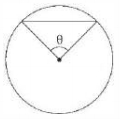
$Two$ point on a circumference of circle of radius $r$.
Distance between two points is atleast $r$.
$\therefore$ Angle subtends to chord of length
atleast $r$ is greater than or equal to $60^{\circ}$.
$\therefore$ Required probability $=1-\frac{60}{180}$
$=1-\frac{1}{3}=\frac{2}{3}$
View full question & answer→MCQ 681 Mark
A company has two plants $\mathrm{A}$ and $\mathrm{B}$ to manufacture motorcycles. $60 \%$ motorcycles are manufactured at plant $\mathrm{A}$ and the remaining are manufactured at plant B. $80 \%$ of the motorcycles manufactured at plant $\mathrm{A}$ are rated of the standard quality, while $90 \%$ of the motorcycles manufactured at plant $B$ are rated of the standard quality. A motorcycle picked up randomly from the total production is found to be of the standard quality. If $p$ is the probability that it was manufactured at plant $\mathrm{B}$, then $126 \mathrm{p}$ is
Answera
| |
$A$ |
$B$ |
| Manufactured |
$60%$ |
$40%$ |
| Standard quality |
$80%$ |
$90%$ |
$\mathrm{P}($ Manufactured at B / found standard quality $)=$ ?
$A$ : Found $S.Q$
$B$ : Manufacture $B$
$C$ : Manufacture $A$
$ P\left(E_1\right)=\frac{40}{100} $
$ P\left(E_2\right)=\frac{60}{100} $
$ P\left(A / E_1\right)=\frac{90}{100} $
$ P\left(A / E_2\right)=\frac{80}{100} $
$ \because P\left(E_1 / A\right)=\frac{P\left(A / E_1\right) P\left(E_1\right)}{P\left(A / E_1\right) P\left(E_1\right)+P\left(A / E_2\right) P\left(E_2\right)}=\frac{3}{7} $
$ \therefore 126 P=54$
View full question & answer→MCQ 691 Mark
There are three bags $X$, $Y$ and $Z$. Bag $X$ contains $5$ one-rupee coins and $4$ five-rupee coins; Bag $\mathrm{Y}$ contains $4$ one-rupee coins and $5$ five-rupee coins and Bag $\mathrm{Z}$ contains $3$ one-rupee coins and $6$ five-rupee coins. A bag is selected at random and a coin drawn from it at random is found to be a one-rupee coin. Then the probability, that it came from bag $\mathrm{Y}$, is :
- ✓
$\frac{1}{3}$
- B
$\frac{1}{2}$
- C
$\frac{1}{4}$
- D
$\frac{5}{12}$
AnswerCorrect option: A. $\frac{1}{3}$
a
$\begin{array}{lll}X & Y & Z\end{array}$
5 one $\& 4$ five 4 one $\& 5$ five $3$ one $\& 6$ five
$P=\frac{4 / 9}{5 / 9+4 / 9+3 / 9}=\frac{4}{12}=\frac{1}{3}$
View full question & answer→MCQ 701 Mark
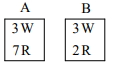
Bag $A$ contains $3$ white, $7$ red balls and bag $B$ contains $3$ white, $2$ red balls. One bag is selected at random and a ball is drawn from it. The probability of drawing the ball from the bag $\mathrm{A}$, if the ball drawn in white, is :
- A
$\frac{1}{4}$
- B
$\frac{1}{9}$
- ✓
$\frac{1}{3}$
- D
$\frac{3}{10}$
AnswerCorrect option: C. $\frac{1}{3}$
c
$\mathrm{E}_1: \mathrm{A}$ is selected
${E}_2: \mathrm{B}$ is selected
${E}:$ white ball is drawn
$P\left(E_1 / E\right)=$
$\frac{P(E) \cdot P\left(E / E_1\right)}{P\left(E_1\right) \cdot P\left(E / E_1\right)+P\left(E_2\right) \cdot P\left(E / E_2\right)}=\frac{\frac{1}{2} \times \frac{3}{10}}{\frac{1}{2} \times \frac{3}{10}+\frac{1}{2} \times \frac{3}{5}}$
$=\frac{3}{3+6}=\frac{1}{3}$
View full question & answer→MCQ 711 Mark
A bag contains $8$ balls, whose colours are either white or black. $4$balls are drawn at random without replacement and it was found that $2$ balls are white and other $2$ balls are black. The probability that the bag contains equal number of white and black balls is:
- A
$\frac{2}{5}$
- ✓
$\frac{2}{7}$
- C
$\frac{1}{7}$
- D
$\frac{1}{5}$
AnswerCorrect option: B. $\frac{2}{7}$
b
$ \mathrm{P}(4 \mathrm{~W} 4 \mathrm{~B} / 2 \mathrm{~W} 2 \mathrm{~B})=$
$ \frac{P(4 W 4 B) \times P(2 W 2 B / 4 W 4 B)}{P(2 W 6 B) \times P(2 W 2 B / 2 W 6 B)+P(3 W 5 B) \times P(2 W 2 B / 3 W 5 B)} +\ldots \ldots \ldots+P(6 W 2 B) \times P(2 W 2 B / 6 W 2 B)$
$ =\frac{\frac{1}{5} \times \frac{{ }^4 \mathrm{C}_2 \times{ }^4 \mathrm{C}_2}{{ }^8 \mathrm{C}_4}}{\frac{1}{5} \times \frac{{ }^2 \mathrm{C}_2 \times{ }^6 \mathrm{C}_2}{{ }^8 \mathrm{C}_4}+\frac{1}{5} \times \frac{{ }^3 \mathrm{C}_2 \times{ }^5 \mathrm{C}_2}{{ }^8 \mathrm{C}_4}+\ldots+\frac{1}{5} \times \frac{{ }^6 \mathrm{C}_2 \times{ }^2 \mathrm{C}_2}{{ }^8 \mathrm{C}_4}}$
$ =\frac{2}{7}$
View full question & answer→MCQ 721 Mark
Three urns $A$, $B$ and $C$ contain $7$ red, $5$ black; $5$ red, $7$ black and $6$ red, $6$ black balls, respectively. One of the urn is selected at random and a ball is drawn from it. If the ball drawn is black, then the probability that it is drawn from urn $\mathrm{A}$ is :
- A
$\frac{4}{17}$
- ✓
$\frac{5}{18}$
- C
$\frac{7}{18}$
- D
$\frac{5}{16}$
AnswerCorrect option: B. $\frac{5}{18}$
b
$A\ \ \ \ \ B \ \ \ \ \ C $
$7 \mathrm{R}, 5 \mathrm{~B}\ \ \ \ 5 \mathrm{R}, 7 \mathrm{~B} \ \ \ \ 6 \mathrm{R}, 6 \mathrm{~B}$
$ \mathrm{P}(\mathrm{B})=\frac{1}{3} \cdot \frac{5}{12}+\frac{1}{3} \cdot \frac{7}{12}+\frac{1}{3} \cdot \frac{6}{12} $
$ \text { required probability }=\frac{\frac{1}{3} \cdot \frac{5}{12}}{\frac{1}{3} \cdot\left[\frac{5}{12}+\frac{7}{12}+\frac{6}{12}\right]}=\frac{5}{18}$
View full question & answer→MCQ 731 Mark
A fair die is thrown until $2$ appears. Then the probability, that $2$ appears in even number of throws, is
- A
$\frac{5}{6}$
- B
$\frac{1}{6}$
- ✓
$\frac{5}{11}$
- D
$\frac{6}{11}$
AnswerCorrect option: C. $\frac{5}{11}$
c
Required probability=
$ \frac{5}{6} \times \frac{1}{6}+\left(\frac{5}{6}\right)^3 \times \frac{1}{6}+\left(\frac{5}{6}\right)^5 \times \frac{1}{6}+\ldots \ldots $
$ =\frac{1}{6} \times \frac{\frac{5}{6}}{1-\frac{25}{36}}=\frac{5}{11}$
View full question & answer→MCQ 741 Mark
If the mean of the following probability distribution of a random variable $\mathrm{X}$;
| $X$ |
$0$ |
$2$ |
$4$ |
$6$ |
$8$ |
| $P(X)$ |
$a$ |
$2a$ |
$a+b$ |
$2b$ |
$3b$ |
is $ \frac{46}{9}$ , then the variance of the distribution is
- A
$\frac{581}{81}$
- ✓
$\frac{566}{81}$
- C
$\frac{173}{27}$
- D
$\frac{151}{27}$
AnswerCorrect option: B. $\frac{566}{81}$
b
$ \sum P_i=1 $
$ a+2 a+a+b+2 b+3 b=1 $
$ 4 a+6 b=1 $.................($i$)
$ E(x)=\text { mean }=\frac{46}{9}$
$ \sum \mathrm{P}_{\mathrm{i}} \mathrm{X}_{\mathrm{i}}=\frac{46}{9} \Rightarrow 4 \mathrm{a}+4 \mathrm{a}+4 \mathrm{~b}+12 \mathrm{~b}+24 \mathrm{~b}=\frac{46}{9} $
$ 8 \mathrm{a}+40 \mathrm{~b}=\frac{46}{9}$
$4 \mathrm{a}+20 \mathrm{~b}=\frac{23}{9}$
Subtract ($I$) from ($II$) we get
$ \mathrm{b}=\frac{1}{9} \& \mathrm{a}=\frac{1}{12} $
$ \text { Variance }=\mathrm{E}\left(\mathrm{x}_{\mathrm{i}}^2\right)-\mathrm{E}\left(\mathrm{x}_{\mathrm{i}}\right)^2 $
$ \mathrm{E}\left(\mathrm{x}_{\mathrm{i}}^2\right)=0^2 \times 9^2+2^2 \times 2 \mathrm{a}+4^2(\mathrm{a}+\mathrm{b})+6^2(2 \mathrm{~b})+8^2(3 \mathrm{~b}) $
$ =24 \mathrm{a}+280 \mathrm{~b}$
Put $\mathrm{a}=\frac{1}{12} \quad \mathrm{~b}=\frac{1}{9}$
$ \mathrm{E}\left(\mathrm{x}_{\mathrm{i}}^2\right)=2+\frac{280}{9}=\frac{298}{9} $
$ \therefore \sigma^2=\mathrm{E}\left(\mathrm{x}_{\mathrm{i}}^2\right)-\mathrm{E}\left(\mathrm{x}_{\mathrm{i}}\right)^2 $
$ =\frac{298}{9}-\left(\frac{46}{9}\right)^2 $
$ \sigma^2=\frac{298}{9}-\frac{2116}{81} $
$ =\frac{566}{81}$
View full question & answer→MCQ 751 Mark
From a lot of $10$ items, which include $3$ defective items, a sample of $5$ items is drawn at random. Let the random variable $\mathrm{X}$ denote the number of defective items in the sample. If the variance of $X$ is $\sigma^2$, then $96 \sigma^2$ is equal to....................
Answera
$\mathrm{X}=$ denotes number of defective
| $X$ |
$0$ |
$1$ |
$2$ |
$3$ |
| $\mathrm{P}(\mathrm{x}) $ |
$\frac{7}{15}$ |
$\frac{5}{12}$ |
$\frac{5}{12}$ |
$\frac{1}{12}$ |
| $ \mathrm{x}_1^2 $ |
$0$ |
$1$ |
$4$ |
$9$ |
| $ \mathrm{P}_{\mathrm{i}} \mathrm{x}_1^2 $ |
$0$ |
$\frac{5}{12}$ |
$\frac{20}{12}$ |
$\frac{9}{12}$ |
| $ \mathrm{p}_{\mathrm{i}} \mathrm{x}_{\mathrm{i}}$ |
$0$ |
$\frac{5}{12}$ |
$\frac{10}{12}$ |
$\frac{3}{12}$ |
$ \mu=\Sigma p_i x_i=\frac{18}{12} $
$ \Sigma p_i x_1^2=\frac{34}{12} $
$ \sigma^2=\Sigma p_i x_1^2-(\mu)^2 $
$ =\frac{34}{12}-\left(\frac{18}{12}\right)^2=\frac{17}{6}-\frac{9}{4} $
$ \frac{34-27}{12}=\frac{7}{12} $
$ 96 \sigma^2=96 \times \frac{7}{12}=56$
View full question & answer→MCQ 761 Mark
Let the mean and the standard deviation of the probability distribution
| $X$ |
$\alpha$ |
$1$ |
$0$ |
$-3$ |
| $P(X)$ |
$\frac{1}{3}$ |
$K$ |
$\frac{1}{6}$ |
$\frac{1}{4}$ |
be $\mu$ and $\sigma$, respectively. If $\sigma-\mu=2$, then $\sigma+\mu$ is equal to....................
Answera
$ \frac{1}{3}+\mathrm{k}+\frac{1}{6}+\frac{1}{4}=1 \quad \Rightarrow \mathrm{k}=\frac{1}{4} $
$ \mu=\frac{\alpha}{3}+\frac{1}{4}-\frac{3}{4} $
$ \mu=\frac{\alpha}{3}-\frac{1}{2} $
$ \sigma=\sqrt{\left(\alpha^2 \frac{1}{3}+\frac{1}{4}+9 \frac{1}{4}\right)-\left(\frac{\alpha}{3}-\frac{1}{2}\right)^2} $
$ \sigma=\sqrt{\frac{2 \alpha^2}{9}+\frac{\alpha}{3}+\frac{9}{4}} $
$ \sigma=\mu+2 $
$ \sigma^2=(\mu+2)^2 \Rightarrow \frac{2 \alpha^2}{9}+\frac{\alpha}{3}+\frac{9}{4}=\frac{\alpha^2}{9}+\frac{9}{4}+\alpha $
$ \frac{\alpha^2}{9}-\frac{2 \alpha}{3}=0 $
$ \alpha=0,(\text { reject }) \text { or } \alpha=6 $
$ (\because \mathrm{x}=0 \text { is already given) } $
$ \Rightarrow \sigma+\mu=2 \mu+2 $
$ =5$
View full question & answer→MCQ 771 Mark
Three balls are drawn at random from a bag containing $5$ blue and $4$ yellow balls. Let the random variables $\mathrm{X}$ and $\mathrm{Y}$ respectively denote the number of blue and Yellow balls. If $\bar{X}$ and $\bar{Y}$ are the means of $X$ and $Y$ respectively, then $7 \bar{X}+4 \bar{Y}$ is equal to ..........
Answerc
| Blue balls |
$0$ |
$1$ |
$2$ |
$3$ |
$4$ |
$5$ |
| Pr of blue. |
$\frac{{ }^5 \mathrm{C}_0 \cdot{ }^4 \mathrm{C}_1}{{ }^9 \mathrm{C}_3}$ |
$\frac{{ }^5 \mathrm{C}_1 \cdot{ }^4 \mathrm{C}_2}{{ }^9 \mathrm{C}_3}$ |
$\frac{{ }^5 \mathrm{C}_2 \cdot{ }^4 \mathrm{C}_1}{{ }^9 \mathrm{C}_3}$ |
$\frac{{ }^5 \mathrm{C}_3{ }^4 \mathrm{C}_0}{{ }^9 \mathrm{C}_3}$ |
$0$ |
$0$ |
$ 7 \overline{\mathrm{x}}=\frac{{ }^5 \mathrm{C}_1{ }^4 \mathrm{C}_2+{ }^5 \mathrm{C}_2 \cdot{ }^4 \mathrm{C}_1 \times 2+{ }^5 \mathrm{C}_3 \cdot{ }^4 \mathrm{C}_0 \times 3}{{ }^9 \mathrm{C}_3} \times 7 $
$ \frac{30+80+30}{84} \times 7 $
$ =\frac{140}{12}=\frac{70}{6}=\frac{35}{3}$
| Yellow |
$0$ |
$1$ |
$2$ |
$3$ |
$4$ |
| Pr of Yellow |
$\frac{{ }^5 \mathrm{C}_3{ }^4 \mathrm{C}_0}{{ }^9 \mathrm{C}_3}$ |
$\frac{{ }^5 \mathrm{C}_2{ }^4 \mathrm{C}_1}{{ }^9 \mathrm{C}_3}$ |
$\frac{{ }^5 \mathrm{C}_1{ }^4 \mathrm{C}_2}{{ }^9 \mathrm{C}_3}$ |
$\frac{{ }^5 \mathrm{C}_0{ }^4 \mathrm{C}_3}{{ }^9 \mathrm{C}_3}$ |
$0$ |
$4 \bar{y}=\frac{40+60+12}{84} \times 4=\frac{112}{21}=\frac{16}{3}$
View full question & answer→MCQ 781 Mark
A fair die is tossed repeatedly until a six is obtained. Let $\mathrm{X}$ denote the number of tosses required and let $\mathrm{a}=\mathrm{P}(\mathrm{X}=3), \mathrm{b}=\mathrm{P}(\mathrm{X} \geq 3)$ and $\mathrm{c}=$ $\mathrm{P}(\mathrm{X} \geq 6 \mid \mathrm{X}>3)$. Then $\frac{\mathrm{b}+\mathrm{c}}{\mathrm{a}}$ is equal to
Answerb
$ a=P(X=3)=\frac{5}{6} \times \frac{5}{6} \times \frac{1}{6}=\frac{25}{216} $
$ b=P(X \geq 3)=\frac{5}{6} \times \frac{5}{6} \times \frac{1}{6}+\left(\frac{5}{6}\right)^3 \cdot \frac{1}{6}+\left(\frac{5}{6}\right)^4 \cdot \frac{1}{6}+\ldots \ldots $
$=\frac{\frac{25}{216}}{1-\frac{5}{6}}=\frac{25}{216} \times \frac{6}{1}=\frac{25}{36} $
$ P(x \geq 6)=\left(\frac{5}{6}\right)^5 \cdot \frac{1}{6}+\left(\frac{5}{6}\right)^6 \cdot \frac{1}{6}+\ldots \ldots .$
$P(X \geq 6)=\left(\frac{5}{6}\right)^5 \cdot \frac{1}{6}+\left(\frac{5}{6}\right)^6 \cdot \frac{1}{6}+\ldots \ldots $
$ =\frac{\left(\frac{5}{6}\right)^5 \cdot \frac{1}{6}}{1-\frac{5}{6}}=\left(\frac{5}{6}\right)^5 $
$ c=\frac{\left(\frac{5}{6}\right)^5}{\left(\frac{5}{6}\right)^3}=\frac{25}{36} $
$ \frac{b+c}{a}=\frac{\left(\frac{5}{6}\right)^2+\left(\frac{5}{6}\right)^2}{\left(\frac{5}{6}\right)^2 \cdot \frac{1}{6}}=12$
View full question & answer→MCQ 791 Mark
Three rotten apples are accidently mixed with fifteen good apples. Assuming the random variable $x$ to be the number of rotten apples in a draw of two apples, the variance of $x$ is
- A
$\frac{37}{153}$
- B
$\frac{57}{153}$
- C
$\frac{47}{153}$
- ✓
$\frac{40}{153}$
AnswerCorrect option: D. $\frac{40}{153}$
d
$3$ bad apples, $15$ good apples.
Let $\mathrm{X}$ be no of bad apples
Then $P(X=0)=\frac{{ }^{15} C_2}{{ }^{18} C_2}=\frac{105}{153}$
${P}(\mathrm{X}=1)=\frac{{ }^3 \mathrm{C}_1 \times{ }^{15} \mathrm{C}_1}{{ }^{18} \mathrm{C}_2}=\frac{45}{153}$
${P}(\mathrm{X}=2)=\frac{{ }^3 \mathrm{C}_2}{{ }^{18} \mathrm{C}_2}=\frac{3}{153}$
$E(X)=0 \times \frac{105}{153}+1 \times \frac{45}{153}+2 \times \frac{3}{153}=\frac{51}{153}$
$=\frac{1}{3}$
$ \operatorname{Var}(X)=E\left(X^2\right)-(E(X))^2 $
$ =0 \times \frac{105}{153}+1 \times \frac{45}{153}+4 \times \frac{3}{153}-\left(\frac{1}{3}\right)^2$
$ =\frac{57}{153}-\frac{1}{9}=\frac{40}{153}$
View full question & answer→MCQ 801 Mark
In a tournament, a team plays $10$ matches with probabilities of winning and losing each match as $\frac{1}{3}$ and $\frac{2}{3}$ respectively. Let $x$ be the number of matches that the team wins, and $y$ be the number of matches that team loses. If the probability $\mathrm{P}(|\mathrm{x}-\mathrm{y}| \leq 2)$ is $\mathrm{p}$, then $3^9 \mathrm{p}$ equals....................
- A
$4215$
- B
$4548$
- ✓
$8288$
- D
$2456$
AnswerCorrect option: C. $8288$
c
$ P(W)=\frac{1}{3} \quad P(L)=\frac{2}{3} $
$ x=\text { number of matches that team wins } $
$ y=\text { number of matches that team loses } $
$ |x-y| \leq 2 \text { and } x+y=10 $
$ |x-y|=0,1,2 \quad x, y \in N$
Case $-I$ : $|x-y|=0 \Rightarrow x=y $
$ \because x+y=10 \Rightarrow x=5=y $
Case $-II$ : $|x-y|=1 \Rightarrow x-y= \pm 1$
| $x=y+1$ |
$x=y-1$ |
| $\because x+y=10$ |
$\because x+y=10$ |
| $2 y=9$ |
$2 y=11$ |
| Not Possible |
Not Possible |
Case $-III$ : $|x-y|=2 \Rightarrow x-y= \pm 2$
$ x-y=2 \quad \text { OR } \quad x-y=-2 $
$ \because \mathrm{x}+\mathrm{y}=10 \quad \because \mathrm{x}+\mathrm{y}=10 $
$ x=6, y=4 \quad x=4, y=6 $
$ \mathrm{P}(|\mathrm{x}-\mathrm{y}|=2)={ }^{10} \mathrm{C}_6\left(\frac{1}{3}\right)^6\left(\frac{2}{3}\right)^4+{ }^{10} \mathrm{C}_4\left(\frac{1}{3}\right)^4\left(\frac{2}{3}\right)^6 $
$ \mathrm{p}={ }^{10} \mathrm{C}_5 \frac{2^5}{3^{10}}+{ }^{10} \mathrm{C}_6 \frac{2^4}{3^{10}}+{ }^{10} \mathrm{C}_4 \frac{2^6}{3^{10}} $
$ 3^9 \mathrm{p}=\frac{1}{3}\left({ }^{10} \mathrm{C}_5 2^5+{ }^{10} \mathrm{C}_6 2^4+{ }^{10} \mathrm{C}_4 2^6\right) $
$ =8288 $
View full question & answer→MCQ 811 Mark
The coefficients $\mathrm{a}, \mathrm{b}, \mathrm{c}$ in the quadratic equation $a x^2+b x+c=0$ are chosen from the set $\{1,2,3,4,5,6,7,8\}$. The probability of this equation having repeated roots is :
- A
$\frac{3}{256}$
- B
$\frac{1}{128}$
- ✓
$\frac{1}{64}$
- D
$\frac{3}{128}$
AnswerCorrect option: C. $\frac{1}{64}$
c
$ a x^2+b x+c=0 $
$ a, b, c \in\{1,2,3,4,5,6,7,8\} $
Repeated roots $ D=0 $
$ \Rightarrow b^2-4 a c=0 \Rightarrow b^2=4 a c $
Prob $=\frac{8}{8 \times 8 \times 8}=\frac{1}{64} $
$ \Rightarrow(a, b, c) $
$ (1,2,1) ;(2,4,2) ;(1,4,4) ;(4,4,1) ;(3,6,3) ; $
$ (2,8,8) ;(8,8,2) ;(4,8,4) $
$ 8 $ case
View full question & answer→MCQ 821 Mark
The coefficients $a, b, c$ in the quadratic equation $a x^2+b x+c=0$ are from the set $\{1,2,3,4,5,6\}$. If the probability of this equation having one real root bigger than the other is $p$, then $216$ p equals:
Answerb
$ \mathrm{D}>0 $
$ \mathrm{~b}^2>4 \mathrm{ac} $
$ \mathrm{b}=3:(\mathrm{a}, \mathrm{c})=(1,1)(1,2)(2,1) $
$ \mathrm{b}=4:(\mathrm{a}, \mathrm{c})=(1,1)(1,2)(2,1)(1,3)(3,1) $
$ \mathrm{b}=5:(\mathrm{a}, \mathrm{c})=(1,1)(1,2)(2,1)(1,3)(3,1)(1,4)(4,1) $
$ (1,5)(5,1)(1,6)(6,1)(2,3)(3,2)(2,2) $
$ \mathrm{b}=6:(\mathrm{a}, \mathrm{c})=(1,1)(1,2)(2,1)(1,3)(3,1)(1,4)(4,1) $
$ (1,5)(5,1)(1,6)(6,1)(2,3)(3,2)(2,4)(4,2)(2,2) $
fav. cases $=38 $
Prob $. : \frac{38}{6 \times 6 \times 6} $
View full question & answer→MCQ 831 Mark
Let the sum of two positive integers be $24$ . If the probability, that their product is not less than $\frac{3}{4}$ times their greatest positive product, is $\frac{\mathrm{m}}{\mathrm{n}}$, where $\operatorname{gcd}(\mathrm{m}, \mathrm{n})=1$, then $\mathrm{n}-\mathrm{m}$ equals :
Answerd
$ x+y=24, x, y \in N $
$ A M>G M \Rightarrow x y \leq 144 $
$ x y \geq 108$
Favorable pairs of $(\mathrm{x}, \mathrm{y})$ are
$ (13,11),(12,12),(14,10),(15,9),(16,8), $
$ (17,7),(18,6),(6,18),(7,17),(8,16),(9,15), $
$ (10,14),(11,13)$
i.e. $13$ cases
Total choices for $x+y=24$ is 23
Probability $=\frac{13}{23}=\frac{\mathrm{m}}{\mathrm{n}}$
$\mathrm{n}-\mathrm{m}=10$
View full question & answer→MCQ 841 Mark
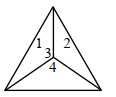
Let $a, b$ and $c$ denote the outcome of three independent rolls of a fair tetrahedral die, whose four faces are marked $1,2,3,4$. If the probability that $a x^2+b x+c=0$ has all real roots is $\frac{m}{n}$, $\operatorname{gcd}(\mathrm{m}, \mathrm{n})=1$, then $\mathrm{m}+\mathrm{n}$ is equal to ..........
Answera
$a, b, c \in\{1,2,3,4\}$
$Image$
Tetrahedral dice
$a x^2+b x+c=0$
has all real roots
$ \Rightarrow \mathrm{D} \geq 0 $
$ \Rightarrow \mathrm{b}^2-4 \mathrm{ac} \geq 0$
Let $b=1 \Rightarrow 1-4 a c \geq 0$ (Not feasible)
$ \mathrm{b}=2 \Rightarrow 4-4 \mathrm{ac} \geq 0 $
$ 1 \geq \mathrm{ac} \Rightarrow \mathrm{a}=1, \mathrm{c}=1, $
$ \mathrm{~b}=3 \Rightarrow 9-4 \mathrm{ac} \geq 0 $
$ \frac{9}{4} \geq \mathrm{ac} $
$ \Rightarrow \mathrm{a}=1, \mathrm{c}=1 $
$ \Rightarrow \mathrm{a}=1, \mathrm{c}=2 $
$ \Rightarrow \mathrm{a}=2, \mathrm{c}=1 $
$ \mathrm{~b}=4 \Rightarrow 16-4 \mathrm{ac} \geq 0 $
$ 4 \geq \mathrm{ac} $
$ \Rightarrow \mathrm{a}=1, \mathrm{c}=1 $
$ \Rightarrow \mathrm{a}=1, \mathrm{c}=2 \quad \Rightarrow \mathrm{a}=2, \mathrm{c}=1 $
$ \Rightarrow \mathrm{a}=1, \mathrm{c}=3 \quad \Rightarrow \mathrm{a}=3, \mathrm{c}=1 $
$ \Rightarrow \mathrm{a}=1, \mathrm{c}=4 \quad \Rightarrow \mathrm{a}=4, \mathrm{c}=1 $
$ \Rightarrow \mathrm{a}=2, \mathrm{c}=2$
$ \text { Probability }=\frac{12}{(4)(4)(4)}=\frac{3}{16}=\frac{m}{m} $
$ m+n=19$
View full question & answer→MCQ 851 Mark
A coin is biased so that the head is $3$ times as likely to occur as tail. This coin is tossed until a head or three tails occur. If $X$ denotes the number of tosses of the coin, then the mean of $X$ is
- ✓
$\frac{21}{16}$
- B
$\frac{81}{64}$
- C
$\frac{15}{16}$
- D
$\frac{37}{16}$
AnswerCorrect option: A. $\frac{21}{16}$
a
$P ( H )=\frac{3}{4}$
$P ( T )=\frac{1}{4}$
| $X$ |
$1$ |
$2$ |
$3$ |
| $P(X)$ |
$\frac{3}{4}$ |
$\frac{1}{4} \times \frac{3}{4}$ |
$\left(\frac{1}{4}\right)^3+\left(\frac{1}{4}\right)^2 \times \frac{3}{4}$ |
$\text { Mean } \overline{ X }=\frac{3}{4}+\frac{3}{8}+3\left(\frac{1}{64}+\frac{3}{64}\right)$
$=\frac{3}{4}+\frac{3}{8}+\frac{3}{16}$
$=3\left(\frac{7}{16}\right)$
$=\frac{21}{16}$
View full question & answer→MCQ 861 Mark
A bag contains $6$ balls. Two balls are drawn from it at random and both are found to be black. The probability that the bag contains at least $5$ black balls is
- ✓
$\frac{5}{7}$
- B
$\frac{2}{7}$
- C
$\frac{3}{7}$
- D
$\frac{5}{6}$
AnswerCorrect option: A. $\frac{5}{7}$
a
$\frac{{ }^5 C _2+{ }^6 C _2}{{ }^2 C _2+{ }^3 C _2+{ }^4 C _2+{ }^5 C _2+{ }^8 C _2}=\frac{10+15}{1+3+6+10+15}$
$=\frac{25}{35}=\frac{5}{7}$
View full question & answer→MCQ 871 Mark
$25 \%$ of the population are smokers. A smoker has $27$ times more chances to develop lung cancer then a non-smoker. A person is diagnosed with lung cancer and the probability that this person is a smoker is $\frac{ k }{10}$. Then the value of $k$ is $.............$
Answera
$E _1:$ Smokers
$P \left( E _1\right)=\frac{1}{4}$
$E _2: \text { non-smokers }$
$P \left( E _2\right)=\frac{3}{4}$
$E :$ diagnosed with lung cancer
$P \left( E / E _1\right)=\frac{27}{28}$
$P \left( E / E _2\right)=\frac{1}{28}$
$P \left( E _1 / E _2\right)=\frac{ P \left( E _1\right) P \left( E / E _1\right)}{ P ( E )}$
$=\frac{\frac{1}{4} \times \frac{27}{28}}{\frac{1}{4} \times \frac{27}{28}+\frac{3}{4} \times \frac{1}{28}}=\frac{27^9}{30_{10}}=\frac{9}{10}$
$K =9$
View full question & answer→MCQ 881 Mark
In a bolt factory, machines $A, B$ and $C$ manufacture respectively $20 \%, 30 \%$ and $50 \%$ of the total bolts. Of their output $3,4$ and $2$ percent are respectively defective bolts. A bolt is drawn at random from the product. If the bolt drawn is found the defective, then the probability that it is manufactured by the machine $C$ is
- A
$\frac{2}{7}$
- B
$\frac{9}{28}$
- ✓
$\frac{5}{14}$
- D
$\frac{3}{7}$
AnswerCorrect option: C. $\frac{5}{14}$
c
$P ( A )=\frac{2}{10} P ( B )=\frac{3}{10} P ( C )=\frac{5}{10}$
$P (\text { Defective/A })=\frac{3}{100}, P (\text { Defective } / B )=\frac{4}{100}, P (\text { Defective } / C )=\frac{2}{100}$
$P(E)=\frac{5 / 10^2 / 100}{\frac{2}{10} \times \frac{3}{100}+\frac{3}{10} \times \frac{4}{100}+\frac{5}{10} \times \frac{2}{100}}=\frac{10}{6+12+10}$
$=\frac{10}{28}$
$=\frac{5}{14}$
View full question & answer→MCQ 891 Mark
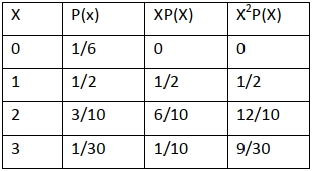
There rotten apples are mixed accidently with seven good apples and four apples are drawn one by one without replacement. Let the random variable $X$ denote the number of rotten apples. If $\mu$ and $\sigma^2$ represent mean and variance of $X$, respectively, then $10\left(\mu^2+\sigma^2\right)$ is equal to
Answera
$\sum xP ( x )=\frac{6}{2}=\mu$
$\sigma^2=\sum x^2 P(x)-\mu^2$
$\sigma^2+\mu^2=0+\frac{1}{2}+\frac{12}{10}+\frac{9}{30}=2$
$10\left(\sigma^2+\mu^2\right)=20 \text { Ans. }$
View full question & answer→MCQ 901 Mark
A fair $n(n > 1)$ faces die is rolled repeatedly until a number less than $n$ appears. If the mean of the number of tosses required is $\frac{ n }{9}$, then $n$ is equal to
Answerd
Mean $=1 \cdot \frac{ n -1}{ n }+2 \frac{1}{ n }\left(\frac{ n -1}{ n }\right)+3\left(\frac{1}{ n }\right)^2\left(\frac{ n -1}{ n }\right)$
$\frac{ n }{9}=\left(\frac{ n -1}{ n }\right)\left(1+2\left(\frac{1}{ n }\right)+3\left(\frac{1}{ n }\right)^2 \ldots \ldots\right)$
$\frac{ n }{9}=\left(\frac{ n -1}{ n }\right)\left(1-\frac{1}{ n }\right)^{-2}=\left(\frac{ n -1}{ n }\right) \cdot \frac{ n ^2}{( n -1)^2}$
$\frac{ n }{9}=\frac{ n }{ n -1} \Rightarrow n =10$
View full question & answer→MCQ 911 Mark
In a binomial distribution $B ( n , p )$, the sum and product of the mean and variance are $5$ and $6$ respectively, then find $6(n+p-q)$ is equal to :-
Answerb
$n p+n p q=5, n p \cdot n p q=6$
$n p(1+q)=5, n^2 p^2 q=6$
$n^2 p^2(1+q)^2=25, n^2 p^2 q=6$
$\frac{6}{q}(1+q)^2=25$
$6 q^2+12 q+6=25 q$
$6 q^2-13 q+6=0$
$6 q^2-9 q-4 q+6=0$
$(3 q-2)(2 q-3)=0$
$q=\frac{2}{3}, \frac{3}{2}, q=\frac{2}{3} \text { is accepted }$
$p=\frac{1}{3} \Rightarrow n \cdot \frac{1}{3}+n \cdot \frac{1}{3} \cdot \frac{2}{3}=5$
$\frac{3 n+2 n}{9}=5$
$n=9$
So $6(n+p-q)=6\left(9+\frac{1}{3}-\frac{2}{3}\right)=52$
View full question & answer→MCQ 921 Mark
The random valuable $X$ follows binomial distribution $B (n, p)$ for which the difference of the mean and the variance is $1$. If $2 P(X=2)=3 P(X=1)$, then $n^2 P(X > 1)$ is equal to $......$.
Answerc
$n p-n p q=1$
$\Rightarrow np ^2=1$
$2^{ n } C _2 p ^2 q ^{ n-2 }=3^{ n } C _1 p q^{n-1}$
$\Rightarrow n p-p=3 q \quad(\therefore q=1-p)$
$\Rightarrow p =\frac{1}{2}$
Hence $n=4$
$P(x > 1)=1-(p(x=0)+p(x=1)$
$=1-\left({ }^4 C _0\left(\frac{1}{2}\right)^4+{ }^4 C_1\left(\frac{1}{2}\right)^1\left(\frac{1}{2}\right)^3\right)=\frac{11}{16}$
View full question & answer→MCQ 931 Mark
Fifteen football players of a club-team are given $15$ T-shirts with their names written on the backside. If the players pick up the T-shirts randomly, then the probability that at least $3$ players pick the correct $T$-shirt is
- A
$\frac{5}{24}$
- B
$\frac{2}{15}$
- ✓
$\frac{1}{6}$
- D
$\frac{5}{36}$
AnswerCorrect option: C. $\frac{1}{6}$
c
Required probability $=1-\frac{D_{(15)}+{ }^{15} C_1 \cdot D_{(14)}+{ }^{15} C_2 D_{(13)}}{15 !}$
Taking $D _{(15)}$ as $\frac{15 \text { ! }}{e}$
$D _{(14)}$ as $\frac{14 !}{e}$
$D _{(13)}$ as $\frac{13 !}{e}$
We get, $1-\left(\frac{\frac{15 !}{e}+15 \cdot \frac{14 !}{e}+\frac{15 \times 14}{2} \times \frac{13 !}{e}}{15 !}\right)$
$=1-\left(\frac{1}{e}+\frac{1}{e}+\frac{1}{2 e}\right)=1-\frac{5}{2 e} \approx .08$
View full question & answer→MCQ 941 Mark
Let $S=\left\{ w _1, w _2, \ldots.\right\}$ be the sample space associated to a random experiment. Let $P \left( w _{ n }\right)=\frac{ P \left( w _{ n -1}\right)}{2}, n \geq 2$.Let $A=\{2 k +3 \ell ; k , \ell \in N \}$ and $B=\left\{ W _{ n } ; n \in A \right\}$.Then $P ( B )$ is equal to
- A
$\frac{3}{32}$
- ✓
$\frac{3}{64}$
- C
$\frac{1}{16}$
- D
$\frac{1}{32}$
AnswerCorrect option: B. $\frac{3}{64}$
b
Let $P \left( w _1\right)=\lambda$ then $P \left( w _2\right)=\frac{\lambda}{2} \ldots P \left( w _{ n }\right)=\frac{\lambda}{2^{ n -1}}$
As $\sum \limits_{ k =1}^{\infty} P \left( w _{ k }\right)=1 \Rightarrow \frac{\lambda}{1-\frac{1}{2}}=1 \Rightarrow \lambda=\frac{1}{2}$
So, $P \left( w _{ n }\right)=\frac{1}{2^{ n }}$
$A =\{2 k +3 \ell ; k , \ell \in N \}=\{5,7,8,9,10 \ldots .\}$
$B =\left\{ w _{ n }: n \in A \right\}$
$B =\left\{ w _5, w _7, w _8, w _9, w _{10}, w _{11}, \ldots .\right\}$
$A = N -\{1,2,3,4,6\}$
$\therefore P ( B )=1-\left[ P \left( w _1\right)+ P \left( w _2\right)+ P \left( w _3\right)+ P \left( w _4\right)+ P \left( w _6\right)\right]$
$=1-\left[\frac{1}{2}+\frac{1}{4}+\frac{1}{8}+\frac{1}{16}+\frac{1}{64}\right]$
$=1-\frac{32+16+8+4+1}{64}=\frac{3}{64}$
View full question & answer→MCQ 951 Mark
If the probability that the random variable $X$ takes values $x$ is given by $P ( X = x )= k ( x +1) 3^{- x }, x =0$, $1,2,3 \ldots$, where $k$ is a constant, then $P ( X \geq 2)$ is equal to
- ✓
$\frac{7}{27}$
- B
$\frac{11}{18}$
- C
$\frac{7}{18}$
- D
$\frac{20}{27}$
AnswerCorrect option: A. $\frac{7}{27}$
a
$\sum \limits_{x=0}^{\infty} P ( X = x )=1$
$k \left(1+2 \cdot 3^{-1}+3 \cdot 3^{-2}+4 \cdot 3^{-3}+\ldots \infty\right)=1$
$\text { Let } \quad s =1+\frac{2}{3}+\frac{3}{3^2}+\frac{4}{3^3}+\ldots \infty$
$\frac{s}{3}=\frac{1}{3}+\frac{2}{3^2}+\frac{3}{3^2}+\ldots \infty$
$\frac{2 s}{3}=1+\frac{1}{3}+\frac{1}{3^2}+\frac{1}{3^2}+\ldots \infty$
$\frac{2 s}{3}-\frac{1}{1-\frac{1}{3}}=\frac{3}{2}$
$s=\frac{9}{4}$
$k=\frac{4}{9}$
$P(x \geq 2)=1-P(x=0)-P(x=1)$
$=1-\frac{4}{9}\left(1+\frac{2}{3}\right)$
$=\frac{7}{27}$
View full question & answer→MCQ 961 Mark
Let the probability of getting head for a biased coin be $\frac{1}{4}$. It is tossed repeatedly until a head appears. Let $N$ be the number of tosses required. If the probability that the equation $64 x ^2+5 Nx +1=0$ has no real root is $\frac{ p }{ q }$, where $p$ and $q$ are co-prime, then $q-p$ is equal to
Answera
$64 x ^2+5 Nx +1=0$
$D =25 N ^2-256 < 0$
$\Rightarrow N ^2 < \frac{256}{25} \Rightarrow N < \frac{16}{5}$
$\therefore N =1,2,3$
$\therefore \text { Probability }=\frac{1}{4}+\frac{3}{4} \times \frac{1}{4}+\frac{3}{4} \times \frac{3}{4} \times \frac{1}{4}=\frac{37}{64}$
$\therefore q - p =27$
View full question & answer→MCQ 971 Mark
Two dice $A$ and $B$ are rolled, Let the numbers obtained on $A$ and $B$ be $\alpha$ and $\beta$ respectively. If the variance of $\alpha-\beta$ is $\frac{p}{q}$, where $p$ and $q$ are coprime, then the sum of the positive divisors of $p$ is equal to
Answerb
$\sum\left( x ^2\right)=\sum x ^2 P ( x )=2\left[\frac{25}{36}+\frac{32}{36}+\frac{27}{36}+\frac{16}{36}+\frac{5}{36}\right]$
$=\frac{105}{18}=\frac{35}{6}$
$\mu=\sum(x)=0$ as data is symmetric
$\sigma^2=\sum\left( x ^2\right)=\sum x ^2 P ( x )=\frac{35}{6} P =35=5 \times 7$
$\text { Sum of divisors }=\left(5^0+5^1\right)\left(7^0+7^1\right)=6 \times 8=48$
View full question & answer→MCQ 981 Mark
Let $N$ denotes the sum of the numbers obtained when two dice are rolled. If the probability that $2^{ N } < N !$ is $\frac{m}{n}$, where $m$ and $n$ are coprime, then $4 m -3 n$ is equal to $......$.
Answera
$N =$ Sum of the numbers when two dice are rolled such that $2^{ N } < N$ !
$\Rightarrow 4 \leq N \leq 12$
Probability that $2^N \geq N$ !
$\text { Now } P(N=2)+P(N=3)=\frac{1}{36}+\frac{2}{36}=\frac{3}{36}=\frac{1}{12}$
$\text { Required probability }=1-\frac{1}{12}=\frac{11}{12}=\frac{m}{n}$
$4 m -3 n =8$
View full question & answer→MCQ 991 Mark
Bag $I$ contains $3$ red,$4$ black and $3$ white balls and Bag $II$ contains $2$ red,$5$ black and $2$ white balls. One ball is transferred from Bag $I$ to Bag $II$ and then a ball is draw from Bag $II$. The ball so drawn is found to be black in colour. Then the probability, that the transferred ball is red,is.
- A
$\frac{4}{9}$
- ✓
$\frac{5}{18}$
- C
$\frac{1}{6}$
- D
$\frac{3}{10}$
AnswerCorrect option: B. $\frac{5}{18}$
b
$A :$ Drown ball from boy II is black
$B :$ Red ball transferred
$P\left(\frac{B}{A}\right)=\frac{P(A \cap B)}{P(A)}$
$= \frac{3}{\frac{3}{9} \times \frac{5}{10}+\frac{4}{9} \times \frac{5}{10}+\frac{6}{9} \times \frac{5}{10}}$
$= \frac{15}{15+24+15}=\frac{15}{54}=\frac{5}{18}$
View full question & answer→MCQ 1001 Mark
A random variable $X$ has the following probability distribution
|
$X$
|
$0$ |
$1$ |
$2$ |
$3$ |
$4$ |
| $P(X)$ |
$k$ |
$2$ |
$4k$ |
$6k$ |
$64$ |
The value of $P (1< X <4 \mid X \leq 2)$ is equal to
- ✓
$\frac{4}{7}$
- B
$\frac{2}{3}$
- C
$\frac{3}{7}$
- D
$\frac{4}{5}$
AnswerCorrect option: A. $\frac{4}{7}$
a
$P \left(\frac{1< x <4}{ x \leq 2}\right)=\frac{ P (1< x <4 \cap x \leq 2)}{ P ( x \leq 2)}$
$=\frac{ P (1< x \leq 2)}{ P ( x \leq 2)}=\frac{ P ( x =2)}{ P ( x \leq 2)}$
$=\frac{4 k }{ k +2 k +4 k }$
$=\frac{4}{7}$
View full question & answer→