MCQ 1011 Mark
Let $X$ be a random variable having binomial distribution $B (7, p )$. If $P ( X =3)=5 P ( X =4)$, then the sum of the mean and the variance of $X$ is
- A
$\frac{105}{16}$
- ✓
$\frac{77}{36}$
- C
$\frac{7}{16}$
- D
$\frac{49}{16}$
AnswerCorrect option: B. $\frac{77}{36}$
b
$B (7, p)$
$n =7 \quad p = p$
given
$P(x=3)=5 P(x=4)$
${ }^{7} C_{3} \times p^{3}(1-p)^{4}=5^{7} C_{4} p^{4}(1-p)^{3}$
$\frac{{ }^{7} C_{3}}{5 \times{ }^{7} C_{4}}=\frac{p}{1-p}$
$1- p =5 p$
$6 p =1$
$p=\frac{1}{6} \Rightarrow q=\frac{5}{6}$
$n =7$
Mean $= np =7 \times \frac{1}{6}=\frac{7}{6}$
Var $= npq =7 \times \frac{1}{6} \times \frac{5}{6}=\frac{35}{36}$
Sum
$=\frac{7}{6}+\frac{35}{36}$
$=\frac{42+35}{36}$
$=\frac{77}{36}$
View full question & answer→MCQ 1021 Mark
Let $X$ be a binomially distributed random variable with mean $4$ and variance $\frac{4}{3}$. Then $54 P ( X \leq 2)$ is equal to.
- A
$\frac{73}{27}$
- ✓
$\frac{146}{27}$
- C
$\frac{146}{81}$
- D
$\frac{126}{81}$
AnswerCorrect option: B. $\frac{146}{27}$
b
$np =4$
$npq =4 / 3$
$n =6, p =2 / 3, q =1 / 3$
$54( P ( X =2)+ P ( X =1)+ P ( X =0))$
$54\left({ }^{6} C _{2}\left(\frac{2}{3}\right)^{2}\left(\frac{1}{3}\right)^{4}+{ }^{6} C _{1}\left(\frac{2}{3}\right)^{1}\left(\frac{1}{3}\right)^{5}+{ }^{6} C _{0}\left(\frac{2}{3}\right)^{0}\left(\frac{1}{3}\right)^{6}\right)$
$=\frac{146}{27}$
View full question & answer→MCQ 1031 Mark
A biased die is marked with numbers $2,4,8,16,32,32$ on its faces and the probability of getting a face with mark $n$ is $\frac{1}{n}$. If the die is thrown thrice, then the probability, that the sum of the numbers obtained is $48$ , is
- A
$\frac{7}{2^{11}}$
- B
$\frac{7}{2^{12}}$
- C
$\frac{3}{2^{10}}$
- ✓
$\frac{13}{2^{12}}$
AnswerCorrect option: D. $\frac{13}{2^{12}}$
d
$P ( n )=\frac{1}{ n }$
$P (2)=\frac{1}{2} \quad P (8)=\frac{1}{8}$
$P (4)=\frac{1}{4} \quad P (16)=\frac{1}{16}$
$P (32)=\frac{2}{32}$
Possible cases
$16,16,16$ and $32,8,8$
Probability $=\frac{1}{16^{3}}+\frac{2}{32} \times \frac{1}{8} \times \frac{1}{8} \times 3=\frac{13}{16^{3}}$
View full question & answer→MCQ 1041 Mark
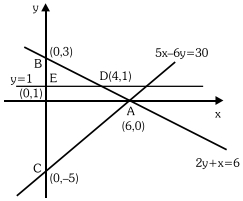
If a point $A ( x , y )$ lies in the region bounded by the $y$-axis, straight lines $2 y+x=6$ and $5 x-6 y=30$, then the probability that $y <1$ is
- A
$\frac{1}{6}$
- ✓
$\frac{5}{6}$
- C
$\frac{2}{3}$
- D
$\frac{6}{7}$
AnswerCorrect option: B. $\frac{5}{6}$
b
Required probability $=\frac{\operatorname{ar}( ADEC )}{\operatorname{ar}( ABC )}$
$=1-\frac{\operatorname{ar}( BDE )}{\operatorname{ar}( ABC )}$
$=1-\frac{\frac{1}{2} \times 2 \times 4}{\frac{1}{2} \times 8 \times 6}=1-\frac{1}{6}=\frac{5}{6}$
View full question & answer→MCQ 1051 Mark
Let $E_{1}$ and $E_{2}$ be two events such that the conditional probabilities $P \left( E _{1} \mid E _{2}\right)=\frac{1}{2}$, $P \left( E _{2} \mid E _{1}\right)=\frac{3}{4}$ and $P \left( E _{1} \cap E _{2}\right)=\frac{1}{8}$. Then
- A
$P \left( E _{1} \cap E _{2}\right)= P \left( E _{1}\right) \cdot P \left( E _{2}\right)$
- B
$P \left( E _{1}^{\prime} \cap E _{2}^{\prime}\right)= P \left( E _{1}^{\prime}\right) \cdot P \left( E _{2}\right)$
- ✓
$P \left( E _{1} \cap E _{2}^{\prime}\right)= P \left( E _{1}\right) \cdot P \left( E _{2}\right)$
- D
$P \left( E _{1}^{\prime} \cap E _{2}\right)= P \left( E _{1}\right) \cdot P \left( E _{2}\right)$
AnswerCorrect option: C. $P \left( E _{1} \cap E _{2}^{\prime}\right)= P \left( E _{1}\right) \cdot P \left( E _{2}\right)$
c
(A) $P \left( E _{1}\right) \cdot P \left( E _{2}\right)=\frac{1}{6} \cdot \frac{1}{4}=\frac{1}{24} \neq P \left( E _{1} \cap E _{2}\right)$
(B) $P \left( E _{1}^{\prime} \cap E _{2}^{\prime}\right)=1- P \left( E _{1} \cup E _{2}\right)$
$=1-\left( P \left( E _{1}\right)+ P \left( E _{2}\right)- P \left( E _{1} \cap E _{2}\right)\right)$
$=1-\left(\frac{1}{6}+\frac{1}{4}-\frac{1}{8}\right)=\frac{17}{24}$
$P \left( E _{1}^{\prime}\right) P \left( E _{2}\right)=\frac{5}{6} \times \frac{1}{4}=\frac{5}{24}$
(C) $P \left( E _{1} \cap E _{2}^{\prime}\right)= P \left( E _{1}\right)- P \left( E _{1} \cap E _{2}\right)=\frac{1}{6}-\frac{1}{8}=\frac{1}{24}$
(D) $P \left( E _{1}^{\prime} \cap E _{2}\right)= P \left( E _{2}\right)- P \left( E _{1} \cap E _{2}\right)=\frac{1}{4}-\frac{1}{8}=\frac{1}{8}$
View full question & answer→MCQ 1061 Mark
If $A$ and $B$ are two events such that $P ( A )=\frac{1}{3}, P ( B )=\frac{1}{5} $ and $P ( A \cup B )=\frac{1}{2}$, then $P \left( A \mid B ^{\prime}\right)+ P \left( B \mid A ^{\prime}\right)$ is equal to
- A
$\frac{3}{4}$
- ✓
$\frac{5}{8}$
- C
$\frac{5}{4}$
- D
$\frac{7}{8}$
AnswerCorrect option: B. $\frac{5}{8}$
b
$P(A)=\frac{1}{3}, P(B)=\frac{1}{5}$ and $P(A \cup B)=\frac{1}{2}$
$\therefore \quad P(A \cap B)=\frac{1}{3}+\frac{1}{5}-\frac{1}{2}=\frac{1}{30}$
Now, $P\left(A \mid B^{\prime}\right)+P\left(B \mid A^{\prime}\right)=\frac{P\left(A \cap B^{\prime}\right)}{P\left(B^{\prime}\right)}+\frac{P\left(B \cap A^{\prime}\right)}{P\left(A^{\prime}\right)}$
$=\frac{\frac{9}{30}}{\frac{4}{5}}+\frac{\frac{5}{30}}{\frac{2}{3}}=\frac{5}{8}$
View full question & answer→MCQ 1071 Mark
Let $A$ and $B$ be two events such that $P ( B \mid A )=\frac{2}{5}$, $P ( A \mid B )=\frac{1}{7}$ and $P ( A \cap B )=\frac{1}{9} .$ Consider
$( S 1) P \left( A ^{\prime} \cup B \right)=\frac{5}{6}$
$( S 2) P \left( A ^{\prime} \cap B ^{\prime}\right)=\frac{1}{18}$. Then.
AnswerCorrect option: A. Both $( S 1)$ and $( S 2)$ are true
a
$P ( A \mid B )=\frac{1}{7} \Rightarrow \frac{ P ( A \cap B )}{ P ( B )}=\frac{1}{7}$
$P(B)=\frac{7}{9}$
$P(B \mid A)=\frac{2}{5} \Rightarrow \frac{P(A \cap B)}{P(A)}=\frac{2}{5}$
$P ( A )=\frac{5}{18}$
Now, $P\left(A^{\prime} \cup B\right)=1-P(A \cup B)+P(B)$
$=1-P(A)+P(A \cap B)=\frac{5}{6}$
$P\left(A^{\prime} \cap B^{\prime}\right)=1-P(A \cup B)$
$=1-P(A)-P(B)+P(A \cap B)=\frac{1}{18}$
$\text { Both }(S 1) \text { and }(S 2) \text { are true. }$
View full question & answer→MCQ 1081 Mark
Bag $A$ contains $2$ white, $1$ black and $3$ red balls and bag $B$ contains $3$ black, $2$ red and $n$ white balls. One bag is chosen at random and $2$ balls drawn from it at random, are found to be $1$ red and $1$ black. If the probability that both balls come from Bag $A$ is $\frac{6}{11}$, then $n$ is equal to
Answerc
$E _{1}=\text { denotes selection for } 1^{\text {st }} \text { bag }$
$E _{2}=\text { denotes selection for } 2^{\text {nd }} \text { bag }$
$P \left( E _{1}\right)=\frac{1}{2}, P \left( E _{2}\right)=\frac{1}{2}$
$A =$ selected balls are $1$ red and $1$ black
$P \left(\frac{ A }{ E _{1}}\right)=\frac{{ }^{3} C _{1} \times{ }^{1} C _{1}}{{ }^{6} C _{2}}=\frac{1}{5}$
$P \left(\frac{ A }{ E _{1}}\right)=\frac{{ }^{3} C _{1} \times{ }^{2} C _{1}}{( n +5)_{ C _{2}}}=\frac{12}{( n +5)( n +4)}$
$P\left(\frac{E_{1}}{A}\right)=\frac{P\left(E_{1}\right) \times P\left(\frac{A}{E_{1}}\right)}{P\left(E_{1}\right) \times P\left(\frac{A}{E_{1}}\right)+P\left(E_{2}\right) \times P\left(\frac{A}{E_{2}}\right)}=\frac{6}{11}$
$=\frac{\frac{1}{10}}{\frac{1}{10}+\frac{6}{(n+5)(n+4)}}$
$\Rightarrow n=4$
View full question & answer→MCQ 1091 Mark
If a random variable $X$ follows the Binomial distribution $B (33, p )$ such that $3 P ( X =0)= P ( X =1)$, then the value of $\frac{ P ( X =15)}{ P ( X =18)}-\frac{ P ( X =16)}{ P ( X =17)}$ is equal to
- ✓
$1320$
- B
$1088$
- C
$\frac{120}{1331}$
- D
$\frac{1088}{1089}$
AnswerCorrect option: A. $1320$
a
$n =33$, let probability of success is $p$ and $q =1- p$
$3 p ( x =0)= p ( x =1)$
3. ${ }^{33} C _{0}( q )^{33}={ }^{33} C _{1} pq ^{32}$
$p =\frac{1}{12}, q =\frac{11}{12}, \frac{ q }{ p }=11$
$\frac{ p ( x =15)}{ p ( x =18)}-\frac{ p ( x =16)}{ p ( x =17)}$
$\frac{{ }^{33} C_{15} p^{15} q^{18}}{{ }^{33} C_{18} p^{18} q^{15}}-\frac{{ }^{33} C_{16} p^{16} q^{17}}{{ }_{17} P ^{17} q^{16}}=\left(\frac{q}{p}\right)^{3}-\left(\frac{q}{p}\right)$
$=(11)^{3}-11$
$=1320$
View full question & answer→MCQ 1101 Mark
If the sum and the product of mean and variance of a binomial distribution are $24$ and $128$ respectively, then the probability of one or two successes is.
- A
$\frac{33}{2^{32}}$
- B
$\frac{33}{2^{29}}$
- ✓
$\frac{33}{2^{28}}$
- D
$\frac{33}{2^{27}}$
AnswerCorrect option: C. $\frac{33}{2^{28}}$
c
$np + npq =24$
$np \cdot npq =128$
Solving $(1)$ and $(2)$:
We get $p =\frac{1}{2}, q =\frac{1}{2}, n =32$.
Now, $P ( X =1)+ P ( X =2)$
$={ }^{32} C _{1} pq ^{31}+{ }^{32} C _{2} p ^{2} q ^{30}$
$=\frac{33}{2^{28}}$
View full question & answer→MCQ 1111 Mark
The mean and variance of a binomial distribution are $\alpha$ and $\frac{\alpha}{3}$ respectively. If $P(X=1)=\frac{4}{243}$, then $P ( X =4$ or $5)$ is equal to.
- A
$\frac{5}{9}$
- B
$\frac{64}{81}$
- ✓
$\frac{16}{27}$
- D
$\frac{145}{243}$
AnswerCorrect option: C. $\frac{16}{27}$
c
$np =\alpha$
$npq =\alpha / 3$
From $(1)$ and $(2)$
$q =1 / 3$ and $p =2 / 3$
${ }^{n} C_{1} q^{n-1} p^{1}=\frac{4}{243}$
$\frac{n}{3^{n}}=\frac{2}{243}$
$n=6$
$P (4$ or 5$)={ }^{6} C _{4}\left(\frac{2}{3}\right)^{4}\left(\frac{1}{3}\right)^{2}+{ }^{6} C _{5}\left(\frac{2}{3}\right)^{5} \cdot\left(\frac{1}{3}\right)^{0}$
$=\frac{16}{27}$
View full question & answer→MCQ 1121 Mark
Let $X$ have a binomial distribution $B ( n , p )$ such that the sum and the product of the mean and variance of $X$ are $24$ and $128$ respectively. If $P ( X > n -3)=\frac{ k }{2^{ n }}$, then $k$ is equal to.
Answerb
Let $\alpha=$ Mean $\& \quad \beta=$ Variance $(\alpha>\beta)$
So, $\alpha+\beta=24, \quad \alpha \beta=128$
$\alpha=16 \quad \& \quad \beta=8$
$np =16 \quad npq =8 \Rightarrow q =\frac{1}{2}$
$\therefore p =\frac{1}{2}, n =32$
$p ( x > n -3)=\frac{1}{2^{ n }}\left({ }^{ n } C _{n-2}+{ }^{ n } C _{n-1}+{ }^{ n } C _{ n }\right)$
$\therefore k ={ }^{32} C _{30}+{ }^{32} C _{31}+{ }^{32} C _{32}=\frac{32 \times 31}{2}+32+1$
$=496+33=529$
View full question & answer→MCQ 1131 Mark
A six faced die is biased such that $3 \times P ($ a prime number $)=6 \times P ($ a composite number $)=2 \times P (1)$.Let $X$ be a random variable that counts the number of times one gets a perfect square on some throws of this die. If the die is thrown twice, then the mean of $X$ is.
- A
$\frac{3}{11}$
- B
$\frac{5}{11}$
- C
$\frac{7}{11}$
- ✓
$\frac{8}{11}$
AnswerCorrect option: D. $\frac{8}{11}$
d
Let $\frac{ P (\text { a prime number })}{2}=\frac{ P (\text { a composite })}{1}=\frac{ P (1)}{3}= k$
So, $P ($ a prime number $)=2 k$,
$P ($ a composite number $)= k$,
$P (1)=3 k$
$3 \times 2 k +2 \times k +3 k =1$
$\Rightarrow k =\frac{1}{11}$
$P ($ success $)= P (1$ or 4$)=3 k + k =\frac{4}{11}$
Number of trials, $n =2$
$\therefore \text { mean }= np =2 \times \frac{4}{11}=\frac{8}{11}$
View full question & answer→MCQ 1141 Mark
A bag contains $4$ white and $6$ black balls. Three balls are drawn at random from the bag. Let $X$ be the number of white balls, among the drawn balls. If $\sigma^{2}$ is the variance of $X$, then $100 \sigma^{2}$ is equal to.
Answerc
| $X$ |
$0$ |
$1$ |
$2$ |
$3$ |
| $P(X)$ |
$\frac{1}{6}$ |
$\frac{1}{2}$ |
$\frac{3}{10}$ |
$\frac{1}{30}$ |
$\sigma^{2}=\sum X ^{2} P ( X )-\left(\sum XP ( X )\right)^{2}=\frac{56}{100}$
$100 \sigma^{2}=56$
View full question & answer→MCQ 1151 Mark
The sum and product of the mean and variance of a binomial distribution are $82.5$ and $1350$ respectively. They the number of trials in the binomial distribution is.
Answerd
Let, mean $=m=n p$
$and$ variance $= v = npq , p + q =1$
Sum $=m+v=\frac{165}{2}$
Product $= mv =1350$
On solving,
$m = np =60$ $v = npq =\frac{45}{2} \therefore q =\frac{3}{8} \therefore P =\frac{5}{8}$
Hence $n =96$
View full question & answer→MCQ 1161 Mark
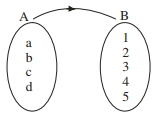
The probability that a randomly chosen one-one function from the set $\{a, b, c, d\}$ to the set $\{1,2,3,4,5\}$ satisfies $f(a)+2 f(b)-f(c)=f(d)$ is
- A
$\frac{1}{24}$
- B
$\frac{1}{40}$
- C
$\frac{1}{30}$
- ✓
$\frac{1}{20}$
AnswerCorrect option: D. $\frac{1}{20}$
d
$n ( s )=5_{ c _{4}} \times 4 !=120$
| $f ( a )$ + |
$2 f(b)$ = |
$f ( c )$ + |
$f ( d )$ |
| $5$ |
$2 \times 1$ |
$4$ |
$4$ |
| $4$ |
$2 \times 2$ |
$3$ |
$5$ |
| $1$ |
$2 \times 3$ |
$2$ |
$5$ |
$n ( A )=2 \times 3=6$
$\therefore P ( A )=\frac{ n ( A )}{ n ( s )}=\frac{6}{120}=\frac{1}{20}$
View full question & answer→MCQ 1171 Mark
The probability that a randomly chosen $2 \times 2$ matrix with all the entries from the set of first $10$ primes, is singular, is equal to
- A
$\frac{133}{10^{4}}$
- B
$\frac{18}{10^{3}}$
- ✓
$\frac{19}{10^{3}}$
- D
$\frac{271}{10^{4}}$
AnswerCorrect option: C. $\frac{19}{10^{3}}$
c
Let matrix $A$ is singular then $| A |=0$
Number of singular matrix $=$ All entries are same $+$ only two prime number are used in matrix
$=10+10 \times 9 \times 2$
$=190$
Required probability $=\frac{190}{10^{4}}=\frac{19}{10^{3}}$
View full question & answer→MCQ 1181 Mark
If the numbers appeared on the two throws of a fair six faced die are $\alpha$ and $\beta$, then the probability that $x ^{2}+\alpha x+\beta>0$, for all $x \in R$, is.
- ✓
$\frac{17}{36}$
- B
$\frac{4}{9}$
- C
$\frac{1}{2}$
- D
$\frac{19}{36}$
AnswerCorrect option: A. $\frac{17}{36}$
a
$x^{2}+\alpha x+\beta>0, \forall x \in R$
$D=\alpha^{2}-4 \beta<0$
$\alpha^{2}<4 \beta$
Total cases $=6 \times 6=36$
Fav. cases $=\beta=1, \alpha=1$
$\beta=2, \alpha=1,2$
$\beta=3, \alpha=1,2,3$
$\beta=4, \alpha=1,2,3$
$\beta=5, \alpha=1,2,3,4$
$\beta=6, \alpha=1,2,3,4$
Total favourable cases $=17$
$P ( x )=\frac{17}{36}$
View full question & answer→MCQ 1191 Mark
Let $S=\left\{E, E_{2} \ldots . E_{8}\right\}$ be a sample space of random experiment such that $P\left(E_{n}\right)=\frac{n}{36}$ for every $n =1,2 \ldots .$. Then the number of elements in the set $\left\{ A \subset S : P ( A ) \geq \frac{4}{5}\right\}$ is
Answerc
$P \left( A ^{\prime}\right)<\frac{1}{5}=\frac{36}{180}$
$5$ times the sum of missing number should be less than $36 .$
If $1$ digit is missing $=7$
If $2$ digit is missing $=9$
If $3$ digit is missing $=2$
If $0$ digit is missing $=1$
Alternate
$A$ is subset of $S$ hence
$A$ can have elements:
type $1:\{\}$
type $2$: $\left\{E_{1}\right\},\left\{E_{2}\right\}, \ldots \ldots .\left\{E_{8}\right\}$
type $3$: $\left\{ E _{1}, E _{2}\right\},\left\{ E _{1}, E _{3}\right\} \ldots \ldots .\left\{ E _{1}, E _{ 8 }\right\}$
.
.
.
type $6$: $\left\{ E _{1}, E _{2}, \ldots \ldots E _{5}\right\}, \ldots \ldots\left\{ E _{4}, E _{5}, E _{6}, E _{7}, E _{8}\right\}$
type $7$: $\left\{ E _{1}, E _{2}, \ldots \ldots . . E _{6}\right\}, \ldots \ldots .\left\{ E _{3}, E _{4}, \ldots \ldots \ldots . . E _{ 8 }\right\}$
type $8$: $\left\{ E _{1}, E _{2}, \ldots \ldots . E _{9}\right\}\left\{ E _{2}, E _{3}, \ldots \ldots \ldots . E _{8}\right\}$
type $9$: $\left\{ E _{1}, E _{2}, \ldots \ldots . . E _{ 8 }\right\}$
As $P ( A ) \geq \frac{4}{5}$
Note : Type $1$ to Type $4$ elements can not be in set
$A$ as maximum probability of type $4$ elements.
$\left\{ E _{5}, E _{6}, E _{ 7 }, E _{ s }\right\}$ is $\frac{5}{36}+\frac{6}{36}+\frac{7}{36}+\frac{8}{36}=\frac{13}{18}<\frac{4}{5}$
Now for Type $5$ acceptable elements let's call probability as $P _{ 5 }$
$P _{5}=\frac{ n _{1}+ n _{2}+ n _{3}+ n _{4}+ n _{5}}{36} \leq \frac{4}{5}$
$\Rightarrow n _{1}+ n _{2}+ n _{3}+ n _{4}+ n _{5} \geq 28.8$
Hence, $2$ possible ways $\left\{ E _{9}, E _{6}, E _{\eta}, E _{\varepsilon}, E _{3}\right.$ or $\left.E _{4}\right\}$
$P _{6}= n _{1}+ n _{2}+ n _{3}+ n _{4}+ n _{5}+ n _{6} \geq 28.8$
$\Rightarrow 9$ possible ways
$P _{8} \Rightarrow n _{1}+ n _{2}+\ldots \ldots \ldots+ n _{1} \geq 288$
$\Rightarrow 7$ possible ways
$P _{ 8 } \Rightarrow n _{1}+ n _{2}+\ldots \ldots \ldots+ n _{ 8 } \geq 28.8$
$\Rightarrow 1$ possible way
Total $=19$
View full question & answer→MCQ 1201 Mark
A pack of cards has one card missing. Two cards are drawn randomly and are found to be spades. The probability that the missing card is not a spade, is
- A
$\frac{3}{4}$
- B
$\frac{52}{867}$
- ✓
$\frac{39}{50}$
- D
$\frac{22}{425}$
AnswerCorrect option: C. $\frac{39}{50}$
c
$E _{1}:$ Event denotes spade is missing
$P \left( E _{1}\right)=\frac{1}{4} ; P \left(\overline{ E }_{1}\right)=\frac{3}{4}$
$A$ : Event drawn two cards are spade
$P ( A )=\frac{\frac{3}{4} \times\left(\frac{{ }^{13} C _{2}}{{ }^{51} C _{2}}\right)}{\frac{1}{4} \times\left(\frac{{ }^{12} C _{2}}{{ }^{51} C _{2}}\right)+\frac{3}{4} \times\left(\frac{{ }^{13} C _{2}}{{ }^{51} C _{2}}\right)}$
$=\frac{39}{50}$
View full question & answer→MCQ 1211 Mark
In a group of $400$ people, $160$ are smokers and nonvegetarian; $100$ are smokers and vegetarian and the remaining $140$ are non-smokers and vegetarian. Their chances of getting a particular chest disorder are $35\, \%, 20 \,\%$ and $10 \,\%$ respectively. A person is chosen from the group at random and is found to be suffering from the chest disorder. The probability that the selected person is a smoker and non-vegetarian is ...... .
- A
$\frac{7}{45}$
- B
$\frac{14}{45}$
- ✓
$\frac{28}{45}$
- D
$\frac{8}{45}$
AnswerCorrect option: C. $\frac{28}{45}$
c
Consider following events
$A :$ Person chosen is a smoker and non vegetarian.
$B :$ Person chosen is a smoker and vegetarian.
$C :$ Person chosen is a non-smoker and vegetarian.
$E :$ Person chosen has a chest disorder
Given
$P ( A )=\frac{160}{400} P ( B )=\frac{100}{400} P ( C )=\frac{140}{400}$
$P \left(\frac{ E }{ A }\right)=\frac{35}{100} P \left(\frac{ E }{ B }\right)=\frac{20}{100} P \left(\frac{ E }{ C }\right)=\frac{10}{100}$
To find
$P\left(\frac{A}{E}\right)=\frac{P(A) P\left(\frac{E}{A}\right)}{P(A) \cdot P\left(\frac{E}{A}\right)+P(B) \cdot P\left(\frac{E}{B}\right)+P(C) \cdot P\left(\frac{E}{C}\right)}$
$=\frac{\frac{160}{400} \times \frac{35}{100}}{\frac{160}{400} \times \frac{35}{100}+\frac{100}{400} \times \frac{20}{100}+\frac{140}{400} \times \frac{10}{100}}$
$=\frac{28}{45}$
View full question & answer→MCQ 1221 Mark
The probability distribution of random variable $\mathrm{X}$ is given by:
| $X$ |
$1$ |
$2$ |
$3$ |
$4$ |
$5$ |
| $P(X)$ |
$K$ |
$2K$ |
$2K$ |
$3K$ |
$K$ |
Let $\mathrm{p}=\mathrm{P}(1\,<\mathrm{X}\,<\,4 \mid \mathrm{X}\,<\,3)$. If $5 \mathrm{p}=\lambda \mathrm{K}$, then $\lambda$ equal to .... .
Answerb
$\sum P(X)=1 \Rightarrow k+2 k+2 k+3 k+k=1$
$\Rightarrow k=\frac{1}{9}$
Now, $\mathrm{p}=\mathrm{P}\left(\frac{\mathrm{kX}\,<\,4}{\mathrm{X}<3}\right)=\frac{\mathrm{P}(\mathrm{X}=2)}{\mathrm{P}(\mathrm{X}\,<\,3)}=\frac{\frac{2 \mathrm{k}}{9 \mathrm{k}}}{\frac{\mathrm{k}}{9 \mathrm{k}}+\frac{2 \mathrm{k}}{9 \mathrm{k}}}=\frac{2}{3}$
$\Rightarrow \mathrm{p}=\frac{2}{3}$
Now, $5 \mathrm{p}=\lambda \mathrm{k}$
$\Rightarrow(5)\left(\frac{2}{3}\right)=\lambda(1 / 9)$
$\Rightarrow \lambda=30$
View full question & answer→MCQ 1231 Mark
Let $X$ be a random variable such that the probability function of a distribution is given by $P(X=$ 0) $=\frac{1}{2}, \mathrm{P}(\mathrm{X}=\mathrm{j})=\frac{1}{3^{j}}(\mathrm{j}=1,2,3, \ldots, \infty)$. Then the mean of the distribution and $\mathrm{P}(\mathrm{X}$ is positive and even) respectively are:
- A
$\frac{3}{4}$ and $\frac{1}{9}$
- B
$\frac{3}{4}$ and $\frac{1}{16}$
- C
$\frac{3}{8}$ and $\frac{1}{8}$
- ✓
$\frac{3}{4}$ and $\frac{1}{8}$
AnswerCorrect option: D. $\frac{3}{4}$ and $\frac{1}{8}$
d
mean $=\sum x_{i} p_{i}=\sum_{r=0}^{\infty} r \cdot \frac{1}{3^{r}}=\frac{3}{4}$
$p(x$ is even $)=\frac{1}{3^{2}}+\frac{1}{3^{4}}+\ldots \infty$
$=\frac{\frac{1}{9}}{1-\frac{1}{9}}=\frac{1}{8}$
View full question & answer→MCQ 1241 Mark
A student appeared in an examination consisting of $8$ true - false type questions. The student guesses the answers with equal probability. The smallest value of $\mathrm{n}$, so that the probability of guessing at least $'n'$ correct answers is less than $\frac{1}{2}$, is:
Answera
$\mathrm{P}(\mathrm{E})<\frac{1}{2}$
$\Rightarrow \sum_{r=n}^{8}{ }^{8} C_{r}\left(\frac{1}{2}\right)^{8-r}\left(\frac{1}{2}\right)^{r}<\frac{1}{2}$
$\Rightarrow \sum_{r=n}^{8}{ }^{8} C_{r}\left(\frac{1}{2}\right)^{8}<\frac{1}{2}$
$\Rightarrow{ }^{8} C_{n}+{ }^{8} C_{n+1}+\cdots \cdot{ }^{8} C_{8}<128$
$\Rightarrow 256-\left({ }^{8} C_{0}+{ }^{8} C_{1}+\ldots+{ }^{8} C_{n-1}\right)<128$
$\Rightarrow{ }^{8} C_{0}+{ }^{8} C_{1}+\ldots+{ }^{8} C_{n-1}<128$
$\Rightarrow \mathrm{n}-1 \geq 4$
$\Rightarrow n \geq 5$
View full question & answer→MCQ 1251 Mark
A fair coin is tossed $n$-times such that the probability of getting at least one head is at least $0.9 .$ Then the minimum value of $n$ is $....$
Answerb
$\mathrm{P}(\mathrm{Head})=\frac{1}{2}$
$1-\left(\frac{1}{2}\right)^{n} \geq 0.9$
$\Rightarrow\left(\frac{1}{2}\right)^{\mathrm{n}} \leq \frac{1}{10}$
$\Rightarrow \mathrm{n}_{\min }=4$
View full question & answer→MCQ 1261 Mark
An electric instrument consists of two units. Each unit must function independently for the instrument to operate. The probability that the first unit functions is $0.9$ and that of the second unit is $0.8$. The instrument is switched on and it fails to operate. If the probability that only the first unit failed and second unit is functioning is $\mathrm{p}$, then $98\, \mathrm{p}$ is equal to ..... .
Answerd
$\mathrm{I}_{1}=$ first unit is functioning
$\mathrm{I}_{2}=$ second unit is functioning
$\mathrm{P}\left(\mathrm{I}_{1}\right)=0.9, \mathrm{P}\left(\mathrm{I}_{2}\right)=0.8$
$\mathrm{P}\left(\overline{\mathrm{I}}_{1}\right)=0.1, \mathrm{P}\left(\overline{\mathrm{I}}_{2}\right)=0.2$
$\mathrm{P}=\frac{0.8 \times 0.1}{0.1 \times 0.2+0.9 \times 0.2+0.1 \times 0.8}=\frac{8}{28}$
$98 \mathrm{P}=\frac{8}{28} \times 98=28$
View full question & answer→MCQ 1271 Mark
Let in a Binomial distribution, consisting of $5$ independent trials, probabilities of exactly $1$ and $2$ successes be $0.4096$ and $0.2048$ respectively. Then the probability of getting exactly $3$ successes is equal to ....... .
- ✓
$\frac{32}{625}$
- B
$\frac{80}{243}$
- C
$\frac{40}{243}$
- D
$\frac{128}{625}$
AnswerCorrect option: A. $\frac{32}{625}$
a
$P ( X =1)={ }^{5} C _{1} \cdot p \cdot q ^{4}=0.4096$
$P ( X =2)={ }^{5} C _{2} \cdot p ^{2} \cdot q ^{3}=0.2048$
$\Rightarrow \frac{ q }{2 p }=2$
$\Rightarrow q=4 p$ and $p+q=1$
$\Rightarrow p=\frac{1}{5}$ and $q=\frac{4}{5}$
Now
$P ( X =3)={ }^{5} C _{3} \cdot\left(\frac{1}{5}\right)^{3} \cdot\left(\frac{4}{5}\right)^{2}=\frac{10 \times 16}{125 \times 25}=\frac{32}{625}$
View full question & answer→MCQ 1281 Mark
An ordinary dice is rolled for a certain number of times. If the probability of getting an odd number $2$ times is equal to the probability of getting an even number $3$ times, then the probability of getting an odd number for odd number of times is
- A
$\frac{1}{32}$
- B
$\frac{5}{16}$
- C
$\frac{3}{16}$
- ✓
$\frac{1}{2}$
AnswerCorrect option: D. $\frac{1}{2}$
d
${ }^{n} C_{2}\left(\frac{1}{2}\right)^{n}={ }^{n} C_{3}\left(\frac{1}{2}\right)^{n} \Rightarrow{ }^{n} C_{2}={ }^{n} C_{3}$
$\Rightarrow n =5$
Probability of getting an odd number for odd number of times is
${ }^{5} C _{1}\left(\frac{1}{2}\right)^{5}+{ }^{5} C _{3}\left(\frac{1}{2}\right)^{5}+{ }^{5} C _{5}\left(\frac{1}{2}\right)^{5}=\frac{1}{2^{5}}(5+10+1)$
$=\frac{1}{2}$
View full question & answer→MCQ 1291 Mark
A fair coin is tossed a fixed number of times. If the probability of getting $7$ heads is equal to probability of getting $9$ heads, then the probability of getting $2$ heads is
- ✓
$\frac{15}{2^{13}}$
- B
$\frac{15}{2^{12}}$
- C
$\frac{15}{2^{8}}$
- D
$\frac{15}{2^{14}}$
AnswerCorrect option: A. $\frac{15}{2^{13}}$
a
Let the coin be tossed $n$ -times
$P ( H )= P ( T )=\frac{1}{2}$
$P (7$ heads $)={ }^{n} C _{7}\left(\frac{1}{2}\right)^{ n -7}\left(\frac{1}{2}\right)^{7}=\frac{{ }^{n} C _{7}}{2^{ n }}$
$P (9$ heads $)={ }^{n} C_{9}\left(\frac{1}{2}\right)^{ n -9}\left(\frac{1}{2}\right)^{9}=\frac{{ }^{n} C _{9}}{2^{ n }}$
$P (7$ heads $)= P (9$ heads $)$
${ }^{n} C_{7}={ }^{n} C_{9} \Rightarrow n=16$
$P (2$ heads $)={ }^{16} C _{2}\left(\frac{1}{2}\right)^{14}\left(\frac{1}{2}\right)^{2}=\frac{15 \times 8}{2^{16}}$
$P (2$ heads $)=\frac{15}{2^{13}}$
View full question & answer→MCQ 1301 Mark
A fair die is tossed until six is obtained on it. Let $X$ be the number of required tosses, then the conditional probability $\mathrm{P}(\mathrm{X} \geq 5 \mid \mathrm{X}>2)$ is :
- A
$\frac{125}{216}$
- B
$\frac{11}{36}$
- C
$\frac{5}{6}$
- ✓
$\frac{25}{36}$
AnswerCorrect option: D. $\frac{25}{36}$
d
$\mathrm{P}(\mathrm{x} \geq 5 \mid \mathrm{x}>2)=\frac{\mathrm{P}(\mathrm{x} \geq 5)}{\mathrm{P}(\mathrm{x}>2)}$
$\frac{\left(\frac{5}{6}\right)^{4} \cdot \frac{1}{6}+\left(\frac{5}{6}\right)^{5} \cdot \frac{1}{6}+\ldots \ldots .+\infty}{\left(\frac{5}{6}\right)^{2} \cdot \frac{1}{6}+\left(\frac{5}{6}\right)^{3} \cdot \frac{1}{6}+\ldots \ldots+\infty}$
$\frac{\frac{\left(\frac{5}{6}\right)^{4} \cdot \frac{1}{6}}{1-\frac{5}{6}}}{\frac{\left(\frac{5}{6}\right)^{2} \cdot \frac{1}{6}}{1-\frac{5}{6}}}=\left(\frac{5}{6}\right)^{2}=\frac{25}{36}$
View full question & answer→MCQ 1311 Mark
When a certain biased die is rolled, a particular face occurs with probability $\frac{1}{6}-\mathrm{x}$ and its opposite face occurs with probability $\frac{1}{6}+\mathrm{x}$. All other faces occur with probability $\frac{1}{6}$. Note that opposite faces sum to $7$ in any die. If $0\,<\,x\,<\,\frac{1}{6}$, and the probability of obtaining total $\mathrm{sum}=7$, when such a die is rolled twice, is $\frac{13}{96}$, then the value of $x$ is:
- A
$\frac{1}{16}$
- ✓
$\frac{1}{8}$
- C
$\frac{1}{9}$
- D
$\frac{1}{12}$
AnswerCorrect option: B. $\frac{1}{8}$
b
Probability of obtaining total sum $7=$ probability of getting opposite faces.
Probability of getting opposite faces
$=2\left[\left(\frac{1}{6}-x\right)\left(\frac{1}{6}+x\right)+\frac{1}{6} \times \frac{1}{6}+\frac{1}{6} \times \frac{1}{6}\right]$
$\Rightarrow 2\left[\left(\frac{1}{6}-x\right)\left(\frac{1}{6}+x\right)+\frac{1}{6} \times \frac{1}{6}+\frac{1}{6} \times \frac{1}{6}\right]=\frac{13}{96}$
(given)
$x=\frac{1}{8}$
View full question & answer→MCQ 1321 Mark
The probability of selecting integers $a \in[-5,30]$ such that $x^{2}+2(a+4) x-5 a+64>0$, for all $x \in R$, is:
- A
$\frac{1}{4}$
- B
$\frac{7}{36}$
- ✓
$\frac{2}{9}$
- D
$\frac{1}{6}$
AnswerCorrect option: C. $\frac{2}{9}$
c
$\mathrm{D}<0$
$\Rightarrow 4(a+4)^{2}-4(-5 a+64)<0$
$\Rightarrow a^{2}+16+8 a+5 a-64<0$
$\Rightarrow a^{2}+13 a-48<0$
$\Rightarrow(a+16)(a-3)<0$
$\Rightarrow a \in(-16,3)$
$\therefore$ Possible a : $\{-5,-4, \ldots, 2\}$
$\therefore$ Required probability $=\frac{8}{36}$
$=\frac{2}{9}$
View full question & answer→MCQ 1331 Mark
Let $9$ distinct balls be distributed among $4$ boxes, $B_{1}, B_{2}, B_{3}$ and $B_{4}$. If the probability that $B_{3}$ contains exactly $3$ balls is $k\left(\frac{3}{4}\right)^{9}$ then $\mathrm{k}$ lies in the set:
AnswerCorrect option: C. $\{x \in R:|x-3|<1\}$
c
$\text { required probability }=\frac{{ }^{9} \mathrm{C}_{3} \cdot 3^{6}}{4^{9}}$
$=\frac{{ }^{9} \mathrm{C}_{3}}{27} \cdot\left(\frac{3}{4}\right)^{9}$
$=\frac{28}{9} \cdot\left(\frac{3}{4}\right)^{9} \Rightarrow \mathrm{k}=\frac{28}{9}$
Which satisfies $|x-3|\,<\,1$
View full question & answer→MCQ 1341 Mark
The probability that a randomly selected $2$ digit number belongs to the set $\left(n \in N:\left(2^{n}-2\right)\right.$ is a multiple of $3\, )$ is equal to:
- ✓
$\frac{1}{2}$
- B
$\frac{1}{3}$
- C
$\frac{2}{3}$
- D
$\frac{1}{6}$
AnswerCorrect option: A. $\frac{1}{2}$
a
Total number of cases $={ }^{90} \mathrm{C}_{1}=90$
Now, $2^{n}-2=(3-1)^{n}-2$
${ }^{n} C_{0} 3^{n}-{ }^{n} C_{1} \cdot 3^{n-1}+\ldots+(-1)^{n-1} \cdot{ }^{n} C_{n-1} 3+(-1)^{n} \cdot{ }^{n} C_{n}-2$
$3\left(3^{n-1}-n 3^{n-2}+\ldots+(-1)^{n-1} \cdot n\right)+(-1)^{n}-2$
$\left(2^{n}-2\right)$ is multiply of $3$ only when $n$ is odd
Req. Probability $=\frac{45}{90}=\frac{1}{2}$
View full question & answer→MCQ 1351 Mark
Let there be three independent events $E _{1}, E _{2}$ and $E _{3}$. The probability that only $E _{1}$ occurs is $\alpha$, only $E _{2}$ occurs is $\beta$ and only $E _{3}$ occurs is $\gamma .$ Let $'p'$ denote the probability of none of events occurs that satisfies the equations $(\alpha-2 \beta) p =\alpha \beta$ and $(\beta-3 \gamma) p =2 \beta \gamma .$ All the given probabilities are assumed to lie in the interval $(0,1)$
Then, $\frac{\text { Probability of occurrence of } E _{1}}{\text { Probability of occurrence of } E _{3}}$ is equal to ..........
Answerb
Let $P \left( E _{1}\right)= P _{1} ; P \left( E _{2}\right)= P _{2} ; P \left( E _{3}\right)= P _{3}$
$P \left( E _{1} \cap \overline{ E }_{2} \cap \overline{ E }_{3}\right)=\alpha= P _{1}\left(1- P _{2}\right)\left(1- P _{3}\right) \ldots \ldots$
$P \left(\overline{ E }_{1} \cap E _{2} \cap \overline{ E }_{3}\right)=\beta=\left(1- P _{1}\right) P _{2}\left(1- P _{3}\right)$
$P \left(\overline{ E }_{1} \cap \overline{ E }_{2} \cap E _{3}\right)=\gamma=\left(1- P _{1}\right)\left(1- P _{2}\right) P _{3} \ldots \ldots$
$P \left(\overline{ E }_{1} \cap \overline{ E }_{2} \cap \overline{ E }_{3}\right)= P =\left(1- P _{1}\right)\left(1- P _{2}\right)\left(1- P _{3}\right) \ldots \ldots$
Given that, $(\alpha-2 \beta) P =\alpha \beta$
$\Rightarrow\left( P _{1}\left(1- P _{2}\right)\left(1- P _{3}\right)-2\left(1- P _{1}\right) P _{2}\left(1- P _{3}\right)\right) P = P _{1} P _{2}$
$\quad\left(1- P _{1}\right)\left(1- P _{2}\right)\left(1- P _{3}\right)^{2}$
$\Rightarrow\left( P _{1}\left(1- P _{2}\right)-2\left(1- P _{1}\right) P _{2}\right)= P _{1} P _{2}$
$\Rightarrow\left( P _{1}- P _{1} P _{2}-2 P _{2}+2 P _{1} P _{2}\right)= P _{1} P _{2}$
$\Rightarrow P _{1}=2 P _{2} \quad \ldots \ldots(1)$
and similarly, $(\beta-3 \gamma) P =2 B \gamma$
$P _{2}=3 P _{3} \quad \ldots \ldots(2)$
So, $P _{1}=6 P _{3} \Rightarrow \frac{ P _{1}}{ P _{3}}=6$
View full question & answer→MCQ 1361 Mark
Let $B _{i}(i=1,2,3)$ be three independent events in a sample space. The probability that only $B _{1}$ occur is $\alpha,$ only $B _{2}$ occurs is $\beta$ and only $B _{3}$ occurs is $\gamma$. Let $p$ be the probability that none of the events $B _{i}$ occurs and these $4$ probabilities satisfy the equations $(\alpha-2 \beta) p =\alpha \beta$ and $(\beta-3 \gamma) p =2 \beta \gamma$ (All the probabilities are assumed to lie in the interval $(0,1))$. Then $\frac{ P \left( B _{1}\right)}{ P \left( B _{3}\right)}$ is equal to ..........
Answerb
Let $P \left( B _{1}\right)= p _{1}, P \left( B _{2}\right)= p _{2}, P \left( B _{3}\right)= p _{3}$
given that $p _{1}\left(1- p _{2}\right)\left(1- p _{3}\right)=\alpha$ $.....(i)$
$p _{2}\left(1- p _{1}\right)\left(1- p _{3}\right)=\beta$ $....(ii)$
$p _{3}\left(1- p _{1}\right)\left(1- p _{2}\right)=\gamma$ $.......(iii)$
and $\quad\left(1- p _{1}\right)\left(1- p _{2}\right)\left(1- p _{3}\right)= p \ldots \ldots (iv)$
$\Rightarrow \quad \frac{ p _{1}}{1- p _{1}}=\frac{\alpha}{ p }, \frac{ p _{2}}{1- p _{2}}=\frac{\beta}{ p } \& \frac{ p _{3}}{1- p _{3}}=\frac{\gamma}{ p }$
Also $\beta=\frac{\alpha p }{\alpha+2 p }=\frac{3 \gamma p }{ p -2 \gamma}$
$\Rightarrow \alpha p -2 \alpha \gamma=3 \alpha \gamma+6 p \gamma$
$\Rightarrow \quad \alpha p -6 p \gamma=5 \alpha \gamma$
$\Rightarrow \quad \frac{ p _{1}}{1- p _{1}}-\frac{6 p _{3}}{1- p _{3}}=\frac{5 p _{1} p _{3}}{\left(1- p _{1}\right)\left(1- p _{3}\right)}$
$\Rightarrow p _{1}-6 p _{3}=0$
$\Rightarrow \frac{ p _{1}}{ p _{3}}=6$
View full question & answer→MCQ 1371 Mark
The coefficients $a, b$ and $c$ of the quadratic equation, $ax ^{2}+ bx + c =0$ are obtained by throwing a dice three times. The probability that this equation has equal roots is
- A
$\frac{1}{72}$
- ✓
$\frac{5}{216}$
- C
$\frac{1}{36}$
- D
$\frac{1}{54}$
AnswerCorrect option: B. $\frac{5}{216}$
b
$a x^{2}+b x+c=0$
For equal roots $D=0$
$\Rightarrow b ^{2}=4 ac$
Case $I : ac =1$
$( a , b , c )=(1,2,1)$
Case $II : ac = 4 ( a , b , c )=(1,4,4)$
or $(4,4,1)$
or $(2,4,2)$
Case $III : ac = 9$
$( a , b , c )=(3,6,3)$
Required probability $=\frac{5}{216}$
View full question & answer→MCQ 1381 Mark
Let $A, B$ and $C$ be three events such that the probability that exactly one of $A$ and $B$ occurs is $(1-k)$, the probability that exactly one of $B$ and $C$ occurs is $(1-2 k)$, the probability that exactly one of $C$ and $A$ occurs is $(1-k)$ and the probability of all $A, B$ and $C$ occur simultaneously is $k^{2}$, where $0\,<\,\mathrm{k}\,<\,1$. Then the probability that at least one of $\mathrm{A}, \mathrm{B}$ and $\mathrm{C}$ occur is:
- ✓
greater than $\frac{1}{2}$
- B
greater than $\frac{1}{4}$ but less than $\frac{1}{2}$
- C
exactly equal to $\frac{1}{2}$
- D
greater than $\frac{1}{8}$ but less than $\frac{1}{4}$
AnswerCorrect option: A. greater than $\frac{1}{2}$
a
$\mathrm{P}(\overrightarrow{\mathrm{A}} \cap \mathrm{B})+\mathrm{P}(\mathrm{A} \cap \overline{\mathrm{B}})=1-K$
$\mathrm{P}(\overrightarrow{\mathrm{A}} \cap \mathrm{C})+\mathrm{P}(\mathrm{A} \cap \bar{C})=1-2 k$
$\mathrm{P}(\overrightarrow{\mathrm{B}} \cap \mathrm{C})+\mathrm{P}(\mathrm{B} \cap \overline{\mathrm{C}})=1-\mathrm{K}$
$\mathrm{P}(\mathrm{A} \cap \mathrm{B} \cap \mathrm{C})=\mathrm{k}^{2}$
$\mathrm{P}(\mathrm{A})+\mathrm{P}(\mathrm{B})-2 \mathrm{P}(\mathrm{A} \cap \mathrm{B})=1-\mathrm{k} \,\,....(i)$
$\mathrm{P}(\mathrm{B})+\mathrm{P}(\mathrm{C})-2 \mathrm{P}(\mathrm{B} \cap \mathrm{C})=1-\mathrm{k}\,\,....(ii)$
$\mathrm{P}(\mathrm{C})+\mathrm{P}(\mathrm{A})-2 \mathrm{P}(\mathrm{A} \cap \mathrm{C})=1-2 \mathrm{k}\,\,....(iii)$
$(1)+(2)+(3)$
$\mathrm{P}(\mathrm{A})+\mathrm{P}(\mathrm{B})+\mathrm{P}(\mathrm{C})-\mathrm{P}(\mathrm{A} \cap \mathrm{B})-\mathrm{P}(\mathrm{B} \cap \mathrm{C})-\mathrm{P}(\mathrm{C} \cap \mathrm{A})=\frac{-4 \mathrm{k}+3}{2}$
So
$P(A \cup B \cup C)=\frac{-4 k+3}{2}+k^{2}$
$P(A \cup B \cup C)=\frac{2 k^{2}-4 K+3}{2}$
$=\frac{2(k-1)^{2}+1}{2}$
$P(A \cup B \cup C)\,>\,\frac{1}{2}$
View full question & answer→MCQ 1391 Mark
Four dice are thrown simultaneously and the numbers shown on these dice are recorded in $2 \times 2$ matrices. The probability that such formed matrices have all different entries and are nonsingular, is :
- A
$\frac{23}{81}$
- B
$\frac{22}{81}$
- C
$\frac{45}{162}$
- ✓
$\frac{43}{162}$
AnswerCorrect option: D. $\frac{43}{162}$
d
$A=\left|\begin{array}{ll} a & b \\ c & d \end{array}\right| \quad|A|=a d-b c$
$\text { Total case }=6^{4}$
For non-singular matrix $|\mathrm{A}| \neq 0 \Rightarrow \mathrm{ad}-\mathrm{bc} \neq 0$ $\Rightarrow \mathrm{ad} \neq \mathrm{bc}$
And $\mathrm{a}, \mathrm{b}, \mathrm{c}, \mathrm{d}$ are all different numbers in the set $\{1,2,3,4,5,6\}$ Now for $\mathrm{ad}=\mathrm{bc}$
$(i)$ $6 \times 1=2 \times 3$
$6 \times 1=6, b=2, c=3, d=1$
$\text { or } a=1, b=2, c=3, d=6$
$8 \text { such cases }$
$(ii)$
$6 \times 2=3 \times 4$
$6 \times=6, b=2, c=3, d=2$
$\text { or } a=1, b=3, c=4, d=6$
$8 \text { such cases }$
favourable cases
$={ }^{6} \mathrm{C}_{4}\lfloor 4-16$
required probability
$=\frac{{ }^{6} \mathrm{C}_{4} \lfloor-16}{6^{4}}=\frac{43}{162}$
View full question & answer→MCQ 1401 Mark
A die is thrown two times and the sum of the scores appearing on the die is observed to be a multiple of $4$. Then the conditional probability that the score $4$ has appeared at least once is
- A
$\frac{1}{8}$
- ✓
$\frac{1}{9}$
- C
$\frac{1}{3}$
- D
$\frac{1}{4}$
AnswerCorrect option: B. $\frac{1}{9}$
b
A : Sum obtained is a multiple of 4
$A=\{(1,3),(2,2),(3,1),(2,6),(3,5),(4,4),(5,3),(6,2),(6,6)\}$
$B$ : Score of $4$ has appeared at least once.
$B=\{(1,4),(2,4),(3,4),(4,4),(5,4),(6,4),(4,1),$
$(4,2),(4,3),(4,5),(4,6)\}$
Required probability $= P \left(\frac{ B }{ A }\right)=\frac{ P ( B \cap A )}{ P ( A )}$
$=\frac{1 / 36}{9 / 36}=\frac{1}{9}$
View full question & answer→MCQ 1411 Mark
In a bombing attack, there is $50 \%$ chance that a bomb will hit the target. At least two independent hits are required to destroy the target completely. Then the minimum number of bombs, that must be dropped to ensure that there is at least $99 \%$ chance of completely destroying the target, is
Answera
$P ( H )=\frac{1}{2}$
$P (\overline{ H })=\frac{1}{2}$
Let total 'n' bomb are required to destroy the
target
$1-{ }^{n} C_{n}\left(\frac{1}{2}\right)^{n}-{ }^{n} C_{1}\left(\frac{1}{2}\right)^{n} \geq \frac{99}{100}$
$1-\frac{1}{2^{n}}-\frac{n}{2^{n}} \geq \frac{99}{100}$
$\frac{1}{100} \geq \frac{n+1}{2^{n}}$
Now check for value of $n$
$n=11$
View full question & answer→MCQ 1421 Mark
Let $A$ and $B$ be two independent events such that $\mathrm{P}(\mathrm{A})=\frac{1}{3}$ and $\mathrm{P}(\mathrm{B})=\frac{1}{6} .$ Then, which of the following is TRUE?
- A
$\mathrm{P}(\mathrm{A} / \mathrm{B})=\frac{2}{3}$
- B
$\mathrm{P}(\mathrm{A} /(\mathrm{A} \cup \mathrm{B}))=\frac{1}{4}$
- ✓
$\mathrm{P}\left(\mathrm{A} / \mathrm{B}^{\prime}\right)=\frac{1}{3}$
- D
$\mathrm{P}\left(\mathrm{A}^{\prime} / \mathrm{B}^{\prime}\right)=\frac{1}{3}$
AnswerCorrect option: C. $\mathrm{P}\left(\mathrm{A} / \mathrm{B}^{\prime}\right)=\frac{1}{3}$
c
$\mathrm{P}(\mathrm{A} / \mathrm{B})=\mathrm{P}(\mathrm{A})=\frac{1}{3}$
$P(A /(A \cup B))=\frac{P(A \cap(A \cup B))}{P(A \cup B)}=\frac{P(A)}{P(A \cup B)}$
$=\frac{\frac{1}{3}}{\frac{1}{3}+\frac{1}{6}-\frac{1}{18}}=\frac{3}{4}$
$\mathrm{P}\left(\mathrm{A} / \mathrm{B}^{\prime}\right)=\mathrm{P}(\mathrm{A})=\frac{1}{3}$
$\mathrm{P}\left(\mathrm{A}^{\prime} / \mathrm{B}^{\prime}\right)=\mathrm{P}\left(\mathrm{A}^{\prime}\right)=\frac{2}{3}$
View full question & answer→MCQ 1431 Mark
Box $I$ contains $30$ cards numbered $1$ to $30$ and Box $II$ contains $20$ cards numbered $31$ to $50 .$ A box is selected at random and a card is drawn from it. The number on the card is found to be a non-prime number. The probability that the card was drawn from Box $I$ is
- ✓
$\frac{8}{17}$
- B
$\frac{2}{3}$
- C
$\frac{4}{17}$
- D
$\frac{2}{5}$
AnswerCorrect option: A. $\frac{8}{17}$
a
Let $\mathrm{B}_{1}$ be the event where Box-I is selected.
$\mathrm{B}_{2} \rightarrow$ where box-II selected
$P\left(B_{1}\right)=P\left(B_{2}\right)=\frac{1}{2}$
Let $\mathrm{E}$ be the event where selected card is non prime.
For $\mathrm{B}_{1}:$ Prime numbers :
$\{2,3,5,7,11,13,17,19,23,29\}$
For $\mathrm{B}_{2}:$ Prime numbers :
$\{31,37,41,43,47\}$
$\mathrm{P}(\mathrm{E}) $$=\mathrm{P}\left(\mathrm{B}_{1}\right) \times \mathrm{P}\left(\frac{\mathrm{E}}{\mathrm{B}_{1}}\right)+\mathrm{P}\left(\mathrm{B}_{2}\right) \mathrm{P}\left(\frac{\mathrm{E}}{\mathrm{B}_{2}}\right) $
$=\frac{1}{2} \times \frac{20}{30}+\frac{1}{2} \times \frac{15}{20}$
Required probability :
$P\left(\frac{B_{1}}{E}\right)=\frac{\frac{1}{2} \times \frac{20}{30}}{\frac{1}{2} \times \frac{20}{30}+\frac{1}{2} \times \frac{15}{20}}=\frac{\frac{2}{3}}{\frac{2}{3}+\frac{3}{4}}=\frac{8}{17}$
View full question & answer→MCQ 1441 Mark
Let $E ^{ C }$ denote the complement of an event $E$. Let $E _{1}, E _{2}$ and $E _{3}$ be any pairwise independent events with $P \left( E _{1}\right) > 0$ and $P \left( E _{1} \cap E _{2} \cap E _{3}\right)=0$ Then $P \left( E _{2}^{ C } \cap E _{3}^{ C } / E _{1}\right)$ is equal to
- ✓
$\mathrm{P}\left(\mathrm{E}_{3}^{\mathrm{C}}\right)-\mathrm{P}\left(\mathrm{E}_{2}\right)$
- B
$\mathrm{P}\left(\mathrm{E}_{2}^{\mathrm{C}}\right)+\mathrm{P}\left(\mathrm{E}_{3}\right)$
- C
$\mathrm{P}\left(\mathrm{E}_{3}^{\mathrm{C}}\right)-\mathrm{P}\left(\mathrm{E}_{2}^{\mathrm{C}}\right)$
- D
$\mathrm{P}\left(\mathrm{E}_{3}\right)-\mathrm{P}\left(\mathrm{E}_{2}^{\mathrm{C}}\right)$
AnswerCorrect option: A. $\mathrm{P}\left(\mathrm{E}_{3}^{\mathrm{C}}\right)-\mathrm{P}\left(\mathrm{E}_{2}\right)$
a
Given $\mathrm{E}_{1}, \mathrm{E}_{2}, \mathrm{E}_{3}$ are pairwise indepedent events $\operatorname{soP}\left(\mathrm{E}_{1} \cap \mathrm{E}_{2}\right)=\mathrm{P}\left(\mathrm{E}_{1}\right) \cdot \mathrm{P}\left(\mathrm{E}_{2}\right)$
and $\mathrm{P}\left(\mathrm{E}_{2} \cap \mathrm{E}_{3}\right)=\mathrm{P}\left(\mathrm{E}_{2}\right) \cdot \mathrm{P}\left(\mathrm{E}_{3}\right)$
and $\mathrm{P}\left(\mathrm{E}_{3} \cap \mathrm{E}_{1}\right)=\mathrm{P}\left(\mathrm{E}_{3}\right) \cdot \mathrm{P}\left(\mathrm{E}_{1}\right)$
$\& \mathrm{P}\left(\mathrm{E}_{1} \cap \mathrm{E}_{2} \cap \mathrm{E}_{3}\right)=0$
Now $\mathrm{P}\left(\frac{\overline{\mathrm{E}}_{2} \cap \overline{\mathrm{E}}_{3}}{\mathrm{E}_{1}}\right)=\frac{\mathrm{P}\left[\mathrm{E}_{1} \cap\left(\overline{\mathrm{E}}_{2} \cap \overline{\mathrm{E}}_{3}\right)\right]}{\mathrm{P}\left(\mathrm{E}_{1}\right)}$
$=\frac{\mathrm{P}\left(\mathrm{E}_{1}\right)-\left[\mathrm{P}\left(\mathrm{E}_{1} \cap \mathrm{E}_{2}\right)+\mathrm{P}\left(\mathrm{E}_{1} \cap \mathrm{E}_{3}\right)-\mathrm{P}\left(\mathrm{E}_{1} \cap \mathrm{E}_{2} \cap \mathrm{E}_{3}\right)\right]}{\mathrm{P}\left(\mathrm{E}_{1}\right)}$
$=\frac{\mathrm{P}\left(\mathrm{E}_{1}\right)-\mathrm{P}\left(\mathrm{E}_{1}\right) \cdot \mathrm{P}\left(\mathrm{E}_{2}\right)-\mathrm{P}\left(\mathrm{E}_{1}\right) \mathrm{P}\left(\mathrm{E}_{3}\right)-0}{\mathrm{P}\left(\mathrm{E}_{1}\right)}$
$=1-\mathrm{P}\left(\mathrm{E}_{2}\right)-\mathrm{P}\left(\mathrm{E}_{3}\right)$
$=\left[1-\mathrm{P}\left(\mathrm{E}_{3}\right)\right]-\mathrm{P}\left(\mathrm{E}_{2}\right)$
$=\mathrm{P}\left(\mathrm{E}_{3}^{\mathrm{c}}\right)-\mathrm{P}\left(\mathrm{E}_{2}\right)$
View full question & answer→MCQ 1451 Mark
An unbiased coin is tossed $5$ times. Suppose that a variable $\mathrm{X}$ is assigned the value $\mathrm{k}$ when $\mathrm{k}$ consecutive heads are obtained for $\mathrm{k}=3,4,5$ otherwise $X$ takes the value $-1 .$ Then the expected value of $X,$ is
- A
$\frac{3}{16}$
- B
$-\frac{3}{16}$
- ✓
$\frac{1}{8}$
- D
$-\frac{1}{8}$
AnswerCorrect option: C. $\frac{1}{8}$
c
$\begin{array}{c|c|c|c|c|c|c}{\mathrm{k}} & {0} & {1} & {2} & {3} & {4} & {5} \\ \hline P(\mathrm{k}) & {\frac{1}{32}} & {\frac{12}{32}} & {\frac{11}{32}} & {\frac{5}{32}} & {\frac{2}{32}} & {\frac{1}{32}}\end{array}$
Expected value $=\Sigma \mathrm{XP}(\mathrm{k})$
$-\frac{1}{32}-\frac{12}{32}-\frac{11}{32}+\frac{15}{32}+\frac{8}{32}+\frac{5}{32}$
$=\frac{28-24}{32}=\frac{4}{32}=\frac{1}{8}$
View full question & answer→MCQ 1461 Mark
A random variable $X$ has the following probability distribution
| $X$ |
$1$ |
$2$ |
$3$ |
$4$ |
$5$ |
| $P(X)$ |
$K^2$ |
$2K$ |
$K$ |
$2K$ |
$5K^2$ |
Then $\mathrm{P}(\mathrm{X}> 2)$ is equal to
- A
$\frac{7}{12}$
- ✓
$\frac{23}{36}$
- C
$\frac{1}{36}$
- D
$\frac{1}{6}$
AnswerCorrect option: B. $\frac{23}{36}$
b
$\sum P(X)=1 \Rightarrow K^{2}+2 K+K+2 K+5 K^{2}=1$
$\Rightarrow 6 \mathrm{K}^{2}+5 \mathrm{K}-1=0 \Rightarrow(6 \mathrm{K}-1)(\mathrm{K}+1)=0$
$\Rightarrow \mathrm{K}=-1$ (rejected) $\Rightarrow \mathrm{K}=\frac{1}{6}$
$\mathrm{P}(\mathrm{X}>2)=\mathrm{K}+2 \mathrm{K}+5 \mathrm{K}^{2}=\frac{23}{36}$
View full question & answer→MCQ 1471 Mark
In a workshop, there are five machines and the probability of any one of them to be out of service on a day is $\frac{1}{4} .$ If the probability that at most two machines will be out of service on the same day is $\left(\frac{3}{4}\right)^{3} \mathrm{k},$ then $\mathrm{k}$ is equal to
- A
$\frac{17}{2}$
- B
$4$
- ✓
$\frac{17}{8}$
- D
$\frac{17}{4}$
AnswerCorrect option: C. $\frac{17}{8}$
c
Probability that at most $2$ machines are out of service
$=\mathrm{^{5}C}_{0}\left(\frac{3}{4}\right)^{5}+^{5} \mathrm{C}_{1}\left(\frac{3}{4}\right)^{4}\left(\frac{1}{4}\right)+^{5} \mathrm{C}_{2}\left(\frac{3}{4}\right)^{3}\left(\frac{1}{4}\right)^{2}$
$=\left(\frac{3}{4}\right)^{4} \times \frac{17}{8} d \Rightarrow \mathrm{k}=\frac{17}{8}$
View full question & answer→MCQ 1481 Mark
The probability of a man hitting a target is $\frac{1}{10}$. The least number of shots required, so that the probability of his hitting the target at least once is greater than $\frac{1}{4},$ is
Answerb
We have, $1-($ probability of all shots result in failure $)>\frac{1}{4}$
$\Rightarrow 1-\left(\frac{9}{10}\right)^{n}>\frac{1}{4}$
$\Rightarrow \frac{3}{4}>\left(\frac{9}{10}\right)^{n} \Rightarrow n \geq 3$
View full question & answer→MCQ 1491 Mark
Four fair dice are thrown independently $27$ times. Then the expected number of times, at least two dice show up a three or a five, is
Answera
4 dice are independently thrown. Each die has probability to show 3 or 5 is
$p=\frac{2}{6}=\frac{1}{3}$
$\therefore \quad q =1-\frac{1}{3}=\frac{2}{3}$ (not showing 3 or $\left.5\right)$
Experiment is performed with 4 dices independently.
$\therefore$ Their binomial distribution is $(q+p)^{4}=(q)^{4}+{ }^{4} C_{1} q^{3} p+{ }^{4} C_{2} q^{2} p^{2}+{ }^{4} C_{3} q p^{3}$
$+{ }^{4} C _{4} p ^{4}$
$\therefore$ In one throw of each dice probability of showing 3 or 5 at least twice is $= p ^{4}+{ }^{4} C _{3} qp ^{3}+{ }^{4} C _{2} q ^{2} p ^{2}$
$=\frac{33}{81}$
$\therefore$ Such experiment performed 27 times
$\therefore$ so expected out comes $= np$
$=\frac{33}{81} \times 27$
$=11$
View full question & answer→MCQ 1501 Mark
Out of $11$ consecutive natural numbers if three numbers are selected at random (without repetition), then the probability that they are in $A.P.$ with positive common difference, is
- A
$\frac{15}{101}$
- B
$\frac{5}{101}$
- ✓
$\frac{5}{33}$
- D
$\frac{10}{99}$
AnswerCorrect option: C. $\frac{5}{33}$
c
Out of 11 consecutive natural numbers either
6 even and 5 odd numbers or 5 even and 6 odd numbers
when 3 numbers are selected at random then total cases $={ }^{11} C _{3}$
since these 3 numbers are in A.P. Let no's are $a, b, c$
$2 b \Rightarrow$ even number
$a + c \Rightarrow\left(\begin{array}{l}\text { even }+\text { even } \\ \text { odd }+\text { odd }\end{array}\right)$
so favourable cases $={ }^{6} C _{2}+{ }^{5} C _{2}$
$=15+10=25$
$P \left(3\right.$ numbers are in A.P. $\left.=\frac{25}{{ }^{11} C _{3}}=\frac{25}{165}=\frac{5}{33}\right)$
View full question & answer→