MCQ 511 Mark
The value of $\tan \left( {\frac{1}{2}{{\cos }^{ - 1}}\left( {\frac{{\sqrt 5 }}{3}} \right)} \right)$ is
AnswerCorrect option: C. $\frac{1}{2} (3 - \sqrt 5)$
c
$\tan \left[\frac{1}{2} \cos ^{-1}\left(\frac{\sqrt{5}}{3}\right)\right]$
Put $\cos ^{-1}\left(\frac{\sqrt{5}}{3}\right)=\alpha$
$\quad \cos \alpha=\frac{\sqrt{5}}{3} \Rightarrow 0<\alpha<\frac{\pi}{2}$
$\tan \frac{\alpha}{2}=\sqrt{\frac{1-\cos \alpha}{1+\cos \alpha}}=\sqrt{\frac{1-\sqrt{5} / 3}{1+\sqrt{5} / 3}}$
$=\sqrt{\frac{3-\sqrt{5}}{3+\sqrt{5}}}=\sqrt{\frac{(3-\sqrt{5})^{2}}{9-5}}$
$=\frac{3-\sqrt{5}}{2}$
View full question & answer→MCQ 521 Mark
If ${\cos ^{ - 1}}x + {\cos ^{ - 1}}y + {\cos ^{ - 1}}z = \pi $, then
- A
${x^2} + {y^2} + {z^2} + xyz = 0$
- B
${x^2} + {y^2} + {z^2} + 2xyz = 0$
- C
${x^2} + {y^2} + {z^2} + xyz = 1$
- ✓
${x^2} + {y^2} + {z^2} + 2xyz = 1$
AnswerCorrect option: D. ${x^2} + {y^2} + {z^2} + 2xyz = 1$
d
(d) Given that ${\cos ^{ - 1}}x + {\cos ^{ - 1}}y + {\cos ^{ - 1}}z = \pi $
$ \Rightarrow \,\,{\cos ^{ - 1}}(x) + {\cos ^{ - 1}}(y) + {\cos ^{ - 1}}(z) = {\cos ^{ - 1}}( - 1)$
$ \Rightarrow \,\,{\cos ^{ - 1}}(x) + {\cos ^{ - 1}}(y) = {\cos ^{ - 1}}( - 1) - {\cos ^{ - 1}}(z)$
$ \Rightarrow \,\,{\cos ^{ - 1}}(xy - \sqrt {1 - {x^2}} \sqrt {1 - {y^2})} = {\cos ^{ - 1}}\,\left\{ {( - 1)\,\,(z)} \right\}$
$ \Rightarrow \,\,xy - \sqrt {(1 - {x^2})\,\,(1 - {y^2})} = - z$
$ \Rightarrow \,\,(xy + z) = \sqrt {(1 - {x^2})\,\,(1 - {y^2})} $
Squaring both sides we get ${x^2} + {y^2} + {z^2} + 2xyz = 1$.
Trick : Put $x = y = z = \frac{1}{2},$ so that
${\cos ^{ - 1}}\frac{1}{2} + {\cos ^{ - 1}}\frac{1}{2} + {\cos ^{ - 1}}\frac{1}{2} = \pi $
Obviously $ (d)$ holds for these values of $ x, y, z.$
View full question & answer→MCQ 531 Mark
If ${\tan ^{ - 1}}\frac{{x - 1}}{{x + 1}} + {\tan ^{ - 1}}\frac{{2x - 1}}{{2x + 1}} = {\tan ^{ - 1}}\frac{{23}}{{36}},$ then $ x =$
- A
$\frac{3}{4},\frac{{ - 3}}{8}$
- B
$\frac{3}{4},\frac{3}{8}$
- C
$\frac{4}{3},\frac{3}{8}$
- ✓
Answerd
(d) $\frac{{x - 1}}{{x + 1}} + \frac{{2x - 1}}{{2x + 1}} = \frac{{23}}{{36}}\left[ {1 - \frac{{(x - 1)(2x - 1)}}{{(x + 1)(2x + 1)}}} \right]$
==> $24{x^2} - 23x - 12 = 0 \Rightarrow (3x - 4)(8x + 3) = 0$.
View full question & answer→MCQ 541 Mark
If ${\sin ^{ - 1}}a + {\sin ^{ - 1}}b + {\sin ^{ - 1}}c = \pi ,$ then the value of $a\sqrt {(1 - {a^2})} + b\sqrt {(1 - {b^2})} + c\sqrt {(1 - {c^2})} $ will be
- ✓
$2abc$
- B
$abc$
- C
$\frac{1}{2}abc$
- D
$\frac{1}{3}abc$
AnswerCorrect option: A. $2abc$
a
(a) Let ${\sin ^{ - 1}}a = A,$
${\sin ^{ - 1}}b = B,$
${\sin ^{ - 1}}c = C$
$\therefore \sin A = a,\sin B = b,\sin C = c$
and $A + B + C = \pi ,$then
$\sin 2A + \sin 2B + \sin 2C$
$ = 4\sin A\,\,\sin B\,\,\sin C$ …..$(i)$
==> $\sin A\,\cos A\, + \sin B\,\cos B + \sin \,C\,\cos C$
$= 2\sin A\sin B\sin C$
==> $\sin A\sqrt {(1 - {{\sin }^2}A)} + \sin B\sqrt {(1 - {{\sin }^2}B)} + \sin C\sqrt {1 - {{\sin }^2}C} $
$ = 2\sin A\sin B\sin C.$ ……$(ii)$
==> $a\sqrt {(1 - {a^2})} + b\sqrt {(1 - {b^2})} + c\sqrt {{{(1 - c)}^2}} = 2abc$,
while ${\sin ^{ - 1}}a + {\sin ^{ - 1}}b + {\sin ^{ - 1}}c = \pi $.
View full question & answer→MCQ 551 Mark
If ${\cos ^{ - 1}}\sqrt p + {\cos ^{ - 1}}\sqrt {1 - p} + {\cos ^{ - 1}}\sqrt {1 - q} = \frac{{3\pi }}{4},$ then the value of $q $ is
- A
$1$
- B
$\frac{1}{{\sqrt 2 }}$
- C
$\frac{1}{3}$
- ✓
$\frac{1}{2}$
AnswerCorrect option: D. $\frac{1}{2}$
d
(d) Let $\alpha = {\cos ^{ - 1}}\sqrt p ;$ $\beta = {\cos ^{ - 1}}\sqrt {1 - p} $
and $\gamma = {\cos ^{ - 1}}\sqrt {1 - q} \,\,{\rm{or}}\cos \alpha = \sqrt p ;\,\,\cos \beta = \sqrt {1 - p} $
and $\cos \gamma = \sqrt {1 - q.} $
Therefore $\sin \alpha = \sqrt {1 - p} ,$ $\sin \beta = \sqrt p $ and $\sin \gamma = \sqrt q $.
The given equation may be written as $\alpha + \beta + \gamma = \frac{{3\pi }}{4}$
or $\alpha + \beta = \frac{{3\pi }}{4} - \gamma $ or $\cos (\alpha + \beta ) = \cos \left( {\frac{{3\pi }}{4} - \gamma } \right)$
==> $\cos \alpha \,\,\,\cos \beta - \sin \alpha \sin \beta = $
$\cos \left\{ {\pi - \left( {\frac{\pi }{4} + \gamma } \right)} \right\} = - \cos \left( {\frac{\pi }{4} + \gamma } \right)$
==> $\sqrt {p\,} \sqrt {1 - p} - \sqrt {1 - p} \sqrt p $
$ = - \left( {\frac{1}{{\sqrt 2 }}\sqrt {1 - q} - \frac{1}{{\sqrt 2 }}.\sqrt q } \right)$
==> $0 = \sqrt {1 - q} - \sqrt q $
==> $1 - q = q$ ==> $q = \frac{1}{2}.$
View full question & answer→MCQ 561 Mark
$\tan \left[ {\frac{1}{2}{{\sin }^{ - 1}}\left( {\frac{{2a}}{{1 + {a^2}}}} \right) + \frac{1}{2}{{\cos }^{ - 1}}\left( {\frac{{1 - {a^2}}}{{1 + {a^2}}}} \right)} \right] = $
- A
$\frac{{2a}}{{1 + {a^2}}}$
- B
$\frac{{1 - {a^2}}}{{1 + {a^2}}}$
- ✓
$\frac{{2a}}{{1 - {a^2}}}$
- D
AnswerCorrect option: C. $\frac{{2a}}{{1 - {a^2}}}$
c
(c) $\tan \left[ {\frac{1}{2}{{\sin }^{ - 1}}\left( {\frac{{2a}}{{1 + {a^2}}}} \right) + \frac{1}{2}{{\cos }^{ - 1}}\left( {\frac{{1 - {a^2}}}{{1 + {a^2}}}} \right)} \right]$
$ = \tan \left[ {\frac{1}{2}{{\sin }^{ - 1}}\left( {\frac{{2\tan \theta }}{{1 + {{\tan }^2}\theta }}} \right) + \frac{1}{2}{{\cos }^{ - 1}}\left( {\frac{{1 - {{\tan }^2}\theta }}{{1 + {{\tan }^2}\theta }}} \right)} \right]$
(Let $a = \tan \theta $)
$ = \tan \left[ {\frac{1}{2}{{\sin }^{ - 1}}(\sin 2\theta ) + \frac{1}{2}{{\cos }^{ - 1}}(\cos 2\theta )} \right]$
$ = \tan (2\theta ) = \tan 2\theta = \frac{{2\tan \theta }}{{1 - {{\tan }^2}\theta }} = \frac{{2a}}{{1 - {a^2}}}$
Trick : Put $a = 0$, then tan $(0+0)=0;$ which is given by $(a)$ and $(c)$.
Again put $a = 1$, then $\tan \left( {\frac{\pi }{4} + \frac{\pi }{4}} \right) = \infty $, which is given by $(c).$
View full question & answer→MCQ 571 Mark
$\tan \left[ {\frac{1}{2}{{\cos }^{ - 1}}\left( {\frac{{\sqrt 5 }}{3}} \right)} \right] = $
- ✓
$\frac{{3 - \sqrt 5 }}{2}$
- B
$\frac{{3 + \sqrt 5 }}{2}$
- C
$\frac{2}{{3 - \sqrt 5 }}$
- D
AnswerCorrect option: A. $\frac{{3 - \sqrt 5 }}{2}$
a
(a) $\tan \left[ {\frac{1}{2}{{\cos }^{ - 1}}\left( {\frac{{\sqrt 5 }}{3}} \right)} \right]$
Let $\frac{1}{2}{\cos ^{ - 1}}\frac{{\sqrt 5 }}{3} = \theta $
$\Rightarrow \cos 2\theta = \frac{{\sqrt 5 }}{3}$
But $\cos 2\theta = \frac{{1 - {{\tan }^2}\theta }}{{1 + {{\tan }^2}\theta }} $
$\Rightarrow \frac{{\sqrt 5 }}{3} = \frac{{1 - {{\tan }^2}\theta }}{{1 + {{\tan }^2}\theta }}$
==>$\sqrt 5 + \sqrt 5 {\tan ^2}\theta = 3 - 3{\tan ^2}\theta $
==> $(\sqrt 5 + 3){\tan ^2}\theta = 3 - \sqrt 5 $
$\Rightarrow {\tan ^2}\theta = \frac{{3 - \sqrt 5 }}{{3 + \sqrt 5 }}$
==> ${\tan ^2}\theta = \frac{{{{(3 - \sqrt 5 )}^2}}}{4} $
$\Rightarrow \tan \theta = \frac{{3 - \sqrt 5 }}{2}$
On rationalising
==> $\tan \theta = \frac{{3 - \sqrt 5 }}{2} \times \frac{{3 + \sqrt 5 }}{{3 + \sqrt 5 }} = \frac{2}{{3 + \sqrt 5 }}$.
View full question & answer→MCQ 581 Mark
${\cot ^{ - 1}}\left[ {\frac{{\sqrt {1 - \sin x} + \sqrt {1 + \sin x} }}{{\sqrt {1 - \sin x} - \sqrt {1 + \sin x} }}} \right] = $
- A
$\pi - x$
- B
$2\pi - x$
- C
$\frac{x}{2}$
- ✓
$\pi - \frac{x}{2}$
AnswerCorrect option: D. $\pi - \frac{x}{2}$
d
(d) ${\cot ^{ - 1}}\left[ {\frac{{\sqrt {1 - \sin x} + \sqrt {1 + \sin x} }}{{\sqrt {1 - \sin x} - \sqrt {1 + \sin x} }}} \right]$
$ = {\cot ^{ - 1}}\left[ {\frac{{(\sqrt {1 - \sin x} + \sqrt {1 + \sin x} )}}{{(\sqrt {1 - \sin x} - \sqrt {1 + \sin x} )}}.\frac{{(\sqrt {1 - \sin x} + \sqrt {1 + \sin x} )}}{{(\sqrt {1 - \sin x} + \sqrt {1 + \sin x} )}}} \right]$
$= {\cot ^{ - 1}}\left[ {\frac{{(1 - \sin x) + (1 + \sin x) + 2\sqrt {1 - {{\sin }^2}x} }}{{(1 - \sin x) - (1 + \sin x)}}} \right]$
$= {\cot ^{ - 1}}\left[ {\frac{{2(1 + \cos x)}}{{ - 2\sin x}}} \right] = {\cot ^{ - 1}}\left[ { - \frac{{2{{\cos }^2}(x/2)}}{{2\sin (x/2)\cos (x/2)}}} \right]$
$= {\cot ^{ - 1}}\left( { - \cot \frac{x}{2}} \right) = {\cot ^{ - 1}}\left[ {\cot \left( {\pi - \frac{x}{2}} \right)} \right] = \pi - \frac{x}{2}$.
Trick : Put $x = \frac{\pi }{4}$, so that the expression becomes
${\cot ^{ - 1}}\left[ {\frac{{\sqrt {\sqrt 2 - 1} + \sqrt {\sqrt 2 + 1} }}{{\sqrt {\sqrt 2 - 1} - \sqrt {\sqrt 2 + 1} }}} \right]$
$= {\cot ^{ - 1}}\left[ {\frac{{\sqrt 2 - 1 + \sqrt 2 + 1 + 2\sqrt {2 - 1} }}{{\sqrt 2 - 1 - \sqrt 2 - 1}}} \right]$
$= {\cot ^{ - 1}}\left[ {\frac{{2\sqrt 2 + 2}}{{ - 2}}} \right] = {\cot ^{ - 1}}( - 1 - \sqrt 2 ) = 157.5^\circ $.
View full question & answer→MCQ 591 Mark
If ${\cos ^{ - 1}}p + {\cos ^{ - 1}}q + {\cos ^{ - 1}}r = \pi $ then ${p^2} + {q^2} + {r^2} + 2pqr = $
Answerb
(b) Trick : According to given condition, we put
$p = q = r = \frac{1}{2}$.
Then, ${p^2} + {q^2} + {r^2} + 2pqr$
$= {\left( {\frac{1}{2}} \right)^2} + {\left( {\frac{1}{2}} \right)^2} + {\left( {\frac{1}{2}} \right)^2} + 2.\frac{1}{2}.\frac{1}{2}.\frac{1}{2}$
$= \frac{1}{4} + \frac{1}{4} + \frac{1}{4} + \frac{2}{8} =1.$
View full question & answer→MCQ 601 Mark
$\tan \left[ {\frac{\pi }{4} + \frac{1}{2}{{\cos }^{ - 1}}\frac{a}{b}} \right] + \tan \left[ {\frac{\pi }{4} - \frac{1}{2}{{\cos }^{ - 1}}\frac{a}{b}} \right] = $
- A
$\frac{{2a}}{b}$
- ✓
$\frac{{2b}}{a}$
- C
$\frac{a}{b}$
- D
$\frac{b}{a}$
AnswerCorrect option: B. $\frac{{2b}}{a}$
b
(b) $\tan \left[ {\frac{\pi }{4} + \frac{1}{2}{{\cos }^{ - 1}}\frac{a}{b}} \right] + \tan \left[ {\frac{\pi }{4} - \frac{1}{2}{{\cos }^{ - 1}}\frac{a}{b}} \right]$
Let $\frac{1}{2}{\cos ^{ - 1}}\frac{a}{b} = \theta $
$\Rightarrow \cos 2\theta = \frac{a}{b}$
Thus, $\tan \left[ {\frac{\pi }{4} + \theta } \right] + \tan \left[ {\frac{\pi }{4} - \theta } \right]$
$= \frac{{1 + \tan \theta }}{{1 - \tan \theta }} + \frac{{1 - \tan \theta }}{{1 + \tan \theta }} = \frac{{{{(1 + \tan \theta )}^2} + {{(1 - \tan \theta )}^2}}}{{(1 - {{\tan }^2}\theta )}}$
$= \frac{{1 + {{\tan }^2}\theta + 2\tan \theta + 1 + {{\tan }^2}\theta - 2\tan \theta }}{{(1 + {{\tan }^2}\theta )}}$
$= \frac{{2(1 + {{\tan }^2}\theta )}}{{1 - {{\tan }^2}\theta }} = 2\sec 2\theta = \frac{2}{{\cos 2\theta }}$
$= \frac{2}{{a/b}} = \frac{{2b}}{a}$.
View full question & answer→MCQ 611 Mark
Assume that $3.13 \leq \pi \leq 15$. The integer closest to the value of $\sin ^{-1}(\sin 1 \cos 4+\cos 1 \sin 4)$, where $1$ and $4$ appearing in sin and cos are given in radians, is
Answera
(a)
We have,
$\sin ^{-1}(\sin 1 \cos 4+\cos 1 \sin 4)$
$\quad=\sin ^{-1}(\sin 5)$
$[\because \sin A \cos B+\cos A \sin B=\sin (A+B)]$
$=5-2 \pi=5-2(3.14)=-1.28$
i.e., nearest integer is $-1$.
View full question & answer→MCQ 621 Mark
For $n \in N$, if $\cot ^{-1} 3+\cot ^{-1} 4+\cot ^{-1} 5+\cot ^1 n=\frac{\pi}{4}$, then $\mathrm{n}$ is equal to .........
Answerd
$ \cot ^{-1} 3+\cot ^{-1} 4+\cot ^{-1} 5+\cot ^1 n=\frac{\pi}{4} $
$ \tan ^{-1} \frac{1}{3}+\tan ^{-1} \frac{1}{4}+\tan ^{-1} \frac{1}{5}+\tan ^{-1} \frac{1}{n}=\frac{\pi}{4} $
$ \tan ^{-1}\left(\frac{46}{48}\right)+\tan ^{-1} \frac{1}{n}=\frac{\pi}{4} $
$ \tan ^{-1}\left(\frac{23}{24}\right)+\tan ^{-1} \frac{1}{n}=\frac{\pi}{4} $
$ \tan ^{-1} \frac{1}{n}=\tan ^{-1} 1-\tan ^{-1} \frac{23}{24} $
$ \tan ^{-1} \frac{1}{n}=\tan ^{-1}\left(\frac{1-\frac{23}{24}}{1+\frac{23}{24}}\right) $
$ \tan ^{-1} \frac{1}{n}=\tan ^{-1}\left(\frac{1}{\frac{24}{47}}\right. $
$ \tan ^{-1} \frac{1}{n}=\tan ^{-1} \frac{1}{47} $
$ n=47$
View full question & answer→MCQ 631 Mark
Let the inverse trigonometric functions take principal values. The number of real solutions of the equation $2 \sin ^{-1} x+3 \cos ^{-1} x=\frac{2 \pi}{5}$, is.........
Answera
$ 2 \sin ^{-1} x+3 \cos ^{-1} x=\frac{2 \pi}{5}$
$ \Rightarrow \quad \pi+\cos ^{-1} x=\frac{2 \pi}{5}$
$ \Rightarrow \quad \cos ^{-1} x=\frac{-3 \pi}{5}$
Not possible
Ans. $0$
View full question & answer→MCQ 641 Mark
If $a=\sin ^{-1}(\sin (5))$ and $b=\cos ^{-1}(\cos (5))$, then $a^2+b^2$ is equal to
- A
$4 \pi^2+25$
- ✓
$8 \pi^2-40 \pi+50$
- C
$4 \pi^2-20 \pi+50$
- D
$25$
AnswerCorrect option: B. $8 \pi^2-40 \pi+50$
b
$a=\sin ^{-1}(\sin 5)=5-2 \pi $
$\text { and } b=\cos ^{-1}(\cos 5)=2 \pi-5 $
$\therefore a^2+b^2=(5-2 \pi)^2+(2 \pi-5)^2 $
$=8 \pi^2-40 \pi+50$
View full question & answer→MCQ 651 Mark
Let $\mathrm{x}=\frac{\mathrm{m}}{\mathrm{n}}$ ( $\mathrm{m}, \mathrm{n}$ are co-prime natural numbers) be a solution of the equation $\cos \left(2 \sin ^{-1} x\right)=\frac{1}{9}$ and let $\alpha, \beta(\alpha>\beta)$ be the roots of the equation $\mathrm{mx}^2-\mathrm{nx}-$ $\mathrm{m}+\mathrm{n}=0$. Then the point $(\alpha, \beta)$ lies on the line
- A
$3 x+2 y=2$
- B
$5 x-8 y=-9$
- C
$3 x-2 y=-2$
- ✓
$5 x+8 y=9$
AnswerCorrect option: D. $5 x+8 y=9$
d
Assume $\sin ^{-1} x=\theta$
$ \cos (2 \theta)=\frac{1}{9} $
$ \sin \theta= \pm \frac{2}{3}$
as $\mathrm{m}$ and $\mathrm{n}$ are co-prime natural numbers,
$\mathrm{x}=\frac{2}{3}$
i.e. $m=2, n=3$
So, the quadratic equation becomes $2 x^2-3 x+1=$ 0 whose roots are $\alpha=1, \beta=\frac{1}{2}$ $\left(1, \frac{1}{2}\right)$ lies on $5 x+8 y=9$
View full question & answer→MCQ 661 Mark
For $\alpha, \beta, \gamma \neq 0$. If $\sin ^{-1} \alpha+\sin ^{-1} \beta+\sin ^{-1} \gamma=\pi$ and $(\alpha+\beta+\gamma)(\alpha-\gamma+\beta)=3 \alpha \beta$, then $\gamma$ equal to
AnswerCorrect option: A. $\frac{\sqrt{3}}{2}$
a
$\text { Let } \sin ^{-1} \alpha=A, \sin ^{-1} \beta=\mathrm{B}, \sin ^{-1} \gamma=\mathrm{C}$
$\mathrm{A}+\mathrm{B}+\mathrm{C}=\pi$
$(\alpha+\beta)^2-\gamma^2=3 \alpha \beta$
$\alpha^2+\beta^2-\gamma^2=\alpha \beta$
$\frac{\alpha^2+\beta^2-\gamma^2}{2 \alpha \beta}=\frac{1}{2}$
$\Rightarrow \cos \mathrm{C}=\frac{1}{2}$
$\operatorname{sinC}=\gamma$
$\cos \mathrm{C}=\sqrt{1-\gamma^2}=\frac{1}{2}$
$\gamma=\frac{\sqrt{3}}{2}$
View full question & answer→MCQ 671 Mark
If $\tan \mathrm{A}=\frac{1}{\sqrt{x\left(x^2+x+1\right)}}, \tan B=\frac{\sqrt{x}}{\sqrt{x^2+x+1}}$ and $\tan C=\left(x^{-3}+x^{-2}+x^{-1}\right)^{\frac{1}{2}}, 0 < A, B, C < \frac{\pi}{2}$ then $A+B$ is equal to :
- ✓
$\mathrm{C}$
- B
$\pi-C$
- C
$2 \pi-C$
- D
$\frac{\pi}{2}-C$
AnswerCorrect option: A. $\mathrm{C}$
a
Finding $\tan (A+B)$ we get
$\Rightarrow \tan (\mathrm{A}+\mathrm{B})=$ $\frac{\tan A+\tan B}{1-\tan A \tan B}$
$=\frac{\frac{1}{\sqrt{x\left(x^2+x+1\right)}}+\frac{\sqrt{x}}{\sqrt{x^2+x+1}}}{1-\frac{1}{x^2+x+1}}$
$\Rightarrow \tan (\mathrm{A}+\mathrm{B})=\frac{(1+x)\left(\sqrt{x^2+x+1}\right)}{\left(x^2+x\right)(\sqrt{x})}$
$\frac{(1+x)\left(\sqrt{x^2+x+1}\right)}{\left(x^2+x\right)(\sqrt{x})}$
$ \tan (A+B)=\frac{\sqrt{x^2+x+1}}{x \sqrt{x}}=\tan C $
$ A+B=C$
View full question & answer→MCQ 681 Mark
Considering only the principal values of inverse trigonometric functions, the number of positive real values of $x$ satisfying $\tan ^{-1}(x)+\tan ^{-1}(2 x)=\frac{\pi}{4}$ is:
- A
more than $2$
- ✓
$1$
- C
$2$
- D
$0$
Answerb
$\tan ^{-1} x+\tan ^{-1} 2 x=\frac{\pi}{4} ; x>0 $
$\Rightarrow \tan ^{-1} 2 x=\frac{\pi}{4}-\tan ^{-1} x$
Taking tan both sides
$\Rightarrow 2 x=\frac{1-x}{1+x} $
$\Rightarrow 2 x^2+3 x-1=0$
$x=\frac{-3 \pm \sqrt{9+8}}{8}=\frac{-3 \pm \sqrt{17}}{8} $
$ \text { Only possible } x=\frac{-3+\sqrt{17}}{8}$
View full question & answer→MCQ 691 Mark
If the domain of the function $f(x)=\cos ^{-1}\left(\frac{2-|x|}{4}\right)+\left(\log _e(3-x)\right)^{-1}$ is $[-\alpha, \beta)-\{y\}$, then $\alpha+\beta+\gamma$ is equal to :
Answerc
$ -1 \leq\left|\frac{2-|x|}{4}\right| \leq 1 $
$ \Rightarrow\left|\frac{2-|x|}{4}\right| \leq 1 $
$ -4 \leq 2-|x| \leq 4 $
$ -6 \leq-|x| \leq 2 $
$ -2 \leq|x| \leq 6 $
$ |x| \leq 6 $
$ \Rightarrow x \in[-6,6]$ $................(1)$
Now, $3-x \neq 1$
And $x \neq 2$ $................(2)$
and $3-x>0$
$x<3$ $............(3)$
From $(1)$, $(2)$ and $(3)$
$ \Rightarrow x \in[-6,3)-\{2\} $
$ \alpha=6$
$ \beta=3 $
$ \gamma=2 $
$ \alpha+\beta+\gamma=11$
View full question & answer→MCQ 701 Mark
Given the inverse trigonometric function assumes principal values only. Let $\mathrm{x}, \mathrm{y}$ be any two real numbers in $[-1,1]$ such that $\cos ^{-1} \mathrm{x}-\sin ^{-1} \mathrm{y}=\alpha, \frac{-\pi}{2} \leq \alpha \leq \pi \text {. }$ Then, the minimum value of $x^2+y^2+2 x y \sin \alpha$ is
- A
$-1$
- ✓
$0$
- C
$\frac{-1}{2}$
- D
$\frac{1}{2}$
Answerb
$ \cos ^{-1} x-\left(\frac{\pi}{2}-\cos ^{-1} y\right)=\alpha $
$ \cos ^{-1} x+\cos ^{-1} y=\frac{\pi}{2}+\alpha $
$ \alpha \in\left[-\frac{\pi}{2}, \pi\right], \frac{\pi}{2}+\alpha \in\left[0, \frac{3 \pi}{2}\right] $
$ \cos ^{-1}\left(x y-\sqrt{1-x^2} \sqrt{1-y^2}\right)=\frac{\pi}{2}+\alpha $
$ x y-\sqrt{1-x^2} \sqrt{1-y^2}=-\sin \alpha $
$ (x y+\sin \alpha)=\left(1-x^2\right)\left(1-y^2\right) $
$ x^2 y^2+2 x y \operatorname{sina}+\sin ^2 a=1-x^2-y^2+x^2 y^2 $
$ x^2+y^2+2 x y \sin \alpha=1-\sin ^2 \alpha $
$ x^2+y^2+2 x y \sin \alpha=\cos ^2 \alpha$
Min. value of $\cos ^2 \alpha=0$
At $\alpha=\frac{\pi}{2}$
Option ($2$) is correct
View full question & answer→MCQ 711 Mark
$\tan ^{-1}\left(\frac{1+\sqrt{3}}{3+\sqrt{3}}\right)+\sec ^{-1}\left(\sqrt{\frac{8+4 \sqrt{3}}{6+3 \sqrt{3}}}\right)$ is equal to $.........$
- A
$\frac{\pi}{4}$
- B
$\frac{\pi}{2}$
- ✓
$\frac{\pi}{3}$
- D
$\frac{\pi}{6}$
AnswerCorrect option: C. $\frac{\pi}{3}$
c
$\tan ^{-1}\left(\frac{1+\sqrt{3}}{3+\sqrt{3}}\right)+\sec ^{-1}\left(\sqrt{\frac{8+4 \sqrt{3}}{6+3 \sqrt{3}}}\right)$
$=\tan ^{-1}\left(\frac{1}{\sqrt{3}}\right)+\sec ^{-1}\left(\frac{2}{\sqrt{3}}\right)=\frac{\pi}{3}$
View full question & answer→MCQ 721 Mark
If $\sin ^{-1} \frac{\alpha}{17}+\cos ^{-1} \frac{4}{5}-\tan ^{-1} \frac{77}{36}=0,0 < \alpha < 13$, then $\sin ^{-1}(\sin \alpha)+\cos ^{-1}(\cos \alpha)$ is equal to $.........$.
- ✓
$\pi$
- B
$16$
- C
$0$
- D
$16-5\,\pi$
Answera
$\cos ^{-1} \frac{4}{5}=\tan ^{-1} \frac{3}{4}$
$\therefore \sin ^{-1} \frac{\alpha}{17}=\tan ^{-1} \frac{77}{36}-\tan ^{-1} \frac{3}{4}=\tan ^{-1}\left(\frac{\frac{77}{36}-\frac{3}{4}}{1+\frac{77}{36} \cdot \frac{3}{4}}\right)$
$\sin ^{-1} \frac{\alpha}{17}=\tan ^{-1} \frac{8}{15}=\sin ^{-1} \frac{8}{17}$
$\Rightarrow \frac{\alpha}{17}=\frac{8}{17} \Rightarrow \alpha=8$
$\therefore \sin ^{-1}(\sin 8)+\cos ^{-1}(\cos 8)$
$=3 \pi-8+8-2 \pi$
$=\pi$
View full question & answer→MCQ 731 Mark
If the sum of all the solutions of $\tan ^{-1}\left(\frac{2 x}{1-x^2}\right)+\cot ^{-1}\left(\frac{1-x^2}{2 x}\right)=\frac{\pi}{3}$ $-1 < x < 1,x \neq 0,$ is $\alpha-\frac{4}{\sqrt{3}}$, then $\alpha$ is equal to $..........$.
Answerb
Case $I: x > 0$
$\tan ^{-1} \frac{2 x}{1-x^2}+\tan ^{-1} \frac{2 x}{1-x^2}=\frac{\pi}{3}$
$x=2-\sqrt{3}$
Case $II:$ $x < 0$
$\tan ^{-1} \frac{2 x}{1-x^2}+\tan ^{-1} \frac{2 x}{1-x^2}+\pi=\frac{\pi}{3}$
$x=\frac{-1}{\sqrt{3}} \Rightarrow \alpha=2$
View full question & answer→MCQ 741 Mark
Let $a_1=1, a_2, a_3, a_4, \ldots$. be consecutive natural numbers. Then $\tan ^{-1}\left(\frac{1}{1+ a _1 a _2}\right)+\tan ^{-1}\left(\frac{1}{1+ a _2 a _3}\right)$ $+\ldots . .+\tan ^{-1}\left(\frac{1}{1+ a _{2021} a _{2022}}\right)$ is equal to
- A
$\frac{\pi}{4}-\cot ^{-1}(2022)$
- B
$\cot ^{-1}(2022)-\frac{\pi}{4}$
- ✓
$\tan ^{-1}(2022)-\frac{\pi}{4}$
- D
$\frac{\pi}{4}-\tan ^{-1}(2022)$
AnswerCorrect option: C. $\tan ^{-1}(2022)-\frac{\pi}{4}$
c
$\quad a _2- a _1= a _3- a _2=\ldots . .= a _{2022}- a _{2021}=1$.
$\therefore \tan ^{-1}\left(\frac{ a _2- a _1}{1+ a _1 a _2}\right)+\tan ^{-1}\left(\frac{ a _3- a _2}{1+ a _2 a _3}\right)+\ldots . .+\tan ^{-1}\left(\frac{ a _{2022}- a _{2021}}{1+ a _{2021} a _{2022}}\right)$
$=\left[\left(\tan ^{-1} a _2\right)-\tan ^{-1} a _1\right]+\left[\tan ^{-1} a _3-\tan ^{-1} a _2\right]+\ldots . .$
$+\left[\tan ^{-1} a _{2022}-\tan ^{-1} a _{2021}\right]$
$=\tan ^{-1} a _{2022}-\tan ^{-1} a _1$
$=\tan ^{-1}(2022)-\tan ^{-1} 1=\tan ^{-1} 2022-\frac{\pi}{4} \text { (option 3) }$
$=\left(\frac{\pi}{2}-\cot ^{-1}(2022)\right)-\frac{\pi}{4}$
$=\frac{\pi}{4}-\cot ^{-1}(2022) \text { (option 1) }$
View full question & answer→MCQ 751 Mark
Let $( a , b ) \subset(0,2 \pi)$ be the largest interval for which $\sin ^{-1}(\sin \theta)-\cos ^{-1}(\sin \theta) > 0, \theta \in(0,2 \pi)$ holds. If $\alpha x^2+\beta x+\sin ^{-1}\left(x^2-6 x+10\right)+\cos ^{-1}$ $\left(x^2-6 x+10\right)=0$ and $\alpha-\beta=b-a$, then $\alpha$ is equal to:
- A
$\frac{\pi}{48}$
- B
$\frac{\pi}{16}$
- C
$\frac{\pi}{8}$
- ✓
$\frac{\pi}{12}$
AnswerCorrect option: D. $\frac{\pi}{12}$
d
$\sin ^{-1} \sin \theta-\left(\frac{\pi}{2}-\sin ^{-1} \sin \theta\right) > 0$
$\Rightarrow \sin ^{-1} \sin \theta > \frac{\pi}{4}$
$\Rightarrow \sin \theta > \frac{1}{\sqrt{2}}$
$\text { So, } \theta \in\left(\frac{\pi}{4}, \frac{3 \pi}{4}\right)$
$\theta \in\left(\frac{\pi}{4}, \frac{3 \pi}{4}\right)=( a , b )$
$b - a =\frac{\pi}{2}=\alpha-\beta$
$\Rightarrow \beta=\alpha-\frac{\pi}{2}$
$\Rightarrow \alpha x^2+\beta x+\sin ^{-1}\left[(x-3)^2+1\right]+\cos ^{-1}\left[(x-3)^2+1\right]=0$
$x =3,9 \alpha+3 \beta+\frac{\pi}{2}+0=0$
$\Rightarrow 9 \alpha+3\left(\alpha-\frac{\pi}{2}\right)+\frac{\pi}{2}=0$
$\Rightarrow 12 \alpha-\pi=0$
$\alpha=\frac{\pi}{12}$
View full question & answer→MCQ 761 Mark
Let $S$ be the set of all solutions of the equation $\cos ^{-1}(2 x)-2 \cos ^{-1}\left(\sqrt{1-x^2}\right)=\pi, \quad x \in\left[-\frac{1}{2}, \frac{1}{2}\right]$.Then $\sum_{x \in S} 2 \sin ^{-1}\left(x^2-1\right)$ is equal to
AnswerCorrect option: B. $\frac{-2 \pi}{3}$
b
$\cos ^{-1}(2 x)-2 \cos ^{-1} \sqrt{1-x^2}=\pi$
$\cos ^{-1}(2 x)-\cos ^{-1}\left(2\left(1-x^2\right)-1\right)=\pi$
$\cos ^{-1}(2 x)-\cos ^{-1}\left(1-2 x^2\right)=\pi$
$-\cos ^{-1}\left(1-2 x^2\right)=\pi-\cos ^{-1}(2 x)$
Taking $\cos$ both sides we get
$\operatorname{Cos}\left(-\cos ^{-1}\left(1-2 x^2\right)\right)=\cos \left(\pi-\cos ^{-1}(2 x)\right)$
$1-2 x^2=-2 x$
$2 x^2-2 x-1=0$
On solving, $x=\frac{1-\sqrt{3}}{2}, \frac{1+\sqrt{3}}{2}$
As $x=[-1 / 2,1 / 2], x=\frac{1+\sqrt{3}}{2}=$ rejected
So $x=\frac{1-\sqrt{3}}{2} \Rightarrow x^2-1=-\sqrt{3} / 2$
$=2 \sin ^{-1}\left(x^2-1\right)=2 \sin ^{-1}\left(\frac{-\sqrt{3}}{2}\right)=\frac{-2 \pi}{3}$
View full question & answer→MCQ 771 Mark
Let $S=\left\{x \in R: 0 < x < 1\right.$ and $\left.2 \tan ^{-1}\left(\frac{1-x}{1+x}\right)=\cos ^{-1}\left(\frac{1-x^2}{1+x^2}\right)\right\}$. If $n ( S )$ denotes the number of elements in $S$ then:
- A
$n(S)=2$ and only one element in $S$ is less then $\frac{1}{2}$.
- B
$n ( S )=1$ and the element in $S$ is more than $\frac{1}{2}$.
- ✓
$n(S)=1$ and the element in $S$ is less than $\frac{1}{2}$.
- D
$n(S)=0$
AnswerCorrect option: C. $n(S)=1$ and the element in $S$ is less than $\frac{1}{2}$.
c
$0 < x < 1$
$2 \tan ^{-1}\left(\frac{1- x }{1+ x }\right)=\cos ^{-1}\left(\frac{1- x ^2}{1+ x ^2}\right)$
$\tan ^{-1} x =\theta \in\left(0, \frac{\pi}{4}\right) \therefore x =\tan \theta$
$2 \tan ^{-1}\left(\tan \left(\frac{\pi}{4}-\theta\right)\right)=\cos ^{-1}(\cos 2 \theta)$
$2\left(\frac{\pi}{4}-\theta\right)=2 \theta \therefore 4 \theta=\frac{\pi}{2} \therefore \theta=\frac{\pi}{8}$
$x =\tan \frac{\pi}{8} \therefore x =\sqrt{2}-1 \simeq 0.414$
View full question & answer→MCQ 781 Mark
For $x \in(-1,1]$, the number of solutions of the equation $\sin ^{-1} x=2 \tan ^{-1} x$ is equal to
Answerb
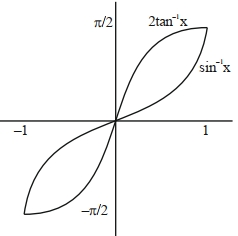
View full question & answer→MCQ 791 Mark
If $S=\left\{x \in R : \sin ^{-1}\left(\frac{x+1}{\sqrt{x^2+2 x+2}}\right)-\sin ^{-1}\left(\frac{x}{\sqrt{x^2+1}}\right)=\frac{\pi}{4}\right\}$
then $\sum_{x \in R }\left(\sin \left(\left(x^2+x+5\right) \frac{\pi}{2}\right)-\cos \left(\left(x^2+x+5\right) \pi\right)\right)$ is equal to $........$.
Answerc
$\sin ^{-1}\left(\frac{(x+1)}{\sqrt{(x+1)^2+1}}\right)-\sin ^{-1}\left(\frac{x}{\sqrt{x^2+1}}\right)=\frac{\pi}{4}$
$\because \frac{t}{\sqrt{t^2+1}} \in(-1,1)$
$\quad \sin ^{-1}\left(\frac{(x+1)}{\sqrt{(x+1)^2+1}}\right)=\sin ^{-1}\left(\frac{x}{\sqrt{x^2+1}}\right)+\frac{\pi}{4}$
$\frac{(x+1)}{\sqrt{(x+1)^2+1}}=\left(\frac{1}{\sqrt{2}}\right) \cos \left(\sin ^{-1}\left(\frac{x}{\sqrt{x^2+1}}\right)\right)+\frac{1}{\sqrt{2}}\left(\frac{x}{\sqrt{x^2+1}}\right)$
$=\frac{1}{\sqrt{2}}\left(\frac{1}{\sqrt{ x ^2+1}}+\frac{ x }{\sqrt{ x ^2+1}}\right)$
$\frac{( x +1)}{\sqrt{( x +1)^2+1}}=\frac{1}{\sqrt{2}}\left(\frac{1+ x }{\sqrt{ x ^2+1}}\right)$
After solving this equation, we get
$x=-1 \text { or } x=0$
$S=\{-1,0\}$
$\sum_{x \in R }\left(\sin \left(\left(x^2+ x +5\right) \frac{\pi}{2}\right)-\cos \left(\left(x^2+ x +5\right) \pi\right)\right)$
$=\left[\sin \left(\frac{5 \pi}{2}\right)-\cos (5 \pi)\right]+\left[\sin \left(\frac{5 \pi}{2}\right)-\cos (5 \pi)\right]$
$=4$
View full question & answer→MCQ 801 Mark
If the inverse trigonometric functions take principal values, then $\cos ^{-1}\left(\frac{3}{10} \cos \left(\tan ^{-1}\left(\frac{4}{3}\right)\right)+\frac{2}{5} \sin \left(\tan ^{-1}\left(\frac{4}{3}\right)\right)\right)$ is equal to
- A
$0$
- B
$\frac{\pi}{4}$
- ✓
$\frac{\pi}{3}$
- D
$\frac{\pi}{6}$
AnswerCorrect option: C. $\frac{\pi}{3}$
c
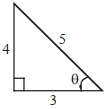
Let
$\tan ^{-1} \frac{4}{3}=\theta \Rightarrow \tan \theta=\frac{4}{3}$
$E =\cos ^{-1}\left(\frac{3}{10} \cos \theta+\frac{2}{5} \sin \theta\right)$
$=\cos ^{-1}\left(\frac{3}{10} \times \frac{3}{5}+\frac{2}{5} \cdot \frac{4}{5}\right)$
$=\cos ^{-1}\left(\frac{9}{50}+\frac{8}{25}\right)=\cos ^{-1}\left(\frac{25}{50}\right)=\cos ^{-1}\left(\frac{1}{2}\right)=\frac{\pi}{3}$
View full question & answer→MCQ 811 Mark
$\sin ^{-1}\left(\sin \frac{2 \pi}{3}\right)+\cos ^{-1}\left(\cos \frac{7 \pi}{6}\right)+\tan ^{-1}\left(\tan \frac{3 \pi}{4}\right) \quad$ is equal to
- A
$\frac{31 \pi}{12}$
- B
$\frac{17 \pi}{12}$
- ✓
$\frac{11 \pi}{12}$
- D
$-\frac{3 \pi}{4}$
AnswerCorrect option: C. $\frac{11 \pi}{12}$
c
$\sin ^{-1}\left(\sin \frac{2 \pi}{3}\right)+\cos ^{-1}\left(\cos \frac{7 \pi}{6}\right)+\tan ^{-1} \tan \left(\frac{3 \pi}{4}\right)$
$\sin ^{-1} \sin \left(\frac{2 \pi}{3}\right)=\pi-\frac{2 \pi}{3}=\frac{\pi}{3}$
$\cos ^{-1}\left(\cos \frac{2 \pi}{6}\right)=2 \pi-\frac{7 \pi}{6}=\frac{5 \pi}{6}$
$\tan ^{-1} \tan \left(\frac{3 \pi}{4}\right)=\frac{3 \pi}{4}-\pi=\frac{-\pi}{4}$
$\sin ^{-1}\left(\sin \frac{2 \pi}{3}\right)+\cos ^{-1} \cos \frac{7 \pi}{6}+\tan ^{-1} \tan \frac{3 \pi}{4}$
$=\frac{11 \pi}{12}$
View full question & answer→MCQ 821 Mark
Considering only the principal values of the inverse trigonometric functions, the domain of the function $f(x)=\cos ^{-1}\left(\frac{x^{2}-4 x+2}{x^{2}+3}\right)$ is.
- A
$\left(-\infty, \frac{1}{4}\right]$
- ✓
$\left[-\frac{1}{4}, \infty\right)$
- C
$\left(-\frac{1}{3}, \infty\right)$
- D
$\left(-\infty, \frac{1}{3}\right]$
AnswerCorrect option: B. $\left[-\frac{1}{4}, \infty\right)$
b
$\left|\frac{x^{2}+4 x+2}{x^{2}+3}\right| \leq 1$
$\left(x^{2}-4 x+2\right)^{2} \leq\left(x^{2}+3\right)^{2}$
$\left(x^{2}-4 x+2\right)^{2}-\left(x^{2}+3\right)^{2} \leq 0$
$\left(2 x^{2}-4 x+5\right)(-4 x-1) \leq 0$
$-4 x-1 \leq 0 \rightarrow x \geq-\frac{1}{4}$
View full question & answer→MCQ 831 Mark
Let $f(x)=2 \cos ^{-1} x+4 \cot ^{-1} x-3 x^{2}-2 x+10, x \in[-$ $1,1]$. If $[ a , b ]$ is the range of the function then $4 a -$ $b$ is equal to
- A
$11$
- ✓
$11-\pi$
- C
$11+\pi$
- D
$15-\pi$
AnswerCorrect option: B. $11-\pi$
b
$f^{\prime}(x)=\frac{-2}{\sqrt{1-x^{2}}}-\frac{4}{1+x^{2}}-6 x-2$
$=-2\left[\frac{1}{\sqrt{1-x^{2}}}+\frac{2}{1+x^{2}}+3 x+1\right]$
$f^{\prime}(x)<0 \Rightarrow f(x)$ is a dec. function
$f(1)=\pi+5$
$f(-1)=5 \pi+5$
Range : $[ a , b ] \equiv[\pi+5,5 \pi+5]$
$a =\pi+5, b =5 \pi+5 \Rightarrow 4 a - b =11-\pi \text {. }$
View full question & answer→MCQ 841 Mark
The value of $\tan ^{-1}\left(\frac{\cos \left(\frac{15 \pi}{4}\right)-1}{\sin \left(\frac{\pi}{4}\right)}\right)$ is equal to
- A
$-\frac{\pi}{4}$
- ✓
$-\frac{\pi}{8}$
- C
$-\frac{5 \pi}{12}$
- D
$-\frac{4 \pi}{9}$
AnswerCorrect option: B. $-\frac{\pi}{8}$
b
$\tan ^{-1}\left[\frac{\cos \left(4 \pi-\frac{\pi}{4}\right)-1}{\sin \frac{\pi}{4}}\right] \Rightarrow \tan ^{-1}\left(\frac{\cos \frac{\pi}{4}-1}{\sin \frac{\pi}{4}}\right)$
$\tan ^{-1}\left(\frac{1-\sqrt{2}}{1}\right)=-\frac{\pi}{8}$
View full question & answer→MCQ 851 Mark
$\tan \left(2 \tan ^{-1} \frac{1}{5}+\sec ^{-1} \frac{\sqrt{5}}{2}+2 \tan ^{-1} \frac{1}{8}\right)$ is equal to.
- A
$1$
- ✓
$2$
- C
$\frac{1}{4}$
- D
$\frac{5}{4}$
Answerb
$\tan \left(2\left(\tan ^{-1} \frac{1}{5}+\tan ^{-1} \frac{1}{8}\right)+\tan ^{-1}\left(\frac{1}{2}\right)\right)$
$=\tan \left[2 \tan ^{-1}\left(\frac{1}{3}\right)+\tan ^{-1}\left(\frac{1}{2}\right)\right]$
$=2$
View full question & answer→MCQ 861 Mark
$50 \tan \left(3 \tan ^{-1}\left(\frac{1}{2}\right)+2 \cos ^{-1}\left(\frac{1}{\sqrt{5}}\right)\right)+4 \sqrt{2} \tan \left(\frac{1}{2} \tan ^{-1}(2 \sqrt{2})\right)$ is equal to
Answera
$50 \tan \left(3 \tan ^{-1} \frac{1}{2}+2 \cos ^{-1} \frac{1}{\sqrt{5}}\right)+4 \sqrt{2} \tan \left(\frac{1}{2} \tan ^{-1} 2 \sqrt{2}\right)$
$=50 \tan \left(\tan ^{-1} \frac{1}{2}+2\left(\tan ^{-1} \frac{1}{2}+\tan ^{-1} 2\right)\right)+4 \sqrt{2} \tan \left(\frac{1}{2} \tan ^{-1} 2 \sqrt{2}\right)$
$\left.=50 \tan \left(\tan ^{-1} \frac{1}{2}+2 \cdot \frac{\pi}{2}\right)\right)+4 \sqrt{2} \times \frac{1}{\sqrt{2}}$
$=50\left(\tan \tan ^{-1} \frac{1}{2}\right)+4$
$=25+4=29$
View full question & answer→MCQ 871 Mark
$x * y=x^{2}+y^{3}$ and $(x * 1) * 1=x *(1 * 1)$. Then a value of $2 \sin ^{-1}\left(\frac{x^{4}+x^{2}-2}{x^{4}+x^{2}+2}\right)$ is
- A
$\frac{\pi}{4}$
- ✓
$\frac{\pi}{3}$
- C
$\frac{\pi}{2}$
- D
$\frac{\pi}{6}$
AnswerCorrect option: B. $\frac{\pi}{3}$
b
$\because( x * 1) * 1= x *(1 * 1)$
$\left(x^{2}+1\right) * 1=x *(2)$
$\left(x^{2}+1\right)^{2}+1=x^{2}+8$
$x^{4}+x^{2}-6=0 \Rightarrow\left(x^{2}+3\right)\left(x^{2}-2\right)=0$
$x^{2}=2$
$\Rightarrow 2 \sin ^{-1}\left(\frac{x^{4}+x^{2}-2}{x^{4}+x^{2}+2}\right)=2 \sin ^{-1}\left(\frac{1}{2}\right)$
$=\frac{\pi}{3}$
View full question & answer→MCQ 881 Mark
The set of all values of $k$ for which $\left(\tan ^{-1} x \right)^{3}+\left(\cot ^{-1} x \right)^{3}= k \pi^{3}, x \in R$, is the interval
- ✓
$\left[\frac{1}{32}, \frac{7}{8}\right)$
- B
$\left(\frac{1}{24}, \frac{13}{16}\right)$
- C
$\left[\frac{1}{48}, \frac{13}{16}\right]$
- D
$\left[\frac{1}{32}, \frac{9}{8}\right)$
AnswerCorrect option: A. $\left[\frac{1}{32}, \frac{7}{8}\right)$
a
Let $S =\left(\tan ^{-1} x \right)^{3}+\left(\cot ^{-1} x \right)^{3}$
$\left(\tan ^{-1} x+\cot ^{-1} x\right)-3 \tan ^{-1} x \cdot \cot ^{-1} x\left(\tan ^{-1} x+\cot ^{-1} x\right)$
$=\frac{\pi^{3}}{8}-\frac{3 \pi}{2} \tan ^{-1} x\left(\frac{\pi}{2}-\tan ^{-1} x\right)$
$=\frac{3 \pi}{2}\left(\tan ^{-1} x-\frac{\pi}{4}\right)^{2}+\frac{\pi^{3}}{32}$
$\Rightarrow \frac{\pi^{3}}{32} \leq S <\frac{7}{8} \pi^{3}$
$=\frac{\pi^{3}}{32} \leq K \pi^{3}<\frac{7}{8} \pi^{3}$
$\frac{1}{32} \leq K <\frac{7}{8}$
View full question & answer→MCQ 891 Mark
The value of $\cot \left(\sum\limits_{n=1}^{50} \tan ^{-1}\left(\frac{1}{1+n+n^{2}}\right)\right)$ is
- ✓
$\frac{26}{25}$
- B
$\frac{25}{26}$
- C
$\frac{50}{51}$
- D
$\frac{52}{51}$
AnswerCorrect option: A. $\frac{26}{25}$
a
$\tan ^{-1} \frac{1}{1+n+n^{2}}=\tan ^{-1}\left(\frac{(n+1)-n}{1+n(n+1)}\right)$
$=\tan ^{-1}(n+1)-\tan ^{-1} n$
so, $\sum\limits_{n=1}^{50}\left(\tan ^{-1}(n+1)-\tan ^{-1} n\right)$
$=\tan ^{-1} 51-\tan ^{-1} 1$
$\cot \left(\sum\limits_{n=1}^{50} \tan ^{-1}\left(\frac{1}{1+n+n^{2}}\right)\right)=\cot \left(\tan ^{-1} 51+\tan ^{-1} 1\right)$
$=\frac{1}{\tan \left(\tan ^{-1} 51-\tan ^{-1} 1\right)}=\frac{1+51 \times 1}{51-1}=\frac{52}{50}=\frac{26}{25}$
View full question & answer→MCQ 901 Mark
The value of $\lim\limits _{n \rightarrow \infty} 6 \tan \left\{\sum\limits_{r=1}^{n} \tan ^{-1}\left(\frac{1}{r^{2}+3 r+3}\right)\right\}$ is equal to
Answerc
$T_{ r }=\tan ^{-1}\left[\frac{( r +2)-( r +1)}{1+( r +2)( r +1)}\right]$
$=\tan ^{-1}( r +2)-\tan ^{-1}( r +1)$
$T _{1}=\tan ^{-1} 3-\tan ^{-1} 2$
$T _{2}=\tan ^{-1} 4-\tan ^{-1} 3$
$T _{ n }=\tan ^{-1}( n +2)-\tan ^{-1}( n +1)$
_______________________________
$S _{ n }=\tan ^{-1}( n +2)-\tan ^{-1} 2=\tan ^{-1}\left(\frac{ n +2-2}{1+2( n +2)}\right)$
$=\tan ^{-1}\left(\frac{n}{2 n+5}\right)$
$\lim\limits _{ n \rightarrow \infty} 6 \tan ^{}\left(\tan ^{-1}\left(\frac{ n }{2 n +5}\right)\right)$
$=\lim \limits_{n \rightarrow \infty} \frac{6 n}{2 n+5}=\frac{6}{2}=3$
View full question & answer→MCQ 911 Mark
Let $x =\sin \left(2 \tan ^{-1} \alpha\right)$ and $y =\sin \left(\frac{1}{2} \tan ^{-1} \frac{4}{3}\right)$. If $S =\left\{\alpha \in R : y ^{2}=1- x \right\}$, then $\sum_{\alpha \in S } 16 \alpha^{3}$ is equal to $...........$
Answerd
$\because \quad x=\sin \left(2 \tan ^{-1} \alpha\right)=\frac{2 \alpha}{1+\alpha^{2}}$
and $y=\sin \left(\frac{1}{2} \tan ^{-1} \frac{4}{3}\right)=\sin \left(\sin ^{-1} \frac{1}{\sqrt{5}}\right)=\frac{1}{\sqrt{5}}$
Now, $y^{2}=1-x$
$\frac{1}{5}=1-\frac{2 \alpha}{1+\alpha^{2}}$
$1+\alpha^{2}=5+5 \alpha^{2}-10 \alpha$
$2 \alpha^{2}-5 \alpha+2=0$
$\therefore \quad \alpha=2, \frac{1}{2}$
$\therefore \quad \sum_{\alpha \in S} 16 \alpha^{3}=16 \times 2^{3}+16 \times \frac{1}{2^{3}}$
View full question & answer→MCQ 921 Mark
If $0 < x < \frac{1}{\sqrt{2}}$ and $\frac{\sin ^{-1} x}{\alpha}=\frac{\cos ^{-1} x}{\beta}$, then a value of $\sin \left(\frac{2 \pi \alpha}{\alpha+\beta}\right)$ is$......$
- A
$4 \sqrt{\left(1-x^{2}\right)}\left(1-2 x^{2}\right)$
- ✓
$4 x \sqrt{\left(1-x^{2}\right)}\left(1-2 x^{2}\right)$
- C
$2 x \sqrt{\left(1-x^{2}\right)}\left(1-4 x^{2}\right)$
- D
$4 \sqrt{\left(1-x^{2}\right)}\left(1-4 x^{2}\right)$
AnswerCorrect option: B. $4 x \sqrt{\left(1-x^{2}\right)}\left(1-2 x^{2}\right)$
b
$\frac{\sin ^{-1} x}{\alpha}=\frac{\cos ^{-1} x}{\beta}= k$
$\sin ^{-1} x=k \alpha$
$\cos ^{-1} x=k \beta$
$k=\frac{\pi}{2(\alpha+\beta)}$
$\sin \left(\frac{2 \pi \alpha}{\alpha+\beta}\right)=\sin \left(4 \sin ^{-1} x\right)$
$=2 \sin \left(2 \sin ^{-1} x\right) \cos \left(2 \sin ^{-1} x\right)$
$=4 x \sqrt{1-x^{2}}\left(1-2 x^{2}\right)$
View full question & answer→MCQ 931 Mark
The domain of the function $f(x)=\sin ^{-1}\left[2 x^{2}-3\right]+\log _{2}\left(\log _{\frac{1}{2}}\left(x^{2}-5 x+5\right)\right)$ where $[ t ]$ is the greatest integer function, is.
- A
$\left(-\sqrt{\frac{5}{2}}, \frac{5-\sqrt{5}}{2}\right)$
- B
$\left(\frac{5-\sqrt{5}}{2}, \frac{5+\sqrt{5}}{2}\right)$
- ✓
$\left(1, \frac{5-\sqrt{5}}{2}\right)$
- D
$\left[1, \frac{5+\sqrt{5}}{2}\right)$
AnswerCorrect option: C. $\left(1, \frac{5-\sqrt{5}}{2}\right)$
c
$f(x)=\sin ^{-1}\left[2 x^{2}-3\right]+\log _{2}\left(\log _{\frac{1}{2}}\left(x^{2}-5 x+5\right)\right)$
$P_{1}:-1 \leq\left[2 x^{2}-3\right]<1$
$\Rightarrow-1 \leq 2 x ^{2}-3<2$
$\Rightarrow 2<2 x ^{2}<5$
$\Rightarrow 1< x ^{2}<\frac{5}{2}$
$\Rightarrow P _{1}: x \in\left(-\sqrt{\frac{5}{2}},-1\right) \cup\left(1, \sqrt{\frac{5}{2}}\right)$
$P_{2}: x^{2}-5 x+5>0$
$\Rightarrow\left( x -\left(\frac{5-\sqrt{5}}{2}\right)\right)\left( x -\left(\frac{5+\sqrt{5}}{2}\right)\right)>0$
$P_{3}: \log _{\frac{1}{2}}\left(x^{2}-5 x+5\right)>0$
$x ^{2}-5 x -5<1$
$x ^{2}-5 x +4<0$
$P _{3}: x \in(1,4)$
So, $P _{1} \cap P _{2} \cap P _{3}=\left(1, \frac{5-\sqrt{5}}{2}\right)$
View full question & answer→MCQ 941 Mark
Considering the principal values of the inverse trigonometric functions, the sum of all the solutions of the equation $\cos ^{-1}(x)-2 \sin ^{-1}(x)=\cos ^{-1}(2 x)$ is equal to.
- ✓
$0$
- B
$1$
- C
$\frac{1}{2}$
- D
$-\frac{1}{2}$
Answera
$\cos ^{-1} x - 2 \sin ^{-1} x=\cos ^{-1} 2 x$
$\cos ^{-1} x-2\left(\frac{\pi}{2}-\cos ^{-1} x\right)=\cos ^{-1} 2 x$
$\cos ^{-1} x-\pi+2 \cos ^{-1} x=\cos ^{-1} 2 x$
$3 \cos ^{-1} x=\pi+\cos ^{-1} 2 x$
$\cos \left(3 \cos ^{-1} x\right)=\cos \left(\pi+\cos ^{-1} 2 x\right)$
$4 x^{3}-3 x=-2 x$
$4 x^{3}=x \Rightarrow x=0, \pm \frac{1}{2}$
All satisfy the original equation
$\text { sum }=-\frac{1}{2} \text { to }+\frac{1}{2}=0$
View full question & answer→MCQ 951 Mark
The domain of the function $f(x)=\sin ^{-1}\left(\frac{x^{2}-3 x+2}{x^{2}+2 x+7}\right)$ is.
- A
$[1, \infty)$
- B
$(-1,2]$
- ✓
$[-1, \infty)$
- D
$(-\infty, 2]$
AnswerCorrect option: C. $[-1, \infty)$
c
$f(x)=\sin ^{-1}\left(\frac{x^{2}-3 x+2}{x^{2}+2 x+7}\right)$ Domain
$\frac{x^{2}-3 x+2}{x^{2}+2 x+7} \geq-1$ and $\frac{x^{2}-3 x+2}{x^{2}+2 x+7} \leq 1$
$2 x^{2}-x+9 \geq 0$ and $5 x \geq-5 \Rightarrow x \geq-1$ $x \in R$
Hence Domain $x \in[-1, \infty)$
View full question & answer→MCQ 961 Mark
For $k \in R$, let the solutions of the equation $\cos \left(\sin ^{-1}\left(x \cot \left(\tan ^{-1}\left(\cos \left(\sin ^{-1} x\right)\right)\right)\right)\right)=k, 0\,<\,|x|<\,\frac{1}{\sqrt{2}}$ be $\alpha$ and $\beta$, where the inverse trigonometric functions take only principal values. If the solutions of the equation $x ^{2}- bx -5=0$ are $\frac{1}{\alpha^{2}}+\frac{1}{\beta^{2}}$ and $\frac{\alpha}{\beta}$, then $\frac{b}{k^{2}}$ is equal to$......$
Answerc
$\cos \left(\sin ^{-1} x\right)=\cos \left(\cos ^{-1} \sqrt{1-x^{2}}\right)=\sqrt{1-x^{2}}$
$\cot \left(\tan ^{-1} \sqrt{1-x^{2}}\right)=\cot ^{-1} \cot ^{-1}\left(\sqrt{\left.\frac{1}{\sqrt{1-x^{2}}}\right)=\frac{1}{\sqrt{1-x^{2}}}}\right.$
$\cos \left(\sin ^{-1}\left(\frac{x}{\sqrt{1-x^{2}}}\right)\right)=\frac{\sqrt{1-2 x^{2}}}{\sqrt{1-x^{2}}}$
$\frac{\sqrt{1-2 x^{2}}}{\sqrt{1-x^{2}}}=k$
$1-2 x^{2}=k^{2}\left(1-x^{2}\right)$
$\left(k^{2}-2\right) x^{2}=k^{2}-1$
$\alpha=\sqrt{\frac{k^{2}-1}{k^{2}-2}} \Rightarrow \alpha^{2}=\frac{k^{2}-1}{k^{2}-2}$
$\beta=\sqrt{\frac{k^{2}-1}{k^{2}-2}} \Rightarrow \beta^{2}=\frac{k^{2}-1}{k^{2}-2}$
$\frac{1}{\alpha^{2}}+\frac{1}{\beta^{2}}=2\left(\frac{k^{2}-2}{k^{2}-1}\right) \& \frac{\alpha}{\beta}=-1$
Sum of roots $=\frac{1}{\alpha^{2}}+\frac{1}{\beta^{2}}+\frac{\alpha}{\beta}=b$
$\frac{2\left(k^{2}-2\right)}{k^{2}-1}-1=b \ldots \ldots(1)$
Product of roots $=\left(\frac{1}{\alpha^{2}}+\frac{1}{\beta^{2}}\right) \frac{\alpha}{\beta}=-5$
$\frac{2\left(k^{2}-2\right)}{k^{2}-1}(-1)=-5$
$2 k^{2}-4=5 k^{2}-5$
$3 k^{2}=1 \Rightarrow k^{2}=\frac{1}{3} \ldots$ Put in $(1)$
$b=\frac{2\left(k^{2}-2\right)}{k^{2}-1}-1=5-1=4$
$\frac{b}{k^{2}}=\frac{4}{\frac{1}{3}}=12$
View full question & answer→MCQ 971 Mark
$\operatorname{cosec}\left[2 \cot ^{-1}(5)+\cos ^{-1}\left(\frac{4}{5}\right)\right]$ is equal to ..... .
- A
$\frac{56}{33}$
- ✓
$\frac{65}{56}$
- C
$\frac{65}{33}$
- D
$\frac{75}{56}$
AnswerCorrect option: B. $\frac{65}{56}$
b
$\operatorname{cosec}\left[2 \tan ^{-1}\left(\frac{1}{5}\right)+\tan ^{-1}\left(\frac{3}{4}\right)\right]$
$\operatorname{cosec}\left[\tan ^{-1}\left(\frac{5}{12}\right)+\tan ^{-1}\left(\frac{3}{4}\right)\right]$
$=\operatorname{cosec}\left[\tan ^{-1}\left(\frac{56}{33}\right)\right]=\frac{65}{56}$
View full question & answer→MCQ 981 Mark
The value of $\tan \left(2 \tan ^{-1}\left(\frac{3}{5}\right)+\sin ^{-1}\left(\frac{5}{13}\right)\right)$ is equal to:
- A
$\frac{-291}{76}$
- B
$\frac{-181}{69}$
- C
$\frac{151}{63}$
- ✓
$\frac{220}{21}$
AnswerCorrect option: D. $\frac{220}{21}$
d
$\underbrace{\tan ^{-1} \frac{3}{5}+\tan ^{-1} \frac{3}{5}}_{\times\,>\,0, y\,>\,0, x y\,<\,1}+\tan ^{-1} \frac{5}{12}$
$\tan ^{-1} \frac{\frac{6}{5}}{1-\frac{9}{25}}=\underbrace{\tan ^{-1} \frac{15}{8}+\tan ^{-1} \frac{5}{12}}_{x\,>\,0, y\,>\,0, x y\,<\,1}$
$\tan ^{-1} \frac{\frac{15}{8}+\frac{5}{12}}{1-\frac{15}{8} \cdot \frac{5}{12}}=\tan ^{-1} \frac{220}{21}$
$\tan \left(\tan ^{-1} \frac{220}{21}\right)=\frac{220}{21}$
View full question & answer→MCQ 991 Mark
A possible value of $\tan \left(\frac{1}{4} \sin ^{-1} \frac{\sqrt{63}}{8}\right)$ is :
- ✓
$\frac{1}{\sqrt{7}}$
- B
$2 \sqrt{2}-1$
- C
$\sqrt{7}-1$
- D
$\frac{1}{2 \sqrt{2}}$
AnswerCorrect option: A. $\frac{1}{\sqrt{7}}$
a
Let $\frac{1}{4} \sin ^{-1} \frac{\sqrt{63}}{8}=\theta$
$\sin 4 \theta=\frac{\sqrt{63}}{8}$
$\cos 4 \theta=\frac{1}{8}$
$2 \cos ^{2} 2 \theta-1=\frac{1}{8}$
$\cos ^{2} 2 \theta=\frac{9}{16}$
$\cos 2 \theta=\frac{3}{4}$
$2 \cos ^{2} \theta-1=\frac{3}{4}$
$\cos ^{2} \theta=\frac{7}{8}$
$\cos \theta=\frac{\sqrt{7}}{2 \sqrt{2}}$
$\tan \theta=\frac{1}{\sqrt{7}}$
View full question & answer→MCQ 1001 Mark
$\cos ^{-1}(\cos (-5))+\sin ^{-1}(\sin (6))-\tan ^{-1}(\tan (12))$ is equal to :
(The inverse trigonometric functions take the principal values)
- A
$3 \pi-11$
- B
$4 \pi-9$
- ✓
$4 \pi-11$
- D
$3 \pi+1$
AnswerCorrect option: C. $4 \pi-11$
c
$\cos ^{-1}(\cos (-5))+\sin ^{-1}(\sin (6))-\tan ^{-1}(\tan (12))$
$\Rightarrow(2 \pi-5)+(6-2 \pi)-(12-4 \pi)$
$\Rightarrow 4 \pi-11$
View full question & answer→