Questions

2 Marks

🎯

Test yourself on this topic

37 questions · timed · auto-graded

Question 12 Marks
What is the maximum value of the function sin x + cos x?
Answer
Let f(x) = sin x + cos x,
$\Rightarrow$ f'(x) = cos x - sin x
Now, f'(x) = 0
$\Rightarrow$ cos x - sin x = 0
$\Rightarrow$ cos x = sin x
$\Rightarrow$ tan x = 1
$\Rightarrow \mathrm{x}=\frac{\pi}{4}, \frac{5 \pi}{4}, \ldots$ 
Now, 
If f''(x) will be negative when (sin x + cos x) > 0, means both sin x and cos x are positive.
And, we know that sin x and cos x both are positive in the first quadrant.
Then, f''(x) will be negative when $\mathrm{x} \in\left(0, \frac{\pi}{2}\right)$.
f''(x) = -sin x - cos x = -(sin x + cos x)
Now, let us take x = $\frac{\pi}{4}$ 
$f^{\prime \prime}\left(\frac{\pi}{4}\right)=-\left(\frac{1}{\sqrt{2}}+\frac{1}{\sqrt{2}}\right)=-\frac{2}{\sqrt{2}}=-\sqrt{2}<0$ 
Then, by second derivative test,
f will be maximum at $x=\frac{\pi}{4}$ 
And, the maximum value of f is
$f\left(\frac{\pi}{4}\right)=\sin \frac{\pi}{4}+\cos \frac{\pi}{4}=\frac{1}{\sqrt{2}}+\frac{1}{\sqrt{2}}=\sqrt{2}$
View full question & answer
Question 22 Marks
At what points in the interval [0, 2$\pi$], does the function sin 2x attain its maximum value?
Answer
Given that f(x) = sin 2x, $x \in[0,2 \pi]$ 
$f^\prime$(x) = 2 cos 2x
Now, f'(x) = 0
$\Rightarrow$ cos 2x = 0
$\Rightarrow$ 2x = 0
$\Rightarrow x=\frac{\pi}{4}, \frac{3 \pi}{4}, \frac{5 \pi}{4}, \frac{7 \pi}{4}$ 
Now, we evaluate the value of f at critical point $x=\frac{\pi}{4}, \frac{3 \pi}{4}, \frac{5 \pi}{4}, \frac{7 \pi}{4}$ and at end points of the interval [0, 2$\pi$]
$f\left(\frac{\pi}{4}\right)=\sin \frac{\pi}{2}=1$ 
$f\left(\frac{3 \pi}{4}\right)=\sin \frac{3 \pi}{2}=-1$ 
$f\left(\frac{5 \pi}{4}\right)=\sin \frac{5 \pi}{2}=1$ 
$f\left(\frac{7 \pi}{4}\right)=\sin \frac{7 \pi}{2}=-1$ 
f(0) = sin 0, and  f(2$\pi$) = sin 4$\pi$ = 0
Therefore, the absolute maximum value of f on $[0,2 \pi]$ is 1 occuring at $x=\frac{\pi}{4}$ and $x=\frac{5 \pi}{4}$.
View full question & answer
Question 32 Marks
Find both the maximum value and minimum value of $3{x^4} - 8{x^3} + 12{x^2} - 48x + 25$ on the interval [0, 3].
Answer
Let $f(x) = 3{x^4} - 8{x^3} + 12{x^2} - 48x + 25$ on [0, 3]
$\therefore f'\left( x \right) = 12{x^3} - 24{x^2} + 24x - 48$
Now $f'\left( x \right) = 0$
$\Rightarrow 12{x^3} - 24{x^2} + 24x - 48 = 0$
$\Rightarrow {x^3} - 2{x^2} + 2x - 4 = 0$
$\Rightarrow \left( {x - 2} \right)\left( {{x^2} + 2} \right) = 0$
$\Rightarrow x = 2$ or $x = \pm \sqrt 2 $ 
Since $x = \pm \sqrt 2 $ is irrational, therefore it is rejected.
$\therefore x = 2$ is turning point.
$\therefore$  At $x = 2,f\left( 2 \right) = 3\left( {16} \right) - 8\left( 8 \right) + 12\left( 4 \right) - 48\left( 2 \right) + 25 = - 39$ 
At x = 0 f(0) = 25 
At x = 3, $f\left( 3 \right) = 3\left( {81} \right) - 8\left( {27} \right) + 12\left( 9 \right) - 48\left( 3 \right) + 25 = 16$ 
Therefore, absolute minimum value is - 39 and absolute maximum value is 25.
View full question & answer
Question 42 Marks
Find the maximum profit that a company can make, if the profit function is given by
p(x) = 41 – 72x – 18x2
Answer
The profit function is, p(x) = 41 - 72x - 18x2 
$\Rightarrow$ p'(x) = -72 - 36x and p''(x) = -36
Now, p'(x) = 0
$\Rightarrow$ 72 = -36x
$\Rightarrow x=\frac{-72}{36}$ 
$\Rightarrow$ x = -2
p''(-2) = -36 < 0
Then, by second derivative test, x = -2 is point of local maxima of p.
So, the local maximum value is
p(-2) = 41 - 72(-2) - 18(-2)2 
= 44 + 144 - 72
= 113
Therefore, the maximum profit that the company can make is 113 units.
View full question & answer
Question 52 Marks
Find the absolute maximum value and the absolute minimum value of the function:
$f(x)=(x-1)^{2}+3, x \in[-3,1]$
Answer
Given that $f(x)=(x-1)^{2}+3, x \in[-3,1]$ 
$\Rightarrow$ f'(x) = 2(x - 1)
Now, f'(x) = 0
$\Rightarrow$ 2(x - 1) = 0
$\Rightarrow$ x = 1
Now, we evaluate the value of 'f ' at critical point x = 1, and at end points of the interval [-3, 1].
f(1) = (1 - 1)2 + 3 = 0 + 3 = 3
f(-3) = (-3 - 1)2 + 3 = 16 + 3 = 19
Therefore, the absolute maximum value of f on [-3, 1] is 19 occuring at x = -3.
And  the absolute minimum value of f on [-3, 1] is 3 occurring at x = 1.
View full question & answer
Question 62 Marks
Find the absolute maximum value and the absolute minimum value of the function:
$f(x)=4 x-\frac{1}{2} x^{2}, x \in\left[-2, \frac{9}{2}\right]$
Answer
Given that $f(x)=4 x-\frac{1}{2} x^{2}, x \in\left[-2, \frac{9}{2}\right]$ 
$\Rightarrow f^{\prime}(x)=4-\frac{1}{2}(2 x)=4-x$ 
Now, f'(x) = 0
$\Rightarrow$ x = 4
Now, we evaluate the value of f at critical point x = 0 and at end points of the interval $\left[-2, \frac{9}{2}\right]$ 
$f(4)=16-\frac{1}{2}(16)=16-8=8$ 
$f(-2)=-8-\frac{1}{2}(4)=-8-2=-10$
$\mathrm{f}\left(\frac{9}{2}\right)=4\left(\frac{9}{2}\right)-\frac{1}{2}\left(\frac{9}{2}\right)^{2}=18-\frac{81}{8}=18-10.125=7.875$ 
Therefore, the absolute maximum value of f on $\left[-2, \frac{9}{2}\right]$ is 8 occurring at x = 4
And, the absolute minimum value of f on $\left[-2, \frac{9}{2}\right]$ is -10 occurring at x = -2
View full question & answer
Question 72 Marks
Find the absolute maximum value and the absolute minimum value of the function:
f(x) = sin x + cos x , x $\in$ [0, $\pi$]
Answer
It is given that f(x) = sin x + cos x, $x \in[0, \pi]$ 
f'(x) = cos x - sin x
Now, f'(x) = 0
$\Rightarrow$ cos x - sin x = 0
$\Rightarrow$ cos x = sin x 
$\Rightarrow$ tan x = 1
$\Rightarrow x=\frac{\pi}{4}$ 
Now, we evaluate the value of 'f ' at critical point $x=\frac{\pi}{4}$ and at end points of the interval [0, $\pi$]
$f\left(\frac{\pi}{4}\right)=\sin \frac{\pi}{4}+ \cos \frac{\pi}{4}=\left(\frac{1}{\sqrt{2}}+\frac{1}{\sqrt{2}}\right)=\frac{2}{\sqrt{2}}=\sqrt{2}$
f(0) = sin 0 + cos 0 = 0 + 1 = 1
$f(\pi)=\sin \pi+\cos \pi=0-1=-1$ 
Therefore, the absolute maximum value of f on $[0, \pi]$ is $\sqrt{2}$ occuring at $x=\frac{\pi}{4}$ 
And, the absolute minimum value of f on $[0, \pi]$ is -1 occurring at x = $\pi$ 
View full question & answer
Question 82 Marks
Find the absolute maximum value and the absolute minimum value of the function:
f(x) = x3, x $\in$ [-2, 2]
Answer
It is given that f(x) = x3, x $\in$ [-2, 2]
$\Rightarrow$ f'(x) = 3x2
Now, f'(x) = 0
$\Rightarrow$ x = 0
Further, we evaluate the value of f at critical point x = 0 and at end points of the interval [-2, 2].
f(0) = 0
f(-2) = (-2)3 = -8 
f(2) = (2)3 = 8
Therefore, the absolute maximum value of f on [-2, 2] is 8 occurring at x = 2
And, the absolute minimum value of f on [-2, 2] is -8 occurring at x = -2
View full question & answer
Question 92 Marks
Prove that the function does not have maxima or minima: h(x) = x3 + x2 + x +1
Answer
h(x) = x3 + x2 + x + 1
$\Rightarrow$ h'(x) = 3x2 + 2x + 1 
h(x) = 0
$\Rightarrow$ 3x2 + 2x + 1 = 0
$\Rightarrow \mathrm{x}=\frac{-2 \pm 2 \sqrt{2} \mathrm{i}}{6}$ 
$\Rightarrow \frac{-1 \pm \sqrt{2} i}{3}, \notin R$ 
Therefore, there does not exist c $\in$ R such that h'(c) = 0, i.e, there are no  real critical points.
Hence, function h does not have maxima or minima.
View full question & answer
Question 102 Marks
Prove that the function does not have maxima or minima: g(x) = log x
Answer
g(x) = log x
$\Rightarrow g^{\prime}(x)=\frac{1}{x}$ 
Since, log x is defined for a positive number x,
g'(x) > 0 for any x.
Therefore, there does not exist c $\in$ R such that f'(c) = 0
Hence, function f does not have maxima or minima.
View full question & answer
Question 112 Marks
Prove that the function does not have maxima or minima: f(x) = ex 
Answer
f(x) = ex 
$\Rightarrow$ f'(x) = e
Now, if f'(x) = 0, then ex = 0 
But, the exponential function can never assume 0 for any value of x.
Therefore, there does not exist c $\in$ R such that f'(c) = 0
Hence, function f does not have maxima or minima.
View full question & answer
Question 122 Marks
Find the local maxima and local minima, of function. Find also the local maximum and the local minimum value, as the case may be: f(x) = x2
Answer
f(x) = x2
$\Rightarrow$ f'(x) = 2x
Now, f'(x) = 0
$\Rightarrow$ x = 0
$\Rightarrow$ x = 0 is the only critical point which could possibly be the point of local maxima or local minima of f.
$\Rightarrow f^{\prime \prime}(0)=2$, which is positive.
Then, by second derivative test,
$\Rightarrow$ x = 0 is point of local minimum of f and value of 'f ' at x = 0 is f(0) = 0
View full question & answer
Question 132 Marks
Find the maximum and minimum value of, h(x) = x + 1, x $\in$ (-1, 1)
Answer
It is given that h(x) = x + 1, x $\in$ (-1, 1)
Now, if a point x0 is closest to -1, then,
We find $\frac{x_{0}}{2}+1<x_{0}+1$ for all x0 $\in$ (-1, 1)
Also, if a point x1 is closest to 1, then,
We find $\mathrm{x}_{1}+1<\frac{\mathrm{x}_{1}} 2+1$ for all x1 $\in$ (-1, 1)
Therefore, the function h(x) has neither maximum nor minimum value in (-1, 1).
View full question & answer
Question 142 Marks
Find the maximum and minimum value, f(x) = |sin 4x + 3|
Answer
It is given that f(x) = |sin 4x + 3|
Now, we can see that $-1 \leq \sin 4 x \leq 1$ 
$\Rightarrow 2 \leq \sin 4 x+3 \leq 4$ 
$\Rightarrow 2 \leq|\sin 4 x+3| \leq 4$ 
Therefore, the maximum and minimum value of function h are 4 and 2 respectively.
View full question & answer
Question 152 Marks
Find the maximum and minimum value of, h(x) = sin(2x) + 5
Answer
It is given that h(x) = sin(2x) + 5
Now, we can see that $-1 \leq \sin 2 x \leq 1$ 
$\Rightarrow-1+5 \leq \sin 2 x+5 \leq 1+5$ 
$\Rightarrow 4 \leq \sin 2 x+5 \leq 6$ 
Therefore, the maximum and minimum value of function h are 6 and 4 respectively.
View full question & answer
Question 162 Marks
Find the maximum and minimum value, g(x) = -|x + 1| + 3
Answer
It is given that g(x) = -|x + 1| + 3
Now, we can see that -|x + 1| $\le$ 0 for every x $\in$ R
$\Rightarrow g(x)=-|x+1|+3 \leq 3$ for every x $\in$ R
The maximum value of f is attained when |x + 1| = 0
|x + 1| = 0
$\Rightarrow x=-1$ 
Then, Maximum value of g = g(-1) = -|-1 + 1| + 3 = 3
Therefore, function f does not have a minimum value.
View full question & answer
Question 172 Marks
Find the maximum and minimum value, f(x) = |x + 2| - 1
Answer
It is given that f(x) = |x + 2| - 1
Now, we can see that |x + 2| $\ge$ 0 for every x $\in$ R
$\Rightarrow f(x)=|x+2|-1 \geq-1$ for every x $\in$ R
Clearly, the minimum value of f is attained when |x + 2| = 0
i.e, |x + 2| = 0
$\Rightarrow$ x = -2
Then, Minimum value of f = f(-2) = |-2 + 2| - 1 = -1
Therefore, function f does not have a maximum value.
View full question & answer
Question 182 Marks
Find the maximum and minimum value, g(x) = x3 + 1
Answer
It is given that g(x) = x3 + 1
Now,
x $\in$ R
$\Rightarrow-\infty \leq x \leq \infty$ 
$\Rightarrow-\infty \leq x^{3} \leq \infty$ 
$\Rightarrow-\infty \leq x^{3}+1 \leq \infty$ 
The function g neither has a maximum value nor a minimum value.
View full question & answer
Question 192 Marks
Find the maximum and minimum value, f(x) = -(x - 1)2 + 10 
Answer
It is given that f(x) = -(x - 1)2 + 10
Now, we can see that (x - 1)2 $\ge$ 0 for every x $\in$ R
$\Rightarrow$ f(x) = -(x - 1)2 + 10 $\le$ 10 for every x $\in$ R
The maximum value of f is attained when x - 1 = 0
i.e,  x - 1 = 0
$\Rightarrow$   x = 1
Then, Maximum value of f = f(1) = -(1 - 1)2 + 10 = 10
Since, x = 1 is the only critical point,
Therefore, function f does not have a minimum value.
View full question & answer
Question 202 Marks
Find the maximum and minimum values of x + sin 2x on [0, 2$\pi$].
Answer
It is given that f(x) = x + sin x, $x \in[0,2 \pi]$ 
f'(x) = 1 + 2cos 2x
Now, f'(x) = 0
$\Rightarrow \cos 2 \mathrm{x}=-\frac{1}{2}=-\cos \frac{\pi}{3}=\cos \left(\pi-\frac{\pi}{3}\right)=\cos \frac{2 \pi}{3}$ 
$2 x=2 \pi \pm \frac{2 \pi}{3}, n \in Z$ 
$\Rightarrow x=n \pi \pm \frac{\pi}{3}, n \in Z$ 
$\Rightarrow \mathrm{x}=\frac{\pi}{3}, \frac{2 \pi}{3}, \frac{4 \pi}{3}, \frac{5 \pi}{3} \in[0,2 \pi)$ 
Now, we evaluate the value of f at critical point $\mathrm{x}=\frac{\pi}{3}, \frac{2 \pi}{3}, \frac{4 \pi}{3}, \frac{5 \pi}{3}$ and at end points of the interval $[0,2 \pi]$ 
$f^{\prime}\left(\frac{\pi}{3}\right)=\frac{\pi}{3}+\sin \frac{2 \pi}{3}=\frac{\pi}{3}+\frac{\sqrt{3}}{2}$ 
$f^{\prime}\left(\frac{2 \pi}{3}\right)=\frac{2 \pi}{3}+\sin \frac{4 \pi}{3}=\frac{2 \pi}{3}-\frac{\sqrt{3}}{2}$,
$f^{\prime}\left(\frac{4 \pi}{3}\right)=\frac{4 \pi}{3}+\sin \frac{8 \pi}{3}=\frac{4 \pi}{3}+\frac{\sqrt{3}}{2}$ 
$f^{\prime}\left(\frac{5 \pi}{4}\right)=\frac{5 \pi}{3}+\sin \frac{10 \pi}{3}=\frac{5 \pi}{3}-\frac{\sqrt{3}}{2}$ 
f'(0) = 0 + sin 0 = 0
$f^{\prime}(2 \pi)=2 \pi+\sin 4 \pi=2 \pi+0=2 \pi$ 
Therefore, we have the absolute maximum value of f on $[0,2 \pi]$ is $2 \pi$ occurring at x = $2\pi$ and absolute minimum value of f(x) in the interval $[0,2 \pi]$ is 0 occurring at x = 0.
View full question & answer
Question 212 Marks
Find the maximum and minimum value, f(x) = 9x2 + 12x + 2
Answer
It is given that f(x) = 9x2 + 12x + 2 = (3x + 2)2 - 2 
Now, we can see that (3x + 2)2 $\ge$ 0 for every x $\in$ R
$\Rightarrow$ f(x) = (3x + 2)2 - 2 $\ge$ -2 for every x $\in$ R
The minimum value of f is attained when 3x + 2 = 0
3x + 2 = 0
$\Rightarrow \mathrm{x}=-\frac{2}{3}$ 
Then, Minimum value of $f=f\left(-\frac{2}{3}\right)=\left(3\left(-\frac{2}{3}\right)+2\right)^{2}-2=-2$ 
Also, since  x = -$\frac23$, is the only critical point which is a minimum,
Therefore, function f does not have a maximum value.
View full question & answer
Question 222 Marks
It is given that at x = 1, the function ${x^4} - 62{x^2} + ax + 9$ attains its maximum value, on the interval [0, 2]. Find the value of a. 
Answer
Let f(x) = x4- 62 x2 + ax + 9

$\Rightarrow f'\left( x \right) = 4{x^3} - 124x + a$

Since, f(x) attains its maximum value at x = 1 in the interval [0, 2], therefore $f'\left( 1 \right) = 0$ 

$\therefore f'\left( 1 \right) = 4 - 124 + a = 0$

$\Rightarrow a - 120 = 0$

$\Rightarrow a = 120$

View full question & answer
Question 232 Marks
Find the maximum and minimum value, f(x) = (2x - 1)2 + 3
Answer
It is given that f(x) = (2x - 1)2 + 3
Now, we can see that (2x - 1)2 $\ge$ 0 for every x $\in$ R
$\Rightarrow$ f(x) = (2x - 1)2 + 3 $\ge$ 3 for every x $\in$ R
The minimum value of f is attained when 2x - 1 = 0
2x - 1 = 0
$\Rightarrow \mathrm{x}=\frac{1}{2}$ 
Then, Minimum value of $f=f\left(\frac{1}{2}\right)=\left(2 \cdot \frac{1}{2}-1\right)^{2}+3=3$ 
Now, f' (x) = 4x - 2 = 0, $\Rightarrow$  x = $\frac12$ is the only critical point which is a minimum.
Therefore, function f does not have a maximum value.
View full question & answer
Question 242 Marks
Find the maximum value of $2{x^3} - 24x + 107$ in the interval [1, 3]. Find the maximum value of the same function in $\left[ { - 3, - 1} \right]$
Answer
Let $f\left( x \right) = 2{x^3} - 24x + 107$

$\Rightarrow f'\left( x \right) = 6{x^2} - 24$

Now $f'\left( x \right) = 0$

$ \Rightarrow 6{x^2} - 24 = 0$

$\Rightarrow {x^2} = 4$

$\Rightarrow x = \pm 2$

$\Rightarrow x = 2$ or $x = - 2$ [Turning points]

For Interval [1, 3], x = 2 is turning point.

At x = 1, $f\left( 1 \right) = 2\left( 1 \right) - 24\left( 1 \right) + 107 = 85$ 

At x = 2, $f\left( 2 \right) = 2\left( 8 \right) - 24\left( 2 \right) + 107 = 75$

At x = 3, $f\left( 3 \right) = 2\left( {27} \right) - 24\left( 3 \right) + 107 = 89$ 

Therefore, maximum value of $f\left( x \right)$ is 89.

For Interval $\left[ { - 3, - 1} \right],x = - 2$ is turning point.

At $x = - 1,$ $f\left( 1 \right) = 2\left( { - 1} \right) - 24\left( { - 1} \right) + 107 = 129$ 

At $x = - 2,$ $f\left( 2 \right) = 2\left( { - 8} \right) - 24\left( { - 2} \right) + 107 = 139$

At $x = - 3,$ $f\left( 3 \right) = 2\left( { - 27} \right) - 24\left( { - 3} \right) + 107 = 125$ 

Therefore, maximum value of f(x) is 139.

View full question & answer
Question 252 Marks
Find the intervals in which the function f given by f(x) = 2x2 – 3x is decreasing.
Answer
It is given that function f(x) = 2x2 - 3x
$\Rightarrow$ f'(x) = 4x - 3
If f'(x) = 0, then we get,
      $x=\frac{3}{4}$ 
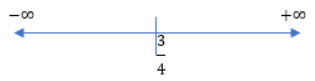
So, the point x = $\frac{3}{4}$, divides the real line into two disjoint intervals, $\left(-\infty, \frac{3}{4}\right)$ and $\left(\frac{3}{4}, \infty\right)$ 

Now, in interval $\left(-\infty, \frac{3}{4}\right)$,  f'(x) = 4x - 3 < 0
Therefore, the given function (f) is strictly decreasing in interval $\left(-\infty, \frac{3}{4}\right)$
View full question & answer
Question 262 Marks
Find the intervals in which the function f given by f(x) = 2x2 – 3x is increasing.
Answer
It is given that function, f(x) = 2x2 - 3x
$\Rightarrow$ f'(x) = 4x - 3
If f'(x) = 0, then we get,
$\mathrm{x}=\frac{3}{4}$ 
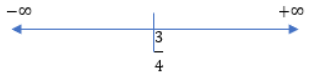
So, the point x = $\frac{3}{4}$, divides the real line into two disjoint intervals, $\left(-\infty, \frac{3}{4}\right)$ and $\left(\frac{3}{4}, \infty\right)$

So, in interval $\left(\frac{3}{4}, \infty\right)$, f'(x) = 4x -3 > 0
Therefore, the given function (f) is strictly increasing in interval $\left(\frac{3}{4}, \infty\right)$
View full question & answer
Question 272 Marks
Prove that the function f given by f (x) = log |cos x| is decreasing on $\left(0, \frac{\pi}{2}\right)$ and increasing on $\left(\frac{3 \pi}{2}, 2 \pi\right)$.
Answer
It is given that f(x) = log |cos x|
$\Rightarrow \mathrm{f}^{\prime}(\mathrm{x})=\frac{1}{\cos \mathrm{x}}(-\sin \mathrm{x})=-\tan \mathrm{x}$
In interval $\left(0, \frac{\pi}{2}\right), f^{\prime}(x)=-\tan x<0$ 
Therefore, f is strictly decreasing on $\left(0, \frac{\pi}{2}\right)$
In interval $\left(\frac{3 \pi}{2}, 2 \pi\right), f^{\prime}(x)=-\tan x>0$ 
Therefore, f is strictly increasing in $\left(\frac{3 \pi}{2}, 2 \pi\right)$.
View full question & answer
Question 282 Marks
Prove that the function f given by f(x) = log sinx is increasing on $\left( {0,\frac{\pi }{2}} \right)$ and decreasing on $\left( {\frac{\pi }{2},\pi } \right)$. 
Answer
Given: f(x) = log sin x
$\Rightarrow f'\left( x \right) = \frac{1}{{\sin x}}\frac{d}{{dx}}(\sin x) = \frac{1}{{\sin x}}\cos x = \cot x$
On the interval $\left( {0,\frac{\pi }{2}} \right)$ i.e., in first quadrant,
f'(x) = cotx > 0
Therefore, f(x) is strictly increasing on $\left( {0,\frac{\pi }{2}} \right)$.
On the interval $\left( {\frac{\pi }{2},\pi } \right)$ i.e., in second quadrant,
f'(x) = cot x < 0
Therefore, f(x) is strictly decreasing on $\left( {\frac{\pi }{2},\pi } \right)$.
View full question & answer
Question 292 Marks
Prove that the function f given by f(x) = x2 - x + 1 is neither strictly increasing nor decreasing on (-1, 1).
Answer
It is given that function f(x) = x2 - x + 1
$f'(x) = 2x - 1$
If $f'(x) = 0$, then we get
$~~~ ~~~x=\frac{1}{2}$ 
So, the point x = $\frac{1}{2}$ divides the interval (-1, 1) into two disjoint intervals, $\left(-1, \frac{1}{2}\right)$ and $\left(\frac{1}{2}, 1\right)$ 
In interval $\left(-1, \frac{1}{2}\right)$, we have
    $f'(x) = 2x - 1 < 0$
Therefore, the given function 'f 'is strictly decreasing in interval $\left(-1, \frac{1}{2}\right)$ 
Also, in interval $\left(\frac{1}{2}, 1\right)$ 
    $f'(x) = 2x - 1 > 0$
Hence, the given function 'f ' is strictly increasing in interval for $\left(\frac{1}{2}, 1\right)$.
Therefore, f is neither strictly increasing nor decreasing in interval (-1, 1).
View full question & answer
Question 302 Marks
Prove that the logarithmic function is increasing on $(0, \infty)$.
Answer
The given function is f(x) = log x
$\Rightarrow$ f'(x) = $\frac{1}{x}$,.
Clearly, for x > 0,
     f'(x) = $\frac{1}{x}$ > 0
Therefore, f(x) = log x is strictly increasing in interval $(0, \infty)$
View full question & answer
Question 312 Marks
The radius of a circle is increasing at the rate of 0.7 cm/s. What is the rate of increase of its circumference?
Answer
Let x cm be the radius and y be the circumference of the circle at any time t. 
Rate of increase of radius of circle = 0.7 cm/sec
$\Rightarrow \frac{{dx}}{{dt}}$ is positive and = 0.7 cm/sec
$ \Rightarrow \frac{{dx}}{{dt}}$ = 0.7 cm / sec ...(i)
$ \Rightarrow y = 2\pi x$
$\therefore$ Rate of change of circumference of circle $ = \frac{{dy}}{{dt}}$
$ = 2\pi \frac{d}{{dt}}x = 2\pi \left( {0.7} \right)$ (from (i))
= 1.4$\pi$cm/sec
View full question & answer
Question 322 Marks
A stone is dropped into a quiet lake and waves move in circles at the speed of 5 cm/s. At the instant when the radius of the circular wave is 8 cm, how fast is the enclosed area increasing?
Answer
Let x cm be the radius and y be the enclosed area of the circular wave at any time t.
Rate of increase of radius of circular wave = 5 cm/sec
$\Rightarrow \frac{{dx}}{{dt}}$ is positive and = 5 cm/sec
$\Rightarrow \frac{{dx}}{{dt}} = 5cm/\sec$ ...(i)
$y = \pi {x^2}$
$\therefore $ Rate of change of area $ = \frac{{dy}}{{dt}} = \pi \frac{d}{{dt}}{x^2}$ 

$ = \pi .2x\frac{{dx}}{{dt}} = 2\pi x\left( 5 \right)$(from (i)

$= 10\pi xc{m^2}/\sec$

Putting $x = 8cm$(given),

$\frac{{dy}}{{dt}} = 10\pi \left( 8 \right) = 80\pi c{m^2}/\sec$

Since $\frac{{dy}}{{dt}}$ is positive, therefore area of circular wave is increasing at the rate of $80\pi c{m^2}/\sec $.

View full question & answer
Question 332 Marks
An edge of a variable cube is increasing at the rate of 3 cm per second. How fast is the volume of the cube increasing when the edge is 10 cm long?
Answer
Let x cm be the edge and y be the volume of the variable cube at any  time t. 

Rate of increase of edge = 3 cm/sec

$ \Rightarrow \frac{{dx}}{{dt}}$ is positive and = 3 cm/sec

$ \Rightarrow \frac{{dx}}{{dt}} = 3cm/\sec $...(i)

$\Rightarrow y = {x^3}$

$\therefore$ Rate of change of volume of cube $= \frac{{dy}}{{dt}} = \frac{d}{{dt}}{x^3}$ 

$= 3{x^2}\frac{{dx}}{{dt}} = 3{x^2}\left( 3 \right)$ [from (1)]

$= 9{x^2}c{m^3}/\sec$

Putting x = 10cm (given),

$\frac{{dy}}{{dt}} = 9{\left( {10} \right)^2} = 900c{m^3}/\sec $

Since $\frac{{dy}}{{dt}}$ is positive, therefore volume of cube is increasing at the rate of 900 cm3/sec.

View full question & answer
Question 342 Marks
The radius of a circle is increasing uniformly at the rate of 3 cm/s. Find the rate at which the area of the circle is increasing when the radius is 10 cm.
Answer
Suppose r cm be the radius and A be the area of the circle at any time t.
Rate of increase of radius of circle = 3 cm/sec
$\Rightarrow \frac{{dr}}{{dt}}$ is positive and = 3 cm/sec
$\frac{{dr}}{{dt}} = 3$….(i)
Now, $A = \pi {r^2}$
$\therefore $ Rate of change of area of circle $= \frac{{dA}}{{dt}} = \pi 2r\frac{{dr}}{{dt}}$
$ \Rightarrow \pi 2r\left( 3 \right) = 6\pi rc{m^2}/\sec $ (from (i))
Substituting r = 10 cm (given),we get
$\frac{{dA}}{{dt}} = 6\pi \left( {10} \right) = 60\pi c{m^2}/\sec $
Since $\frac{{dA}}{{dt}}$ is positive, thus surface area is increasing at the rate of $60\pi c{m^2}/\sec $
View full question & answer
Question 352 Marks
The volume of a cube is increasing at the rate of 8 cm3/sec. How fast is the surface area increasing when the length of an edge is 12 cm?
Answer
Let x cm be the edge of the cube and y be the surface area of the cube at any time t

Given: Rate of increase of volume of cube $ = 8c{m^3}/\sec $

$ \frac{d}{{dt}}\left( {{x^3}} \right)$ = 8             

$ \Rightarrow 3{x^2}\frac{{dx}}{{dt}} = 8$

$ \Rightarrow \frac{{dx}}{{dt}} = \frac{8}{{3{x^2}}}$ ...(i)

$y = 6{x^2}$

$\therefore$  Rate of change of surface area of the cube $= \frac{{dy}}{{dt}} = 6\frac{d}{{dt}}{x^2}$ 

$= 6\left( {2x\frac{{dx}}{{dt}}} \right)$

$ = 12x\left( {\frac{8}{{3{x^2}}}} \right)$ [from (1)]

$= 4\left( {\frac{8}{x}} \right) = \frac{{32}}{x}c{m^2}/\sec$

Putting x = 12 cm (given),

$\frac{{dy}}{{dt}} = \frac{{32}}{{12}} = \frac{8}{3}c{m^2}\sec $

Since $\frac{{dy}}{{dt}}$  is positive, therefore surface area is increasing at the rate of $\frac{8}{3}c{m^2}/\sec $

View full question & answer
Question 362 Marks
A particle moves along the curve 6y = x3 + 2. Find the points on the curve at which the y-coordinate is changing 8 times as fast as the x – coordinate.
Answer
Given curve is 6y = x3 + 2 ...(i)
so, $6\frac{{dy}}{{dt}} = 3{x^2}\frac{{dx}}{{dt}}$
$\Rightarrow6 \times 8\frac{{dx}}{{dt}} = 3{x^2}\frac{{dx}}{{dt}}\,\,\left[ {\because \frac{{dy}}{{dt}} = 8\frac{{dx}}{{dt}}} \right]$
$\Rightarrow16 = {x^2}$
$\Rightarrow x = \pm 4$
Put the value of x in equation (1)
When x = 4
6y = ( 4 )3 + 2
$\Rightarrow$ 6y = 64 + 2
$\Rightarrow$ 6y = 66
$\therefore$  $y = \frac{{66}}{6} = 11$
So, point is (4, 11)
Now, When $$x = - 4
6y = ( - 4}3 + 2
= - 64 + 2
$\therefore$  $y = \frac{{ - 62}}{6}= \frac{-31}{3}$
So the point is $\left( { - 4,\frac{{ - 31}}{3}} \right)$
View full question & answer
Question 372 Marks
A ladder 5 m long is leaning against a wall. The bottom of the ladder is pulled along the ground, away from the wall, at the rate of 2cm/s. How fast is its height on the wall decreasing when the foot of the ladder is 4 m away from the wall?
Answer
$\frac{{dx}}{{dt}} = 2cm/s$ 
$\frac{{dx}}{{dt}} = 0.02m/\sec $ 
${x^2} + {y^2} = {5^2}$ 
$2x\frac{{dy}}{{dt}} + 2y\frac{{dy}}{{dt}} = 0$ 
When x = 4
$y = \sqrt {{5^2} - {4^2}} $ = 3
$2 \times 4\left( {0.02} \right) + 2 \times 3\frac{{dy}}{{dt}} = 0$ 
$\frac{{dy}}{{dt}} = \frac{{2 \times 4 \times 0.02}}{{2 \times 3}}$ 
$= - \frac{{0.08}}{3} \times {100}$ 
$ = - \frac{8}{3}cm/\sec $
View full question & answer
2 Marks - Maths STD 12 Science Questions - Vidyadip