Questions · Page 2 of 5

M.C.Q (1 Marks)

MCQ 511 Mark
If the constraints in a linear programming problem are changed
  • A
    the problem is to be re-evaluated
  • B
    solution is not defined
  • C
    the objective function has to be modified
  • D
    the change in constraints is ignored
Answer
  1. the problem is to be re-evaluated

Solution:

The optimisation of the objective function of a LPP is governed by the constraints.

Therefore, if the constraints in a linear programming problem are changed, then the problem needs to be re-evaluated.
View full question & answer
MCQ 521 Mark
Z = 20x1 + 20x2, subject to $\text{x}1\geq0,\text{x}_{2}\geq0,\text{x}_{1}+2\text{x}_{2}\geq8,3\text{x}_{1}+2\text{x}_{2}\geq15,5\text{x}_{1}+2\text{x}_{2}\geq20.$ The minimum value of Z occurs at
  • A
    $(8, 0)$
  • B
    $\Big(\frac{5}{2},\frac{15}{4}\Big)$
  • C
    $\Big(\frac{7}{2},\frac{9}{4}\Big)$
  • D
    $(0, 10)$
Answer
  1. $\Big(\frac{7}{2},\frac{9}{4}\Big)$
View full question & answer
MCQ 531 Mark
Objective of linear programming for an objective function is to:
  • A
    Maximize or minimize.
  • B
    Subset or proper set modeling.
  • C
    Row or column modeling.
  • D
    Adjacent modeling.
Answer
  1. Maximize or minimize.

Solution:

In linear programming, the objective function is the linear equation which is representing some quantity (such as profit gained, cost, ...) which is to be maximized or minimized subject to the given constraints.

View full question & answer
MCQ 541 Mark
The corner points of the feasible region determined by the system of linear constraints are (0, 10),(5, 5),(15, 15),(0, 20). Let z = px + qy where p, q > 0. Condition on p and q so that the maximum of z occurs at both the points (15, 15) and (0, 20) is __________:
  • A
    q = 2p
  • B
    p = 2p
  • C
    p = q
  • D
    q = 3p
Answer
  1. q = 3p

Solution:

Let z0​ be the maximum value of z in the feasible region.

Since maximum occurs at both (15, 15) and (0, 20)$, the value z0​ is attained at  both (15, 15) and (0, 20).

⟹ z0​ = p(15) + q(15) and z0​ = p(0) + q(20)

⟹ p(15) + q(15) = p(0) + q(20)

⟹ 15p = 5q

⟹ 3p = q

View full question & answer
MCQ 551 Mark
The ratio of the rate of flow of water in pipes varies inversely as the square of the radius of the pipes. What is the ratio of the rates of flow in two pipes diameters 2cm and 4cm?
  • A
    1 : 6
  • B
    1 : 4
  • C
    1 : 2
  • D
    3 : 1
Answer
  1. 1 : 4

Solution:

Given: d1 ​= 2cm

d2​ = 4cm

Since the diameter are 2cm and 4cm.

The replacement ratio of the two pipes are 1cm and 2cmr1 ​= 1cm

r2​ = 2cm


Square of the ratio of the pipes are 1 and 4

$\therefore$ The ratio of rates of flow in two pipes $=1:\frac{1}{4}$

$\Rightarrow\frac{1}{4}$

View full question & answer
MCQ 561 Mark
The corner points of the feasible region are A(0, 0), B(16, 0), C(8, 16) and D(0, 24). The minimum value of the objective function z = 300x + 190y is _______.
  • A
    5440
  • B
    4800
  • C
    4560
  • D
    0
Answer
  1. 0

Solution:

We know that, for a cartesian polygon, the maximum value occurs at the corner points or vertices of the polygon.

Given z = 300x + 190y

By substituting A(0, 0) in the equation we get z = 0

By substituting B(16, 0) in the equation we get z = 4800

By substituting C(8,16) in the equation we get z = 5440

By substituting D(0, 24) in the equation we get z = 4560

Hence the minimum value of Z occured at C(0, 0) with z = 0

View full question & answer
MCQ 571 Mark
If a = b then ax = ...........
  • A
    b + x
  • B
    bx
  • C
    b - x
  • D
    b ÷ x
Answer
  1. bx

Solution:

Given, a = b Multiplying both sides by x.

ax = bx.

View full question & answer
MCQ 581 Mark
In order to maximize the profit of the company, the optimal solution of which of the following equations is required?
  • A
    P = x + y - 200
  • B
    P = 5y - 2x
  • C
    P = y - 80
  • D
    P = 200 - x
Answer
  1. P = 5y - 2x

Solution:

Let the number of normal calculators produced in a day be x andthe number of scientific calculators produced in a day be y the minimum of total calculators to be produced per day is 200

$\Rightarrow\text{x}+\text{y}\leq200$

Given, the minimum number of normal calculators to be produced per day is 100

$\Rightarrow\text{x}\geq100$

andthe minimum number of scientific calculators to be produced per day is 80

 $\Rightarrow\text{y}\geq80$

Also given, the maximum number of normal calculators can be produced per day is 200

$\Rightarrow\text{x}\leq200$

 andthe maximum number of scientific calculators can be produced per day is 170

$\Rightarrow\text{x}\leq170$

A normal calculator incurred a loss of Rs. 2

For x normal calculators, the loss is Rs. 2x

A scientific calculator gained a profit of Rs. 5

For xy scientific calculators, the gain is Rs. 5y

Therefore, profit of the manufacturer P = 5y - 2x.

View full question & answer
MCQ 591 Mark
Corner points of the bounded feasible region for an LP problem are A(0, 5) B(0, 3) C(1, 0) D(6, 0). Let z = -50x + 20y be the objective function. Minimum value of z occurs at ______ center point.
  • A
    (0, 5)
  • B
    (1, 0)
  • C
    (6, 0)
  • D
    (0, 3)
Answer
  1. (6, 0)

Solution:

We check the value of the z at each of the corner points.

A (0, 5) -z = -50x + 20y = -50(0) + 20(5) = 100

At B (0, 3) -z = -50x + 20y = -50(0) + 20(3) = 60

At C (1, 0) -z = -50x + 20y = -50(1) + 20(0) = -50

At D (6, 0) -z = -50x + 20y = -50(6) + 20(0) = -300

Hence, we see that z is minimum at D(6, 0) and minimum value is -300.

View full question & answer
MCQ 601 Mark
If A = {1, 2, 3}; B = {3, 4, 5}; C = {4, 6}, then $\text{A}\times(\text{B}\cap\text{C})=?$
  • A
    {(2, 4)(1, 4)}
  • B
    {(2, 4)(3, 4)(5, 6)}
  • C
    {(1, 4)(2, 4)(3, 4)}
  • D
    None of these
Answer
  1. {(1, 4)(2, 4)(3, 4)}

Solution:

Given,

A = {1, 2, 3}

B = {3, 4, 5}

C = {4, 6}

Now, $\text{B}\cap\text{C}=\{{4\}}$

$\therefore\text{A}\times(\text{B}\cap\text{C})=\{(1,4),(2,4),(3,4)\}$

View full question & answer
MCQ 611 Mark
Corner points of the feasible region determined by the system of linear constraints are (0, 3), (1, 1) and (3, 0). Let Z = px + qy, where p, q > 0. Condition on p and q so that the minimum of Z occurs at (3, 0) and (1, 1) is:
  • A
    $\text{p}=2\text{q}$
  • B
    $\text{p}=\frac{\text{q}}{2}$
  • C
    $\text{p}=3\text{q}$
  • D
    $\text{p}=\text{q}$
Answer
  1. $\text{p}=\frac{\text{q}}{2}$
View full question & answer
MCQ 621 Mark
In an LPP, if the objective function Z = ax + by has the same maximum value on two corner points of the feasible region, then the number of points of which Zmax occurs is:
  • A
    0
  • B
    2
  • C
    Finite
  • D
    Infinite
Answer
  1. Infinite
View full question & answer
MCQ 631 Mark
The given table shows the number of cars manufactured in four different colours on a particular day. Study it carefully and answer the question.
 
Number of cars manufactured
Colour
Vento
Creta
WagonR
Red
65
88
93
White
54
42
80
Black
66
52
88
Sliver
37
49
74
What was the total number of black cars manufactured?
  • A
    240
  • B
    206
  • C
    205
  • D
    159
Answer
  1. 206

Solution:

The number of Black cars manufactured.

= no. of black V ento + no. of black Creta + no. of black W agon R.

= 66 + 52 + 88 = 206

View full question & answer
MCQ 641 Mark
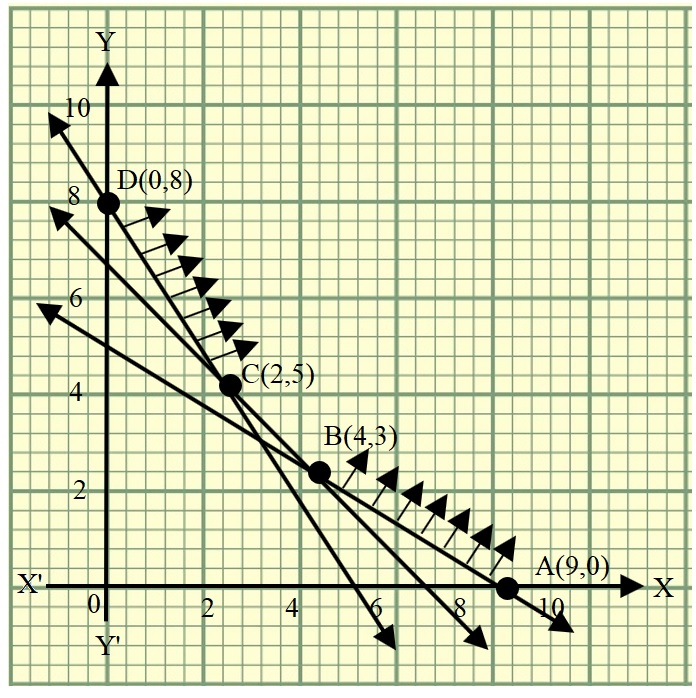
Feasible region (shaded) for a LPP is shown in the given figure. Minimum of z = 4x + 3y occurs at the point.

  • A
    (0, 8)
  • B
    (2, 5)
  • C
    (4, 3)
  • D
    (9, 0)
Answer
  1. (2, 5)
View full question & answer
MCQ 651 Mark
The corner points of the feasible region determined by the system of linear constraints are (0, 10), (5, 5), (25, 20) and (0, 30). Let Z = px + qy, where p, q > 0. Condition on p and q so that the maximum of Z occurs at both the points (25, 20) and (0, 30) is _______.
  • A
    5p = 2q
  • B
    2p = 5q
  • C
    p = 2q
  • D
    q = 3p
Answer
  1. 5p = 2q

Solution:

Maximum of Z occurs at (25, 20) and at (0, 30).

Hence, equating the vales of Z at these points, we get 25p + 20q = 30q

$\therefore$ 5p = 2q

This is the required relation.

Also as p, q > 0, the value of Z is always positive and hence, is greater at (25, 20) and at (0, 30) than at (0,10) and (5, 5).

View full question & answer
MCQ 661 Mark
Which of the termis not used in a linear programming problem:
  • A
    Slack inequation
  • B
    Objective function
  • C
    Concave region
  • D
    Feasible Region
Answer
  1. Concave region
View full question & answer
MCQ 671 Mark
The region represented by the inequalities $\text{x}\geq6,\text{y}\geq2,2\text{x}+\text{y}\leq0,\text{x}\geq0,\text{y}\geq{0}$ is:
  • A
    Unbounded
  • B
    A polygon
  • C
    Exterior of a triangle
  • D
    None of these
Answer
  1. None of these
View full question & answer
MCQ 681 Mark
If $\text{x}+\text{y}\leq2,$ $\text{x}\leq0,$ $\text{y}\leq0$ the point at which maximum value of 3x + 2y attained will be.
  • A
    $(0,0)$
  • B
    $\Big(\frac{1}{2},\frac{1}{2}\Big)$
  • C
    $(0,2)$
  • D
    $(2,0)$
Answer
  1. $(0,0)$

Solution:

$\text{x}\leq0$ and $\text{y}\leq0$ represents third Quadrant $\text{x}+\text{y}\leq2$ represents the region below the line $\text{x}+\text{y}\leq2$ (the region which contains origin)

The common region of given set of equations is third quadrant (including negative x axis and negative y axis)

Since x and y values are $\leq0$ in the third quadrant, the maximum value of 3x + 2y occurs at x = 0 and y = 0 and the maximum value is 0.

View full question & answer
MCQ 691 Mark
Choose the correct answer from the given four options.

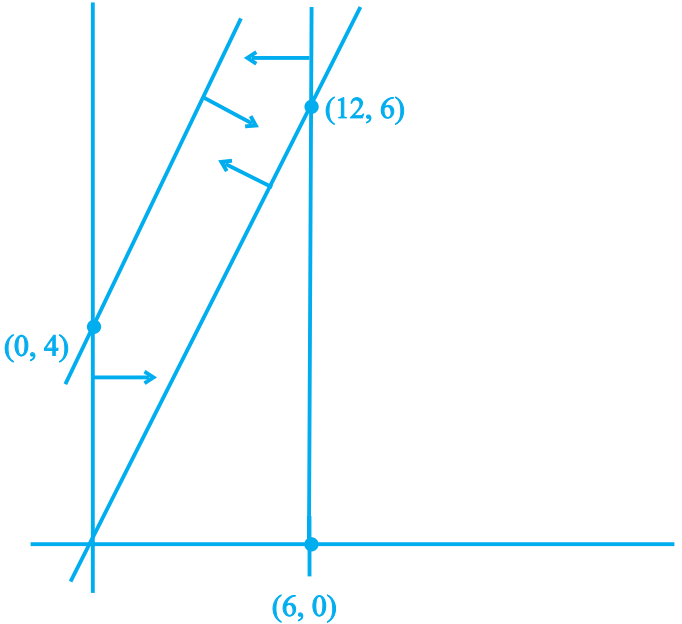
Let F = 3x - 4y be the objective function. Maximum value of F is:

  • A
    0.
  • B
    8.
  • C
    12.
  • D
    -18.
Answer
  1. 12.

Solution:

The feasible region as shown in the figure, has objective function F = 3x - 4y

Corner points
Corresponding value of Z = 3x - 4y
(0, 0)
(12, 6)
(0, 4)
0
12 (maximum)
-16 (minimum)

Hence, the maximum value of F is 12.

View full question & answer
MCQ 701 Mark
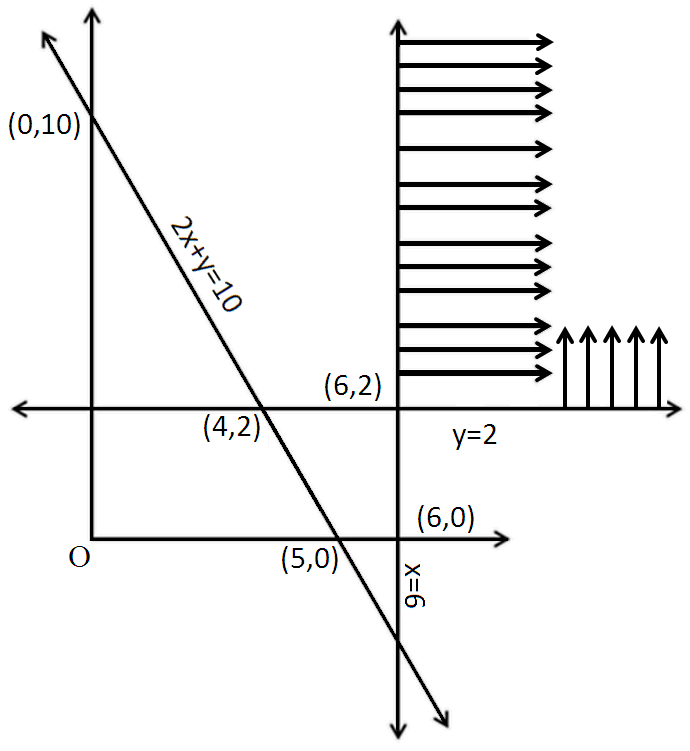
In solving the LPP: “minimize f = 6x + 10y subect to constraints $\text{x}\geq6,\text{y}\geq2,2\text{x}+\text{y}\geq10,\text{x}\geq0,\text{y}\geq0$” redundant constraints are:
  • A
    $\text{x}\geq6,\text{y}\geq2$
  • B
    $2\text{x}+\text{y}\geq10,\text{x}\geq0,\text{y}\geq0$
  • C
    $\text{x}\geq6$
  • D
    $\text{None of these}$
Answer
  1. $2\text{x}+\text{y}\geq10,\text{x}\geq0,\text{y}\geq0$
View full question & answer
MCQ 711 Mark
Consider the objective function Z = 40x + 50y The minimum number of constraints that are required to maximize Z are:
  • A
    4
  • B
    2
  • C
    3
  • D
    1
Answer
  1. 3

Solution:

Since in the given function Z = 40x + 50y, two variables are used.

So, the two constraints will be $\text{x}\geq0,\text{y}\geq0$ and the third one will be of the type

$\text{ax}+\text{by}\geq\text{c}.$

Hence, at least 3 constraints are required.

View full question & answer
MCQ 721 Mark
Consider a LPP given by
Minimum Z = 6x + 10y
Subjected to x ≥ 6, y ≥ 2, 2x + y ≥ 10, x ≥ 0, y ≥ 0
Redundant constraints in this LPP are
  • A
    x ≥ 0, y ≥ 0
  • B
    x ≥ 6
  • C
    2x + y ≥ 10
  • D
    none of these
Answer
  1. 2x + y ≥ 10

Solution:

Consider, x = 6

and y = 2

Now 2x + y = 10

x
y
(x, y)
0
10
(0, 10)
5
0
(5, 0)


Minimum Z will be at 2x + y ≥ 10.

View full question & answer
MCQ 731 Mark
Conclude from the following: n2 > 10, and n is a positive integer. A: n3 B: 50.
  • A
    The quantity A is may be greater or smaller than B.
  • B
    The quantity B is greater than A.
  • C
    The two quantities are equal.
  • D
    The relationship cannot be determined from the information given.
Answer
  1. The quantity A is may be greater or smaller than B.

Solution:

given, n2 > 10 and n > 0 multiplying both equations we get n3 > 0

so, it may be greater than or less than 50.

Hence, quantity A is may be greater or smaller than B

View full question & answer
MCQ 741 Mark
If x + y = 3 and xy = 2, then the value of x3 - y3 is equal to.
  • A
    6
  • B
    7
  • C
    8
  • D
    0
Answer
  1. 7

Solution:

Formula used:

$\text{x}^3-\text{y}^3=(\text{x}-\text{y})(\text{x}^2+\text{xy}+\text{y}^2)$

$=(\sqrt{(\text{x}+\text{y})^{2}-4\text{xy}})[(\text{x}+\text{y})^{2}-\text{xy}]$

$=(\sqrt{(3)^{2}-4(2})[(3)^{2}-2]$

$=(\sqrt{1})(7)=7$

View full question & answer
MCQ 751 Mark
The maximum value of Z = 3x + 4y subjected to contraints $\text{x}+\text{y}\leq40,\text{x}+2\text{y}\leq60,\text{x}\geq0$ and $\text{y}\geq0$ is:
  • A
    120
  • B
    140
  • C
    100
  • D
    160
Answer
  1. 140
View full question & answer
MCQ 761 Mark
An iso-profit line represents:
  • A
    An infinite number of solutions all of which yield the same profit.
  • B
    An infinite number of solution all of which yield the same cost.
  • C
    An infinite number of optimal solutions.
  • D
    A boundary of the feasible region.
Answer
  1. An infinite number of solutions all of which yield the same profit.

Solution:

The graph of the profit function is called an iso profit line. It is called this because iso means same or equal and the profit anywhere on the line is the same.

So, an iso-profit lines represents an infinite number of solutions all of which yield the same profit.

View full question & answer
MCQ 771 Mark
The corner points of the feasible region are A(0, 0), B(16, 0), C(8, 16) and D(0, 24). The minimum value of the objective function z = 300x + 190y is _______:
  • A
    5440
  • B
    4800
  • C
    4560
  • D
    0
Answer
  1. 0

Solution:

We know that, for a cartesian polygon , the maximum value occurs at the corner points or vertices of the polygon.

Given z = 300x + 190y

By substituting A(0, 0) in the equation we get z = 0

By substituting B(16, 0) in the equation we get z = 4800

By substituting C(8, 16) in the equation we get z = 5440

By substituting D(0, 24) in the equation we get z = 4560

Hence the minimum value of Z occured at C(0, 0) with z = 0

View full question & answer
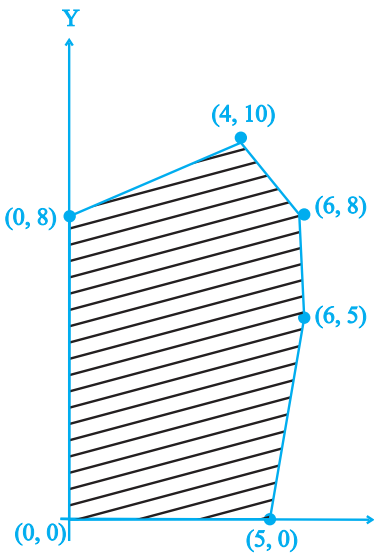
MCQ 781 Mark
Choose the correct answer from the given four options.
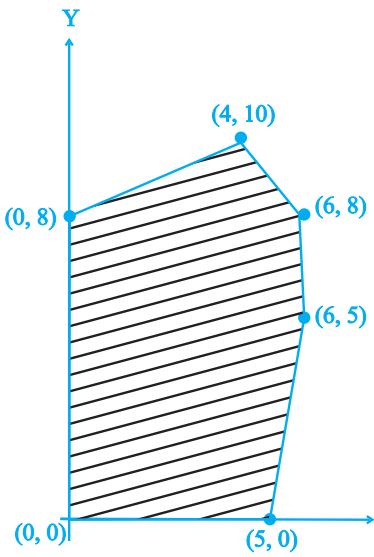
The feasible solution for a LPP is shown in. Let Z = 3x - 4y be the objective function.

Minimum of Z occurs at:
  • A
    (0, 0)
  • B
    (0, 8)
  • C
    (5, 0)
  • D
    (4, 10)
Answer
  1. (0, 8)

Solution:

Corner points
Corresponding value of Z = 3x - 4y
(0, 0)
(5, 0)
(6, 5)
(6, 8)
(4, 10)
(0, 8)
0
15 - 2
-14
-28
-32 (Minimum)

Hence, the minimum of Z occurs at (0, 8) and its minimum value is (-32).

View full question & answer
MCQ 791 Mark
Region represented by $\text{x}\geq0, \text{y}\geq0$ is:
  • A
    First quadrant
  • B
    Second quadrant
  • C
    Third quadrant
  • D
    Fourth quadrant
Answer
  1. First quadrant

Solution:

 All the positive values of x and y will lie in the first quadrant.

View full question & answer
MCQ 801 Mark
Vikas printing company takes fee of Rs. 28 to print a oversized poster and Rs. 7 for each colour of ink used. Raaj printing company does the same work and charges poster for Rs. 34 and Rs. 5.50 for each colour of ink used. If z is the colours of ink used, find the values of z such that Vikas printing company would charge more to print a poster than Raaj printing company.
  • A
    $\text{z}<4$
  • B
    $2\leq\text{z}\leq4$
  • C
    $4\leq\text{z}\leq7$
  • D
    $\text{z}>4$
Answer
  1. $\text{z}>4$

Solution:

$28+7\text{z}>34+5.50\text{z}$

$\rightarrow1.50\text{z}>6$

$\rightarrow\text{z}>\frac{6}{1.5}\text{z}>4$

View full question & answer
MCQ 821 Mark
If two constraints do not intersect in the positive quadrant of the graph, then.
  • A
    The problem is infeasible
  • B
    The solution is unbounded
  • C
    One of the constraints is redundant
  • D
    None of the above
Answer
  1. The problem is infeasible

Solution:

Any linear programming problem must have the following properties:-1.

The relationship between variables and constraints must be linear2.

The constraints must be non - negative.3.. objective function must be linear.

Non - negativity conditions are used because the variables cannot take negative values.

i.e., it is not possible to have negative resources (land, capital, labour cannot be negative).

Because of the non - negativity condition, the feasible region exists only in I quadrant.

View full question & answer
MCQ 831 Mark
Which of the following is an essential condition in a situation for linear programming to be useful?
  • A
    Linear constraints
  • B
    Bottlenecks in the objective function
  • C
    Non - homogeneity
  • D
    Uncertainty
Answer
  1. Linear constraints

Solution:

For linear programming, the constraints must be linear.

View full question & answer
MCQ 841 Mark
Z = 4x1 + 5x2, subject to $2\text{x}_{1}+\text{x}_{2}\geq7,2\text{x}_{1}+3\text{x}2\leq15,\text{x}_{2}\leq3,\text{x}_{1},\text{x}_{2}\geq0.$ The minimum value of Z occurs at:
  • A
    (3.5, 0)
  • B
    (3, 3)
  • C
    (7.5, 0)
  • D
    (2, 3)
Answer
  1. (3.5, 0)
View full question & answer
MCQ 851 Mark
The feasible region for a LPP is shown shaded in the figure. Let Z = 3x - 4y be the objective function. Minimum of Z occurs at.

  • A
    (0, 0)
  • B
    (0, 8)
  • C
    (5, 0)
  • D
    (4, 10)
Answer
  1. (0, 8)
View full question & answer
MCQ 861 Mark
If $\text{a},\text{b},\text{c}\in+\text{R}$ such that $\lambda\text{ abc}$ is the minimum value of a(b2 + c2) + b(c2 + a2) + c(a2 + b2), then $\lambda=$
  • A
    1
  • B
    3
  • C
    4
  • D
    None of the above.
Answer
  1. None of the above.

Solution:

We know that $ \text{A}.\text{M}.\geq\text{G}.\text{M}.$

Therefore, $ \frac{{\text{b}^2+\text{c}^2}​}{2}\geq\sqrt{\text{b}^2\text{c}^2}​$

$\Rightarrow\text{b}^{2}+\text{c}^{2}\geq2\text{bc}$

Multiplying a on both sides doesn’t change the inequality.

Since, given that a is positive.

$\Rightarrow\text{a}(\text{b}^{2}+\text{c}^{2})\geq2\text{abc}\ ...(1)$

Similarly, $\text{b}(\text{a}^{2}+\text{c}^{2})\geq2\text{abc}\ ...(2)$

and $\text{c}(\text{a}^{2}+\text{c}^{2})\geq2\text{abc}\ ...(3)$

adding (1), (2) and (3) we get

$\text{a}(\text{b}^{2}+\text{c}^{2})+\text{b}(\text{a}^{2}+\text{c}^{2})+\text{c}(\text{a}^{2}+\text{b}^{2})\geq2\text{abc}+2\text{abc}+2\text{abc}$

$\Rightarrow\text{a}(\text{b}^{2}+\text{c}^{2})+\text{b}(\text{a}^{2}+\text{b}^{2})+\text{c}(\text{a}^{2}+\text{b}^{2})\geq6\text{abc}$

Therefore $\lambda$ is 6

View full question & answer
MCQ 871 Mark
The maximum value of f = 4x + 3y subject to constraints $\text{x}\geq0,$ $\text{y}\geq0,$ $2\text{x}+3\text{y}\leq18;\text{x}+\text{y}\geq10$ is:
  • A
    35
  • B
    36
  • C
    34
  • D
    None of these
Answer
  1. None of these
View full question & answer
MCQ 881 Mark
In Graphical solution the redundant constraint is:
  • A
    Which forms the boundary of feasible region.
  • B
    Which do not optimizes the objective function.
  • C
    Which does not form boundary of feasible region.
  • D
    Which optimizes the objective function.
Answer
  1. Which does not form boundary of feasible region.

Solution:

A constraint in an LP model becomes redundant when the feasible region doesnt change by the removing the constraint.

For example, $2\text{x}+\text{y}\geq10$ and $6\text{x}+3\text{y}\geq30$ are constraints.

$6\text{x}+3\text{y}\geq30$

$\Rightarrow3\times(2\text{x}+\text{y})\geq3\times10$

$\Rightarrow2\text{x}+\text{y}\geq10$

 which is same as the first constraint.

Therefore, $6\text{x}+3\text{y}\geq30$  can be removed.

By removing this constraint the feasible region doesnt change.

If the boundary of the feasible region is removed then feasible solution set changes.

Hence, redundant constraint cannot be the boundary of the feasible region.

View full question & answer
MCQ 891 Mark
z = 10x + 25y subject to $0\leq\text{X}\leq3$ and $0\leq\text{X}\leq3,$ $\text{x}+\text{y}\leq5$ then the maximum value of z is:
  • A
    80
  • B
    95
  • C
    30
  • D
    75
Answer
  1. 95

Solution:

The end points of the figure which forms as per the given condition are (0, 0), (3, 0), (0, 3), (3, 2), (2, 3) We check the value of z at these points.

At (0, 3), z = 0 + 75 = 75 At (3, 0), z = 30 + 0 = 30 At (0, 0), z = 0 At (3, 2), z = 30 + 50 = 80 At (2, 3), z = 20 + 75 = 95

Therefore, the maximum value of z turns out to be 95.

View full question & answer
MCQ 901 Mark
If the constraints in linear programming problem are changed.
  • A
    The problem is to be re - evaluated
  • B
    Solution is not defined
  • C
    The objective function has to be modified
  • D
    The change in constraints is ignored
Answer
  1. The problem is to be re - evaluated

Solution:

The above question asks for the impact of change in constraints on the Linear programming problem.

In this scenario, when there is a change in constraint, the solution will change definitely.

Whether the solution exists or not, we can only find once the problem is re - evaluated.

In an LPP, the objective function is related to the main objective of any problem, either we have to maximize or minimize the function based on the situation whereas the constraints is related to physical restrictions in achieving the defined objective function.

In real life problems, there might be situations when the constraints change, but objective function does not changes to accommodate the change in constraints.

Thus, if constraints in linear programming problem is changed, the problem has to be re - evaluated for the same objective function and after solving we can find whether the solution exists or not.

View full question & answer
MCQ 911 Mark
Choose the correct answer from the given four options.
Corner points of the feasible region determined by the system of linear constraints are (0, 3), (1, 1) and (3, 0). Let Z = px + qy, where p, q > 0. Condition on p and q so that the minimum of Z occurs at (3, 0) and (1, 1) is:
  • A
    p = 2q
  • B
    $\text{p}=\frac{\text{q}}{2}$
  • C
    p = 3q
  • D
    p = q
Answer
  1. $\text{p}=\frac{\text{q}}{2}$

Solution:

Corner point
Corresponding value of X = px + qy; p,q > 0
(0, 3)
3q
(1, 1)
p + q
(3, 0)
3p

So, condition of p and q, so that the minimum of Z occurs at (3, 0) and (1, 1) is,

p + q = 3p

⇒ 2p = q

$\therefore\text{p}=\frac{\text{q}}{2}$

View full question & answer
MCQ 921 Mark
The corner points of the feasible region determined by the system of linear constraints are (0, 10), (5, 5), (15, 15), (0, 20). Let z = px + qy where p, q > 0. Condition on p and q so that the maximum of z occurs at both the points (15, 15) and (0, 20) is __________.
  • A
    q = 2p
  • B
    p = 2p
  • C
    p = q
  • D
    q = 3p
Answer
  1. q = 3p

Solution:

Since Z occurs maximum at (15, 15) and (0, 20)

Therefore, 15p + 15q = 0.p + 20q

⇒ q = 3p.

View full question & answer
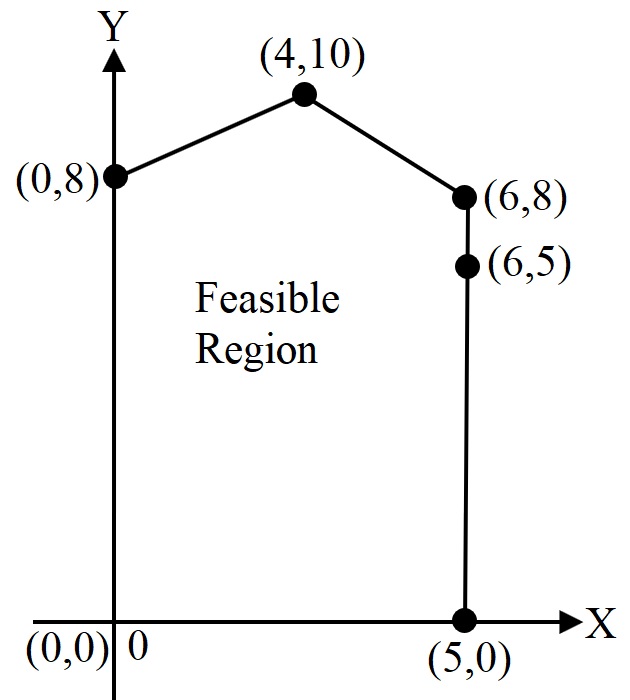
MCQ 931 Mark
The feasible solution for a LPP is shown in the following figure. Let Z = 3x - 4y be the objective function.

Minimum of Z occurs at:

  • A
    (0, 0)
  • B
    (0, 8)
  • C
    (5, 0)
  • D
    (4, 10)
Answer
  1. (0, 8)
View full question & answer
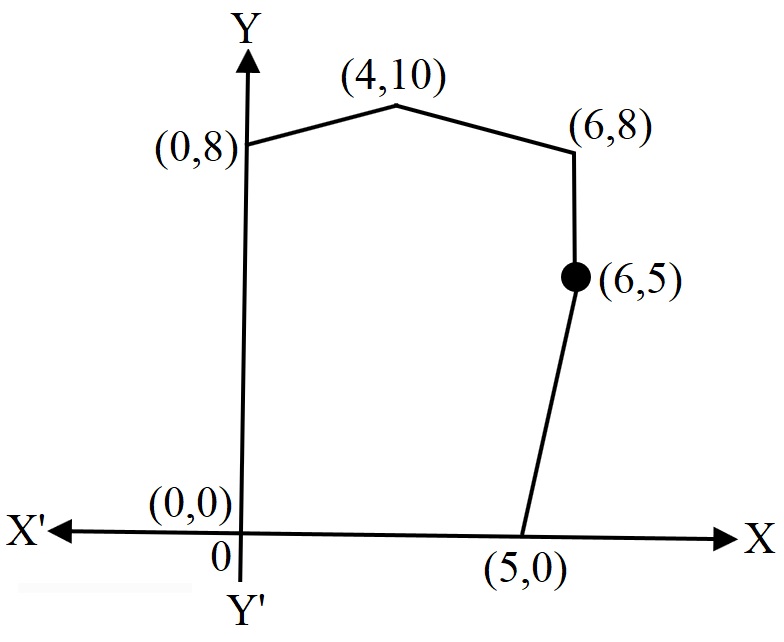
MCQ 941 Mark
Choose the correct answer from the given four options.

The feasible solution for a LPP is shown in. Let Z = 3x - 4y be the objective function.

Maximum of Z occurs at:

  • A
    (5, 0)
  • B
    (6, 5)
  • C
    (6, 8)
  • D
    (4, 10)
Answer
  1. (5, 0)

Solution:

Corner points
Corresponding value of Z = 3x - 4y
(0, 0)
(5, 0)
(6, 5)
(6, 8)
(4, 10)
(0, 8)
0
15 (Maxmimum)
-2
-14
-28
-32

Hence, maximum of Z occurs at (5, 0) and its maximum value is 27.

View full question & answer
MCQ 951 Mark
The point which does not lie in the half - plane 2x + 3y -12 < 0 is:
  • A
    (2, 1)
  • B
    (1, 2)
  • C
    (-2, 3)
  • D
    (2, 3)
Answer
  1. (2, 3)

Solution:

By putting the value of point (2, 3) in 2x + 3y - 12, we get;

2(2) + 3(3) = -12

= 4 + 9 - 12

= 13 - 12

= 1 which is greater than 0.

View full question & answer
MCQ 961 Mark
The minimum value of Z = 3x + 5y subjected to constraints $\text{x}+3\text{y}\geq3,\text{x}+\text{y}\geq2,\text{x},\text{y}\geq0$ is:
  • A
    5
  • B
    7
  • C
    10
  • D
    11
Answer
  1. 7

Solution:

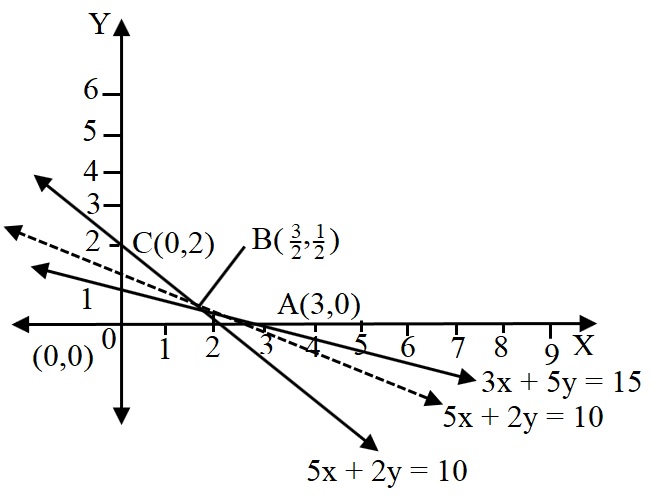
The feasible region determined by the system of constraints, $\text{x}+3\text{y}\geq3,\text{x}+\text{y}\geq2,$ and $\text{x},\text{y}\geq0$ is given below

It can be seen that the feasible region is unbounded.

The corner points of the feasible region are A(3, 0), $ \text{B}\Big(\frac{3}{2},\frac{1}{2}\Big)$ and C(0, 2)

The values of Z at these corner points are given below

Corner point
z = 3x + 5y
 
A (3, 0)
9
 
$ \text{B}\Big(\frac{3}{2},\frac{1}{2}\Big)$
7
Smallest
C (0, 2)
10
 

7 may or may not be the minimum value of Z because the feasible region is unbounded

For this purpose, we draw the graph of the inequality, 3x + 5y < 7 and check the resulting half - plane have common points with the feasible region or not.

Hence, it can be seen that the feasible region has no common point with 3x + 5y < 7.

Thus, the minimum value of Z is 7 at point $ \text{B}\Big(\frac{3}{2},\frac{1}{2}\Big).$

View full question & answer
MCQ 971 Mark
The number of points in $(-\infty,\infty)$ for which $\text{x}^{2}-\text{x}\sin\text{x}-\cos\text{x}=0,$ is:
  • A
    6
  • B
    4
  • C
    2
  • D
    None of the above
Answer
  1. 2

Solution:

Better approch is with graphs.Considering graphs in eqaution we get

 $\text{x}^{2}-\text{x}\sin\text{x}-\cos\text{x}=0$

$\text{x}^{2}=\text{x}\sin\text{x}+\cos\text{x}$

Let  $\text{f}(\text{x})=\text{x}^{2},\text{g}(\text{x})=\text{x}\sin\text{x}+\cos\text{x}$

Using graphical methods,we can do the graph of f(x) and g(x)

The graph f(x) and g(x) intersects at two points between $(-\infty,\infty)$

View full question & answer
MCQ 981 Mark
In linear programming, objective function and objective constraints are:
  • A
    Solved
  • B
    Linear
  • C
    Quadratic
  • D
    Adjacent
Answer
  1. Linear

Solution:

In linear programming, objective function and objective constraints are linear.

Any linear programming problem must have the following properties:-1.

The relationship between variables and constraints must be linear 2.

The constraints must be non - negative.3.. objective function must be linear.

View full question & answer
MCQ 991 Mark
The maximum value of Z = 3x + 4y subjected to constraints $\text{x}+\text{y}\leq4,\text{x}\geq0$ and $\text{y}\geq0$ is:
  • A
    12
  • B
    14
  • C
    16
  • D
    None of the above
Answer
  1. 16

Solution:

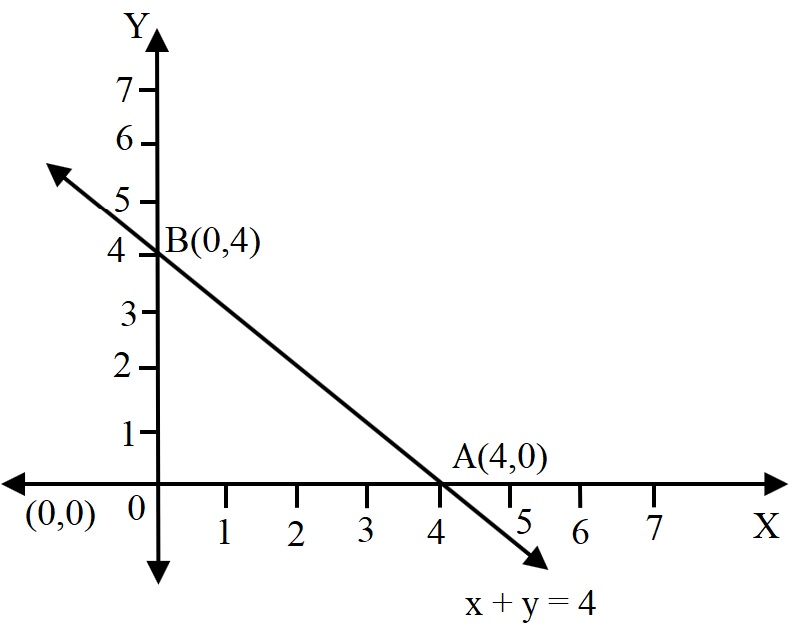
 The feasible region determined by the constraints, $\text{x}+\text{y}\leq4,\text{x}\geq0,$ $\text{y}\geq0,$ is given below

O (0, 0), A (4, 0), and B (0, 4) are the corner points of the feasible region. The values of Z at these points are given below:

Corner Point
z = 3x + 4y
O(0, 0)
0
A(4, 0)
12
B(0, 4)
16

Hence, the maximum value of Z is 16 at point B (0, 4)

View full question & answer
MCQ 1001 Mark
In transportation models designed in linear programming, points of demand is classified as:
  • A
    Ordination
  • B
    Transportation
  • C
    Destinations
  • D
    Origins
Answer
  1. Destinations

Solution:

In linear programming, transportation modeltransportation model are applied to problems related to the study of efficient transportation routes.

i.e., how effectively the available resources are transported to different destinations with minimum cost.

Therefore, the points of demand is classified as destinations.

View full question & answer