MCQ
The number of points in $(-\infty,\infty)$ for which $\text{x}^{2}-\text{x}\sin\text{x}-\cos\text{x}=0,$ is:
  • A
    6
  • B
    4
  • C
    2
  • D
    None of the above

Answer

  1. 2

Solution:

Better approch is with graphs.Considering graphs in eqaution we get

 $\text{x}^{2}-\text{x}\sin\text{x}-\cos\text{x}=0$

$\text{x}^{2}=\text{x}\sin\text{x}+\cos\text{x}$

Let  $\text{f}(\text{x})=\text{x}^{2},\text{g}(\text{x})=\text{x}\sin\text{x}+\cos\text{x}$

Using graphical methods,we can do the graph of f(x) and g(x)

The graph f(x) and g(x) intersects at two points between $(-\infty,\infty)$

Need a full question paper?

Generate a complete, print-ready paper with questions like this in minutes — across 16+ boards, with answer keys.
Start Generating Free

Similar questions

If $A=\left[\begin{array}{cc}3 & x-1 \\ 2 x+3 & x+2\end{array}\right]$ is a symmetric matrix, then $x=$
Calculate: $\int(\text{x}^3-\frac{1}{\text{x}}+{3\text{x}})\text{dx:}$
  1. $\frac{\text{x}^{4}}{3}-\log\text{x}+\frac{\text{5x}^{2}}{2}+\text{c}$
  2. $\frac{\text{x}^{4}}{4}-\log\text{x}+\frac{\text{2x}^{2}}{3}+\text{c}$
  3. $\frac{\text{x}^{4}}{4}-\log\text{x}+\frac{\text{3x}^{2}}{4}+\text{c}$
  4. $\frac{\text{x}^{4}}{4}-\log\text{x}+\frac{\text{3x}^{2}}{2}+\text{c}$
Let $a, b$ and $c$ denote the outcome of three independent rolls of a fair tetrahedral die, whose four faces are marked $1,2,3,4$. If the probability that $a x^2+b x+c=0$ has all real roots is $\frac{m}{n}$, $\operatorname{gcd}(\mathrm{m}, \mathrm{n})=1$, then $\mathrm{m}+\mathrm{n}$ is equal to ..........
Two dice are thrown simultaneously. The probability of getting a pair of aces is
If $f(x)\, = \,\left\{ {\begin{array}{*{20}{c}}{x{e^{ - \,\left( {\frac{1}{{|\,x\,|}}\, + \,\frac{1}{x}} \right)}},}&{x \ne 0}\\{0\,\,\,\,\,\,\,\,\,\,\,\,\,,}&{x = 0}\end{array}} \right.$ , then $f(x)\,$ is
$\int_{}^{} {\frac{{dx}}{{{x^2} + 2x + 2}} = } $
The maximum solution of the objective function lies :
$\int_{}^{} {\frac{{10{x^9} + {{10}^x}{{\log }_e}10}}{{{{10}^x} + {x^{10}}}}} \;dx = $
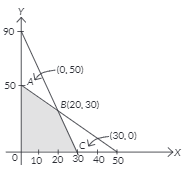
The maximum value of $Z=4 x+y$ for a L.P.P. whose feasible region is given below is:
Image
If $\triangle_1=\begin{vmatrix}1&1&1\\\text{a}&\text{b}&\text{c}\\\text{a}^2&\text{b}^2&\text{c}^2\end{vmatrix},\triangle_2=\begin{vmatrix}1&\text{bc}&\text{a}\\1&\text{ca}&\text{b}\\1&\text{ab}&\text{c}\end{vmatrix},$ then:
  1. $\triangle_1+\triangle_2=0$
  2. $\triangle_1+2\triangle_2=0$
  3. $\triangle_1=\triangle_2$
  4. None of these.