MCQ 2011 Mark
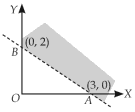
The graph of the inequality $2 x+3 y>6$ is
AnswerCorrect option: B. half plane that neither contains the origin nor the points of the line $2 x+3 y=6$.
(b) : From the graph of inequality $2 x+3 y>6$. It is clear that it does not contain the origin nor the points of the line $2 x+3 y=6$.
View full question & answer→MCQ 2021 Mark
For the following LPP, maximise $Z=3 x+4 y$ subject to constraints $x-y \geq-1, x \leq 3, x \geq 0, y \geq 0$, the maximum value is
Answer(c) : Given, $Z=3 x+4 y$
Subject to constraints, $x-y \geq-1, x \leq 3 ; x \geq 0, y \geq 0$
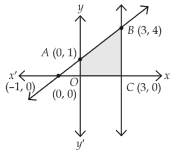
The shaded region $O A B C$ is the feasible region, where corner points are $O(0,0), A(0,1), B(3,4)$ and $C(3,0)$
At $O(0,0), Z=3(0)+4(0)=0$
At $A(0,1), Z=3(0)+4(1)=4$
At $B(3,4), Z=3(3)+4(4)=25$
At $C(3,0), Z=3(3)+4(0)=9$
$\therefore \quad$ Maximum value of $Z$ is 25 , which occurs at $B(3,4)$. View full question & answer→MCQ 2031 Mark
In an LPP, the objective function is always
MCQ 2041 Mark
Corner points of the feasible region for an LPP are $(0,2),(3,0)$, $(6,0),(6,8)$ and $(0,5)$.
Let $F=4 x+6 y$ be the objective function.
Maximum of $F$ - Minimum of $F=$
Answer(a): Max. $F-$ Min. $F=72-12=60$.
View full question & answer→MCQ 2051 Mark
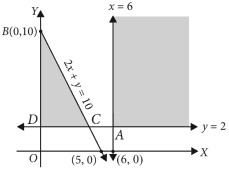
The region represented by the inequalities $x \geq 6, y \geq 2,2 x+y \leq 10, x \geq 0, y \geq 0$ is
View full question & answer→MCQ 2061 Mark
Region represented by $x \geq 0, y \geq 0$ is
View full question & answer→MCQ 2071 Mark
The optimal value of the objective function is attained at the points
- A
on $X$-axis
- B
on $Y$-axis
- ✓
which are corner points of the feasible region
- D
AnswerCorrect option: C. which are corner points of the feasible region
(c) : When we solve an L.P.P. graphically, the optimal (or optimum) value of the objective function is attained at corner points of the feasible region.
View full question & answer→MCQ 2081 Mark
A set is said to be convex if
- A
all points except the end points of the line segment inside the set lie inside the set
- B
- ✓
all points on the line segment in the set lie inside the set
- D
AnswerCorrect option: C. all points on the line segment in the set lie inside the set
View full question & answer→MCQ 2091 Mark
Which of the following term is used in a linear programming problem?
MCQ 2101 Mark
Minimize $z=\sum_{j=1}^n \sum_{i=1}^m c_{i j} x_{i j}$, subject to
$
\sum_{j=1}^n x_{i j}=a_i, i=1,2, \ldots, m \text { and } \sum_{i=1}^m x_{i j}=b_j, j=1,2, \ldots, n
$
is an L.P.P. with number of constraints
- ✓
$m+n$
- B
$m-n$
- C
$m n$
- D
$\frac{m}{n}$
View full question & answer→MCQ 2111 Mark
Corner points of the feasible region of inequalities gives
- ✓
Optimal solution of L.P.P.
- B
- C
- D
AnswerCorrect option: A. Optimal solution of L.P.P.
View full question & answer→MCQ 2121 Mark
Optimization of the objective function is a process of
- A
Maximizing the objective function
- ✓
Maximizing or minimizing the objective function
- C
Minimizing the objective function
- D
AnswerCorrect option: B. Maximizing or minimizing the objective function
View full question & answer→MCQ 2131 Mark
Which of the following points satisfies both the inequations $2 x+y \leq 10$ and $x+2 y \geq 8$ ?
Answer(d): We have, $2 x+y \leq 10$ and $x+2 y \geq 8$
Let us check which of the given points satisfy the given inequation one by one.
(a) $(-2,4)$
$
2 \times(-2)+4=-4+4=0 \leq 10
$
and $-2+2 \times 4=-2+8=6 \nsucceq 8$
(b) $(3,2)$
$
\begin{array}{l}
2 \times 3+2=6+2=8 \leq 10 \\
3+2 \times 2=3+4=7 \nsucceq 8
\end{array}
$
(c) $(-5,6)$
$
\begin{array}{l}
2 \times(-5)+6=-10+6=-4 \leq 10 \\
-5+2 \times 6=-5+12=7 \nsucceq 8
\end{array}
$
(d) $(4,2)$
$
2 \times 4+2=10 \leq 10 ; 4+2 \times 2=8 \geq 8
$
$\therefore \quad(4,2)$ satisfy both the inequations.
View full question & answer→MCQ 2141 Mark
Solution set of the inequality $x \geq 0$ is
- A
half plane on the left of $Y$-axis
- B
half plane on the right of $Y$-axis excluding the points on $Y$-axis
- ✓
half plane on the right of $Y$-axis including the points on $Y$-axis
- D
AnswerCorrect option: C. half plane on the right of $Y$-axis including the points on $Y$-axis
(c) : Solution set of the given inequality is $\{(x, y): x \geq 0\}$ i.e., the set of all points whose abscissae are non-negative. All these points lie either on $Y$-axis or on the right of $Y$-axis.
View full question & answer→MCQ 2151 Mark
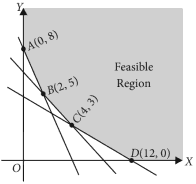
Feasible region for an L.P.P. is shown shaded in the following figure. Minimum of $Z=5 x+3 y$ occurs at the point point
- ✓
$(0,8)$
- B
$(2,5)$
- C
$(4,3)$
- D
$(12,0)$
AnswerCorrect option: A. $(0,8)$
(a) : The objective function is $Z=5 x+3 y$| Corner Point | Value of $Z= 5x+3 y$ |
| A(0,8) | $5 \times 0+3 \times 8=24$ |
| B(2,5) | $5 \times 2+3 \times 5=25$ (minimum) |
| C(4,3) | $5 \times 4+3 \times 3=29$ |
| D(12,0) | $5 \times 12+3 \times 0=60$ |
View full question & answer→MCQ 2161 Mark
The feasible region of an LPP is given in the following figure
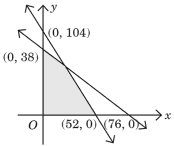
Then, the constraints of the LPP are $x \geq 0, y \geq 0$ and - A
$2 x+y \leq 52$ and $x+2 y \leq 76$
- ✓
$2 x+y \leq 104$ and $x+2 y \leq 76$
- C
$x+2 y \leq 104$ and $2 x+y \leq 76$
- D
$x+2 y \leq 104$ and $2 x+y \leq 38$
AnswerCorrect option: B. $2 x+y \leq 104$ and $x+2 y \leq 76$
(b) : Clearly, the pair of points given in graph, and $(0,104) ;(52,0)$ and $(0,38) ;(76,0)$ satisfy the corresponding equations given in option(b) i.e., $2 x+y \leq 104$ and $x+2 y \leq 76$.
View full question & answer→MCQ 2171 Mark
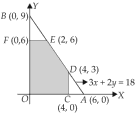
Maximum value of $Z=3 x+5 y$ subject to $3 x+2 y \leq 18, x \leq 4, y \leq 6, x \geq 0, y \geq 0$ is
Answer(c) : On plotting the constraints, we get $O C D E F$ as the feasible region with corner points $O, C, D, E, F$.
$
\begin{array}{l}
\therefore \quad Z(O)=0 \\
Z(C)=3 \times 4=12 \\
Z(D)=3 \times 4+5 \times 3=27 \\
Z(E)=3 \times 2+5 \times 6=36 \\
Z(F)=5 \times 6=30
\end{array}
$
$\therefore \quad$ Maximum value of $Z$ is 36 at point $E(2,6)$. View full question & answer→MCQ 2181 Mark
Consider the linear programming problem Max. $Z=4 x+y$
Subject to $x+y \leq 50 ; x+y \geq 100 ; x, y \geq 0$ The max. value of $Z$
Answer(d) : Let $l_1: x+y=50 ; l_2: x+y=100 ; l_3: x=0$; $l_4: y=0$
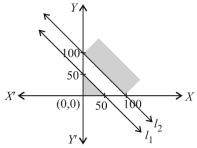
Since, no feasible region determined, hence, no maximum value of $Z$ exists. View full question & answer→MCQ 2191 Mark
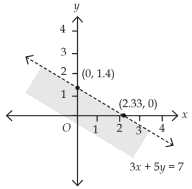
The solution set of the inequation $3 x+5 y<7$ is
- A
whole $x y$-plane except the points lying on the line $3 x+5 y=7$.
- B
whole $x y$-plane along with the points lying on the line $3 x+5 y=7$.
- C
open half plane containing the origin except the points of line $3 x+5 y=7$.
- D
open half plane not containing the origin.
View full question & answer→MCQ 2201 Mark
In a LPP, if the objective function $Z=a x+b y$ has the same maximum value on two corner points of the feasible region, then every point on the line segment joining these two points give the same ______ value.
View full question & answer→MCQ 2211 Mark
Maximize $Z=7 x+11 y$, subject to $3 x+5 y \leq 26$, $5 x+3 y \leq 30, x \geq 0, y \geq 0$.
AnswerCorrect option: A. 59 at $\left(\frac{9}{2}, \frac{5}{2}\right)$
(a): We have, maximize $Z=7 x+11 y$
Subject to $3 x+5 y \leq 26,5 x+3 y \leq 30, x \geq 0, y \geq 0$
Let $l_1: 3 x+5 y=26, l_2: 5 x+3 y=30, l_3: x=0, l_4: y=0$
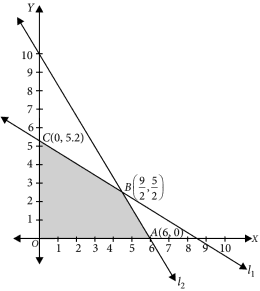
For B : Solving $l_1$ and $l_2$, we get $B\left(\frac{9}{2}, \frac{5}{2}\right)$
Shaded portion $O A B C$ is the feasible region, where $O(0,0), A(6,0), B(9 / 2,5 / 2), C(0,5.2)$.
Now maximize $Z=7 x+11 y$
$Z$ at $O(0,0)=7(0)+11(0)=0$
$Z$ at $A(6,0)=7(6)+11(0)=42$
$Z$ at $B\left(\frac{9}{2}, \frac{5}{2}\right)=7\left(\frac{9}{2}\right)+11\left(\frac{5}{2}\right)=59$
$Z$ at $C(0,5.2)=7(0)+11(5.2)=57.2$
Thus, $Z$ is maximized at $B\left(\frac{9}{2}, \frac{5}{2}\right)$ and its maximum value is 59 . View full question & answer→MCQ 2221 Mark
The feasible region for an LPP is always a ______ polygon.
MCQ 2231 Mark
Corner points of the feasible region determined by the system of linear constraints are $(0,3),(1,1)$ and $(3,0)$. Let $Z=p x+q y$, where $p, q>0$. Condition on $p$ and $q$ so that the minimum of $Z$ occurs at $(3,0)$ and $(1,1)$ is
- A
$p=2 q$
- ✓
$p=\frac{q}{2}$
- C
$p=3 q$
- D
$p=q$
AnswerCorrect option: B. $p=\frac{q}{2}$
(b) : We must have value of $Z$ at $(3,0)=$ value of $Z$ at $(1,1)$
$\Rightarrow \quad 3 p+0 \cdot q=1 p+1 \cdot q \Rightarrow 3 p=p+q \Rightarrow p=\frac{1}{2} q$
View full question & answer→MCQ 2241 Mark
Objective function of a L.P.P. is
- A
- ✓
a function to be optimised
- C
a relation between the variables
- D
AnswerCorrect option: B. a function to be optimised
(b) : Objective function is a linear function (involve variable) whose maximum or minimum value is to be found.
View full question & answer→MCQ 2251 Mark
Corner points of the feasible region for an LPP are $(0,2),(3,0)$, $(6,0),(6,8)$ and $(0,5)$.
Let $F=4 x+6 y$ be the objective function.
0The minimum value of $F$ occurs at
- A
$(0,2)$ only
- B
$(3,0)$ only
- C
the mid-point of the line segment joining the points $(0,2)$ and $(3,0)$ only
- ✓
any point on the line segment joining the points $(0,2)$ and $(3,0)$
AnswerCorrect option: D. any point on the line segment joining the points $(0,2)$ and $(3,0)$
(d) : Construct the following table of values of objective function :| Corner Point | Value of $F= 4 x+6 y$ |
| (0,2) | $4 \times 0+6 \times 2=12$ (Minimum) |
| (3,0) | $4 \times 3+6 \times 0=-12$ (Minimum) |
| (6,0) | $4 \times 6+6 \times 0=-24$ |
| (6,8) | $4 \times 6+6 \times 8=-72$ (Maximum) |
| (0,5) | $4 \times 0+6 \times 5=-30$ |
Since the minimum value $(F)=12$ occurs at two distinct corner points, it occurs at every point of the segment joining these two points. View full question & answer→MCQ 2261 Mark
A feasible region of a system of linear inequalities is said to be ______, if it can be enclosed within a circle.
MCQ 2271 Mark
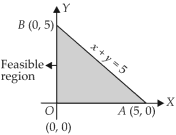
Maximise $Z=2 x+3 y$ subject to the constraints : $x+y \leq 5, x \geq 0$, $y \geq 0$. the maximum value of $Z$
Answer(b): On plotting the given constraints $x+y=5$, $x=y=0$, we get $O(0,0)$, $A(5,0)$ and $B(0,5)$ as corner points of the feasible region $O A B$.
$
\begin{array}{l}
\therefore Z(O)=2 \times 0+3 \times 0=0, \\
Z(A)=2 \times 5+3 \times 0=10, \\
Z(B)=2 \times 0+3 \times 5=15
\end{array}
$
$\therefore \quad$ Maximum value of $Z$ is 15 at point $B(0,5)$. View full question & answer→MCQ 2281 Mark
The corner points of the feasible region determined by the system of linear constraints are $(0,10),(5,5),(15,15),(0,20)$. Let $Z=p x+q y$, where $p, q>0$. Condition on $p$ and $q$ so that the maximum of $Z$ occurs at both the points $(15,15)$ and $(0,20)$ is
- A
$p=q$
- B
$p=2 q$
- C
$q=2 p$
- ✓
$q=3 p$
AnswerCorrect option: D. $q=3 p$
(d) : Value of $Z=p x+q y$ at $(15,15)$ is $15 p+15 q$ and that at $(0,20)$ is $20 q$. According to given condition, we must have
$
15 p+15 q=20 q \Rightarrow 15 p=5 q \Rightarrow q=3 p
$
View full question & answer→