MCQ 1511 Mark
Which of the following is a property of all linear programming problems?
- A
Alternate courses of action to choose from.
- B
Minimization of some objective.
- C
- D
Usage of graphs in the solution.
Answer - Alternate courses of action to choose from.
Solution:
According to Robbins, the resources(capital, land, labour, materials, ...) are always limited.
Every resource have multiple uses.
The problem before any organisation or manager is to choose the best alternatives which can maximize the profit or minimize the cost of production.
Linear programming is the method which is used to select the best possible alternatives from the all alternatives.
According to William M. Fox, "Linear programming is a planning technique that permits some objective function to be maximized or minimized within the framework of given situational restrictions"
Therefore, the linear programming is the process of selecting best courses of action to choose from various alternatives.
View full question & answer→MCQ 1521 Mark
Let X1 and X2 are optimal solutions of a LPP, then:
- A
$\text{X}=\lambda\ \text{X}_1+(1-\lambda)\text{X}_2,\lambda\in$ R is also an optimal solution
- B
$\text{X}=\lambda\ \text{X}_1+(1-\lambda)\text{X}_2,0\leq\lambda\leq1$ given an optimal solution
- C
$\text{X}=\lambda\ \text{X}_1+(1+\lambda)\text{X}_2,0\leq\lambda\leq1$ given an optimal solution
- D
$\text{X}=\lambda\ \text{X}_1+(1+\lambda)\text{X}_2,\lambda\in$ R given an optimal solution
Answer - $\text{X}=\lambda\ \text{X}_1+(1-\lambda)\text{X}_2,0\leq\lambda\leq1$ given an optimal solution
Solution:
A set A is convex if, for any two points X1, X2
$\in\text{A}$ and $\lambda\in0,1$ imply that $\lambda\times1+1-\lambda\times2\in\text{A}$. Since, here X1 and X2 are optimal solution
Therefore, their convex combination will also be an optimal solution
Thus, $\text{X}=\lambda\ \text{X}_1+(1-\lambda)\text{X}_2,0\leq\lambda\leq1$ gives an optimal solution.
View full question & answer→MCQ 1531 Mark
To write the dual; it should be ensured that
- All the primal variables are non - negative.
- All the bi values are non - negative.
- All the constraints are $\leq$ type if it is maximization problem and $\geq$ type if it is a minimization problem.
Answer - I and III
Solution:
To write the dual, then all the primal variables must be non-negative.
All the constraints are $\leq$ type if it ia maximization problem and $\geq$ type if it is a minimization problem.
View full question & answer→MCQ 1541 Mark
A constraint in an LP model becomes redundant because:
- A
Two iso - profit line may be parallel to each other
- B
The solution is unbounded
- C
This constraint is not satisfied by the solution values
- D
Answer - None of the above
Solution:
A constraint in an LP model becomes redundant when the feasible region doesnt change by the removing the constraint.
For example, $\text{x}+2\text{y}\leq20$ and $2\text{x}+4\text{y}\leq40$ are the constraints.
$2\text{x}+4\text{y}\leq40$
$\Rightarrow2\times(\text{x}+2\text{y})\leq2\times20$
$\Rightarrow\text{x}+2\text{y}\leq20$
which is same as the first constraint.
Therefore, $2\text{x}+4\text{y}\leq40$ can be removed.
By removing this constraint feasible region doesnt change.
View full question & answer→MCQ 1551 Mark
In order for a linear programming problem to have a unique solution, the solution must exist.
- A
At the intersection of the nonnegativity constraints.
- B
At the intersection of a nonnegativity constraint and a resource constraint.
- C
At the intersection of the objective function and a constraint.
- D
At the intersection of two or more constraints.
Answer - At the intersection of two or more constraints.
Solution:
In order for a linear programming problem to have a unique solution, the solution must exist at the intersection of two or more constraints.
Then the problem becomes convex and has a single optimum (maximum or minimum).
View full question & answer→MCQ 1561 Mark
Z = 8x + 10y, subject to $2\text{x}+\text{y}\geq1,2\text{x}+3\text{y}\geq15,\text{y}\geq2,\text{x}\geq0,\text{y}\geq0.$ The minimum value of Z occurs at.
View full question & answer→MCQ 1571 Mark
The optimal value of the objective function is attained at the points.
- A
Given by intersection of inequation with y - axis only.
- B
Given by intersection of inequation with x - axis only.
- C
Given by corner points of the feasible region.
- D
Answer - Given by corner points of the feasible region.
View full question & answer→MCQ 1581 Mark
The objective function of a linear programming problem is:
- A
- B
- C
A relation between the variables
- D
View full question & answer→MCQ 1591 Mark
In Graphical solution the feasible solution is any solution to a LPP which satisfies.
- A
- B
Non - negativity restriction.
- C
- D
Answer - Non - negativity restriction.
Solution:
The feasible region is the set of all the points that satisfy all the given constraints.
The variables of the linear programs must always take the non - negative values (i.e., $\text{x}\geq0$ and $\text{y}\geq0$).
These are used because x and y are usually the number of items produced and we cannot produce the negative number of items.
The least possible number of items could be zero.
Therefore, the feasible solution should satisfy the non - negativity restriction.
View full question & answer→MCQ 1601 Mark
For the LPP; maximise z = x + 4y subject to the constraints $\text{x}+2\text{y}\leq2,$ $\text{x}+2\text{y}\geq8,$ $\text{x},\text{y}\geq0.$
Answer - Has no feasible solution
Solution:
$\text{x}+2\text{y}\leq2$
$\text{x}+2\text{y}\geq8$
$\text{x},\text{y}\geq0.$
View full question & answer→MCQ 1611 Mark
Which of the following sets are convex?
- A
$\{(\text{x},\text{y}):\text{x}^2+\text{y}^2\geq1\}$
- B
$\{(\text{x},\text{y}):\text{y}^2\geq\text{x}\}$
- C
$\{(\text{x},\text{y}):3\text{x}^2+4\text{y}^2\geq5\}$
- D
$\{(\text{x},\text{y}):\text{y}\geq2,\text{y}\leq4\}$
Answer - $\{(\text{x},\text{y}):\text{y}\geq2,\text{y}\leq4\}$
Solution:
is the region between two parallel lines, so any line segment joining any two points in it lies in it.
Hence, it is a convex set.
View full question & answer→MCQ 1621 Mark
Graphical method can be used only when the decision variables is:
Answer - Two
Solution:
Graphical method can be used only when the decision variables is two.
View full question & answer→MCQ 1631 Mark
An objective function in a linear program can be which of the following?
- A
- B
A nonlinear maximization function
- C
A quadratic maximization function
- D
Answer - A maximization function
Solution:
Linear programming problem may be defined as the problem of maximizing or minimizing a linear function subject to linear constraints.
The objective function in a linear program is a maximization function.
View full question & answer→MCQ 1641 Mark
Maximize Z = 3x + 5y, subject to constraints: $\text{x}+4\text{y}\leq24,3\text{x}+\text{y}\leq21,\text{x}+\text{y}\geq9,\text{x}\geq0,\text{y}\geq0.$
Answer - 37 at (4, 5)
Solution:
Find the maximum value of Z = 3x + 5y referring to the explanation of Q.5.
View full question & answer→MCQ 1651 Mark
Maximize Z = 4x + 6y, subject to $3\text{x}+2\text{y}\leq12,\text{x}+\text{y}\geq4,\text{x},\text{y}\geq0.$
View full question & answer→MCQ 1661 Mark
The maximum value of Z = 4x + 2y subject to the constraints $2\text{x}+3\text{y}\leq18,\text{x}+\text{y}\geq10,\text{x},\text{y}\leq0$ is:
View full question & answer→MCQ 1671 Mark
The maximum value of Z = 3x + 2y, subjected to $\text{x}+2\text{y}\leq2,\text{x}+2\text{y}\geq8;\text{x},\text{y}\geq0 $ is:
View full question & answer→MCQ 1681 Mark
Maximize Z = 7x + 11y, subject to $3\text{x}+5\text{y}\leq26,5\text{x}+3\text{y}\leq30,\text{x}\geq0,\text{y}\geq0.$
Answer - 59 at$\Big(\frac{9}{2},\frac{5}{2}\Big)$
View full question & answer→MCQ 1691 Mark
Maximize Z = 10 x1 + 25 x2, subject to $0\leq\text{x}_{1}\leq3,0\leq\text{x}_{2}\leq3,\text{x}_{1}+\text{x}_{2}\leq5.$
View full question & answer→MCQ 1701 Mark
An article manufactured by a company consists of two parts X and Y. In the process of manufacture of the part X. 9 out of 100 parts may be defective. Similarly 5 out of 100 are likely to be defective in part Y. Calculate the probability that the assembled product will not be defective.
Answer - 0.8645
Solution:
Let A = Part X is not defective
Probability of A is $\text{P}(\text{A})=\frac{91}{100}$
B = Part Y is not defective.
Probability of B is $\text{P}(\text{B})=\frac{95}{100}$
Required probability
$=\text{P}(\text{A}\cap\text{B})=\text{P}(\text{A})\text{P}(\text{B})=\frac{91}{100}\times\frac{95}{100}=\frac{8645}{10000}$
View full question & answer→MCQ 1711 Mark
The corner points of the feasible region determined by the following system of linear inequalities: $2\text{x}+\text{y}\leq10,\text{x}+3\text{y}\leq15, \text{x},\text{y}\geq0$ are (0, 0), (5, 0), (3, 4) and (0, 5). Let Z = px + qy, where p, q > 0. Conditions on p and q so that the maximum of Z occurs at both (3, 4) and (0, 5) is:
View full question & answer→MCQ 1721 Mark
The maximum value of Z = 4x + 3y subjected to the constraints $2\text{x}+3\text{y}\leq18,$ $\text{x}+\text{y}\geq10;\text{x},\text{y}\geq0$ is:
View full question & answer→MCQ 1731 Mark
In equation $3\text{x}-\text{y}\geq3$ and 4x - 4y > 4.
- A
Have solution for positive x and y.
- B
Have no solution for positive x and y.
- C
- D
Answer - Have solution for positive x and y.
View full question & answer→MCQ 1741 Mark
Z = 6x + 21y, subject to $ \text{x}+2\text{y}\geq3,\text{x}+4\text{y}\geq4,3\text{x}+\text{y}\geq3,\text{x}\geq0,\text{y}\geq0.$ The minimum value of Z occurs at.
Answer - $\Big(2,\frac{7}{2}\Big)$
View full question & answer→MCQ 1751 Mark
In graphical solutions of linear inequalities, solution can be divided into.
Answer - Two subsets
Solution:
In graphical solutions of linear inequalities, solution can be divided into two subsets.
for example, $2\text{x}+\text{y}\leq4$
One subset includes all values (x, y) that satisfy the equation 2x + y = 4 and the other subset includes all the values (x, y) that satisfy 2x + y < 4.
View full question & answer→MCQ 1761 Mark
The taxi fare in a city is as follows. For the first km the fare is Rs.10 and subsequent distance is Rs.6/ km.Taking the distance covered as x km and fare as Rs y, write a linear equation.
Answer - y = 4 + 6x
Solution:
First kmkm fare = Rs.10 Subsequent distance fare = Rs 6/ km
Then fare x km of distance y = (x - 1) × 6 + 10y = 6x - 6 + 10y = 6x + 4
View full question & answer→MCQ 1771 Mark
Given a system of inequation: $2\text{y}-\text{x}\leq4$ $-2\text{x}+\text{y}\geq-4$Find the value of s, which is the greatest possible sum of the x and y co - ordinates of the point which satisfies the following inequalities as graphed in the xy plane.
Answer - 8
Solution:
First, rewrite each equation, so that it is in the slope - intercept form of a line, which is y = mx + b, where mm is the slope and b is the y - intercept of the line.
The first equation becomes 2y < x + 4 or $\text{y}\leq\frac{1}{2}\text{x}+2.$
The second equation becomes $\text{y}\geq2\text{x}-4.$
The greatest x + y is the point at which the two lines intersect.
Set the equations of the two lines, $\text{y}=\frac{1}{2}\text{x}+2$ and y = 2x - 4, equal to each other and solve for x.
The resulting equation is $\text{y}=\frac{1}{2}\text{x}+2$
and y = 2x - 4.
Solve for x to get $\text{y}=\frac{3}{-2}\text{x}+2=-4$ or $\frac{3}{-2}\text{x}=-6,$
$\Rightarrow\text{x}=4$
Next, plug 4 into one of the two equations to solve for y.
Therefore, y = 2(4) - 4 = 4 and x + y = 4 + 4 = 8.
View full question & answer→MCQ 1781 Mark
Directions: In the following questions, the Assertions (A) and Reason(s) (R) have been put forward. Read both the statements carefully and choose the correct alternative from the following:
Assertion (A): Assertion (A):For an objective function Z= 15x + 20y, corner points are (0, 0), (10, 0), (0, 15) and (5, 5). Then optimal values are 300 and 0 respectively.
Reason (R): The maximum or minimum value of an objective function is known as optimal value of LPP. These values are obtained at corner points.
- A
Both A and R are true and R is the correct explanation of A
- B
Both A and R are true but R is NOT the correct explanation of A
- C
A is true but R is false.
- D
A is false but R is true.
Answer - Both A and R are true and R is the correct explanation of A
View full question & answer→MCQ 1791 Mark
Z = 7x + y, subject to $ 5\text{x}+\text{y}\geq5,\text{x}+\text{y}\geq3,\text{x}\geq0, y\geq0.$ The minimum value of Z occurs at:
View full question & answer→MCQ 1801 Mark
Choose the correct answer from the given four options.
Corner points of the feasible region for an LPP are (0, 2), (3, 0), (6, 0), (6, 8) and (0, 5)
Let F = 4x + 6y be the objective function Find the
Maximum of F - Minimum of F =
Answer - 60.
Solution:
| Corner points | Corresponding value of F = 4x + 6y |
| (0, 2) | 12 (Minimum) |
| (3, 0) | 12 (minimum) |
| (6, 0) | 24 |
| (6, 8) | 72 (maxmimum) |
| (0, 5) | 30 |
Maximum of F - Minimum of F = 72 - 12 = 60.
View full question & answer→MCQ 1811 Mark
The minimum value of Z = 4x + 3y subjected to the constraints $3\text{x}+2\text{y}\geq160,$ $5+2\text{y}\geq200,$$ 2\text{y}\geq80;\text{x},\text{y}\geq0$ is:
View full question & answer→MCQ 1821 Mark
Objective function of a L.P.P. is:
- A
- B
A function to be optimised
- C
A relation between the variables
- D
Answer - A function to be optimised
View full question & answer→MCQ 1831 Mark
The solution of the set of constraints of a linear programming problem is a convex (open or closed) is called ______ region.
Answer - Feasible
Solution:
Our experts are building a solution for this.
View full question & answer→MCQ 1841 Mark
The feasible region for an LPP is shown shaded in the figure. Let $F=3 x-4 y$ be the objective function.
Maximum value of $F$ is
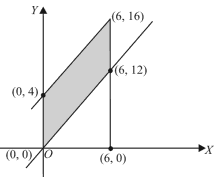
Answer(a) : Construct the following table of values of the objective function $F$ :| Corner Point | Value of $F= 3 x-4 y$ |
| (0,0) | $3 \times 0-4 \times 0=0$ (Maximum) |
| (6,12) | $3 \times 6-4 \times 12=-30$ |
| (6,16) | $3 \times 6-4 \times 16=-46$ (Minimum) |
| (0,4) | $3 \times 0-4 \times 4=-16$ |
Hence, maximum of $F=0$ View full question & answer→MCQ 1851 Mark
An owner of a lodge plans an extension which contains not more than 50 rooms. At least 5 must be executive single rooms. The number of executive double rooms should be at least 3 times the number of executive single rooms. He charges ₹ 3000 for executive double room and ₹ 1800 for executive single room per day. Formulate the above problem as L.P.P. to maximize the profit.
- A
Maximize $P=1800 x_1+3000 x_2$ subject to, $x_1+x_2 \geq 50, x_1=5, x_2=3 x_1, x_1 \geq 0, x_2 \geq 0$
- B
Maximize $P=1800 x_1+3000 x_2$ subject to $x_1+x_2 \leq 50, x_1 \geq 5, x_2 \geq 3 x_1, x_1 \leq 0, x_2 \leq 0$
- C
Maximize $P=1800 x_1+3000 x_2$ subject to $x_1+x_2 \geq 50, x_1 \geq 5, x_2 \geq 3 x_1, x_1 \geq 0, x_2 \geq 0$
- ✓
Maximize $P=1800 x_1+3000 x_2$ subject to, $x_1+x_2 \leq 50, x_1 \geq 5, x_2 \geq 3 x_1, x_1 \geq 0, x_2 \geq 0$
AnswerCorrect option: D. Maximize $P=1800 x_1+3000 x_2$ subject to, $x_1+x_2 \leq 50, x_1 \geq 5, x_2 \geq 3 x_1, x_1 \geq 0, x_2 \geq 0$
View full question & answer→MCQ 1861 Mark
The construction company uses concrete blocks made up of cement and sand. The weight of a concrete block has to be at least $5 kg$. Cement costs ₹ 20 per kg, while sand costs ₹ 6 per kg. Strength considerations dictate that the concrete block should contain minimum $4 kg$ of cement and not more than $2 kg$ of sand. Formulate the L.P.P for the cost to be minimum.
- A
Minimize $C=20 x+6 y$ subject to, $x \geq 4, y \leq 2$, $x+y \geq 5, x \geq 0, y \geq 0$
- B
Minimize $C=6 x+20 y$ subject to, $x \leq 4, y \leq 2$, $x+y \leq 5, x \leq 0, y \leq 0$
- C
Minimize $C=20 x+6 y$ subject to, $x \geq 4, y \geq 2$, $x+y \geq 5, x \geq 0, y \geq 0$
- D
Minimize $C=20 x+6 y$ subject to, $x \geq 4, y \leq 2$, $x+y=5, x \geq 0, y 0 \geq 0$
Answer18. (a) : Let the concrete block contains x kg of cement and y kg of sand. As the cost of cement and sand is given to be ₹ 20 and ₹ 6 per kg respectively. Hence, we would like to minimize it. Let us denote the cost by $C$.
$
\therefore \quad C=20 x+6 y
$
The weight of the concrete block has to at least 5 kg.
$
\therefore \quad x+y \geq 5
$
Minimum 4 kg of cement is to be used, $\therefore x \geq 4$
Also sand cannot exceed 2 kg. $\therefore y \leq 2$
Obviously weight of the concrete block cannot be negative. $\therefore x \geq 0, y \geq 0$
Thus the L.P.P. is
Minimize $C=20 x+6 y$
Subject to, $x \geq 4, y \leq 2, x+y \geq 5, x \geq 0, y \geq 0$.
View full question & answer→MCQ 1871 Mark
The maximum value of $Z=3 x+4 y$ subject to the constraints $x \geq 0, y \geq 0$ and $x+y \leq 1$ is
Answer(b) : We have to maximise $Z=3 x+4 y$
Subject to constraints, $x \geq 0, y \geq 0$ and $x+y \leq 1$
The shaded portion $O A B$ is the feasible region, where $O(0,0), A(1,0)$ and $B(0,1)$ are the corner points.
At $O(0,0), Z=3 \times 0+4 \times 0=0$
At $A(1,0), Z=3 \times 1+4 \times 0=3$
At $B(0,1), Z=3 \times 0+4 \times 1=4$
$\therefore$ Maximum value of $Z$ is 4 , which occurs at $B(0,1)$. View full question & answer→MCQ 1881 Mark
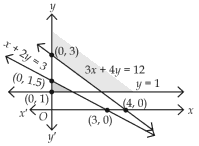
The number of solutions of the system of inequations $x+2 y \leq 3,3 x+4 y \geq 12, x \geq 0$, $y \geq 1$ is
Answer(a) : Given,
$
x+2 y \leq 3,3 x+4 y \geq 12, x \geq 0, y \geq 1
$
The graph of given constraints is shown here.
Since, there is no common region. So, no solution exists. View full question & answer→MCQ 1891 Mark
The maximum value of $Z=5 x+3 y$, if the shaded region represents the feasible region, is
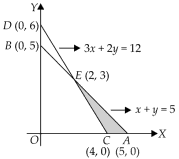
Answer(b) : We have,
$
\begin{array}{l}
Z(C)=5 \times 4+3 \times 0=20 \\
Z(A)=5 \times 5+3 \times 0=25 \\
Z(E)=5 \times 2+3 \times 3=19
\end{array}
$
$\therefore \quad$ Maximum value of $Z$ is 25 at point $A(5,0)$
View full question & answer→MCQ 1901 Mark
The point which does not lie in the half plane $2 x+3 y-12 \leq 0$ is
- A
$(1,2)$
- B
$(2,1)$
- ✓
$(2,3)$
- D
AnswerCorrect option: C. $(2,3)$
(c) : We have, $2 x+3 y-12 \leq 0$ ...(i)
Putting $(1,2)$ in (i), we get $-4 \leq 0$
Putting $(2,1)$ in (i), we get $-5 \leq 0$
Putting $(2,3)$ in (i), we get $1 \leq 0$, which is not true.
So, $(2,3)$ does not lie in the half plane.
View full question & answer→MCQ 1911 Mark
Which of the following statement is correct?
- A
Every L.P.P. has atleast one optimal solution.
- B
Every L.P.P. has a unique optimal solution.
- ✓
If an L.P.P. has two optimal solutions, then it has infinitely many solutions.
- D
AnswerCorrect option: C. If an L.P.P. has two optimal solutions, then it has infinitely many solutions.
(c) : If optimal solution is obtained at two distinct points $A$ and $B$ (corners of the feasible region), then optimal solution is obtained at every point of segment $[A B]$.
View full question & answer→MCQ 1921 Mark
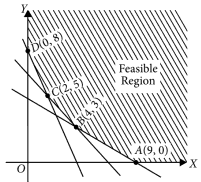
Feasible region for an L.P.P. is shown shaded in the following figure. Minimum of $Z=4 x+3 y$ occurs at the point
- A
$(0,8)$
- ✓
$(2,5)$
- C
$(4,3)$
- D
$(9,0)$
AnswerCorrect option: B. $(2,5)$
(b) : The objective function is $Z=4 x+3 y$| Corner Point | Value of $Z= 4 x+3 y$ |
| (0,8) | $4 \times 0+3 \times 8=24$ |
| (2,5) | $4 \times 2+3 \times 5=23$ (minimum) |
| (4,3) | $4 \times 4+3 \times 3=25$ |
| (9,0) | $4 \times 9+3 \times 0=36$ |
View full question & answer→MCQ 1931 Mark
Which of the following statements is false?
- ✓
The feasible region is always a concave region.
- B
The maximum (or minimum) solution of the objective function occurs at the vertex of the feasible region.
- C
If two corner points produce the same maximum (or minimum) value of the objective function, then every point on the line segment joining these points will also give the same maximum (or minimum) value.
- D
AnswerCorrect option: A. The feasible region is always a concave region.
(a) : The feasible region is always a convex region.
View full question & answer→MCQ 1941 Mark
The corner points of the feasible region determined by the system of linear constraints are $(0,0),(0,40),(20,40),(60,20),(60,0)$. The objective function is $Z=4 x+3 y$.
Compare the quantity in Column A and Column B| Column A | Column B |
| Maximum of Z | 325 |
AnswerCorrect option: A. The quantity in column $A$ is greater
(a) : The objective function is $Z=5 x+3 y$| Corner Point | Value of $Z= 4 x+3 y$ |
| (0,0) | $4 \times 0+3 \times 0=0$ |
| (0,40) | $4 \times 0+3 \times 40=120$ |
| (20,40) | $4 \times 20+3 \times 40=200$ |
| (60,20) | $4 \times 60+3 \times 20=300$ (Maximum) |
| (60,0) | $4 \times 60+3 \times 0=240$ |
View full question & answer→MCQ 1951 Mark
Consider $Z(x, y)=p x+q y$ subject to $2 x+y \leq 10$, $x+3 y \leq 15, x, y \geq 0$. If $Z$ is maximum at both the points $(3,4)$ and $(0,5)$, then find $q$.
Answer(c) : $\because$ Value of $Z$ at $(3,4)=$ Value of $Z$ at $(0,5)$
$
\begin{array}{l}
\Rightarrow 3 p+4 q=5 q \\
\therefore \quad q=3 p .
\end{array}
$
View full question & answer→MCQ 1961 Mark
The corner points of the feasible region determined by the system of linear inequalities are $(0,0),(4,0),(2,4)$ and $(0,5)$. If the maximum value of $Z=a x+b y$, where $a, b>0$ occurs at both $(2,4)$ and $(4,0)$, then
- ✓
$a=2 b$
- B
$2 a=b$
- C
$a=b$
- D
$3 a=b$
AnswerCorrect option: A. $a=2 b$
(a) : Since, maximum value of $Z=a x+b y$ occurs at both $(2,4)$ and $(4,0)$.
$
\therefore \quad 2 a+4 b=4 a+0 \Rightarrow 4 b=2 a \Rightarrow 2 b=a
$
View full question & answer→MCQ 1971 Mark
If the minimum value of an objective function $Z=a x+b y$ occurs at two points $(3,4)$ and $(4,3)$ then
- A
$a+b=0$
- ✓
$a=b$
- C
$3 a=b$
- D
$a=3 b$
Answer(b) : Since, minimum value of $Z=a x+b y$ occurs at two points $(3,4)$ and $(4,3)$.
$
\therefore 3 a+4 b=4 a+3 b \Rightarrow a=b
$
View full question & answer→MCQ 1981 Mark
The feasible region for an LPP is shown shaded in the figure. Let $F=3 x-4 y$ be the objective function.
Minimum value of $F$ is
Answer(d) : Minimum of $F=-46$
View full question & answer→MCQ 1991 Mark
In an LPP, if the objective function $Z=a x+b y$ has the same maximum value on two corner points of the feasible region, then the number of points at which $Z_{\max }$ occurs is
Answer(d) : In an LPP, if the objective function $Z=a x+b y$ has the same maximum value on two corner points of the feasible region, then the number of points at which $Z_{\max }$ occurs is infinite.
View full question & answer→MCQ 2001 Mark
If the corner points of the feasible region of an LPP are $(0,3),(3,2)$ and $(0,5)$, then the minimum value of $Z=11 x+7 y$ is
Answer(a) : Given, $Z =11 x+7 y$
At $(0,3), Z=11 \times 0+7 \times 3=21$
At $(3,2), Z=11 \times 3+7 \times 2=47$
At $(0,5), Z=11 \times 0+7 \times 5=35$
Thus, $Z$ is minimum at $(0,3)$ and minimum value of $Z$ is 21.
View full question & answer→