Questions

5 Marks Questions

Take a timed test

6 questions · self-marked practice — reveal the answer and mark yourself.

Question 15 Marks
Prove that the semi $-$ vertical angle of the right circular cone of given volume and least curved surface area is $\cot ^{-1} \sqrt{2}$
Answer
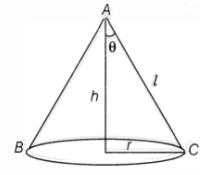
Let $r$ be the radius of the base $,h$ be the height, $V$ be the volume, $S$ be the surface area of the cone, slant height $= AC = 1 $; and $0$ be the semi $-$ vertical angle.
Image
$\text { Then, } V=\frac{1}{3} \pi r^2 h$
$\Rightarrow 3 V=\pi r^2 h$
$\Rightarrow 9 V^2=\pi^2 r^4 h^2 \quad \ [$on squaring both sides $]$
$\Rightarrow S^2=\pi^2 r^2\left(\frac{9 V^2}{\pi^2 r^4}+r^2\right)\ [$from Eq. $(i)]$
$\Rightarrow S^2=\frac{9 V^2}{r^2}+\pi^2 r^4......(ii)$
When $S$ is least, then $S^2$ is also least.
Now, $\frac{d}{d r}\left(S^2\right)=-\frac{18 V^2}{r^3}+4 \pi^2 r^3 \ldots(iii)$
For maxima or minima, put $\frac{d}{d r}\left(S^2\right)=0$
$\Rightarrow \quad-\frac{18 V^2}{r^3}+4 \pi^2 r^3=0$
$\Rightarrow 18 V^2=4 \pi^2 r^6$
$\Rightarrow 9 V^2=2 \pi^2 r^6 \ldots \text { (iv) }$
Again, on differentiating Eq. $(iii)\ \text{w.r.t.r},$ we get
$\frac{d^2}{d r^2}\left(S^2\right)=\frac{54 V^2}{r^4}+12 \pi^2 r^2;0$
$\text { At } r=\left(\frac{9 V^2}{2 \pi^2}\right)^{1 / 6}, \frac{d^2}{d r^2}\left(S^2\right);0$
So, $S ^2$ or $S$ is minimum, when
$V^2=2 \pi^2 r^6 / 9$
On putting $V^2=2 \pi^2 r^6 / 9$ in Eq. $(i)$ we get
$2 \pi^2 r^6=\pi^2 r^4 h^2$
$\Rightarrow 2 r^2=h^2$
$\Rightarrow h=\sqrt{2} r$
$\Rightarrow \frac{h}{r}=\sqrt{2}$
$\Rightarrow \cot \theta=\sqrt{2}$$\left[\right.$ from the figure, $\left.\cot \theta=\frac{h}{r}\right]$
Hence, the semi $-$ vertical angle of the right circular cone of given volume and least cured surface area is $\cot ^{-1} \sqrt{2}$
View full question & answer
Question 25 Marks
Show that a cylinder of a given volume which is open at the top has minimum total surface area, when its height is equal to the radius of its base
Answer
Let $r$ be the radius, $h$ be the height, $V$ be the volume and $S$ be the total surface area of a right circular cylinder which is open at the top.
Now, given that $V=\pi r^2 h$
$\Rightarrow h=\frac{V}{\pi r^2}$
We know that, total surface area $S$ is given by
$S=2 \pi r h+\pi r^2$
$[\because$ Cylinder is open at the top, therefore $S=$ curved surface area of cylinder $+$ area of base $]$
$\Rightarrow S=2 \pi r\left(\frac{V}{\pi r^2}\right)+\pi r^2$
$\left[\right.$ put $h=\frac{V}{\pi r^2}$, from Eq. $(i) ]$
$\Rightarrow S=\frac{2 V}{r}+\pi r^2$
On differentiating both sides $\text{w.r.t.r,}$ we get
$\frac{d S}{d r}=-\frac{2 V}{r^2}+2 \pi r$
For maxima or minima, put $\frac{d S}{d r}=0$
$\Rightarrow \quad-\frac{2 V}{r^2}+2 \pi r=0 $
$\Rightarrow V=\pi r^3$
$\Rightarrow \pi r^2 h=\pi r^3 \quad\ \left[\because V=\pi r^2 h\right]$
$\Rightarrow h=r$
Also, $ \frac{d^2 S}{d r^2}=\frac{d}{d r}\left(\frac{d S}{d r}\right)$
$=\frac{d}{d r}\left(\frac{-2 V}{r^2}+2 \pi r\right)$
$\Rightarrow \frac{d^2 S}{d r^2}=\frac{4 V}{r^3}+2 \pi$
On putting $r = h,$ we get
$\left[d^2 S \ d r^2\right]_{r=h}=\frac{4 V}{h^3}+2 \pi;0$ as $h;0$
Then, $\frac{d^2 S}{d s^2};0$
Thus, $S$ is minimum.
Hence, $S$ is minimum, when $h = r_{s}$
i.e. when height of cylinder is equal to radius of the base.
View full question & answer
Question 35 Marks
Express the matrix $B=\left[\begin{array}{ccc}2 & -2 & -4 \\ -1 & 3 & 4 \\ 1 & -2 & -3\end{array}\right]$ as the sum of a symmetric and a skew $-$ symmetric matrix.
Answer
$B^{\prime}=\left[\begin{array}{ccc}2 & -1 & 1 \\ -2 & 3 & -2 \\ -4 & 4 & -3\end{array}\right]$
Let $P=\frac{1}{2}\left(B+B^{\prime}\right)=\left[\begin{array}{ccc}2 & \frac{-3}{2} & \frac{-3}{2} \\ \frac{-3}{2} & 3 & 1 \\ \frac{-3}{2} & 1 & -3\end{array}\right]$
$P^{\prime}=\left[\begin{array}{ccc}2 & \frac{-3}{2} & \frac{-3}{2} \\ \frac{-3}{2} & 3 & 1 \\ \frac{-3}{2} & 1 & -3\end{array}\right]=P$
Thus $P=\frac{1}{2}\left(B+B^{\prime}\right)$ is a symmetric matrix
Let $Q=\frac{1}{3}\left(B-B^{\prime}\right)=\left[\begin{array}{ccc}0 & \frac{-1}{2} & \frac{-5}{2} \\ \frac{1}{2} & 0 & 3 \\ \frac{5}{2} & -3 & 0\end{array}\right]$
$\begin{array}{l}Q^{\prime}=\left[\begin{array}{ccc}0 & \frac{-1}{2} & \frac{5}{2} \\ \frac{-1}{2} & 0 & -3 \\ \frac{-5}{2} & 3 & 0\end{array}\right] \\ Q^{\prime}=\left[\begin{array}{ccc}0 & \frac{-1}{2} & \frac{-5}{2} \\ \frac{1}{2} & 0 & 3 \\ \frac{5}{2} & -3 & 0\end{array}\right]\end{array}$
$Q^{\prime}=-Q$
Thus $Q=\frac{1}{2}\left(B-B^{\prime}\right)$ is a skew symmetric matrix
$P+Q=\left[\begin{array}{ccc}2 & \frac{-3}{2} & \frac{-3}{2} \\ \frac{-3}{2} & 3 & 1 \\ \frac{-3}{2} & 1 & -3\end{array}\right]+\left[\begin{array}{ccc}0 & \frac{-1}{2} & \frac{-5}{2} \\ \frac{1}{2} & 0 & 3 \\ \frac{5}{2} & -3 & 0\end{array}\right]$
View full question & answer
Question 45 Marks
Show that the relation $R$ in the set $A=\{1,2,3,4,5\}$ given by $R=\{(a, b):|a-b|$ is even $\}$, is an equivalence relation. Show that all the elements of $\{1,3,5\}$ are related to each other and all the elements of $\{2,4\}$ are related to each other. But no element of $\{1,3,5\}$ is related to any element of $\{2,4\}$.
Answer
$A=\{1,2,3,4,5\}$ and $R=\{(a, b):|a-b|$ is even $\}$, then $R=\{(1,3),(1,5),(3,5),(2,4)\}$
1. For $(a, a),|a-a|=0$ which is even. $\therefore R$ is reflexive.
If $| a - b |$ is even, then $| b - a |$ is also even. $\therefore R$ is symmetric.
Now, if $| a - b |$ and $| b - c |$ is even then $| a - b + b - c |$ is even
$\Rightarrow| a - c |$ is also even. $\therefore R$ is transitive.
Therefore, R is an equivalence relation.
2. Elements of {1, 3, 5} are related to each other.
Since $|1-3|=2,|3-5|=2,|1-5|=4$ all are even numbers
$\Rightarrow$ Elements of $\{1,3,5\}$ are related to each other.
Similarly elements of (2, 4) are related to each other.
Since |2 - 4| = 2 an even number, then no element of the set {1, 3, 5) is related to any element of (2, 4).
Hence no element of (1, 3, 5) is related to any element of (2, 4).
View full question & answer
Question 55 Marks
Let $A = R -\{3\}, B = R -\{1\}$. If $f: A \rightarrow B$ be defined by $f(x)=\frac{x-2}{x-3} \forall x \in A$. Then, show that $f$ is bijective.
Answer
Given that, $A = R -\{3\}, B = R -\{1\}$
$f: A \rightarrow B$ is defined by $f(x)=\frac{x-2}{x-3} \forall x \in A$
For injectivity
Let $f\left(x_1\right)=f\left(x_2\right)$
$\Rightarrow \frac{x_1-2}{x_1-3}=\frac{x_2-2}{x_2-3}$
$\Rightarrow\left(x_1-2\right)\left(x_2-3\right)=\left(x_2-2\right)\left(x_1-3\right)$
$\Rightarrow x_1 x_2-3 x_1-2 x_2+6=x_1 x_2-3 x_2-2 x_1+6$
$\Rightarrow-3 x_1-2 x_2=-3 x_2-2 x_1$
$\Rightarrow-x_1=-x_2$
$\Rightarrow x_1=x_2$
So, $f(x)$ is an injective function For surjectivity
Let $y=\frac{x-2}{x-3}$
$\Rightarrow x -2= xy -3 y$
$\Rightarrow x (1- y )=2-3 y$
$\Rightarrow x=\frac{2-3 y}{1-y}$
$\Rightarrow x=\frac{3 y-2}{y-1} \in A, \forall y \in B [$codomain$]$
So, $f(x)$ is surjective function.
Hence, $f(x)$ is a bijective function.
View full question & answer
Question 65 Marks
Find the area bounded by the circle $x^2+y^2=16$ and the line $\sqrt{3} y=x$ inthe first quadrant, using integration
Answer
According to the question,
Given equation of circle is $x2 + y2 = 16 ...(i)$
Equation of line given is,
$\sqrt{3} y=x \ldots (ii)$
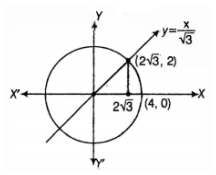
$\Rightarrow y=\frac{1}{\sqrt{3}} x$ represents a line passing through the origin.
To find the point of intersection of circle and line,
substitute eq. $(ii)$ in eq $- (i)$ we get
$x^2+\frac{x^2}{3}=16$
$\frac{3 x^2+x^2}{3}=16$
$\Rightarrow 4 x^2=48$
$\Rightarrow x^2=12$
$\Rightarrow x= \pm 2 \sqrt{3}$
When $x=2 \sqrt{3},$ then $y=\frac{2 \sqrt{3}}{\sqrt{3}}=2$
Image
Required area $($In first quadrant$) =\left(\right.$ Area under the line $y=\frac{1}{\sqrt{3}} x$ from $x =0$ to $\left.2 \sqrt{3}\right)+($ Area under the circle from $x=2 \sqrt{3}$ to $x =4)$
$=\int_0^{2 \sqrt{3}} \frac{1}{\sqrt{3}} x d x+\int_{2 \sqrt{3}}^4 \sqrt{16-x^2} d x$
$=\frac{1}{\sqrt{3}}\left[\frac{x^2}{2}\right]_0^{2 \sqrt{3}}+\left[\frac{x}{2} \sqrt{16-x^2}+\frac{(4)^2}{2} \sin ^{-1}\left(\frac{x}{4}\right)\right]_{2 \sqrt{3}}^4$
$=\frac{1}{2 \sqrt{3}}\left[(2 \sqrt{3})^2-0\right]+\left[0+8 \sin ^{-1}(1)-\frac{2 \sqrt{3}}{2} \sqrt{16-12}-8 \sin ^{-1}\left(\frac{2 \sqrt{3}}{4}\right)\right]$
$=2 \sqrt{3}+8\left(\frac{\pi}{2}\right)-\frac{2 \sqrt{3}}{2} \times 2-8 \sin ^{-1}\left(\frac{\sqrt{3}}{2}\right)$
$=2 \sqrt{3}+4 \pi-2 \sqrt{3}-8\left(\frac{\pi}{3}\right)$
$=4 \pi-\frac{8 \pi}{3}$
$=\frac{12 \pi-8 \pi^3}{3}$
$=\frac{4 \pi}{3} \text { sq units. }$
View full question & answer