Sample QuestionsModel Paper 3 questions
One sample from each question group in this chapter. Select any group above to see the full set with answer keys.
If the points $A (-1,3,2), B (-4,2,-2)$ and $C (5,5, \lambda)$ are collinear then the value of $\lambda$ is
Answer: B.
View full solution →The point of discontinuity of the function $f ( x )=\left\{\begin{array}{ll}2 x+3, & \text { if } x \leq 2 \\ 2 x-3, & \text { if } x>2\end{array}\right.is$
View full solution →The scalar product of two nonzero vectors $\vec{a}$ and $\vec{b}$ is defined as
- ✓
$\vec{a} \cdot \vec{b}=|\vec{a}||\vec{b}| \cos \theta$
- B
$\vec{a} \cdot \vec{b}=2|\vec{a}||\vec{b}| \cos \theta$
- C
$\vec{a} \cdot \vec{b}=2|\vec{a}||\vec{b}| \sin \theta$
- D
$\vec{a} \cdot \vec{b}=|\vec{a}||\vec{b}| \sin \theta$
Answer: A.
View full solution →The solution of the differential equation $\left(x^2+1\right) \frac{d y}{d x}+\left(y^2+1\right)=0$, is
- ✓
$y=\frac{1-x}{1+x}$
- B
$y=\frac{1+x}{1-x}$
- C
$y=2+x^2$
- D
$Y x( x -1)$
Answer: A.
View full solution →If $A$ and $B$ are two events such that $P(A \cup B)=\frac{5}{6}, P(A \cap B)=\frac{1}{3}$ and $P(\bar{B})=\frac{1}{2}$ then the events $A$ and $B$ are
Answer: B.
View full solution →Let R be any relation in the set A of human beings in a town at a particular time.
Assertion (A): If $R=\{(x, y): x$ is wife of $y\}$, then $R$ is reflexive.
Reason (R): If $R=\{(x, y): x$ is father of $y\}$, then R is neither reflexive nor symmetric nor transitive.
- A
Both A and R are true and R is the correct explanation of A.
- B
Both A and R are true but R is not the correct explanation of A.
- C
A is true but R is false.
- ✓
A is false but R is true.
Answer: D.
View full solution →Assertion $(A):$ A particle moving in a straight line covers a distance of $x \ cm$ in $t$ second, where $x=t^3+3 t^2-6 t +18$ The velocity of particle at the end of $3$ seconds is $39 \ cm/s.$
Reason $(R):$ Velocity of the particle at the end of $3$ seconds is $\frac{d x}{d t}$ at $t =3$
- ✓
Both $A$ and $R$ are true and $R$ is the correct explanation of $A.$
- B
Both $A$ and $R$ are true but $R$ is not the correct explanation of $A.$
- C
$A$ is true but $R$ is false.
- D
$A$ is false but $R$ is true.
Answer: A.
View full solution →Find values of $k$ if area of triangle is $35$ square units having vertices as $(2, -6), (5, 4), (k, 4).$
View full solution →Evaluate: $\int \frac{\left\{e^{\sin ^{-1} x}\right\}^2}{\sqrt{1-x^2}} d x$
View full solution →Show that $f ( x )=\cos ^2 x$ is a decreasing function on $\left(0, \frac{\pi}{2}\right)$.
View full solution →A ladder $13 m$ long is leaning against a vertical wall. The bottom of the ladder is dragged away from the wall along the ground at the rate of $2 \ cm/\sec.$ How fast is the height on the wall decreasing when the foot of the ladder is $5 m$ away from the wall?
View full solution →Show that $f(x)=\frac{1}{1+x^2}$ is neither increasing nor decreasing on $R .$
View full solution →Show that the function $f(x)$ defined by $f ( x )=\left\{\begin{array}{ll}\frac{\sin x}{x}+\cos x, & x>0 \\ 2, & x=0 \text { is continuous at } x =0 . \\ \frac{4(1-\sqrt{1-x})}{x}, & x<0\end{array}\right.$
View full solution →If $\vec{a}=\hat{i}+\hat{j}+2 \hat{k}$ and $\vec{b}=2 \hat{i}+\hat{j}-2 \hat{k}$ , find the unit vector in the direction of $2 \vec{a}-\vec{b.}$
View full solution →If with reference to the right handed system of mutually perpendicular unit vectors $\hat{i}, \hat{j}$ and $\hat{k}, \vec{\alpha}=3 \hat{i}-\hat{j.}$ $\vec{\beta}=2 \hat{i}+\hat{j}-3 \hat{k.}$ then express $\vec{\beta}$ in the form $\vec{\beta}=\vec{\beta}_1+\vec{\beta}_2$, where $\vec{\beta}_1$ is $\|$ to $\vec{\alpha}$ and $\vec{\beta}_2$ is perpendicular to $\vec{\alpha}$.
View full solution →Find the particular solution of the differential equation $\left[x \sin ^2\left(\frac{y}{x}\right)-y\right] dx + x d y =0$, given that $y =\frac{\pi}{4}$ when $x =1$
View full solution →Find the general solution for the differential equation $\left(x^2 y-x^2\right) d x+\left(x y^2-y^2\right) d y=0$
View full solution →Prove that the semi $-$ vertical angle of the right circular cone of given volume and least curved surface area is $\cot ^{-1} \sqrt{2}$
View full solution →Show that a cylinder of a given volume which is open at the top has minimum total surface area, when its height is equal to the radius of its base
Express the matrix $B=\left[\begin{array}{ccc}2 & -2 & -4 \\ -1 & 3 & 4 \\ 1 & -2 & -3\end{array}\right]$ as the sum of a symmetric and a skew $-$ symmetric matrix.
View full solution →Show that the relation $R$ in the set $A=\{1,2,3,4,5\}$ given by $R=\{(a, b):|a-b|$ is even $\}$, is an equivalence relation. Show that all the elements of $\{1,3,5\}$ are related to each other and all the elements of $\{2,4\}$ are related to each other. But no element of $\{1,3,5\}$ is related to any element of $\{2,4\}$.
View full solution →Let $A = R -\{3\}, B = R -\{1\}$. If $f: A \rightarrow B$ be defined by $f(x)=\frac{x-2}{x-3} \forall x \in A$. Then, show that $f$ is bijective.
View full solution →View full solution →Read the following text carefully and answer the questions that follow:
Two motorcycles $A$ and $B$ are running at the speed more than allowed speed on the road along the lines
$\vec{r}=\lambda(\hat{i}+2 \hat{j}-\hat{k})$ and $\vec{r}=3 \hat{i}+3 \hat{j}+\mu(2 \hat{i}+\hat{j}+\hat{k})$, respectively.
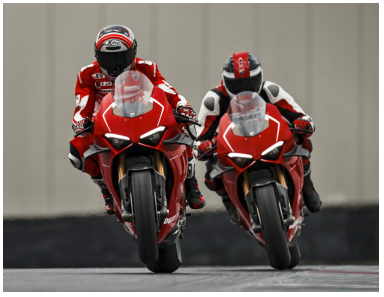
$i$. Find the cartesian equation of the line along which motorcycle $A$ is running. $(1)$
$ii$. Find the direction cosines of line along which motorcycle $A$ is running. $(1)$
$iii$. Find the direction ratios of line along which motorcycle $B$ is running. $(2)$
OR
Find the shortest distance between the given lines. $(2)$ View full solution →Read the following text carefully and answer the questions that follow:
To hire a marketing manager, it's important to find a way to properly assess candidates who can bring radical
changes and has leadership experience.
Ajay, Ramesh and Ravi attend the interview for the post of a marketing manager. Ajay, Ramesh and Ravi
chances of being selected as the manager of a firm are in the ratio $4:1:2$ respectively. The respective probabilities for them to introduce a radical change in marketing strategy are $0.3, 0.8,$ and $0.5$. If the change does take place.

$i.$ Find the probability that it is due to the appointment of Ajay $(A). (1)$
$ii.$ Find the probability that it is due to the appointment of Ramesh $(B). (1)$
$iii$. Find the probability that it is due to the appointment of Ravi $(C). (2)$
OR
Find the probability that it is due to the appointment of Ramesh or Ravi. $(2)$ View full solution →