Questions · Page 2 of 4

2 Marks

Question 512 Marks
Let A = {a, b, c} and the relation R be defined on A as follows: R = {(a, a), (b, c), (a, b)}. Then, write minimum number of ordered pairs to be added in R to make it reflexive and transitive.
Answer
We have,
A = {a, b, c} and R = {(a, a), (b, c), (a, b)}.
R can be a reflexive relation only when elements (b, b) and (c, c) are added to it.
R can be a transitive relation only when the element (a, c) is added to it.
So, the minimum number of ordered pairs to be added in R is 3.
View full question & answer
Question 522 Marks
Let R0 denote the set of all non-zero real numbers and let A = R0 × R0. If '*' is a binary operation on adefined by,
(a, b) * (c, d) = (ac, bd) for all (a, b), (c, d) ∈ A
Find the invertible element in A.
Answer
Let (m, n) be the inverse of $(\text{a, b})\forall(\text{a, b})\in\text{A}$. Then,
(a, b) * (m, n) = (1, 1)
Implies that (am, bn) = (1, 1)
Implies that am = 1 & bn = 1
Implies that $\text{m}=\frac{1}{\text{a}}\text{ and }\text{n}=\frac{1}{\text{b}}$
Thus, $\Big(\frac{1}{\text{a}},\frac{1}{\text{b}}\Big)$ is the inverse of $(\text{a, b})\forall(\text{a, b})\in\text{A}$.
View full question & answer
Question 532 Marks
If f : C → C is defined by f(x) = (x - 2)3, write f-1(-1).
Answer
Let f-1(1) = x ......(1)
⇒ f(x) = -1
⇒ (x - 2)3 = -1
$\Rightarrow\ \text{x}-2=-1\ \text{or }-\omega\text{ or }-\omega^2$
as the roots of $(-1)^\frac{1}{3}$ are $-1,-\omega\text{ and }-\omega^2,$ where $\omega=\frac{1\pm\text{i}\sqrt{3}}{2}$
$\Rightarrow\ \text{x}=-1+2\text{ or }2-\omega\text{ or }2-\omega^2=1,2-\omega,2-\omega$
$\Rightarrow\ \text{f}^{-1}(-1)=1,2-\omega,2-\omega^2$ [from 1]
View full question & answer
Question 542 Marks
Let * be the binary operation on N defined by a * b = H.C.F. of a and b. Is * commutative? Is * associative? Does there exist identity for this binary operation on N?
Answer
a * b = H.C.F. of a and b.

  1. a * b = H.C.F. of a and b = H.C.F. of b and a = b * a

Therefore, operation * is commutative.

  1. (a * b) * c = (H.C.F. of a and b) * c = H.C.F. of (H.C.F. of a and b) and c

= H.C.F. of a, b and c = a * (b * c)

Therefore, the operation is associative.

$1*\text{a}=\text{a}*1\neq\text{a}.$

View full question & answer
Question 552 Marks
Let f: X → Y be an invertible function. Show that f has unique inverse. (Hint: suppose g1 and g2 are two inverses of f. Then for all y ∈ Y, fog1(y) = 1Y(y) = fog2(y). Use one-one ness of f).
Answer
Given: f: X → Y be an invertible function.
Thus f is 1 – 1 and onto and therefore f−1 exists.
Let g1 and g2 be two inverses of f . Then for all $\text{y}\in\text{Y},$
fog1(y) = Iy(y) = fog2(y) $\therefore$ fog1(y) = fog2(y)
⇒ f[g1(y)] = f[g2(y)] ⇒ g1(y) = g2(y)
$\therefore$ The inverse is unique and hence f has a unique inverse.
View full question & answer
Question 562 Marks
If A = {1, 2, 3, 4} define relations on A which have properties of being:
Reflexive, symmetric and transitive.
Answer
The relation on A having properties of being symmetric, reflexive and transitive is,
R = {(1, 1), (2, 2), (3, 3), (4, 4), (1, 2), (2, 1)}
The relation R is an equivalence relation on A.
View full question & answer
Question 572 Marks
Let C denote the set of all complex numbers. A function f : C → C is defined by f(x) = x3. Write f-1(1).
Answer
f : R → R defined by f(x) = x3
$\therefore$ f-1(x3) = x
$\Rightarrow\ \text{f}^{-1}(1)=\{1,\omega,\omega^2\}$ $[\because\ \sqrt[3]{1}=\{1,\omega,\omega^2\}]$
View full question & answer
Question 582 Marks
Find gof and fog when f : R → R and g : R → R are defined by:
f(x) = 2x + x2 and g(x) = x3
Answer
Given: f : R → R and g : R → R
Therefore, gof : R → R and fog : R → R
f(x) = 2x + x2 and g(x) = x3
gof(x) = g(f(x)) = g(2x + x2)
gof(x) = g(2x + x2)3
fog(x) = f(g(x)) = f(x3)
$\therefore$ fog(x) = 2x3 + x6
View full question & answer
Question 592 Marks
Consider f: R+→ [4, ∞) given by f(x) = x2 + 4. Show that f is invertible with the inverse f–1 of f given by $f^{-1}(\text{y})=\sqrt{\text{y}-4},$ where R+ is the set of all non-negative real numbers.
Answer
Consider $f:\text{R}_{+}\rightarrow[4,\infty]$ and f(x) = x2 + 4.
Let $\text{x}_1,\text{x}_2\in\text{R}\rightarrow[4,\infty],\text{ then }f(\text{x}_1)=\text{x}_{1}^{2}+4\text{ and }f(\text{x}_2)=\text{x}_{2}^{2}+4$
$\Rightarrow\ \text{x}_{1}^{2}+4=\text{x}_{2}^{2}+4\Rightarrow\text{x}_1=\text{x}_2\ \ \ \ \ \therefore f\text{ is one-one.}$ 
Now $\text{y}=\text{x}^2+4\Rightarrow\text{x}=\sqrt{\text{y}-4}$ as x > 0
$\therefore\ \ f\left(\sqrt{\text{y}-4}\right)=\left(\sqrt{\text{y}-4}\right)^2+4=\text{y}\ \ f(\text{x})=\text{y}\ \ \ \ \therefore\ f\text{ is onto.}$
Therefore, f(x) is invertible and $f^{-1}(\text{y})=\sqrt{\text{y}-4}.$
View full question & answer
Question 602 Marks
If the mappings f and g are given by f = {(1, 2), (3, 5), (4, 1)} and g = {(2, 3), (5, 1), (1, 3)}, write fog.
Answer
We are given that, f = {(1, 2), (3, 5), (4, 1)} and g = {(2, 3), (5, 1), (1, 3)}

Now, the domain of g is {2, 5, 1}

We know that, fog(x) = f{g(x)}

$\therefore$ fog(2) = f{g(2)} = f(3) = 5

$\therefore$ fog(5) = f{g(5)} = f(1) = 2

$\therefore$ fog(1) = f{g(1)} = f(3) = 5

Therefore, fog = {(2, 5), (5, 2), (1, 5)}

View full question & answer
Question 612 Marks
Write the identity element for the binary operation * defined on the set R of all real numbers by the rule $\text{a}\times\text{b}=\frac{3\text{ab}}{7}\ \forall\text{ a, b}\in\text{R}$.
Answer
We have,
$\text{a}\times\text{b}=\frac{3\text{ab}}{7}$
Let e be the identity element with respect to *. Then
a * e = a
$\Rightarrow\frac{3\text{ae}}{7}=\text{a}\ \Rightarrow\text{e}=\frac{7}{3}$
View full question & answer
Question 622 Marks
Let * be a binary operation on the set Q of rational numbers as follows:
a * b = a – b
Answer
a * b = a - b = -(b - a) = -b * a
$\therefore$ operation is not commutative.
(a * b) * c = (a - b) * c = (a - b) - c = a - b - c
And a * b (b * c) = a * (b - c) = a - (b - c) = a - b + c
Here, $(\text{a}*\text{b})*\text{c}\neq\text{a}*(\text{b}*\text{c})$
$\therefore$ operation * is not associative.
View full question & answer
Question 632 Marks
For each binary operation * defined below, determine whether * is commutative or associative.
On Q, define $\text{a} * \text{b} =\frac{\text{ab}}{2}$
Answer
For commutativity: $\text{a}*\text{b}=\frac{\text{ab}}{2}\ \text{and}\ \text{b}*\text{a}=\frac{\text{ba}}{2}=\frac{\text{ab}}{2}=\text{a}*\text{b}$
For associativity: $\text{a}*(\text{b}*\text{c})=\text{a}*\Big(\frac{\text{bc}}{2}\Big)=\frac{\text{abc/2}}{2}=\frac{\text{abc}}{4}$
Also, $(\text{a}*\text{b})*\text{c}=\Big(\frac{\text{ab}}{2}\Big)*\text{c}=\frac{\text{abc}/2}{2}=\frac{\text{abc}}{4}$
$\therefore$ a * (b * c) = (a * b) * c
Therefore, the operation * is commutative and associative.
View full question & answer
Question 642 Marks
Let S = {a, b, c}. Find the total number of binary operations on S.
Answer
Number of binary operations on a set with n elements is n2.
Here, S = {a, b, c}
Number of elements in S = 3
Number of binary operations on a set with 3 elements is $3^{3^{2}}=3^9$
View full question & answer
Question 652 Marks
Find which of the binary operations are commutative and which are associative.
Show that none of the operations given above has identity.
Answer
Let the identity be I.

  1. $\text{a}*\text{I}=\text{a - I}\neq\text{a}$
  2. $\text{a}*\text{I}=\text{a}^2-\text{I}^2\neq\text{a}$
  3. $\text{a}*\text{I}=\text{a + aI}\neq\text{a}$
  4. $\text{a}*\text{I}=(\text{a - I})^2\neq\text{a}$
  5. $\text{a}*\text{I}=\frac{\text{aI}}{4}\neq\text{a}$
  6. $\text{a}*\text{I}=\text{aI}^2\neq\text{a}$

Therefore, none of the operations given above has identity.

View full question & answer
Question 662 Marks
Let * be a binary operation on the set Q of rational numbers as follows:
a * b = a2+ b2
Answer
a * b = a2 + b2 = b2 + a2 = b * a
$\therefore$ operation is commutative.
(a * b) * c = (a2 + b2) * c = (a2 + b2) + c2 = a2 + b2 + c2
And a * b (b * c) = a * (b2 + c2) = a2 + (b2 + c2)2
Here, $(\text{a}*\text{b})*\text{c}\neq\text{a}*(\text{b}*\text{c})$
$\therefore$ operation * is not associative.
View full question & answer
Question 672 Marks
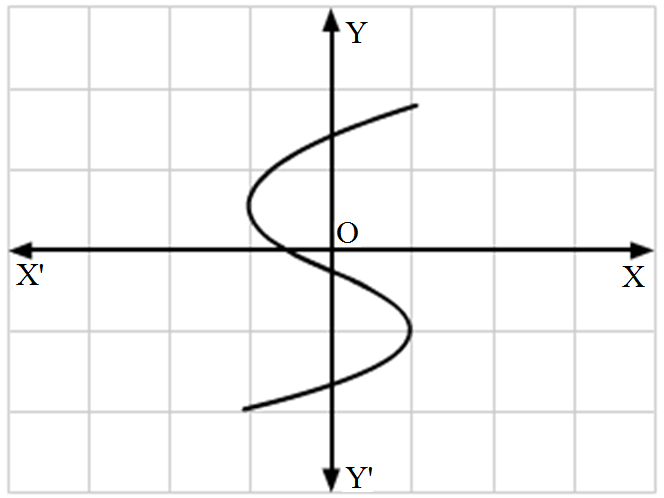
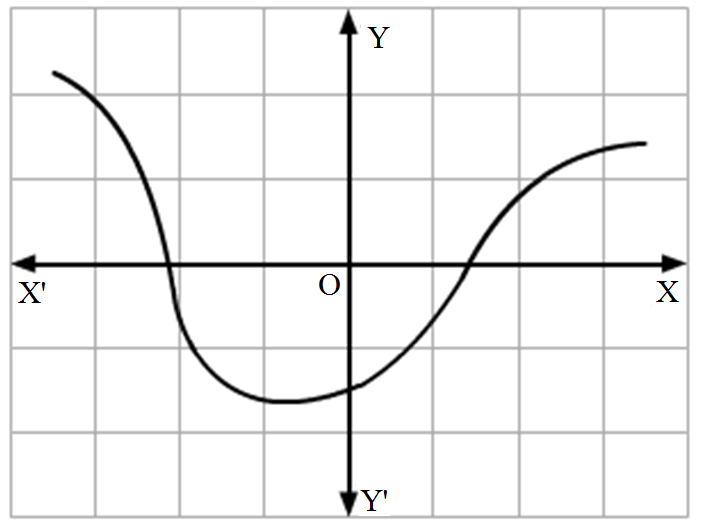
Which one of the following graphs represents a function?

  1.  

  1.  

Answer
Figure (a) represents a function f : R → R
Whereas fig (b) does not represent a function.
View full question & answer
Question 682 Marks
Determine whether the following operations define a binary operation on the given set or not:

$'\odot'$ on N defined by $\text{a}\odot\text{b}=\text{a}^{\text{b}}+\text{b}^{\text{a}}$ for all $\text{a, b}\in\text{N.}$

Answer
Let $\text{a, b}\in\text{N.}$ Then,
$\text{a}^{\text{b}},\text{b}^{\text{a}}\in\text{N}$
$\Rightarrow\ \text{a}^{\text{b}}+\text{b}^{\text{a}}\in\text{N}$ $\big[\because$ Addition is binary operation on N$\big]$
$\Rightarrow\ \text{a}\odot\text{b}\in\text{N}$
Thus, $\odot$ is a binary operation on N.
View full question & answer
Question 692 Marks
Give an example of a relation which is,
Transitive but neither reflexive nor symmetric.
Answer
Let R be the relation on A such that
R = {(1, 2), (2, 3), (1, 3)}
The relation R on A is transitive, but neither symmetric nor reflexive.
View full question & answer
Question 702 Marks
Let 'o' be a binary operation on the set Q0 of all non-zero rational numbers defined by $\text{a}\ ^*\ \text{b}=\frac{\text{ab}}{2}$ for all $\text{a},\text{b}\in\text{Q}_0.$
Find the invertible elements of Q0.
Answer
We have,
 $\text{a }^*\text{ b}=\frac{\text{ab}}{2}$ for all
 $\text{a},\text{b}\in\text{Q}_0$
Let $\text{b}\in\text{Q}_0$ be the inverse of $\text{a}\in\text{Q}_0$ with respect to *, then,
a * b = b * a = e for all $\text{a}\in\text{Q}_0$
$\Rightarrow\frac{\text{ab}}{2}=\text{e}\Rightarrow\frac{\text{ab}}{2}=2$
$\Rightarrow\text{b}=\frac{4}{\text{a}}$
Thus, $\text{b}=\frac{4}{\text{a}}$ is the inverse of a with respect to *.
View full question & answer
Question 712 Marks
Find the identity element in the set I+ of all positive integers defined by a * b = a + b for all a, b ∈ I+.
Answer
Let e be the identity element in I+ with respect to * such that
a * e = a = e * a, $\forall\ \text{a}\in\text{I}^{+}$
a * e = a and e * a = a, $\forall\ \text{a}\in\text{I}^{+}$
a + e = a and e + a = a, $\forall\ \text{a}\in\text{I}^{+}$
e = 0, $\forall\ \text{a}\in\text{I}^{+}$
Thus, 0 is the identity element in I+ with respect to *.
View full question & answer
Question 722 Marks
Let C be the set of complex numbers. Prove that the mapping f : C → R given by f(z) = |z|, ∀ z ∈ C, is neither one-one nor onto.
Answer
The mapping f : C → R

Given, f(z) = |z|, ∀ z ∈ C

f(1) = |1| = 1

f(-1) = |-1| = 1

f(1) = f(-1)

$\text{But}\ 1\neq-1$

So, f(z) is not one-one. Also, f(z) is not onto as there is no pre-image for any negative element of R under the mapping f(z).

View full question & answer
Question 732 Marks
Find the number of all onto functions from the set A = {1, 2, 3, ..., n} to itself.
Answer
We know that every onto function from A to itself is one-one.
Therefore, the number of one-one functions = number of bijections =n!
View full question & answer
Question 742 Marks
Let '*' be a binary operation on N defined by a * b = 1.c.m. (a, b) for all $\text{a, b}\in\text{N}$
Find 2 * 4, 3 * 5, 1 * 6.
Answer
a * b = 1.c.m. (a, b)
2 * 4 = 1.c.m. (2, 4)
= 4
3 * 5 = 1.c.m. (3, 5)
= 15
1 * 6 = 1.c.m. (1, 6)
= 6
View full question & answer
Question 752 Marks
Let 'o' be a binary operation on the set Q0 of all non-zero rational numbers defined by $\text{a}\ ^*\ \text{b}=\frac{\text{ab}}{2}$ for all $\text{a},\text{b}\in\text{Q}_0.$
Show that 'o' is both commutative and associate.
Answer
We have,

 $\text{a }^*\text{ b}=\frac{\text{ab}}{2}$ for all
 $\text{a},\text{b}\in\text{Q}_0$

Commutativity:

Let $\text{a},\text{b}\in\text{Q}_0,$ 
then

$\Rightarrow\text{a }^*\text{ b}=\frac{\text{ab}}{2}=\frac{\text{ba}}{2}=\text{a }^*\text{ b}$

$\Rightarrow\text{a }^*\text{ b}=\text{b }^*\text{ a}$

Thus, * is commutative on Q0.

Associativity:

Let $\text{a},\text{b},\text{c}\in\text{Q}_0,$ then

$\Rightarrow(\text{a }^*\text{ b})\ ^*\ \text{c}=\frac{\text{ab}}{2}\ ....(1)$

and, $\text{a }^*\ (\text{b }^*\text{ c})=\text{a }^*\ \frac{\text{bc}}{2}=\frac{\text{abc}}{4}\ ....(2)$

From (1) & (2)

$(\text{a }^*\text{ b})\ ^*\ \text{c}=\text{a }^*\ (\text{b }^*\text{ c})$

⇒ * is accosiative on Q0.

View full question & answer
Question 762 Marks
If f : A → A, g : A → A are two bijections, then prove that:
fog is an injection.
Answer
Given: A → A, g : A → A are two bijections.
Then, fog : A → A
Injectivity of fog: Let x and y be two elements of the domain (A), such that
(fog)(x) = (fog)(y)
⇒ f(g(x)) = f(g(y))
⇒ g(x) = g(y) (As, f is one-one)
⇒ x = y (As, g is one-one)
So, fog is an injection.
View full question & answer
Question 772 Marks
Let S = {a, b, c} and T = {1, 2, 3}. Find F–1 of the following functions F from S to T, if it exists:
F = {(a, 3), (b, 2), (c, 1)}
Answer
S = {a, b, c}, T = {1, 2, 3}
F: S → T is defined as:
F ={(a, 3), (b, 2), (c, 1)}
⇒ F(a) = 3, F(b) = 2, F(c) = 1
Therefore, F-1: T → S is given by
F-1 = {(3, a), (2, b), (1, c)}.
View full question & answer
Question 782 Marks
Write the total number of binary operations on a set consisting of two elements.
Answer
Number of binary operations on a set with n elements $=\text{n}^{\text{n}^2}$
Here, Number of binary operations on a set with 2 elements $=2^{2^2}$
= 24
=16
View full question & answer
Question 792 Marks
Which of the following functions from A to B are one-one and onto?
f1 = {(1, 3), (2, 5), (3, 7)}; A = {1, 2, 3}, B = {3, 5, 7}
Answer
f1 = {(1, 3), (2, 5), (3, 7)}
A = {1, 2, 3}, B = {3, 5, 7}
We can earily observe that in f1 every element of A has different image from B.
$\therefore$ f1 in not one-one.
Also, each element of B is the image of some element of A.
$\therefore$ f1 in not on to.
View full question & answer
Question 802 Marks
If f : R → R be defined by f(x) = x4, write f-1(1).
Answer
Let f-1(1) = x ......(1)
⇒ f(x) = 1
⇒ x4 = 1
⇒ x4 - 1 = 0
⇒ (x2 - 1)(x2 + 1) = 0 [Using identity: a2 - b2 = (a - b)(a + b)]
⇒ (x - 1)(x + 1)(x2 + 1) = 0 [Using identity: a2 - b2 = (a - b)(a + b)]
$\Rightarrow\ \text{x}=\pm1\ [\text{as x}\in\text{R}]$
⇒ f-1(1) = {-1, 1} [from (1)]
View full question & answer
Question 812 Marks
If A = {2, 3, 4}, B = {1, 3, 7} and R = {(x, y): x ∈ A, y ∈ B and x < y} is a relation from A to B, then write R-1.
Answer
Since R = {(x, y): x ∈ A, y ∈ B and x < y}
R = {(2, 3), (2, 7), (3, 7), (4, 7)}
Hence, R-1 = {(3, 2), (7, 2), (7, 3), (7, 4)}
View full question & answer
Question 822 Marks
If f : A → B is an injection, such that range of f = {a}, determine the number of elements in A.
Answer
Range of f = {a}
Therefore, the number of images of f = 1
Since, is an injection, there will be exactly one image for each element of f.
Therefore, number of element in A = 1.
View full question & answer
Question 832 Marks
If the binary operation * on the set Z of integers is defined by a * b = a + 3b2, find the value of 2 * 4.
Answer
Given: a * b = a + 3b2
Here,
2 * 4 = 2 + 3(4)2
= 2 + 3(16)
= 2 + 48
= 50
View full question & answer
Question 842 Marks
Prove that the operation * on the set $\text{M}=\Bigg\{\begin{bmatrix}\text{a} & 0 \\0 & \text{b} \end{bmatrix};\text{ a, b}\in\text{R}-\{0\}\Bigg\}$ defined by A * B = AB is a binary operation.
Answer
Given that * is an operation that is valid on the set $\text{M}=\Bigg\{\left(\begin{array}{c}\text{a}&0\\ 0&\text{b}\end{array}\right):\text{b}\in \text{R}-\big\{0\big\}\Bigg\}$ and it is defined as given: A * B = AB.
According to the problem it is given that on applying the operation * fore two given numbers in the set 'M' it gives a number in the set 'M' as a result of the operation.
$\Rightarrow \text{A}*\text{B}\in \text{M}...(1)$
Let us take $\text{A}=\left(\begin{array}{c}\text{a}&0\\ 0&\text{b}\end{array}\right)\text{ and }\text{B}=\left(\begin{array}{c}\text{c}&0\\ 0&\text{d}\end{array}\right)$ here $\text{a}\in \text{R},\ \text{c}\in \text{R},\ \text{d}\in \text{R}$ then,
$\Rightarrow \text{AB}=\left(\begin{array}{c}\text{a}&0\\ 0&\text{b}\end{array}\right)\times\left(\begin{array}{c}\text{c}&0\\ 0&\text{d}\end{array}\right)$
$\Rightarrow \text{AB}=\begin{pmatrix}((\text{a}\times\text{c})+(0\times 0))&((\text{a}\times0)+(0\times \text{d}))\$(0\times\text{c})+(\text{b}\times 0))&((0\times0)+(\text{b}\times\text{d})) \end{pmatrix}$
$\Rightarrow \text{Ab}=\begin{pmatrix}(\text{ac}+0)&(0+0)\$0+0)&(0+\text{bd}) \end{pmatrix}$
$\Rightarrow \text{AB}=\begin{pmatrix} \text{ac}&0\\0&\text{bd}\end{pmatrix}$
Since $\text{b}\in \text{R}$ and $\text{c}\in \text{R}$ then $\text{ac}\in \text{R}$
And also $\text{b}\in \text{R}$ and $\text{d}\in \text{R}$ then $\text{bd}\in \text{R}$
$\Rightarrow \text{AB}\in \text{R}$
View full question & answer
Question 852 Marks
Let A = {3, 5, 7}, B = {2, 6, 10} and R be a relation from A to B defined by R = {(x, y): x and y are relatively prime}. Then, write R and R-1.
Answer
R = {(x, y): x and y are relatively prime}
Then,
R = {(3, 2), (5, 2), (7, 2), (3, 10), (7, 10), (5, 6), (7, 6)}
So, R-1 = {(2, 3), (2, 5), (2, 7), (10, 3), (10, 7), (6, 5), (6, 7)}
View full question & answer
Question 862 Marks
Write the domain of the real function $\text{f(x)}=\frac{1}{\sqrt{|\text{x}|-\text{x}}}.$
Answer
Case-1: When x > 0
|x| = x
$\Rightarrow\ \frac{1}{\sqrt{|\text{x}|-\text{x}}}=\frac{1}{\sqrt{\text{x}-\text{x}}}=\frac{1}{0}=\infty$
Case-2: When x < 0
|x| = -x
$\Rightarrow\ \frac{1}{\sqrt{|\text{x}|-\text{x}}}=\frac{1}{\sqrt{-\text{x}-\text{x}}}=\frac{1}{\sqrt{-2\text{x}}}$ (exists because when x < 0, -2x > 0)
⇒ f(x) is defined when x < 0
So, domain $=(-\infty,0)$
View full question & answer
Question 872 Marks
Define an equivalence relation.
Answer
A relation R on a set A is said to be equivalence relation on a if R is:
Reflexive, Symmetric and Transitive.
R = {(x, y): x = y} on the set of real numbers is an equivalence relation.
View full question & answer
Question 882 Marks
f: Z → Z given by f(x) = x2
Answer
f: Z → Z is given by,
f(x) = x2
It is seen that for f(= 1) = f(1) = 1,  but $-1\neq1.$
$\therefore$ f is not injective.
Now, $-2\in\text{Z}.$ But, there does not exist any element $\text{x}\in\text{Z}$ such that f(x) = x2 = -2.
$\therefore$ f is not surjective.
Hence, function f is neither injective but not surjective.
View full question & answer
Question 892 Marks
If A = {a, b, c, d} and the function f = {(a, b), (b, d), (c, a), (d, c)}, write f-1.
Answer
We are given that, f = {(a, b), (b, d), (c, a), (d, c)}
An inverse relation is the set of ordered pairs obtained by interchanging the first and second elements of each pair in the original relation.
$\therefore$ f-1 = {(b, a), (d, b), (a, c), (c, d)}
View full question & answer
Question 902 Marks
Let A = {0, 1, 2, 3} and R be a relation on A defined as R = {(0, 0), (0, 1), (0, 3), (1, 0), (1, 1), (2, 2), (3, 0), (3, 3)}. Is R reflexive? symmetric? transitive?
Answer
We have,

R = {(0, 0), (0, 1), (0, 3), (1, 0), (1, 1), (2, 2), (3, 0), (3, 3)}

As, $(\text{a, a})\in\text{R}\ \forall\ \text{a}\in\text{A}$

So, R is a reflexive relation.

Also, $(\text{a, b})\in\text{R}$ and $(\text{b, a})\in\text{R}$

So, R is a symmetric as well

And, $(0,1)\in\text{R}$ but $(1,2)\notin\text{R}$ and $(2,3)\notin\text{R}$

So, R is not a transitive relation.

View full question & answer
Question 912 Marks
Let A = {1, 2, 3}, B = {4, 5, 6, 7} and let f = {(1, 4), (2, 5), (3, 6)} be a function from A to B. Show that f is one-one.
Answer
It is given that a = {1, 2, 3}, B = {4, 5, 6, 7}
f: A → B is defined as f = {(1, 4), (2, 5), (3, 6)}.
$\therefore$ f(1) = 4, f(2) = 5, f(3) = 6
It is seen that the images of distinct elements of A under f are distinct.
Hence, function f is one-one.
View full question & answer
Question 922 Marks
Let * be a binary operation, on the set of all non-zero real numbers, given by
$\text{a}\times\text{b}=\frac{\text{ab}}{5}\ \forall\text{ a, b}\in\text{R}-\{0\}$
Write the value of x given by 2 * (x * 5) = 10.
Answer
Given: 2 * (x * 5) = 10
Here,
$2\times\Big(\frac{5\text{x}}{5}\Big)=10$
Implies that 2 * x = 10
Implies that $\frac{2\text{x}}{5}=10$
Implies that $\text{x}=\frac{10\times5}{2}$
Implies that x = 25
View full question & answer
Question 932 Marks
Show that the relation R in the set R of real numbers, defined as R = {(a, b) : a ≤ b2} is neither reflexive nor symmetric nor transitive.
Answer
$\text{R}=\big\{(\text{a},\text{b}):\text{a}\leq\text{b}^2\big\},$ Relation R is defined as the set of real numbers.
(i)  Whether $(\text{a},\text{a})\in\text{R},\ \text{then}\ \text{a}\leq\text{a}^2$ which is false. $\therefore$ R is not reflexive.
(ii) Whether (a,b) = (b, a) , then $\text{a}\leq\text{b}^2\ \text{and}\ \text{b}\leq\text{a}^2,$ it is false $\therefore$ R is not symmetric.
(iii) $\text{Now }\text{a}\leq\text{b}^2\ \text{and}\ \text{b}\leq\text{c}^2\Rightarrow\text{a}\leq\text{c}^4,$ which is false $\therefore$ R is not transitive.
Therefore, R is neither reflexive, nor symmetric and nor transitive.
View full question & answer
Question 942 Marks
Write the total number of one-one functions from set A = {1, 2, 3, 4} to set B = {a, b, c}.
Answer
A has 4 elements and B has 3 elements.
Also, one-one function is only possible from A to B if nA ≤ nB.
But, here nA > nB
So, the number of one-one functions from A to B is 0.
View full question & answer
Question 952 Marks
Consider f: {1, 2, 3} → {a, b, c} given by f(1) = a, f(2) = b and f(3) = c. Find f–1 and show that (f–1)–1 = f.
Answer
f = {(1, a), (2, b), (3, c)}, then it is clear that f is 1 – 1 and onto and therefore f-1 exists.
Also, f-1 = {(1, a), (b, 2), (c, 3)} and (f-1)-1 = {(1, a), (2, b), (3, c)} = f
Hence, (f-1)-1 = f.
View full question & answer
Question 962 Marks
If f : R → R is defined by f(x) = 3x + 2, find f(f(x)).
Answer
f(f(x)) = f(3x + 2)
= 3(3x + 2) + 2
= 9x + 6 + 2
= 9x + 8
View full question & answer
Question 972 Marks
Let A = {1, 2, 3, 4} and B = {a, b} be two sets. Write the total number of onto functions from A to B.
Answer
When two sets A and B have m and n elements respectively, then the number of onto functions from A to B is,

$\begin{cases}\sum_{\text{r}=1}^\text{n}(-1)^\text{r}\text{ nC}_\text{r}\text{r}^\text{m},&\text{if m}\geq\text{n}\\0,&\text{if m}<\text{n}\end{cases}$

Here, number of elements in A = 4 = m

Number of elements in B = 2 = n

So, m > n

Number of onto functions

$=\sum_{\text{r}=1}^2(-1)^\text{r}2\text{C}_\text{r}\text{r}^4$

$= (-1)^12\text{C}_11^4 + (-1)^22\text{C}_22^4$

$= -2 + 16$

$= 14$

View full question & answer
Question 982 Marks
If functions f : A → B and g : B → A satisfy gof = IA, then show that f is oneone and g is onto.
Answer
Given that, f : A → B and g : B → A satisfy gof = IA,

$\because$ gof = IA

⇒ gof{f(x1)} = gof{f(x2)}

⇒ g(x1) = g(x2$[\because\text{gof}=\text{I}_\text{A}]$

$\therefore$ x1 = x2

Hence, f is one-one and g is onto.

View full question & answer
Question 992 Marks
Let A = {a, b, c, d} and f : A → A be given by f = {(a, b), (b, d), (c, a), (d, c)}. Write f -1.
Answer
We have,
A = {a, b, c, d} and f : A → A be given by
f = {(a, b), (b, d), (c, a), (d, c)}
(Since, the elements of a function when interchanged gives inverse function. Therefore, f-1 = {(b, a), (d, b), (a, c), (c, d)})
View full question & answer
Question 1002 Marks
Define a transitive relation.
Answer
A relation R on a set A is said to be transitive if
$(\text{a, b})\in\text{R}$ and $(\text{b, c})\in\text{R}$
$\Rightarrow\ (\text{a, c})\in\text{R}$ for all $\text{a, b, c}\in\text{R}$
i.e., aRb and bRc
⇒ aRc for all $\text{a, b, c}\in\text{R}$
View full question & answer
2 Marks - Page 2 - Maths STD 12 Science Questions - Vidyadip