Question
A large conducting plane has a surface charge density $1.0\times10^{-4}\text{Cm}^{-2}.$ Find the electrostatic energy stored in a cubical volume of edge 1.0cm in front of the plane.

Answer

$\sigma=1\times10^{-4}\text{c/m}^2$
$\text{a}=1\text{cm}=1\times10^{-2}\text{m}$
$\text{a}^3=10^{-6}\text{m}$
The energy stored in the plane $=\frac{1}{2}\frac{\sigma^2}{\in_0}=\frac{1}{2}\frac{(1\times10^{-4})^2}{8.85\times10^{-12}}$
$=\frac{10^4}{17.7}=564.97$
The necessary electro static energy stored in a cubical volume of edge 1cm infront of the plane $=\frac{1}{2}\frac{\sigma^2}{\in_0}\text{a}^3=265\times10^{-6}=5.65\times10^{-4}\text{J}$

Need a full question paper?

Generate a complete, print-ready paper with questions like this in minutes — across 16+ boards, with answer keys.
Start Generating Free

Similar questions

A cube of ice of edge 4cm is placed in an empty cylindrical glass of inner diameter 6cm. Assume that the ice melts uniformly from each side so that it always retains its cubical shape. Remembering that ice is lighter than water, find the length of the edge of the ice cube at the instant it just leaves contact with the bottom of the glass.
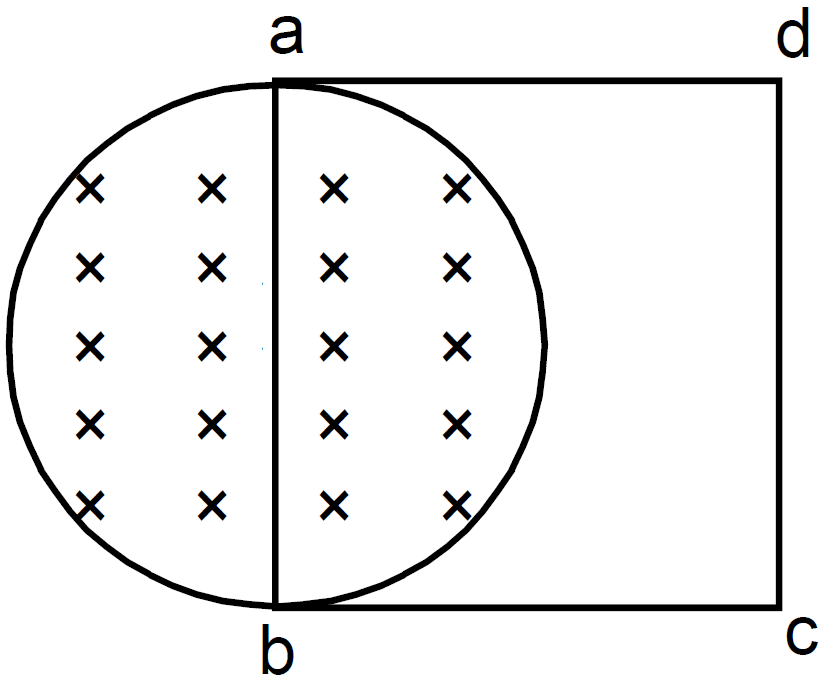
A uniform magnetic field B exists in a cylindrical region of radius 10cm as shown in figure. A uniform wire of length 80cm and resistance $4.0\Omega$ is bent into a square frame and is placed with one side along a diameter of the cylindrical region. If the magnetic field increases at a constant rate of 0.010T/s, find the current induced in the frame.

A particle having a charge of 2.0 × 10-4C is placed directly below and at a separation of 10cm from the bob of a simple pendulum at rest. The mass of the bob is 100g. What charge should the bob be given so that the string becomes loose?
A compound microscope uses an objective lens of focal length 4 cm and eyepiece lens of focal length 10 cm. An object is placed at 6 cm from the objective lens. Calculate the magnifying power of the compound microscope. Also calculate the length of the microscope.
Get the electric field due to on infinitely long straight uniformly changed wire.
Would the Bohr formula for the H-atom remain unchanged if proton had a charge (+4/3)e and electron a charge (-3/4)e, where e = 1.6 × 10⁻¹⁹C. Give reasons for your answer?
Prove that $n_{12}=\frac{1}{\sin i_C}$ where $I_c$ is the critical angle.
The radius of innertmost orbit of hydrogen atom is $5.3 \times 10^{-11} m$. What is the radius of second excited state?
How are electromagnetic waves produced? What is the source of energy carried by a propagating electromagnetic wave? Identify the electromagnetic radiations used:
  1. In remote switches of household electronic devices.
  2. As diagnostic tool in medicine.