A bob suspended from the ceiling of a car which is accelerating on a horizontal road. The bob stays at rest with respect to the car with the string making an angle $\theta$ with the vertical. The linear momentum of the bob as seen from the road is increasing with time. Is it a violation of conservation of linear momentum? If not, where is the external force which changes the linear momentum?
View full solution →Question types
Centre of Mass, Linear Momentum, Collision question types
118 questions across 6 question groups — pick any mix to generate a Physics paper with step-by-step answer keys.
118
Questions
6
Question groups
5
Question types
01
2 Marks Questions
14 Q→023 Marks Question
18 Q→031 Marks Question
5 Q→044 Marks Questions
10 Q→05M.C.Q (1 Marks)
29 Q→065 Marks Questions
42 Q→Sample Questions
Centre of Mass, Linear Momentum, Collision questions
One sample from each question group in this chapter. Select any group above to see the full set with answer keys.
Can the centre of mass of a body be at a point outside the body?
When a nucleus at rest emits a beta particle, it is found that the velocities of the recoiling nucleus and the beta particle are not along the same straight line. How can this be possible in view of the principle of conservation of momentum?
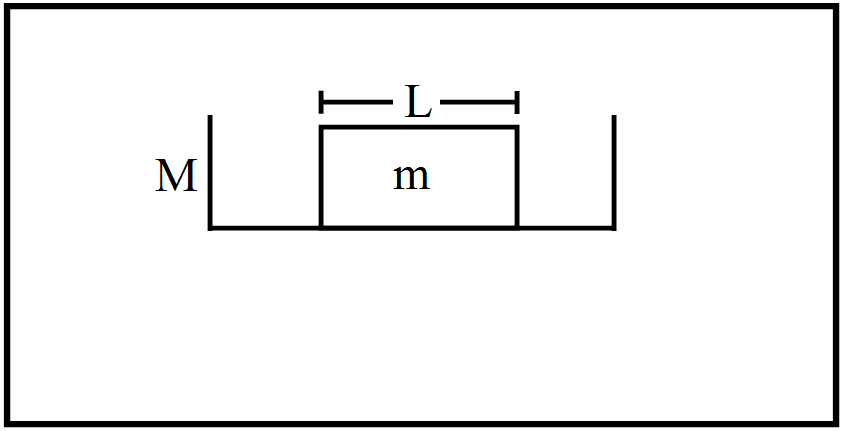
Consider a gravity-free hall in which a tray of mass M, carrying a cubical block of ice of mass m and edge L, is at rest in the middle. If the ice melts, by what distance does the centre of mass of "the tray plus the ice" system descend?
Consider the situation of the previous problem. Take "the table plus the ball" as the system. Friction between the table and the ball is then an internal force. As the ball slows down, the momentum of the system decreases. Which external force is responsible for this change in the momentum?
Two bodies make an elastic head-on collision on a smooth horizontal table kept in a car. Do you expect a change in the result if the car is accelerated on a horizontal road because of the noninertial character of the frame? Does the equation "Velocity of separation = Velocity of approach" remain valid in an accelerating car? Does the equation "Final momentum = Initial momentum" remain valid in the accelerating car?
In one-dimensional elastic collision of equal masses, the velocities are interchanged. Can velocities in a onedimensional collision be interchanged if the masses are not equal?
Two blocks of masses m1 and m2 are connected by a spring of spring constant k. The block of mass m2 is given a sharp impulse so that it acquires a velocity v0 towards right. Find
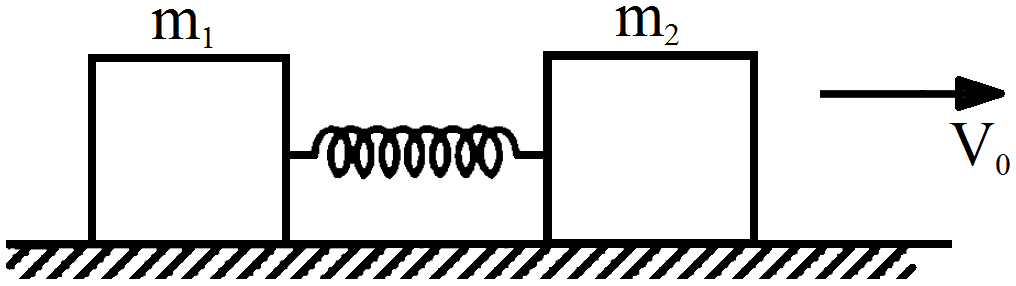
- The velocity of the centre of mass.
- The maximum elongation that the spring will suffer.
Light in certain cases may be considered as a stream of particles called photons. Each photon has a linear momentum $\frac{\text{h}}{\lambda}$ where h is the Planck's constant and $\lambda$ is the wavelength of the light. A beam of light of wavelength $\lambda$ is incident on a plane mirror at an angle of incidence $\theta.$ Calculate the change in the linear momentum of a photon as the beam is reflected by the mirror.
View full solution →The centre of mass is defined as $\overrightarrow{\text{R}}=\frac{1}{\text{M}}\sum\limits_\text{i}\text{m}_\text{i}\overrightarrow{\text{r}_{\text{i}}}.$ Suppose we define "centre of charge" as $\overrightarrow{\text{R}}_\text{c}=\frac{1}{\text{Q}}\sum\limits_\text{i}\text{q}_\text{i}\overrightarrow{\text{r}_{\text{i}}}$ where qi represents the ith charge placed at $\overrightarrow{\text{r}_\text{i}}$ and Q is the total charge of the system.
View full solution →- Can the centre of charge of a two-charge system be outside the line segment joining the charges?
- If all the charges of a system are in X-Y plane, is it necessary that the centre of charge be in X-Y plane?
- If all the charges of a system lie in a cube, is it necessary that the centre of charge be in the cube?
Suppose we define a quantity 'Linear Pomentum' as linear pomentum = mass × speed. The linear pomentum of a system of particles is the sum of linear pomenta of the individual particles. Can we state a principle of conservation of linear pomentum as ''linear pomentum of a system remains constant if no external force acts on it?''
A ball is moved on a horizontal table with some velocity. The ball stops after moving some distance. Which external force is responsible for the change in the momentum of the ball?
If all the particle of a system lie in a cube, is it neccesary that the centre of mass be in the cube?
Use the definition of linear pomentum from the previous question. Can we state the principle of conservation of linear pomentum for a single particle?
If all the particles of a system lie in X-Y plane, is it necessary that the centre of mass be in X-Y plane?
The weight Mg of an extended body is generally shown in a diagram to act through the centre of mass. Does it mean that the earth does not attract other particles?
A fat person is standing on a light plank floating on a calm lake. The person walks from one end to the other on the plank. His friend sitting on the shore watches him and finds that the person hardly moves any distance because the plank moves backward about the same distance as the person moves on the plank. Explain.
Two fat astronauts each of mass 120kg are travelling in a closed spaceship moving at a speed of 15km/s in the outer space far removed from all other material objects. The total mass of the spaceship and its contents including the astronauts is 660kg. If the astronauts do slimming exercise and thereby reduce their masses to 90kg each, with what velocity will the spaceship move?
You are holding a cage containing a bird. Do you have to make less effort if the bird flies from its position in the cage and manages to stay in the middle without touching the walls of the cage? Does it make a difference whether the cage is completely closed or it has rods to let air pass?
A collision experiment is done on a horizontal table kept in an elevator. Do you expect a change in the results if the elevator is accelerated up or down because of the noninertial character of the frame?
If the external force acting on a system have zero resultant, the centre of mass:
- Must not move.
- Must not accelerate.
- May move.
- May accelerate.
In an elastic collision:
- The kinetic energy remains constant.
- The linear momentum remains constant.
- The final kinetic energy is equal to the initial kinetic energy.
- The final linear momentum is equal to the initial linear momentum.
Consider the following two statements:
- The linear momentum of a particle is independent of the frame of reference.
- The kinetic energy of a particle is independent of the frame of reference.
- Both A and B are true.
- A is true but B is false.
- A is false but B is true.
- Both A and B are false.
A ball kept in a closed box moves in the box making collisions with the walls. The box is kept on a smooth surface. The velocity of the centre of mass:
- Of the box remains constant.
- Of the box plus the ball system remains constant.
- Of the ball remains constant.
- Of the ball relative to the box remains constant.
Consider the following two equations:
View full solution →-
$\overrightarrow{\text{R}}=\frac{1}{\text{M}}\sum\limits_{\text{i}}\text{m}_\text{i}\overrightarrow{\text{r}}_\text{i}$
-
$\overrightarrow{\text{a}}_\text{cm}=\frac{\overrightarrow{\text{F}}}{\text{M}}$
- Both are correct.
- Both are wrong.
- A is correct but B is wrong.
- B is correct but A is wrong.
A uniform disc of radius R is put over another uniform disc of radius 2R of the same thickness and density. The peripheries of the two discs touch each other. Locate the centre of mass of the system.
A disc of radius R is cut out from a larger disc of radius 2R in such a way that the edge of the hole touches the edge of the disc. Locate the centre of mass of the residual disc.
Calculate the velocity of the centre of mass of the system of particles shown in figure.
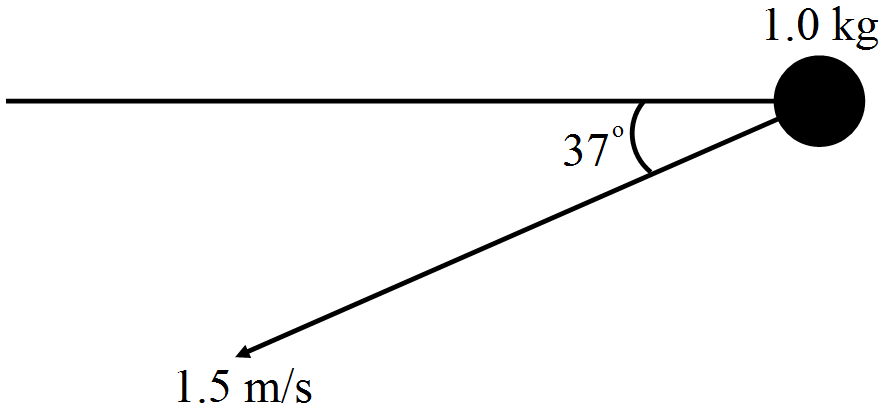
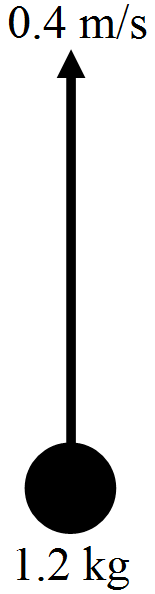
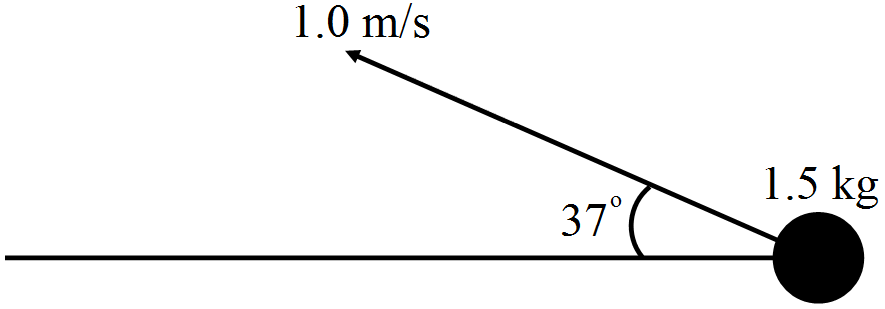

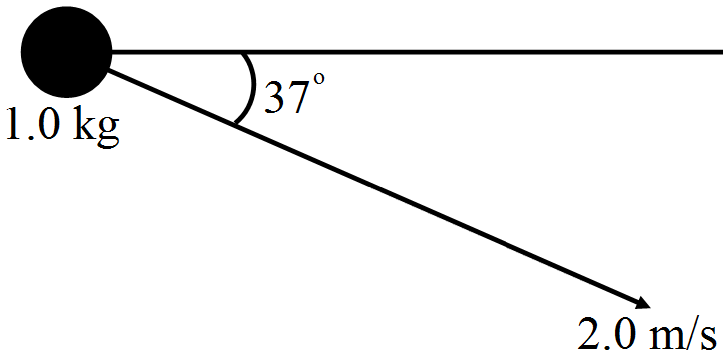
Three particles of masses 1.0kg, 2.0kg and 3.0kg are placed at the corners A, B and C respectively of an equilateral triangle ABC of edge 1m. Locate the centre of mass of the system.
A small particle travelling with a velocity u collides elastically with a spherical body of equal mass and of radius r initially kept at rest. The centre of this spherical body is located a distance (p < r) away from the direction of motion of the particle. Find the final velocities of the two particles.
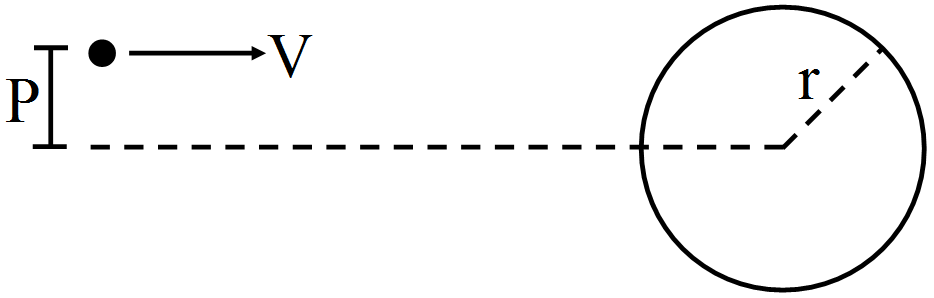
[Hint: The force acts along the normal to the sphere through the contact. Treat the collision as onedimensional for this direction. In the tangential direction no force acts and the velocities do not change].
[Hint: The force acts along the normal to the sphere through the contact. Treat the collision as onedimensional for this direction. In the tangential direction no force acts and the velocities do not change].
Generate a Centre of Mass, Linear Momentum, Collision paper free
Pick question groups from the list above, set marks and difficulty, and export a branded PDF with step-by-step answer keys. First 3 chapters free — no signup.