Questions

3 Marks Question

🎯

Test yourself on this topic

18 questions · timed · auto-graded

Question 13 Marks
Two bodies make an elastic head-on collision on a smooth horizontal table kept in a car. Do you expect a change in the result if the car is accelerated on a horizontal road because of the noninertial character of the frame? Does the equation "Velocity of separation = Velocity of approach" remain valid in an accelerating car? Does the equation "Final momentum = Initial momentum" remain valid in the accelerating car?
Answer
In case car is accelerated it would affect velocity of both bodies,
  1. In this case the change in velocity would affect velocity of both bodies. (body moving in direction of car would slow down and other one moving in opposite direction would speed up in case car is accelerated)
  2. Velocity of separation would be equal to velocity of approach. As only change would be in velocity but everything would remain same.
  3. Yes final momentum would be still equal to initial momentum as with increase in velocity of one body the velocity of other body does decrease.
View full question & answer
Question 23 Marks
In one-dimensional elastic collision of equal masses, the velocities are interchanged. Can velocities in a onedimensional collision be interchanged if the masses are not equal?
Answer
No, it’s not possible as total momentum is to be constant thus if heavy body is at rest and light body is moving the light body will move back with same speed in opposite direction. If a heavy body strikes a lighter body at rest the light body would start moving with double as velocity of heavy body but the heavy body would retain its velocity.
View full question & answer
Question 33 Marks
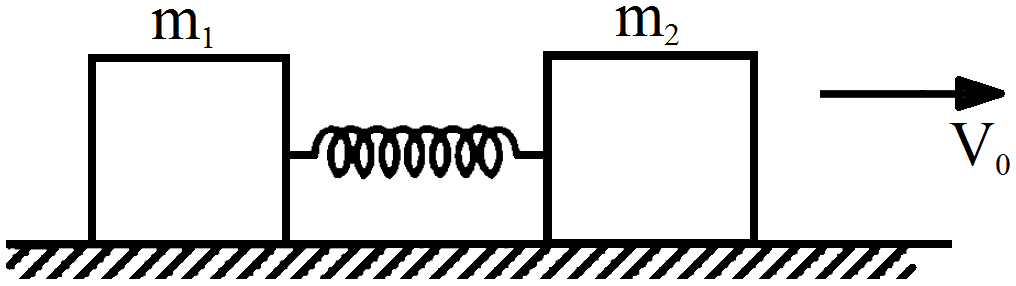
Two blocks of masses m1 and m2 are connected by a spring of spring constant k. The block of mass m2 is given a sharp impulse so that it acquires a velocity v0 towards right. Find
  1. The velocity of the centre of mass.
  2. The maximum elongation that the spring will suffer.
​​​​​​​
Answer
  1. $\therefore$ Velocity of centre of mass $=\frac{\text{m}_2\times\text{v}_0+\text{m}_1\times0}{\text{m}_1+\text{m}_2}=\frac{\text{m}_2\text{v}_0}{\text{m}_1+\text{m}_2}$
  2. The spring will attain maximum elongation when both velocity of two blocks will attain the velocity of centre of mass.
  3. x → maximum elongation of spring.

Change of kinetic energy = Potential stored in spring.

$\Rightarrow\Big(\frac{1}{2}\Big)\text{m}_2\text{v}_0^2-\Big(\frac{1}{2}\Big)(\text{m}_1+\text{m}_2)\Big(\frac{\text{m}_2\text{v}_0}{\text{m}_1+\text{m}_2}\Big)^2=\Big(\frac{1}{2}\Big)\text{kx}^2$

$\Rightarrow\text{m}_2\text{v}_0^2\Big(1-\frac{\text{m}_2}{\text{m}_1+\text{m}_2}\Big)=\text{kx}^2$

$\Rightarrow\text{x}=\Big(\frac{\text{m}_1\text{m}_2}{\text{m}_1+\text{m}_2}\Big)^{\frac{1}{2}}\times\text{v}_0$

View full question & answer
Question 43 Marks
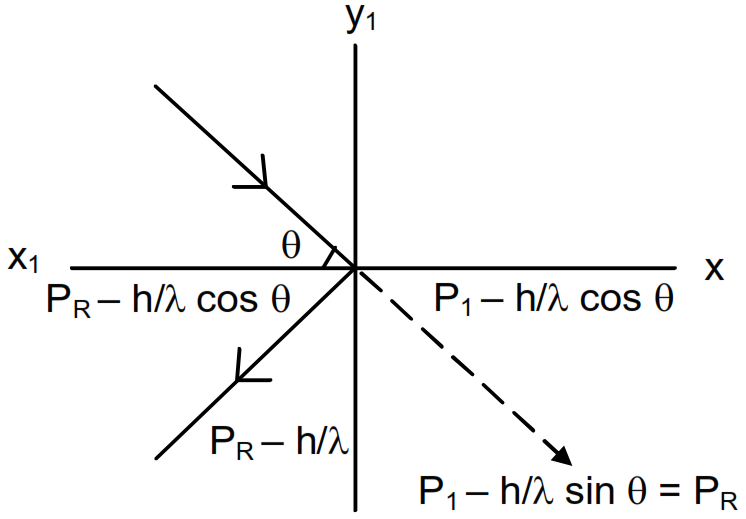
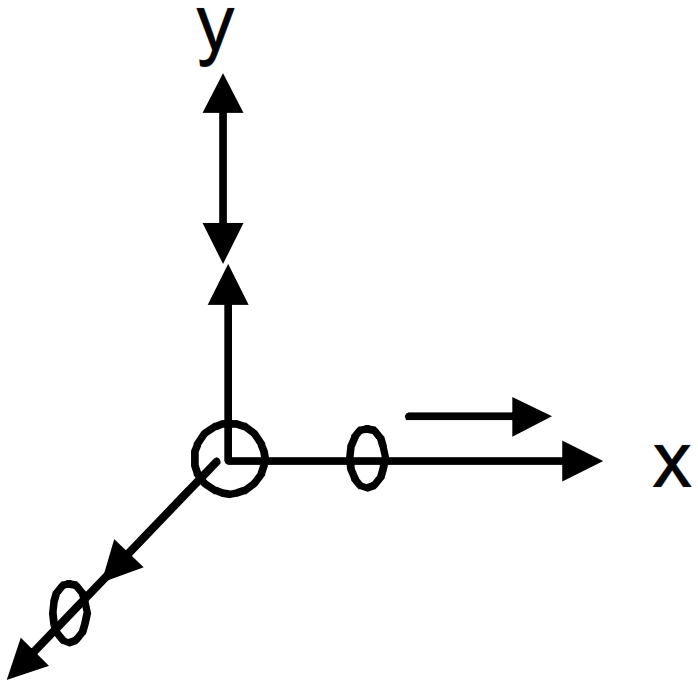
Light in certain cases may be considered as a stream of particles called photons. Each photon has a linear momentum $\frac{\text{h}}{\lambda}$ where h is the Planck's constant and $\lambda$ is the wavelength of the light. A beam of light of wavelength $\lambda$ is incident on a plane mirror at an angle of incidence $\theta.$ Calculate the change in the linear momentum of a photon as the beam is reflected by the mirror.
Answer
$\overrightarrow{\text{P}}_{\text{incidence}}=\Big(\frac{\text{h}}{\lambda}\Big)\cos\theta\hat{\text{i}}-\Big(\frac{\text{h}}{\lambda}\Big)\sin\theta\hat{\text{j}}$

$\overrightarrow{\text{P}}_{\text{Reflected}}=-\Big(\frac{\text{h}}{\lambda}\Big)\cos\theta\hat{\text{i}}-\Big(\frac{\text{h}}{\lambda}\Big)\sin\theta\hat{\text{j}}$

The change in momentum will be only in the x-axis direction. i.e.

$|\triangle\text{P}|=\Big(\frac{\text{h}}{\lambda}\Big)\cos\theta-\Big(\frac{\text{h}}{\lambda}\Big)\cos\theta=\Big(\frac{\text{2h}}{\lambda}\Big)\cos\theta$

View full question & answer
Question 53 Marks
The centre of mass is defined as $\overrightarrow{\text{R}}=\frac{1}{\text{M}}\sum\limits_\text{i}\text{m}_\text{i}\overrightarrow{\text{r}_{\text{i}}}.$ Suppose we define "centre of charge" as $\overrightarrow{\text{R}}_\text{c}=\frac{1}{\text{Q}}\sum\limits_\text{i}\text{q}_\text{i}\overrightarrow{\text{r}_{\text{i}}}$ where qi represents the ith charge placed at $\overrightarrow{\text{r}_\text{i}}$ and Q is the total charge of the system.
  1. Can the centre of charge of a two-charge system be outside the line segment joining the charges?
  2. If all the charges of a system are in X-Y plane, is it necessary that the centre of charge be in X-Y plane?
  3. If all the charges of a system lie in a cube, is it necessary that the centre of charge be in the cube?
Answer
  1. Center of charge can lie away from line segment joining two charges in case both charges are unequal and are of same charge. but eventually would lie on the axis joining two charges.
  2. Yes in case all charge particles are in same plane the center of charge would lie on same plane.
  3. Yes in case all charges are in cube in that case center of charge would lie on the same cube.
View full question & answer
Question 63 Marks
During a heavy rain, hailstones of average size 1.0cm in diameter fall with an average speed of 20m/s. Suppose 2000 hailstones strike every square meter of a 10m × 10m roof perpendicularly in one second and assume that the hailstones do not rebound. Calculate the average force exerted by the falling hailstones on the roof. Density of a hailstone is 900kg/m3.
Answer
$\text{d}=1\text{cm},\ \text{v}=20\text{cm},\ \text{u}=0,\ \rho=900\text{kg/m}^3=0.9\text{gm/cm}^3$

Volume $=\Big(\frac{4}{3}\Big)\pi\text{r}^3=\Big(\frac{4}{3}\Big)\pi(0.5)^3=0.5238\text{cm}^3$

$\therefore$ Mass $=\text{v}_\rho=0.5238\times0.9=0.4714258\text{gm}$

$\therefore$ Mass of 2000 hailstone = 2000 × 0.4714 = 947.857

$\therefore$ Rate of change in momentum per unit area = 947.857 × 2000 = 19N/m3

$\therefore$ Total force exerted = 19 × 100 = 1900N

View full question & answer
Question 73 Marks
Two blocks of masses 10kg and 30kg are placed along a vertical line. The first block is raised through a height of 7cm. By what distance should the second mass be moved to raise the centre of mass by 1cm?
Answer
Two masses m1 & m2 are kept in a vertical line.

m1 = 10kg, m2 = 30kg

The first block is raised through a height of 7cm.

The centre of mass is raised by 1cm.

$\therefore1=\frac{\text{m}_1\text{y}_1+\text{m}_2\text{y}_2}{\text{m}_1+\text{m}_2}=\frac{10\times7+\text{30y}_2}{40}$

$\Rightarrow1=\frac{70+30\text{y}_2}{40}$

$\Rightarrow70+30\text{y}_2=40$

$\Rightarrow30\text{y}_2=-30$

$\Rightarrow\text{y}_2=-1$

The 30kg body should be displaced 1cm downward inorder to raise the centre of mass through 1cm.

View full question & answer
Question 83 Marks
Consider a head-on collision between two particles of masses m1 and m2. The initial speeds of the particles are u1 and u2 in the same direction. The collision starts 2 at t = 0 and the particles interact for a time interval $\triangle\text{t}.$ During the collision, the speed of the first particle varies as.

$\text{v}(\text{t})=\text{u}_1+\frac{\text{t}}{\triangle\text{t}}(\text{v}_1-\text{u}_1).$

Find the speed of the second particle as a function of time during the collision.

Answer
Using law of conservation of momentum.

m1u1 + m2u2 = m1v(t) + m2v'

Where v' = speed of 2nd particle during collision.

$\Rightarrow\text{m}_1\text{u}_1+\text{m}_2\text{u}_2=\text{m}_1\text{u}_1+\text{m}_1+\Big(\frac{\text{t}}{\triangle\text{t}}\Big)(\text{v}_1-\text{u}_1)+\text{m}_2\text{v}'$

$\Rightarrow\frac{\text{m}_2\text{u}_2}{\text{m}^2}-\frac{\text{m}_1}{\text{m}_2}\frac{\text{t}}{\triangle\text{t}}(\text{v}_1-\text{u}_1)\text{v}'$

$\therefore\text{v}'=\text{u}_2-\frac{\text{m}_1}{\text{m}_2}\frac{\text{t}}{\triangle\text{t}}(\text{v}_1-\text{u})$

View full question & answer
Question 93 Marks
A ball falls on the ground from a height of 2.0m and rebounds up to a height of 1.5m. Find the coefficient of restitution.
Answer
Let the velocity of the ball falling from height h1 be u (when it approaches the ground).

Velocity on the ground $\text{u}=\sqrt{2\text{gh}}_1$

Let the velocity of ball when it separates from the ground be v. (Assuming it goes up to height h2)

$\Rightarrow\text{v}=\sqrt{2\text{gh}}_2$

$=\sqrt{2\times9.8\times1.5}$

Let the coefficient of restituti be e.

We khow, v = eu

$\Rightarrow\text{e}=\frac{\sqrt{2\times9.8\times1.5}}{\sqrt{2\times9.8\times2}}=\frac{\sqrt{3}}{2}$

Hence, the coefficient of restitution is $\frac{\sqrt{3}}{2}$

View full question & answer
Question 103 Marks
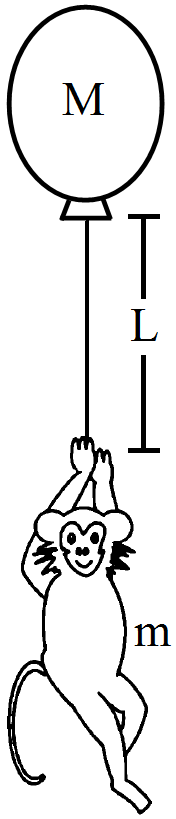
The balloon, the light rope and the monkey shown in figure are at rest in the air. If the monkey reaches the top of the rope, by what distance does the balloon descend ? Mass of the balloon = M, mass of the monkey = m and the length of the rope ascended by the monkey = L.

Answer
Initially the monkey & balloon are at rest.

So the CM is at ‘P’

When the monkey descends through a distance ‘L’

The CM will shift

$\text{t}_0=\frac{\text{m}\times\text{L}+\text{M}\times0}{\text{M}+\text{m}}=\frac{\text{mL}}{\text{M}+\text{m}}$ from P

So, the balloon descends through a distance $\frac{\text{mL}}{\text{M}+\text{m}}$

View full question & answer
Question 113 Marks
In a typical Indian Bugghi (a luxury cart drawn by horses), a wooden plate is fixed on the rear on which one person can sit. A bugghi of mass 200kg is moving at a speed of 10km/h. As it overtakes a school boy walking at a speed of 4km/h, the boy sits on the wooden plate. If the mass of the boy is 25kg, what will be the new velocity of the bugghi?
Answer
Mass of the boggli = 200kg, VB = 10km/ hour.

Mass of the boy = 2.5kg & VBoy = 4km/ hour.

If we take the boy & boggle as a system then total momentum before the process of sitting will remain constant after the process of sitting.

mb Vb = mboyVboy = (mb + mboy)v

⇒ 200 × 10 + 25 × 4 = (200 + 25) × v

$\Rightarrow\text{v}=\frac{2100}{225}=\frac{28}{3}=9.3\text{m/sec}$

View full question & answer
Question 123 Marks
Two blocks of mares 10kg and 20kg are placed on the X-axis. The first mass is moved on the axis by a distance of 2cm. By what distance should the second mass be moved to keep the position of the centre of mass unchanged?
Answer
Two masses m1 & m2 are placed on the X-axis

m1 = 10kg, m2 = 20kg.

The first mass is displaced by a distance of 2cm.

$\therefore\overline{\text{X}}_{\text{cm}}=\frac{\text{m}_1\text{x}_1+\text{m}_2\text{x}_2}{\text{m}_1+\text{m}_2}=\frac{10\times2+\text{20x}_2}{30}$

$\Rightarrow0=\frac{20+20\text{x}_2}{30}$

$\Rightarrow20+20\text{x}_2=0$

$\Rightarrow20=-20\text{x}_2$

$\Rightarrow\text{x}_2=-1$

$\therefore$ The 2nd mass should be displaced by a distance 1cm towards left so as to kept the position of centre of mass unchanged.

View full question & answer
Question 133 Marks
A block at rest explodes into three equal parts. Two parts start moving along X and Y axes respectively with equal speeds of 10m/s. Find the initial velocity of the third part.

Answer
As the block is exploded only due to its internal energy. So net external force during this process is 0. So the centre mass will not change. Let the body while exploded was at the origin of the co-ordinate system. If the two bodies of equal mass is moving at a speed of 10m/s in +x & +y axis direction respectively,

$\sqrt{10^2+10^2+210.10\cos90^\circ}=10\sqrt2\text{m/s}$ 45° w.r.t. + x axis 

If the centre mass is at rest, then the third mass which have equal mass with other two, will move in the opposite direction (i.e. 135° w.r.t. +x- axis) of the resultant at the same velocity.

View full question & answer
Question 143 Marks
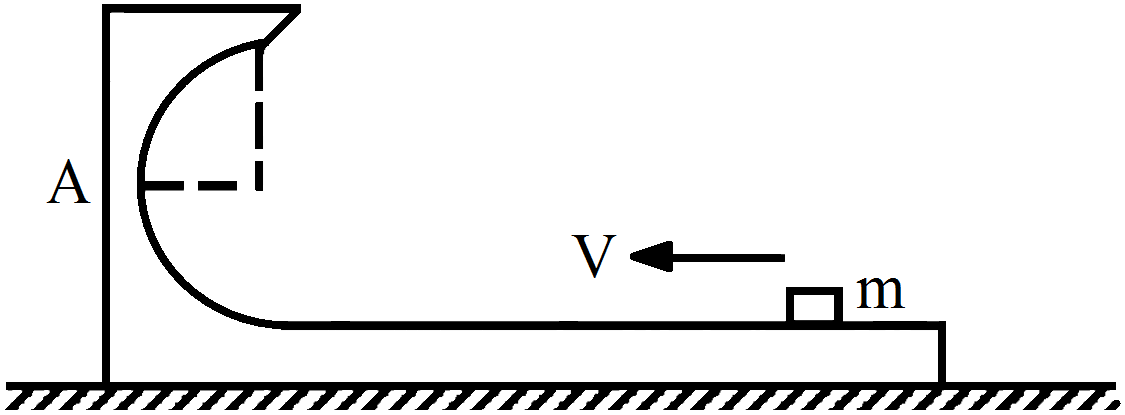
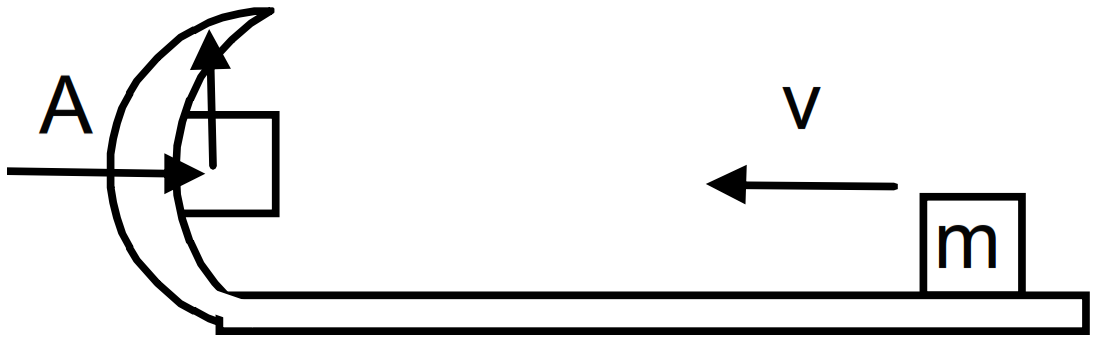
Figure shows a small block of mass m which is started with a speed v on the horizontal part of the bigger block of mass M placed on a horizontal floor. The curved part of the surface shown is semicircular. All the surfaces are frictionless. Find the speed of the bigger block when the smaller block reaches the point A of the surface.

Answer
A small block of mass m which is started with a velocity V on the horizontal part of the bigger block of mass M placed on a horizontal floor.

Since the small body of mass m is started with a velocity V in the horizontal direction, so the total initial momentum at the initial position in the horizontal direction will remain same as the total final momentum at the point A on the bigger block in the horizontal direction.

From L.C.K. m:

$\text{mv}+\text{M}\times\text{O}=(\text{m}+\text{M})\text{v}$

$\Rightarrow\text{v}'=\frac{\text{mv}}{\text{M}+\text{m}}$

View full question & answer
Question 153 Marks
Find the ratio of the linear momenta of two particles of masses 1.0kg and 4.0kg if their kinetic energies are equal.
Answer
Let the mass of the to particles be m1 & m2 respectively

m1 = 1kg, m2 = 4kg

$\therefore$ According to question

$\frac{1}{2}\text{m}_1\text{v}_1^2=\frac{1}{2}\text{m}_2\text{v}_2^2$

$\Rightarrow\frac{\text{m}_1}{\text{m}_2}=\frac{\text{v}_2^2}{\text{v}_1^2}$

$\Rightarrow\frac{\text{v}_2}{\text{v}_1}=\sqrt{\frac{\text{m}_1}{\text{m}_2}}$

$\Rightarrow\frac{\text{v}_1}{\text{v}_2}=\sqrt{\frac{\text{m}_2}{\text{m}_1}}$

Now, $\frac{\text{m}_1\text{v}_1}{\text{m}_2\text{v}_2}=\frac{\text{m}_1}{\text{m}_2}\times\sqrt{\frac{\text{m}_2}{\text{m}_1}}=\sqrt{\frac{\text{m}_1}{\text{m}_2}}=\frac{\sqrt{1}}{\sqrt{4}}=\frac{1}{2}$

$\Rightarrow\frac{\text{m}_1\text{v}_1}{\text{m}_2\text{v}_2}=1:2$

View full question & answer
Question 163 Marks
A 60kg man skating with a speed of 10m/s collides with a 40kg skater at rest and they cling to each other. Find the loss of kinetic energy during the collision.
Answer
Mass of the man = m1 = 60kg

Speed of the man = v1 = 10m/s

Mass of the skater = m2 = 40kg

let its velocity = v'

$\therefore$ 60 × 10 + 0 = 100 × v'

⇒ v' = 6m/s

loss in $\Delta\text{KE}=\frac{1}{2}\text{m}_1\text{v}_1^2-\frac{1}{2}(\text{m}_1+\text{m}_2)\text{v}^2$

$\text{K.E.}=\Big(\frac{1}{2}\Big)60\times(10)^2-\Big(\frac{1}{2}\Big)\times100\times36=1200\text{J}$


View full question & answer
Question 173 Marks
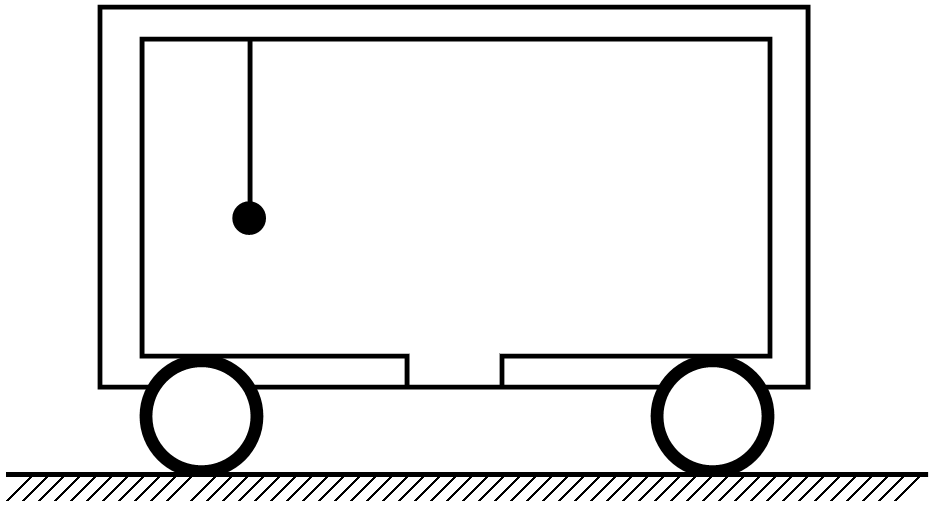
A cart of mass M is at rest on a frictionless horizontal surface and a pendulum bob of mass m hangs from the roof of the cart. The string breaks, the bob falls on the floor, makes several collisions on the floor and finally lands up in a small slot made in the floor. The horizontal distance between the string and the slot is L. Find the displacement of the cart during this process.

Answer
Let the bob fall at A, The mass of bob = m.

The mass of cart = M.

Initially their centre of mass will be at

$\frac{\text{m}\times\text{L}+\text{M}\times0}{\text{M}+\text{m}}=\Big(\frac{\text{m}}{\text{M}+\text{m}}\Big)\text{L}$

Distance from P,

When, the bob falls in the slot the CM is at a distance ‘O’ from P.

Shift in $\text{CM}=0-\frac{\text{mL}}{\text{M}+\text{m}}=-\frac{\text{mL}}{\text{M}+\text{m}}$ towards left

$=\frac{\text{mL}}{\text{M}+\text{m}}$ towards right.

But there is no external force in horizontal direction.

So the cart displaces a distance $\frac{\text{mL}}{\text{M}+\text{m}}$ towards right.

View full question & answer
Question 183 Marks
A ball of mass 0.50kg moving at a speed of 5.0m/s collides with another ball of mass 1.0kg. After the collision the balls stick together and remain motionless. What was the velocity of the 1.0kg block before the collision?
Answer
Mass of the ball = m1 = 0.5kg,

Velocity of the ball = 5m/s

Mass of the another ball m2 = 1kg

Let it’s velocity = v' m/s

Using law of conservation of momentum,

0.5 × 5 + 1 × v' = 0

⇒ v' = -2.5

$\therefore$ Velocity of second ball is 2.5m/s opposite to the direction of motion of 1st ball.

View full question & answer
3 Marks Question - Physics STD 12 Science Questions - Vidyadip