Questions · Page 2 of 11

M.C.Q (1 Marks)

Question 511 Mark

The n rows each containing m cells in series are joined in parallel. Maximum current is taken from this combination across an external resistance of 3W resistance. If the total number of cells used are 24 and internal resistance of each cell is 0.5 W then

(a) m = 8, n = 3

(b) m = 6, n = 4

(c) m= 12, n = 2

(d) m = 2, n = 12

Answer

(c) m= 12, n = 2
View full question & answer
Question 521 Mark

An unknown resistance R1 is connected in series with a resistance of 10 W. This combinations is connected to one gap of a metre bridge while a resistance R2 is connected in the other gap. The balance point is at 50 cm. Now, when the 10 W resistance is removed the balance point shifts to 40 cm. The value of R1 is (in ohm)

(a) 60

(b) 40

(c) 20

(d) 10

Answer

(c) 20

View full question & answer
Question 531 Mark

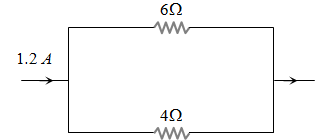
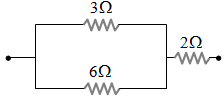
In the figure given below, the current passing through 6 Ω  resistor is

(a) 0.40 ampere

(b) 0.48 ampere

(c) 0.72 ampere

(d) 0.80 ampere

Answer

(b) 0.48 ampere

View full question & answer
Question 541 Mark

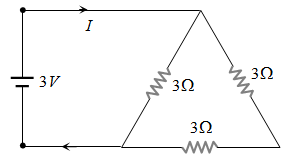
A 3volt battery with negligible internal resistance is connected in a circuit as shown in the figure.  The current I, in the circuit will be

(a) 1/3 A

(b) 1 A

(c) 1.5 A  

(d) 2 A

Answer

(c) 1.5 A  

View full question & answer
Question 551 Mark

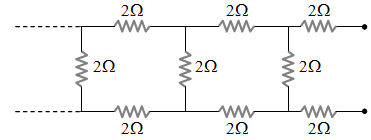
The equivalent resistance of the following infinite network of resistances is

(a) Less than 4 Ω

(b) 4 Ω

(c) More than 4 Ω  but less than 12 Ω
(d) 12 Ω

Answer

(c) More than 4 Ω  but less than 12 Ω

View full question & answer
Question 561 Mark

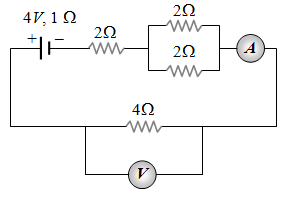
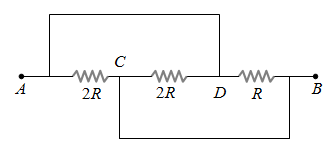
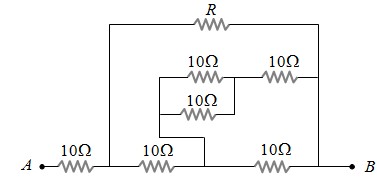
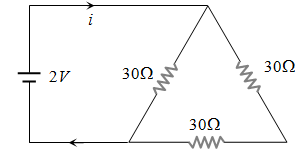
What is the equivalent resistance of the circuit

(a) 6 Ω

(b) 7 Ω

(c) 8 Ω

(d) 9 Ω

Answer

(c) 8 Ω

View full question & answer
Question 571 Mark

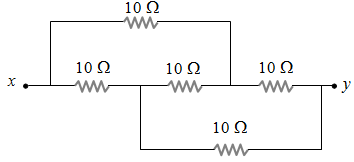
The equivalent resistance between x and y in the circuit shown is

(a) 10 W

(b) 40 W

(c) 20 W

(d)  

Answer

(a) 10 W

View full question & answer
Question 591 Mark

A student has 10 resistors of resistance ‘r’. The minimum resistance made by him from given resistors is

(a) 10 r

(b)  

(c)

(d)  

Answer

(b)  

View full question & answer
Question 601 Mark

Masses of 3 wires of same metal are in the ratio 1 : 2 : 3 and their lengths are in the ratio 3 : 2 : 1.  The electrical resistances are in ratio

(a) 1 : 4 : 9

(b) 9 : 4 : 1

(c) 1 : 2 : 3

(d) 27 : 6 : 1

Answer

(d) 27 : 6 : 1

View full question & answer
Question 611 Mark

Which of the following is vector quantity

(a) Current density

(b) Current

(c) Wattless current

(d) Power

Answer

(a) Current density

View full question & answer
Question 621 Mark

The electric resistance of a certain wire of iron is R. If its length and radius are both doubled, then

(a) The resistance will be doubled and the specific resistance will be halved

(b) The resistance will be halved and the specific resistance will remain unchanged

(c) The resistance will be halved and the specific resistance will be doubled

(d) The resistance and the specific resistance, will both remain unchanged

Answer

(b) The resistance will be halved and the specific resistance will remain unchanged

View full question & answer
Question 631 Mark

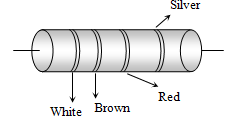
In the figure a carbon resistor has bands of different colours on its body as mentioned in the figure.  The value of the resistance is

(a) 2.2 k W

(b) 3.3 k W

(c) 5.6 k W

(d) 9.1 k W

Answer

(d) 9.1 k W

View full question & answer
Question 641 Mark

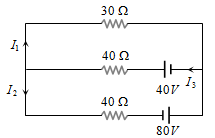
In the given circuit the current I1 is

(a) 0.4 A

(b) – 0.4 A

(c) 0.8 A

(d) – 0.8 A

Answer

(b) – 0.4 A

View full question & answer
Question 651 Mark

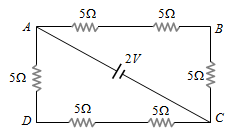
The potential difference between points  A and  B of adjoining figure is

(a)  

(b)  

(c)  

(d) 2 V

Answer

(c)  

View full question & answer
Question 671 Mark

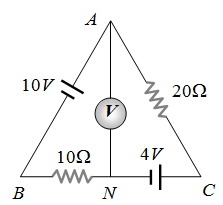
The reading of the ideal voltmeter in the adjoining diagram will be

(a) 4 V

(b) 8 V

(c) 12 V

(d) 14 V

Answer

(b) 8 V

View full question & answer
Question 681 Mark

For what value of R the net resistance of the circuit will be 18 ohms

(a) 8 Ω     

(b) 10 Ω

(c) 16 Ω   

(d) 24 Ω

Answer

(c) 16 Ω   

View full question & answer
Question 691 Mark

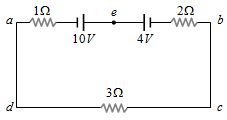
The magnitude and direction of the current in the circuit shown will be

(a)  A from a to b through e

(b)  A from b to a through e

(c) 1 A from b to a through e

(d) 1 A from a to b through e

Answer

(d) 1 A from a to b through e

View full question & answer
Question 701 Mark

Which arrangement of four identical resistances should be used to draw maximum energy from a cell of voltage V

(a)

(b)

(c)

(d)

Answer

(b)

View full question & answer
Question 711 Mark

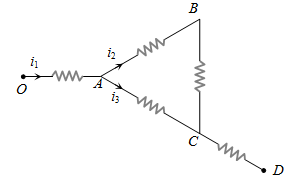
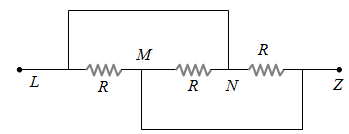
Three equal resistances each of value R are joined as shown in the figure. The equivalent resistance between M and N is

(a) R

(b) 2R

(c)  

(d)  

Answer

(d)  

View full question & answer
Question 741 Mark

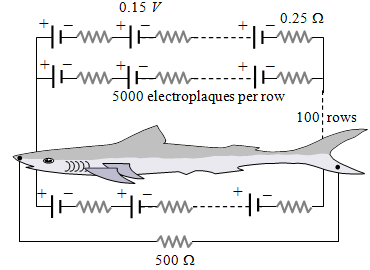
Eels are able to generate current with biological cells called electroplaques. The electroplaques in an eel are arranged in 100 rows, each row stretching horizontally along the body of the fish containing 5000 electroplaques. The arrangement is suggestively shown below. Each electroplaques has an emf of 0.15 V and internal resistance of 0.25 W

The water surrounding the eel completes a circuit between the head and its tail. If the water surrounding it has a resistance of 500 W, the current an eel can produce in water is about

(a) 1.5 A

(b) 3.0 A

(c) 15 A

(d) 30 A

Answer

(a) 1.5 A

View full question & answer
Question 751 Mark

Equal potentials are applied on an iron and copper wire of same length.  In order to have the same current flow in the two wires, the ratio r (iron)/r (copper) of their radii must be (Given that specific resistance of iron =  ohm–m and specific resistance of copper =  1.7  ohm-m)

(a) About 1.2

(b) About 2.4

(c) About 3.6

(d) About 4.8

Answer

(b) About 2.4

View full question & answer
Question 761 Mark

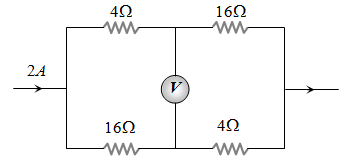
In the circuit shown below,  The reading of the voltmeter V is

(a) 12 V   

(b) 8 V

(c) 20 V

(d) 16 V

Answer

(a) 12 V   

View full question & answer
Question 771 Mark

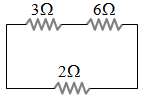
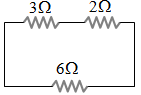
If you are provided three resistances 2 W, 3 W and 6 W. How will you connect them so as to obtain the equivalent resistance of 4 W

(a)

(b)

(c)

(d) None of these

Answer

(c)

View full question & answer
Question 781 Mark

The resistance of a conductor increases with

(a) Increase in length

(b) Increase in temperature

(c) Decrease in cross–sectional area

(d) All of these

Answer

(d) All of these

View full question & answer
Question 791 Mark

A uniform wire of resistance R is uniformly compressed along its length, until its radius becomes n times the original radius.  Now resistance of the wire becomes

(a)   

(b)

(c)  

(d) nR

Answer

(a)   

View full question & answer
Question 801 Mark

The resistance of an incandescent lamp is

(a) Greater when switched off

(b) Smaller when switched on

(c) Greater when switched on 

(d) The same whether it is switched off or switched on

Answer

(c) Greater when switched on 

View full question & answer
Question 811 Mark

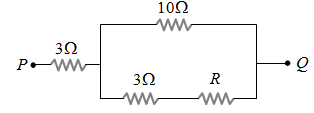
In the circuit shown here, what is the value of the unknown resistor R so that the total resistance of the circuit between points P and Q is also equal to R

(a) 3 ohms

(b)  

(c) ohms

(d) 10 ohms

Answer

(c) ohms

View full question & answer
Question 821 Mark

The resistance of a 5 cm long wire is 10 W.  It is uniformly stretched so that its length becomes 20 cm.  The resistance of the wire is

(a) 160 W   

(b) 80 W

(c) 40 W  

(d) 20 W

Answer

(a) 160 W   

View full question & answer
Question 831 Mark

At room temperature, copper has free electron density of 8.4   per .  The copper conductor has a cross-section of 10–6 m2 and carries a current of 5.4 A.  The electron drift velocity in copper is

(a) 400 m/s

(b) 0.4 m/s

(c) 0.4 mm/s

(d) 72 m/s

Answer

(c) 0.4 mm/s

View full question & answer
Question 841 Mark

There is a current of 40 ampere in a wire of   area of cross-section.  If the number of free electron per   is ,  then the drift velocity will be     

(a) 1.25 ×   m/s

(b) 2.50 ×   m/s

(c) 25.0 ×   m/s

(d) 250 ×  m/s

Answer

(b) 2.50 ×   m/s

View full question & answer
Question 851 Mark

The drift velocity does not depend upon

(a) Cross-section of the wire

(b) Length of the wire

(c) Number of free electrons

(d) Magnitude of the current

Answer

(b) Length of the wire

View full question & answer
Question 861 Mark

If a wire of resistance R is melted and recasted to half of its length, then the new resistance of the wire will be

(a) R/4    

(b) R/2

(c) R 

(d) 2R

Answer

(a) R/4    

View full question & answer
Question 871 Mark

Calculate the amount of charge flowing in 2 minutes in a wire of resistance 10 W when a potential difference of 20 V is applied between its ends

(a) 120 C 

(b) 240 C

(c) 20 C

(d) 4 C

Answer

(b) 240 C

View full question & answer
Question 881 Mark

If an observer is moving with respect to a stationary electron, then he observes

(a) Only magnetic field

(b) Only electric field

(c) Both (a) and (b)

(d) None of the above

Answer

(c) Both (a) and (b)

View full question & answer
Question 891 Mark

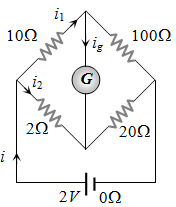
In the circuit shown below the resistance of the galvanometer is 20 W.  In which case of the following alternatives are the currents arranged strictly in the decreasing order

(a) i, i1, i2, ig

(b) i, i2, i1, ig

(c) i, i2, ig, i1

(d) i, i1, ig, i2

Answer

(b) i, i2, i1, ig

View full question & answer
Question 901 Mark

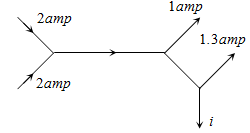
The figure below shows currents in a part of electric circuit. The current i is

(a) 1.7 amp

(b) 3.7 amp

(c) 1.3 amp

(d) 1 amp

Answer

(a) 1.7 amp

View full question & answer
Question 911 Mark

A nichrome wire 50 cm long and one square millimetre cross-section carries a current of 4A when connected to a 2V battery.  The resistivity of nichrome wire in ohm metre is

(a) 1

(b) 4

(c) 3

(d) 2

Answer

(a) 1

View full question & answer
Question 921 Mark

If potential  V = 100 ± 0.5 Volt and current I = 10  ± 0.2 amp are given to us.  Then what will be the value of resistance

(a) 10 ± 0.7 ohm

(b) 5 ± 2 ohm

(c) 0.1 ± 0.2 ohm

(d) None of these

Answer

(d) None of these

View full question & answer
Question 931 Mark

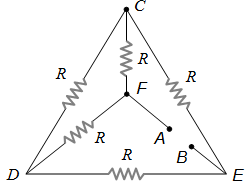
Five equal resistances each of resistance R are connected as shown in the figure. A battery of V volts is connected between A and B. The current flowing in AFCEB will be

(a)  

(b)  

(c)  

(d)         

Answer

(b)  

View full question & answer
Question 941 Mark

The charge of an electron is 1.6 × 10⁻¹⁹ C.  How many electrons strike the screen of a cathode ray tube each second when the beam current is 16 mA

(a) 1017   

(b) 1019

(c) 10–19  

(d) 10–17

Answer

(a) 1017   

View full question & answer
Question 951 Mark

An electron revolves 6 × 10¹⁵ times/sec in circular loop.  The current in the loop is

(a) 0.96 mA

(b) 0.96 m A

(c) 28.8 A

(d) None of these

Answer

(a) 0.96 mA

View full question & answer
Question 961 Mark

At what temperature will the resistance of a copper wire become three times its value at 0 oC  (Temperature coefficient of resistance for copper = 4 × 10⁻³ per oC )

(a)  400 oC

(b)  450 oC

(c)  500 oC

(d)  550 oC

Answer

(c)  500 oC

View full question & answer
Question 971 Mark

A rod of a certain metal is 1.0 m long and 0.6 cm in diameter.  Its resistance is 3.0 ×   ohm.  Another disc made of the same metal is 2.0 cm in diameter and 1.0 mm thick.  What is the resistance between the round faces of the disc

(a) 1.35 ×   ohm

(b) 2.70 ×   ohm

(c) 4.05 ×   ohm

(d) 8.10 ×   ohm

Answer

(b) 2.70 ×   ohm

View full question & answer
Question 981 Mark

If an electron revolves in the path of a circle of radius of 0.5  m at frequency of 5 × 10¹⁵ cycles/s the electric current in the circle is (Charge of an electron = 1.6 × 10⁻¹⁹ C )

(a) 0.4 mA

(b) 0.8 mA

(c) 1.2 mA

(d) 1.6 mA

Answer

(b) 0.8 mA

View full question & answer
Question 991 Mark

The resistance of a conductor is 5 ohm at 50 oC and 6 ohm at 100 oC.  Its resistance at  0 oC is

(a) 1 ohm

(b) 2 ohm

(c) 3 ohm

(d) 4 ohm

Answer

(d) 4 ohm

View full question & answer