Questions · Page 4 of 11

M.C.Q (1 Marks)

Question 1511 Mark

An electric wire is connected across a cell of e.m.f. E. The current  I is measured by an ammeter of resistance R. According to ohm's law

(a)  

(b) E = IR

(c) E = R/I

(d) E = I/R

Answer

(b) E = IR

View full question & answer
Question 1521 Mark

The positive temperature coefficient of resistance is for

(a) Carbon

(b) Germanium

(c) Copper

(d) An electrolyte

Answer

(c) Copper

View full question & answer
Question 1531 Mark

The resistivity of a wire

(a) Increases with the length of the wire

(b) Decreases with the area of cross-section

(c) Decreases with the length and increases with the cross-section of wire

(d) None of the above statement is correct

Answer

(d) None of the above statement is correct

View full question & answer
Question 1541 Mark

A wire of length 5 m and radius 1 mm has a resistance of 1 ohm. What length of the wire of the same material at the same temperature and of radius 2 mm will also have a resistance of 1 ohm

(a) 1.25 m

(b) 2.5 m

(c) 10 m  

(d) 20 m

Answer

(d) 20 m

View full question & answer
Question 1551 Mark

A wire is broken in four equal parts. A packet is formed by keeping the four wires together. The resistance of the packet in comparison to the resistance of the wire will be

(a) Equal

(b) One fourth

(c) One eight

(d)  

Answer

(d)  

View full question & answer
Question 1561 Mark

A certain wire has a resistance R. The resistance of another wire identical with the first except having twice its diameter is

(a)  2R

(b) 0.25 R

(c) 4R

(d) 0.5 R

Answer

(b) 0.25 R

View full question & answer
Question 1571 Mark

A wire 100 cm long and 2.0 mm diameter has a resistance of 0.7 ohm, the electrical resistivity of the material is

(a) 4.4  

(b) 2.2  

(c) 1.1  

(d) 0.22  

Answer

(b) 2.2  

View full question & answer
Question 1581 Mark

When a piece of aluminium wire of finite length is drawn through a series of dies to reduce its diameter to half its original value, its resistance will become

(a) Two times

(b) Four times

(c) Eight times

(d) Sixteen times

Answer

(d) Sixteen times

View full question & answer
Question 1591 Mark

A piece of wire of resistance 4 ohms is bent through 180°  at its mid point and the two halves are twisted together, then the resistance is

(a) 8 ohms

(b) 1 ohm

(c) 2 ohms

(d) 5 ohms

Answer

(b) 1 ohm

View full question & answer
Question 1601 Mark

62.5  electrons per second are flowing through a wire of area of cross-section 0.1, the value of current flowing will be

(a) 1 A

(b) 0.1 A

(c) 10 A

(d) 0.11 A

Answer

(c) 10 A

View full question & answer
Question 1611 Mark

The specific resistance of a wire is ρ, its volume is 3  and its resistance is 3 ohms, then its length will be

(a)  

(b)  

(c)

(d)

Answer

(b)  

View full question & answer
Question 1621 Mark

In a conductor 4 coulombs of charge flows for 2 seconds. The value of electric current will be

(a) 4 volts

(b) 4 amperes

(c) 2 amperes

(d) 2 volts

Answer

(c) 2 amperes

View full question & answer
Question 1631 Mark

When the current i is flowing through a conductor, the drift velocity is v. If  2i  current is flowed through the same metal but having double the area of cross-section, then the drift velocity will be

(a) v/4

(b) v/2

(c) v  

(d) 4v

Answer

(c) v  

View full question & answer
Question 1641 Mark

When current flows through a conductor, then the order of drift velocity of electrons will be

(a)  

(b)  

(c)  

(d)  

Answer

(b)  

View full question & answer
Question 1651 Mark

Every atom makes one free electron in copper. If 1.1 ampere current is flowing in the wire of copper having 1 mm diameter, then the drift velocity (approx.) will be (Density of copper  = 9   and atomic weight = 63)

(a) 0.3 mm/sec

(b) 0.1 mm/sec

(c) 0.2 mm/sec

(d) 0.2 mm/sec

Answer

(b) 0.1 mm/sec

View full question & answer
Question 1661 Mark

Which one is not the correct statement

(a) 1 volt × 1 coulomb = 1 joule

(b) 1 volt × 1 ampere = 1 joule/second

(c) 1 volt × 1 watt = 1 H.P.

(d) Watt-hour can be expressed in eV

Answer

(c) 1 volt × 1 watt = 1 H.P.

View full question & answer
Question 1671 Mark

On increasing the temperature of a conductor, its resistance increases because

(a) Relaxation time decreases

(b) Mass of the electrons increases

(c) Electron density decreases

(d) None of the above

Answer

(a) Relaxation time decreases

View full question & answer
Question 1681 Mark

If a 0.1 % increase in length due to stretching, the percentage increase in its resistance will be

(a) 0.2 %

(b) 2 %

(c) 1 %

(d) 0.1 %

Answer

(a) 0.2 %

View full question & answer
Question 1691 Mark

The specific resistance of manganin is . The resistance of a cube of length 50 cm  will be

(a)  

(b) 2.5  

(c)  

(d) 5  

Answer

(a)  

View full question & answer
Question 1701 Mark

The temperature coefficient of resistance for a wire is 0.00125/. At 300K its resistance is 1 ohm. The temperature at which the resistance becomes 2 ohm is

(a) 1154 K

(b) 1100 K

(c) 1400 K

(d) 1127 K

Answer

(d) 1127 K

View full question & answer
Question 1711 Mark

When the length and area of cross-section both are doubled, then its resistance

(a) Will become half

(b) Will be doubled

(c) Will remain the same

(d) Will become four times

Answer

(c) Will remain the same

View full question & answer
Question 1721 Mark

Two wires of the same material and equal length are joined in parallel combination.  If one of them has half the thickness of the other and the thinner wire has a resistance of 8 ohms, the resistance of the combination is equal to

(a)  

(b)  

(c)  

(d)  

Answer

(b)  

View full question & answer
Question 1731 Mark

To draw maximum current from a combination of cells, how should the cells be grouped

(a) Series

(b)Parallel

(c) Mixed

(d) Depends upon the relative values of external and internal resistance

Answer

(d) Depends upon the relative values of external and internal resistance

View full question & answer
Question 1741 Mark

The resistance of a wire is 20 ohms. It is so stretched that the length becomes three times, then the new resistance of the wire will be

(a) 6.67 ohms

(b) 60.0 ohms

(c) 120 ohms

(d) 180.0 ohms

Answer

(d) 180.0 ohms

View full question & answer
Question 1751 Mark

Ohm's law is true

(a) For metallic conductors at low temperature

(b) For metallic conductors at high temperature

(c) For electrolytes when current passes through them

(d) For diode when current flows

Answer

(a) For metallic conductors at low temperature

View full question & answer
Question 1761 Mark

The resistivity of iron is 1 . The resistance of a iron wire of particular length and thickness is 1 ohm. If the length and the diameter of wire both are doubled, then the resistivity in ohm - m  will be

(a)  

(b) 2  

(c) 4 

(d) 8 

Answer

(a)  

View full question & answer
Question 1771 Mark

The example for non-ohmic resistance is

(a) Copper wire

(b) Carbon resistance

(c) Diode

(d) Tungston wire

Answer

(c) Diode

View full question & answer
Question 1781 Mark

A current of 1 mA is flowing through a copper wire.  How many electrons will pass a given point in one second [e = 1.6 × 10⁻¹⁹ Coulomb]

(a) 6.25 ×  

(b) 6.25 ×  

(c) 6.25 ×

(d) 6.25 ×  

Answer

(b) 6.25 ×  

View full question & answer
Question 1791 Mark

Drift velocity  varies with the intensity of electric field as per the relation

(a)  

(b)  

(c)  constant

(d)

Answer

(a)  

View full question & answer
Question 1801 Mark

A potentiometer wire of length 1 m and resistance 10 W is connected in series with a cell of emf 2V with internal resistance 1 W and a resistance box including a resistance R.  If potential difference between the ends of the wire is 1 mV, the value of R is

(a) 20000 W

(b) 19989 W

(c) 10000 W

(d) 9989 W

Answer

(b) 19989 W

View full question & answer
Question 1811 Mark

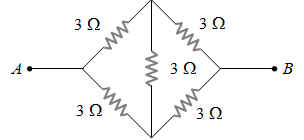
The equivalent resistance of the following diagram A and B is

(a)  

(b) 9 W

(c) 6 W

(d) None of these

Answer

(d) None of these

View full question & answer
Question 1821 Mark

Assertion  :   The electric bulbs glows immediately when switch is on.

Reason      : The drift velocity of electrons in a metallic wire is very high.

(a) If both assertion and reason are true and the reason is the correct explanation of the assertion.

(b) If both assertion and reason are true but reason is not the correct explanation of the assertion.

(c) If assertion is true but reason is false.

(d) If the assertion and reason both are false.

Answer

(c) If assertion is true but reason is false.

View full question & answer
Question 1831 Mark

Assertion  :   The temperature coefficient of resistance is positive for metals and negative for p-type semiconductor.

Reason      : The effective charge carriers in metals are negatively charged whereas in p-type semiconductor they are positively charged.

(a) If both assertion and reason are true and the reason is the correct explanation of the assertion.

(b) If both assertion and reason are true but reason is not the correct explanation of the assertion.

(c) If assertion is true but reason is false.

(d) If the assertion and reason both are false.

Answer

(b) If both assertion and reason are true but reason is not the correct explanation of the assertion.

View full question & answer
Question 1841 Mark

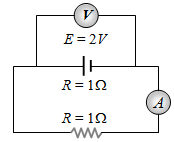
Assertion   :   In the following circuit emf is 2V and internal resistance of the cell is 1 W and R = 1W, then reading of the voltmeter is 1V.

Reason      :  V = E - ir where E = 2V, i =  and R = 1 W

(a) If both assertion and reason are true and the reason is the correct explanation of the assertion.

(b) If both assertion and reason are true but reason is not the correct explanation of the assertion.

(c) If assertion is true but reason is false.

(d) If the assertion and reason both are false.

Answer

(a) If both assertion and reason are true and the reason is the correct explanation of the assertion.

View full question & answer
Question 1851 Mark

Assertion  :  There is no current in the metals in the absence of electric field.

Reason      : Motion of free electron are randomly.

(a) If both assertion and reason are true and the reason is the correct explanation of the assertion.

(b) If both assertion and reason are true but reason is not the correct explanation of the assertion.

(c) If assertion is true but reason is false.

(d) If the assertion and reason both are false.

Answer

(a) If both assertion and reason are true and the reason is the correct explanation of the assertion.

View full question & answer
Question 1861 Mark

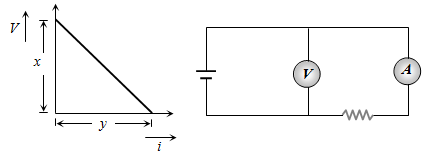
In an experiment, a graph was plotted of the potential difference V between the terminals of a cell against the circuit current i by varying load rheostat. Internal conductance of the cell is given by

(a) xy

(b)  

(c)  

(d) (x – y)

Answer

(b)  

View full question & answer
Question 1871 Mark

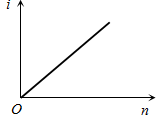
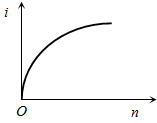
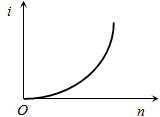
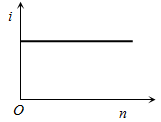
A battery consists of a variable number 'n' of identical cells having internal resistances connected in series. The terminals of battery are short circuited and the current i is measured. Which of the graph below shows the relation ship between i and n

(a)

(b)

(c)

(d)

Answer

(d)

View full question & answer
Question 1881 Mark

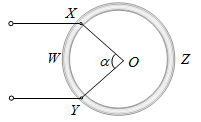
A wire of resistor R is bent into a circular ring of radius r. Equivalent resistance between two points X and Y on its circumference, when angle XOY is a, can be given by

(a)  

(b)  

(c) R (2 pa)

(d)  

Answer

(a)  

View full question & answer
Question 1891 Mark

A moving coil galvanometer has 150 equal divisions. Its current sensitivity is 10 divisions per milliampere and voltage sensitivity is 2 divisions per millivolt. In order that each division reads 1 volt, the resistance in ohms needed to be connected in series with the coil will be

(a) 99995

(b) 9995

(c)  

(d)  

Answer

(b) 9995

View full question & answer
Question 1901 Mark

The resistance of the series combination of two resistance is S. When they are joined in parallel the total resistance is P. If S = nP, then the minimum possible value of n is

(a) 4

(b) 3

(c) 2

(d) 1

Answer

(a) 4

View full question & answer
Question 1911 Mark

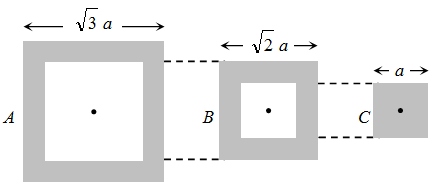
Following figure shows cross-sections through three long conductors of the same length and material, with square cross-section of edge lengths as shown. Conductor B will fit snugly within conductor A, and conductor C will fit snugly within conductor B. Relationship between their end to end resistance is

(a) RA = RB = RC

(b) RA > RB > RC

(c) RA < RB < R

(d) Information is not sufficient

Answer

(a) RA = RB = RC

View full question & answer
Question 1921 Mark

12 cells each having same emf are connected in series with some cells wrongly connected. The arrangement is connected in series with an ammeter and two cells which are in series. Current is 3 A when cells and battery aid each other and is 2 A when cells and battery oppose each other. The number of cells wrongly connected is

(a) 4 

(b) 1

(c) 3  

(d) 2

Answer

(b) 1

View full question & answer
Question 1931 Mark

Length of a hollow tube is 5m, it’s outer diameter is 10 cm and thickness of it’s wall is 5 mm. If resistivity of the material of the tube is 1.7 ×  W × m then resistance of tube will be

(a) 5.6 × 10⁻⁵ W

(b) 2 × 10⁻⁵ W

(c) 4 × 10⁻⁵ W

(d) None of these

Answer

(a) 5.6 × 10⁻⁵ W

View full question & answer
Question 1941 Mark

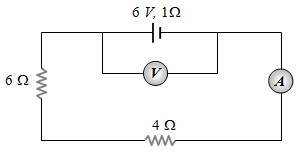
In the circuit shown here, the readings of the ammeter and voltmeter are

(a) 6 A, 60 V

(b) 0.6 A, 6 V

(c) 6/11 A, 60/11 V

(d) 11/6 A, 11/60 V

Answer

(c) 6/11 A, 60/11 V

View full question & answer
Question 1951 Mark

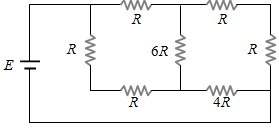
A battery of internal resistance 4W is connected to the network of resistances as shown. In order to give the maximum power to the network, the value of R (in Ω) should be

(a) 4/9     

(b) 8/9

(c) 2  

(d) 18

Answer

(c) 2  

View full question & answer
Question 1961 Mark

Two wires of resistance R1 and R2 have temperature coefficient of resistance  and , respectively.  These are joined in series.  The effective temperature coefficient of resistance is

(a)

(b)

(c)

(d)

Answer

(c)

View full question & answer
Question 1971 Mark

The resistance of a wire of iron is 10 ohms and temp. coefficient of resistivity is  5 . At  20 it carries 30 milliamperes of current. Keeping constant potential difference between its ends, the temperature of the wire is raised to 120. The current in milliamperes that flows in the wire is

(a) 20

(b) 15

(c) 10       

(d) 40

Answer

(a) 20

View full question & answer
Question 1981 Mark

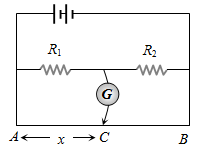
In the shown arrangement of the experiment of the meter bridge if AC corresponding to null deflection of galvanometer is x, what would be its value if the radius of the wire AB is doubled

(a) x

(b) x/4

(c) 4x       

(d) 2x

Answer

(b) x/4

View full question & answer
Question 1991 Mark

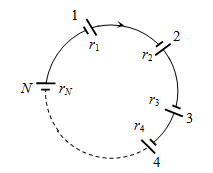
A group of N cells whose emf varies directly with the internal resistance as per the equation EN = 1.5 rN are connected as shown in the figure below.  The current I in the circuit is

(a) 0.51 amp

(b) 5.1 amp

(c) 0.15 amp

(d) 1.5 amp

Answer

(d) 1.5 amp

View full question & answer
Question 2001 Mark

The current in a conductor varies with time t as  where I is in ampere and t in seconds.  Electric charge flowing through a section of the conductor during t = 2 sec to t = 3 sec is

(a) 10 C   

(b) 24 C

(c) 33 C   

(d) 44 C

Answer

(b) 24 C

View full question & answer