Questions · Page 3 of 11

M.C.Q (1 Marks)

Question 1011 Mark

For a metallic wire, the ratio V/i   (V =  the applied potential difference, i = current flowing) is

(a) Independent of temperature

(b) Increases as the temperature rises

(c) Decreases as the temperature rises

(d) Increases or decreases as temperature rises, depending upon the metal

Answer

(b) Increases as the temperature rises

View full question & answer
Question 1021 Mark

Masses of three wires of copper are in the ratio of 1 : 3 : 5 and their lengths are in the ratio of 5 : 3 : 1. The ratio of their electrical resistances are

(a) 1 : 3 : 5

(b) 5 : 3 : 1

(c) 1 : 15 : 125

(d) 125 : 15 : 1

Answer

(d) 125 : 15 : 1

View full question & answer
Question 1031 Mark

If an electric current is passed through a nerve of a man, then man         

(a) Begins to laugh

(b) Begins to weep

(c) Is excited

(d) Becomes insensitive to pain

Answer

(c) Is excited

View full question & answer
Question 1041 Mark

A wire of radius r has resistance R.  If it is stretched to a radius of  , its resistance becomes

(a)  

(b)

(c)      

(d)

Answer

(d)

View full question & answer
Question 1051 Mark

A copper wire of length 1 m and radius 1 mm is joined in series with an iron wire of length 2 m and radius 3 mm and a current is passed through the wires. The ratio of the current density in the copper and iron wires is

(a) 18 : 1

(b) 9 : 1

(c) 6 : 1

(d) 2 : 3

Answer

(b) 9 : 1

View full question & answer
Question 1061 Mark

When a potential difference is applied across the ends of a linear metallic conductor

(a) The free electrons are accelerated continuously from the lower potential end to the higher potential end of the conductor

(b) The free electrons are accelerated continuously from the higher potential end to the lower potential end of the conductor

(c) The free electrons acquire a constant drift velocity from the lower potential end to the higher potential end of the conductor

(d) The free electrons are set in motion from their position of rest

Answer

(c) The free electrons acquire a constant drift velocity from the lower potential end to the higher potential end of the conductor

View full question & answer
Question 1071 Mark

A metal wire of specific resistance 64   and length 198 cm has a resistance of  7 ohm, the radius of the wire will be

(a) 2.4 cm

(b) 0.24 cm

(c) 0.024 cm

(d) 24 cm

Answer

(c) 0.024 cm

View full question & answer
Question 1081 Mark

A current I is passing through a wire having two sections P and Q of uniform diameters d and d/2 respectively.  If the mean drift velocity of electrons in sections P and Q is denoted by vP and vQ respectively, then

(a) vP = vQ

(b) vP =  vQ

(c) vP =  vQ

(d) vP = 2 vQ

Answer

(c) vP =  vQ

View full question & answer
Question 1091 Mark

1.6 mA current is flowing in conducting wire then the number of electrons flowing per second is

(a) 1011

(b) 1016

(c) 1019

(d) 1015

Answer

(b) 1016

View full question & answer
Question 1101 Mark

n equal resistors are first connected in series and then connected in parallel. What is the ratio of the maximum to the minimum resistance

(a) n 

(b)  

(c)       

(d)  

Answer

(c)        

View full question & answer
Question 1111 Mark

 and  are the electrical conductivities of Ge and Na respectively. If these substances are heated, then

(a) Both    and  increase

(b)   increases and   decreases

(c)   decreases and  increases

(d) Both   and  decrease

Answer

(b)   increases and   decreases

View full question & answer
Question 1121 Mark

20 μA current flows for 30 seconds in a wire, transfer of charge will be

(a) 2

(b) 4

(c) 6

(d) 8

Answer

(c) 6

View full question & answer
Question 1131 Mark

Two rods of same material and length have their electric resistance in ratio 1 : 2. When both rods are dipped in water, the correct statement will be

(a) A has more loss of weight

(b) B has more loss of weight

(c) Both have same loss of weight

(d) Loss of weight will be in the ratio 1 : 2

Answer

(a) A has more loss of weight

View full question & answer
Question 1141 Mark

A copper wire has a square cross-section, 2.0 mm on a side.  It carries a current of 8 A and the density of free electrons is 8  . The drift speed of electrons is equal to

(a) 0.156 ×   m.s–1

(b) 0.156 ×   m.s–1

(c) 3.12 ×   m.s–1

(d) 3.12 ×   m.s–1

Answer

(a) 0.156 ×   m.s–1

View full question & answer
Question 1151 Mark

An electron (charge = 1.6 × 10⁻¹⁹ coulomb) is moving in a circle of radius 5.1 × 10⁻¹¹m at a frequency of 6.8 × 10¹⁵ revolutions/sec.  The equivalent current is approximately

(a) 5.1   amp

(b) 6.8  amp

(c) 1.1  amp

(d) 2.2  amp

Answer

(c) 1.1  amp

View full question & answer
Question 1161 Mark

A steady current flows in a metallic conductor of non-uniform cross-section. The quantity/ quantities constant along the length of the conductor is/are

(a) Current, electric field and drift speed

(b) Drift speed only

(c) Current and drift speed

(d) Current only

Answer

(d) Current only

View full question & answer
Question 1171 Mark

The conductivity of a superconductor is

(a) Infinite

(b) Very large

(c) Very small

(d) Zero

Answer

(a) Infinite

View full question & answer
Question 1181 Mark

The resistivity of a wire depends on its

(a) Length

(b) Area of cross-section

(c) Shape

(d) Material

Answer

(d) Material

View full question & answer
Question 1191 Mark

In a wire of circular cross-section with radius r, free electrons travel with a drift velocity V when a current I flows through the wire. What is the current in another wire of half the radius and of the same material when the drift velocity is 2V

(a) 2I

(b) I

(c) I/2  

(d) I/4

Answer

(c) I/2      

View full question & answer
Question 1201 Mark

We are able to obtain fairly large currents in a conductor because

(a) The electron drift speed is usually very large

(b) The number density of free electrons is very high and this can compensate for the low values of the electron drift speed and the very small magnitude of the electron charge

(c) The number density of free electrons as well as the electron drift speeds are very large and these compensate for the very small magnitude of the electron charge

(d) The very small magnitude of the electron charge has to be divided by the still smaller product of the number density and drift speed to get the electric current

Answer

(b) The number density of free electrons is very high and this can compensate for the low values of the electron drift speed and the very small magnitude of the electron charge

View full question & answer
Question 1211 Mark

If the resistance of a conductor is 5 W at 50oC and 7 W at 100oC then the mean temperature coefficient of resistance of the material is

(a) 0.008/oC

(b) 0.006/oC

(c) 0.004/oC

(d) 0.001/oC

Answer

(a) 0.008/oC

View full question & answer
Question 1221 Mark

All of the following statements are true except

(a) Conductance is the reciprocal of resistance and is measured in Siemens

(b) Ohm's law is not applicable at very low and very high temperatures

(c) Ohm's law is applicable to semiconductors

(d) Ohm's law is not applicable to electron tubes, discharge tubes and electrolytes

Answer

(c) Ohm's law is applicable to semiconductors

View full question & answer
Question 1231 Mark

Two wires A and B of same material and same mass have radius 2rand r. If resistance of wire A is 34 Ω, then resistance of B will be

(a) 544 Ω

(b) 272 Ω

(c) 68 Ω

(d) 17 Ω

Answer

(a) 544 Ω

View full question & answer
Question 1241 Mark

A solenoid is at potential difference 60 V and current flows through it is 15 ampere, then the resistance of coil will be

(a) 4 Ω 

(b) 8 Ω

(c) 0.25 Ω

(d) 2 Ω

Answer

(a) 4 Ω 

View full question & answer
Question 1251 Mark

The reciprocal of resistance is

(a) Conductance

(b) Resistivity

(c) Voltage

(d) None of the above

Answer

(a) Conductance

View full question & answer
Question 1261 Mark

Which of the following has a negative temperature coefficient

(a) C 

(b) Fe

(c) Mn

(d) Ag

Answer

(a) C 

View full question & answer
Question 1271 Mark

The resistance of a wire is R. If the length of the wire is doubled by stretching, then the new resistance will be

(a) 2R

(b) 4R

(c) R 

(d)  

Answer

(b) 4R

View full question & answer
Question 1281 Mark

Through a semiconductor, an electric current is due to drift of

(a) Free electrons

(b) Free electrons and holes

(c) Positive and negative ions

(d) Protons

Answer

(b) Free electrons and holes

View full question & answer
Question 1291 Mark

The resistance of a discharge tube is

(a) Ohmic

(b) Non-ohmic

(c) Both (a) and (b)

(d) Zero

Answer

(b) Non-ohmic

View full question & answer
Question 1301 Mark

When there is an electric current through a conducting wire along its length, then an electric field must exist

(a)  Outside the wire but normal to it

(b) Outside the wire but parallel to it

(c) Inside the wire but parallel to it

(d) Inside the wire but normal to it

Answer

(c) Inside the wire but parallel to it

View full question & answer
Question 1311 Mark

Resistance of tungsten wire at 150  is 133 . Its resistance temperature coefficient is 0.0045/. The resistance of this wire at 500  will be

(a) 180 Ω

(b) 225 Ω

(c) 258 Ω

(d) 317 Ω

Answer

(c) 258 Ω

View full question & answer
Question 1321 Mark

A certain piece of silver of given mass is to be made like a wire. Which of the following combination of length (L) and the area of cross-sectional (A) will lead to the smallest resistance

(a) L and A

(b) 2L and A/2

(c) L/2 and 2 A

(d) Any of the above, because volume of silver remains same

Answer

(c) L/2 and 2 A

View full question & answer
Question 1331 Mark

In an electrolyte 3.2   bivalent positive ions  drift to the right per second while 3.6   monovalent negative ions drift to the left per second. Then the current is

(a) 1.6 amp to the left

(b) 1.6 amp to the right

(c) 0.45 amp to the right

(d) 0.45 amp to the left

Answer

(b) 1.6 amp to the right

View full question & answer
Question 1341 Mark

A metallic block has no potential difference applied across it, then the mean velocity of free electrons is  T = absolute temperature of the block)

(a) Proportional to T

(b) Proportional to  

(c) Zero

(d) Finite but independent of temperature

Answer

(b) Proportional to  

View full question & answer
Question 1351 Mark

Which of the following statement is correct

(a) Liquids obey fully the ohm's law

(b) Liquids obey partially the ohm's law

(c) There is no relation between current and p.d. for liquids

(d) None of the above

Answer

(b) Liquids obey partially the ohm's law

View full question & answer
Question 1361 Mark

The relaxation time in conductors

(a) Increases with the increase of temperature

(b) Decreases with the increase of temperature

(c) It does not depend on temperature

(d) All of sudden changes at 400 K

Answer

(b) Decreases with the increase of temperature

View full question & answer
Question 1371 Mark

An electric wire of length ‘I’ and area of cross-section a has a resistance R ohms. Another wire of the same material having same length and area of cross-section 4a has a resistance of

(a) 4R

(b) R/4

(c) R/16

(d) 16R

Answer

(b) R/4

View full question & answer
Question 1381 Mark

Two wires of the same material are given. The first wire is twice as long as the second and has twice the diameter of the second. The resistance of the first will be

(a) Twice of the second

(b) Half of the second

(c) Equal to the second

(d) Four times of the second

Answer

(b) Half of the second

View full question & answer
Question 1391 Mark

The drift velocity of free electrons in a conductor is ‘v’ when a current ‘i’ is flowing in it.  If both the radius and current are doubled, then drift velocity will be

(a) v

(b)  

(c)  

(d)  

Answer

(b)  

View full question & answer
Question 1401 Mark

5 amperes of current is passed through a metallic conductor. The charge flowing in one minute in coulombs will be

(a) 5 

(b) 12

(c) 1/12

(d) 300

Answer

(d) 300

View full question & answer
Question 1411 Mark

It is easier to start  a car engine on a hot day than on a cold day. This is because the internal resistance of the car battery

(a) Decreases with rise in temperature

(b) Increases with rise in temperature

(c) Decreases with a fall in temperature

(d) Does not change with a change in temperature

Answer

(a) Decreases with rise in temperature

View full question & answer
Question 1421 Mark

If n, e, τ and m respectively represent the density, charge relaxation time and mass of the electron, then the resistance of a wire of length l  and area of cross-section  A will be

(a)  

(b)

(c)  

(d)

Answer

(a)  

View full question & answer
Question 1431 Mark

There is a current of 1.344 amp in a copper wire whose area of cross-section normal to the length of the wire is 1 . If the number of free electrons per   is 8.4 , then the drift velocity would be

(a) 1.0 mm/sec

(b) 1.0 m/sec

(c) 0.1 mm/sec

(d) 0.01 mm/sec

Answer

(c) 0.1 mm/sec

View full question & answer
Question 1441 Mark

The resistance of a wire of uniform diameter d and length L is R. The  resistance of another wire of the same material but diameter 2d  and length 4L will be

(a) 2R

(b) R

(c) R/2

(d) R/4

Answer

(b) R

View full question & answer
Question 1451 Mark

The resistances of a wire at temperatures t and 0  are related by

(a)  

(b)  

(c)  

(d)  

Answer

(a)  

View full question & answer
Question 1461 Mark

The electric intensity  E, current density j  and specific resistance k are related to each other by the relation

(a) E = j/k

(b) E = jk

(c) E = k/j

(d) k = jE

Answer

(b) E = jk

View full question & answer
Question 1471 Mark

There is a current of 20 amperes in a copper wire of  square metre area of cross-section. If the number of free electrons per cubic metre is , then the drift velocity is

(a) 125  

(b) 12.5  

(c) 1.25  

(d) 1.25  

Answer

(c) 1.25  

View full question & answer
Question 1481 Mark

In the above question, the resistance between the square faces is

(a) 3  

(b) 3  

(c) 3  

(d) 3  

Answer

(d) 3  

View full question & answer
Question 1491 Mark

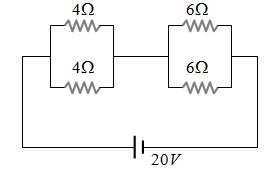
Four resistances are connected in a circuit in the given figure. The electric current flowing through 4 ohm and 6 ohm resistance is respectively

(a)  2 amp and 4 amp

(b) 1 amp and 2 amp

(c) 1 amp and 1 amp

(d) 2 amp and 2 amp

Answer

(d) 2 amp and 2 amp

View full question & answer
Question 1501 Mark

The fact that the conductance of some metals rises to infinity at some temperature below a few Kelvin is called

(a) Thermal conductivity

(b) Optical conductivity

(c) Magnetic conductivity

(d) Superconductivity

Answer

(d) Superconductivity

View full question & answer