MCQ 1011 Mark
Flux density under trailing pole tips in case of generator will:
- ✓
- B
- C
either increase or decrease
- D
Answer$\text{LPT}=$ leading pole tip
$\text{TPT}=$ tailling pole top
Considering armature reaction.
where $\text{GNA}=$Geometrical axis
$\text{MNA}=$ Magnetic neutral axis
here clearly see that $\text{TPT}$ side flux increases due to armature in case of generator.
View full question & answer→MCQ 1021 Mark
A metal rod moves at a constant velocity in a direction perpendicular to its length. A constant uniform magnetic field exists in space in a direction perpendicular to the rod as well its velocity. Select correct statements $(s)$ from the following.
- A
the entire rod is at the same potential
- ✓
there is an electric field in the rod
- C
the electric potential is highest at the centre
- D
the electric potential is lowest at its centre and increases towards its ends
AnswerCorrect option: B. there is an electric field in the rod
The moving rod develops an electric field $= Bvl$
and the $\text{EMF}$ induced is such that it opposes the change of magnetic field.
Due to shifting of electrons, one end of the rod becomes positive and the other end negative. This developes a electric field in the rod.
View full question & answer→MCQ 1031 Mark
A tank containing a liquid has turns of wire wrapped around it, causing it to act as an inductor. The liquid content of the tank can be measured by using its inductance to determine the height of the liquid level in the tank. The inductance of the tank changes from a value of $L_0$ corresponding to a relative permeability of $1$ when the tank is empty to value $L_f$ corresponding to a relative permeability $X_m$ (relative permeability of liquid) when the tank is full. The appropriate electronic circuit can determine the inductance correct upto $5$ significant figures and thus the effective relative permeability of the combined air and liquid within the rectangular has height $D$. The height of the liquid level in the tank is d . Ignore the fringing effects. Assume tank is fitted with $H _{ g } X _{ Hg }=2.9 \times 10^5$. Express d as a function of $L$, inductance corresponding to a certain liquid height $LO,Lf$ and $D$.
- ✓
$\text{d}=\frac{(\text{L - L})_0\text{D}}{\text{L}_\text{f}-\text{L}_0}$
- B
$\text{d}=\frac{\text{L}\text{D}}{\text{L}_\text{f}-\text{L}_0}$
- C
$\text{d}=\frac{(\text{L - L})_0\text{D}}{\text{L}_\text{f}}$
- D
$\text{None of these}$
AnswerCorrect option: A. $\text{d}=\frac{(\text{L - L})_0\text{D}}{\text{L}_\text{f}-\text{L}_0}$
Inductance of empty tank $=L_0$
Relative permeability $=1$
Inductance of full tank $=L_f$
Relative permeability $=X_m$
Now, $L_f-L_0 \alpha D$
and $L_f-L_0 \alpha \frac{1}{d}$
therefore, $\left(L_f-L_0\right)$
or $\left(L_f-L_0\right)=k \frac{D}{d}[k \text { is the probability constant }]$
Now when the tank is filled partly with liquid and partly empty, Inductance $= L$
$K=L-L_0$
$L_f-L_0=\left(L-L_0\right) \frac{D}{d}$
$d=\frac{(L-L)_0 D}{L_f-L_0}$
View full question & answer→MCQ 1041 Mark
What is the $SI$ unit of self$-$inductance?
AnswerHenry $($symbol $H)$ is the $SI$ derived unit of self$-$inductance.
View full question & answer→MCQ 1051 Mark
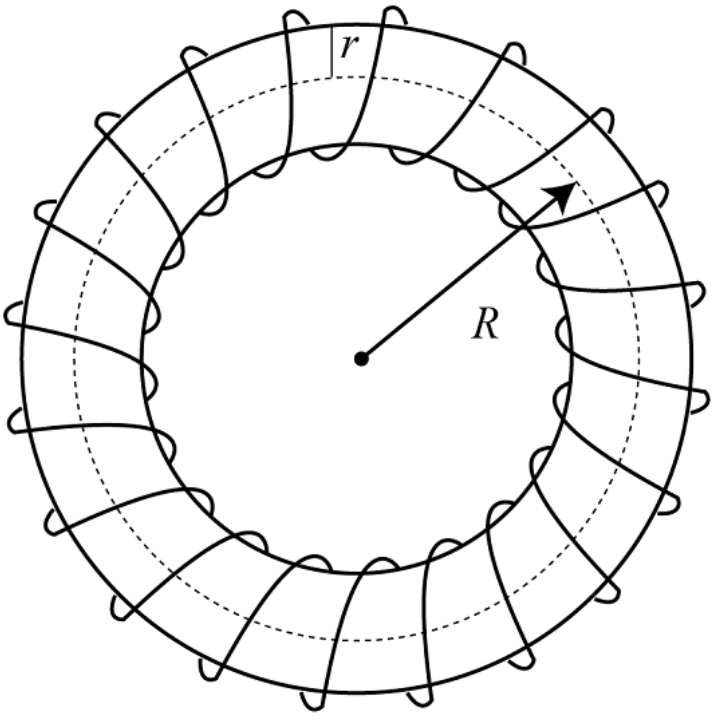
A toroid is wound over a circular core with total no. of turns equal to $N$. The radius of each turn is $r$ and radius of toroid is $R(>>r).$ The coefficient of self$-$inductance of the toroid is given by.
- A
$\text{L}=\frac{\text{M}_0\text{Nr}^2}{2\text{R}}$
- B
$\text{L}=\frac{\text{M}_0\text{Nr}}{2\text{R}}$
- C
$\text{L}=\frac{\text{M}_0\text{Nr}^2}{\text{R}}$
- ✓
$\text{L}=\frac{\text{M}_0\text{N}^2{\text{r}}^2}{2\text{R}}$
AnswerCorrect option: D. $\text{L}=\frac{\text{M}_0\text{N}^2{\text{r}}^2}{2\text{R}}$
$\text{L}=\frac{\text{F}}{\text{I}},\text{f}=\text{NAB}$
$\text{B}=\text{M}_0\text{nI}$
Where $\text{n}=\frac{\text{N}}{2\pi\text{R}}$
$\therefore\text{F}=\text{N}\pi\text{r}^2=\bigg(\text{M}_0\frac{\text{N}}{2\pi\text{R}}\text{I}\bigg)$
$\text{F}=\frac{\text{M}_0\text{N}^2{\text{r}}^2\text{I}}{2\text{R}}$
$\text{L}=\frac{\text{F}}{\text{I}},=\frac{\text{M}_0\text{N}^2{\text{r}}^2}{2\text{R}}$
View full question & answer→MCQ 1061 Mark
The self induction takes place when magnetic flux through a coil:
- A
- B
- C
- ✓
Either $(B)$ or $(C)$
AnswerCorrect option: D. Either $(B)$ or $(C)$
As per Faradays law, $\text{EMF}$ is always directly proportional to the rate of change of magnetic flux. Therefore, electromagnetic induction takes place whenever the magnetic flux passing through the object changes.
View full question & answer→MCQ 1071 Mark
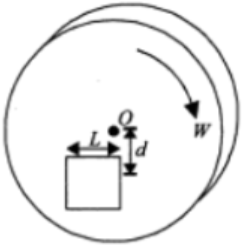
Find the approximate value of induced current assuming the resistance to the current is confined to the square.
- ✓
$\frac{\text{BL}\omega\text{dt}}{\rho}$
- B
$\frac{\text{BL}^2\omega\text{dt}}{\rho}$
- C
$\frac{\text{BL}^2\omega\text{d}}{\rho}$
- D
$\frac{\text{BL}\omega\text{d}^2}{\rho}$
AnswerCorrect option: A. $\frac{\text{BL}\omega\text{dt}}{\rho}$
$\text{emf},\in=\frac{\text{d}\phi}{\text{dt}}=\text{BL}^2\omega$
$\text{I}=\frac{\in}{\text{R}}=\frac{\text{BL}^2\omega}{\rho\frac{\text{L}}{\text{dt}}}=\frac{\text{BL}\omega\text{dt}}{\rho}$
View full question & answer→MCQ 1081 Mark
Two identical cycle wheels $($geometrically$)$ have different number of spokes connected from center to rim. One is having $20$ spokes and the other having only $10 ($the rim and the spokes are resistanceless$)$. One resistance of value $R$ is connected between center and rim. The current in $R$ will be.
- A
double in the first wheel than in the second wheel
- B
four times in the first wheel than in the second wheel
- C
will be double in the second wheel than that of the first wheel
- ✓
will be equal in both these wheels
AnswerCorrect option: D. will be equal in both these wheels
View full question & answer→MCQ 1091 Mark
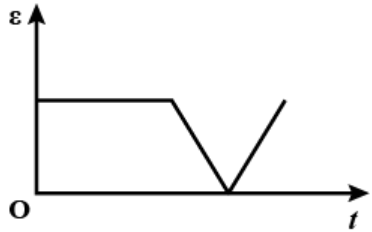
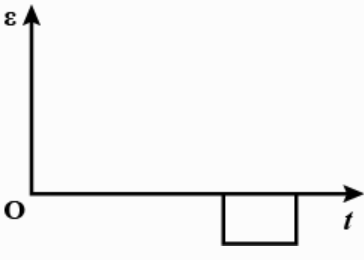
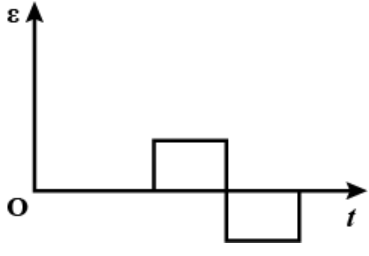
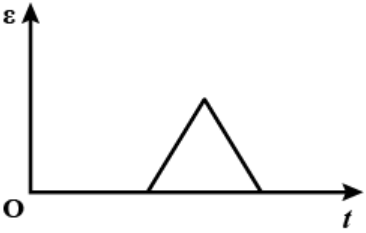
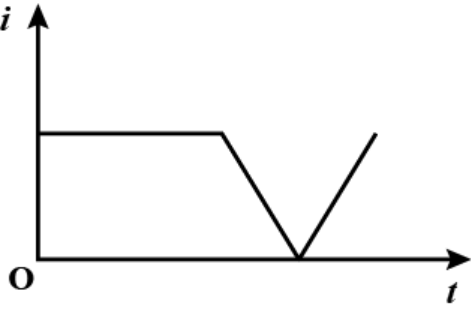
The current I in an induction coil varies with time t according to the graph shown in the figure. Which of the following graphs shows the induced emf (ε)in the coil with time.
MCQ 1101 Mark
The coefficient of mutual induction between two coils is $1.25 H$ . If the rate of fall of current in the primary is $80 As ^{-1}$, then the induced emf in the secondary coil will be.
- ✓
$100V$
- B
$64V$
- C
$12.5V$
- D
$0.016V$
AnswerCorrect option: A. $100V$
$\text{emf}=-\text{M}\frac{\text{dI}}{\text{dt}}$
$= − 1.25 \times-80 = 100\text{V}$
View full question & answer→MCQ 1111 Mark
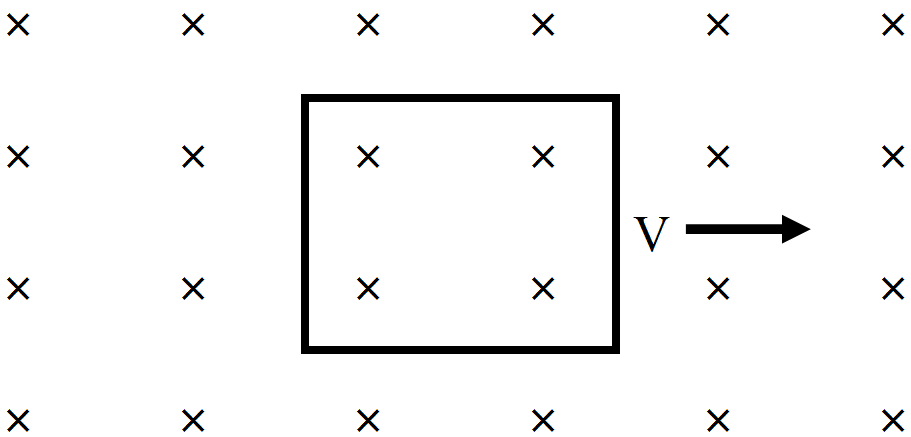
A conducting square loop of side $l$ and resistance $R$ moves in its plane with a uniform velocity $u$ perpendicular to one of its sides. A uniform and constant magnetic field $B$ exists along the perpendicular to the plane of the loop as shown in figure. The current induced in the loop is:
- A
$\frac{\text{Blv}}{\text{R}}$ clockwise.
- B
$\frac{\text{Blv}}{\text{R}}$ anticlockwise.
- C
$\frac{2\text{Blv}}{\text{R}}$ anticlockwise.
- ✓
$\text{Zero.}$
AnswerCorrect option: D. $\text{Zero.}$
Induced emf is $AB$ is $Bvl$ and Induced emf is $DC$ is also Bvl.
Net emf in the closed circuit $($loop$)$ is zero.
So induced current in the loop is zero.
View full question & answer→MCQ 1121 Mark
Solve the previous question if the closed loop is completely enclosed in the circuit containing the switch.
- A
An anticlockwise current$-$pulse.
- B
A clockwise current$-$pulse.
- ✓
An anticlockwise current$-$pulse and then a clockwise current$-$pulse.
- D
A clockwise current$-$pulse and then an anticlockwise current$-$pulse.
AnswerCorrect option: C. An anticlockwise current$-$pulse and then a clockwise current$-$pulse.
An anticlockwise current$-$pulse generated and then a clock$-$wise current pulse.
View full question & answer→MCQ 1131 Mark
The coefficient of mutual inductance of the two coils is $5H$. The current through the primary coil is reduced to zero value from $3A$ in $1$ millisecond. The induced emf in the secondary coils is.
AnswerCorrect option: C. $15KV$
Flux linking the secondary coil due to current in primary $= Mi _1$
induced emf in the secondary coils $=$ rate of change of flux
$=\text{M}\frac{\triangle\text{i}_1}{\triangle\text{t}}$
$=5\times\frac{3-0}{0.001}$
$=15\text{kv}$
View full question & answer→MCQ 1141 Mark
A solenoid $($air core$)$ ahs $400$ turns, is $20 \ cm$ long and has a cross section of $4 \ cm^2$. Then the coefficient of self induction is approximately
- A
$4 \times 10^{-5} H$
- B
$4 \times 10^1 H$
- ✓
$4 \times 10^{-4} H$
- D
$4H$
AnswerCorrect option: C. $4 \times 10^{-4} H$
$n = 400$ turns, $l = 20 \ cm, A=4 \ cm^2$
$L = ?$
$\text{L}=\frac{1.25\times10^{-6}\text{Hm}^{-1}\times400\times400\times4\times100}{100\times100\times20}$
$=4 \times 10^{-4} H$
View full question & answer→MCQ 1151 Mark
Complete the following statement. For electromagnetic induction to occur:
- ✓
a magnet must be at rest within a coil of wire
- B
a coil of wire must be at rest relative to the magnet.
- C
a magnet must move through a coil of wire.
- D
a magnet and a coil must have the same velocity.
AnswerCorrect option: A. a magnet must be at rest within a coil of wire
Current is induced in a coil when flux through the coil changes. The flux through the coil changes when a magnet moves relative to the coil and coil is at rest relative to the magnet.
View full question & answer→MCQ 1161 Mark
In one second, a current of $10$ A changes through a coil. The induced emf is $10V$, then, self-inductance of the coil is
AnswerFrom Faradays law the induced emf ise $=\text{L}\frac{\text{di}}{\text{dt}}$
Given, $di = 10A, dt = 1s, e = 10$
$\therefore10=\text{L}\frac{10}{1}$
$\Rightarrow\text{L}=1\text{H}$
View full question & answer→MCQ 1171 Mark
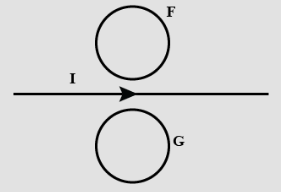
Two conducting circular loops $F$ and $G$ are kept in a plane on either side of a straight current$-$carrying wire as shown in the figure below. If the current in the wire decreases in magnitude, the induced current in the loops will be.
- A
clockwise in $F$ and clockwise in $G.$
- ✓
anti$-$clockwise in $F$ and clockwise in $G.$
- C
clockwise in $F$ and anti$-$clockwise in $G.$
- D
anti-clockwise in $F$ and anti$-$clockwise in $G.$
AnswerCorrect option: B. anti$-$clockwise in $F$ and clockwise in $G.$
The magnetic field above the wire is out of the plane. This flux is decreasing and should be compensated by the current in the loop $F$ and so the current in loop $F$ will be anti$-$clockwise. For loop $G$ the situation is opposite
View full question & answer→MCQ 1181 Mark
A straight copper wire is moved in a uniform magnetic field such that it cuts the magnetic lines of force. Then
- A
- ✓
- C
sometimes emf will be induced and sometimes not
- D
AnswerAs the copper wire cuts the magnetic lines of force, the free charges in the wire will experience a force and will get displaced. This displacement of charges in the wire creates a potential difference and hence emf is induced.
View full question & answer→MCQ 1191 Mark
A conducting rod of length $l$ and mass $m$ is moving down a smooth inclined plane of inclination $\theta$ with constant velocity $v$. A current i is flowing in the conductor in a direction perpendicular to paper inward. A vertically upward magnetic field $B$ exists in space. Then, magnitude of magnetic field $B$ is:
- A
$\frac{\text{mg}}{\text{il}}\sin\theta$
- ✓
$\frac{\text{mg}}{\text{il}}\tan\theta$
- C
$\frac{\text{mg}\cos\theta}{\text{il}}\tan\theta$
- D
$\frac{\text{mg}}{\text{il}\sin\theta}$
AnswerCorrect option: B. $\frac{\text{mg}}{\text{il}}\tan\theta$
The magnetic force due to the conducting rod of length $I$ and mass $m$ is, $F_m=i(I \times B)$, the angle between $I$ and $B$ is $90^{\circ}$.
$F_m= ilB$
The horizontal component of $F _{ m }$ is
$F = F _{ m } \cos \theta$
The force due to gravity is $F = mg$ and its horizontal component is
$F ^{\prime \prime}= mg \sin \theta$
From the above figure,
$mg \sin \theta= ilB \cos \theta$
$B =\frac{ mg }{ il } \tan \theta$
View full question & answer→MCQ 1201 Mark
Which of the following best describe the electromagnetic induction?
- ✓
The ability of a changing magnetic field to induce a voltage in a conductor
- B
The ability of a conductor to generate a magnetic field
- C
The ability of a static magnetic field to induce a voltage in a conductor
- D
The ability of a permanent magnet to induce a voltage in a coil
AnswerCorrect option: A. The ability of a changing magnetic field to induce a voltage in a conductor
Electromagnetic induction is a process where a conductor placed in a changing magnetic field $($or a conductor moving through a stationary magnetic field$)$ causes the production of a voltage across the conductor. Changing magnetic field causes a change in flux which gives rise to induced emf. Also, a moving rod in a uniform magnetic field would mean moving electrons in a magnetic field which would exert force on them to move in a particular direction in the rod, thus creating a potential difference across ends.
View full question & answer→MCQ 1211 Mark
Mark the incorrect statement.
- A
electric current produces magnetism.
- B
magnets can produce electric current.
- ✓
magnets can't produce electric current.
- D
$a$ and $b$
AnswerCorrect option: C. magnets can't produce electric current.
A magnet can generate electric current by the means of electromagnetic induction. When there is a relative motion between a coil and a magnet, the magnetic flux linked to the coil changes due to that relative motion. This change in magnetic flux will induce a current in the coil, which is known as induced current.
View full question & answer→MCQ 1221 Mark
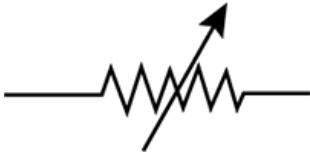
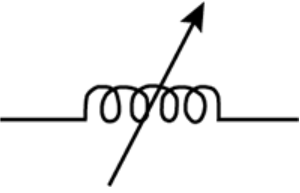
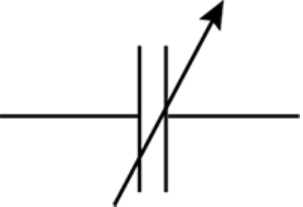
Given below are the symbols of a few electronic components. Which of these components denote a variable inductor?
AnswerAn inductor whose inductance can be adjusted is known as variable inductor. It may consist, for instance, of a coil whose inductance can be varied by using one or more moving elements such as taps or sliding contacts. This contrasts with a fixed inductor, which has a single inductance which cannot be varied.
View full question & answer→MCQ 1231 Mark
The rate of change of current needed to induce an emf of $8V$ in $0.1H$ coil is.
- A
$\frac{0.8\text{A}}{\text{s}}$
- B
$\frac{0.125\text{A}}{\text{s}}$
- ✓
$\frac{80\text{A}}{\text{s}}$
- D
$\frac{8\text{A}}{\text{s}}$
AnswerCorrect option: C. $\frac{80\text{A}}{\text{s}}$
$\text{emf}=\text{L}\frac{\text{di}}{\text{dt}}$
$\frac{\text{di}}{\text{dt}}=\frac{\text{emf}}{\text{L}}$
$=\frac{8}{0.1}$
$=\frac{80\text{A}}{\text{s}}$
View full question & answer→MCQ 1241 Mark
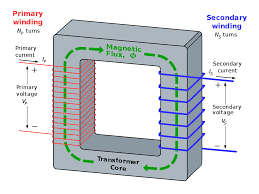
Which of the following statement regarding transformer is incorrect?
AnswerCorrect option: D. The current induced in primary circuit is of same nature as in secondary circuit with differences in amplitude only.
The transformer does this by linking together two or more electrical circuits using .The two coil windings are not electrically connected but are only .The difference in voltage between the primary and the secondary windings is .Also this induced voltage has the same frequency as the primary winding voltage.The current induced in primary circuit is of same nature as in secondary circuit with differences in amplitude only.A transformer is a static electrical device that transfers electrical energy between two or more circuits through electromagnetic induction.
View full question & answer→MCQ 1251 Mark
An $LR$ circuit with a battery is connected at $t = 0$. Which of the following quantities is not zero just after the connection?
- A
- B
Magnetic field energy in the inductor.
- C
Power delivered by the battery.
- ✓
Emf induced in the inductor.
AnswerCorrect option: D. Emf induced in the inductor.
Current will be zero at $t = 0+$
if the current is zero magnetic field will be zero at $t = 0+$
power delivered will be zero at $t = 0+$
The $\text{EMF}$ induced will be equal to the applied voltage in the inductor to oppose the current.
View full question & answer→MCQ 1261 Mark
A coil of self-inductance $L$ is connected in series with a bulb $B$ and an $AC$ source. Brightness of the bulb decreases when:
AnswerCorrect option: D. an iron rod is inserted in the coil
Self$-$inductance of a coil is,
$\text{L}=\frac{\mu_0\mu_\text{r}\text{N}^2\text{A}}{1}$
Current flow through the circuit,
$\text{I}=\frac{\text{E}}{(\text{W}^2\text{L}^2+\text{R}^2)^\frac{1}{2}}$
Current in the circuit decrease with increasing self-inductance,
$\text{L}\alpha\mu_\text{r}.$
When an iron rod is inserted in the coil, self$-$inductance increases, and the current decreases.
The brightness of the bulb decreases.
View full question & answer→MCQ 1271 Mark
Two ends of a conducting rod of varying cross$-$section are maintained at $200^{\circ} C$ and $0^{\circ} C$ respectively, figure. In steady state.
- A
Temperature difference across $AB$ and $CD$ are equal
- B
Temperature difference across $AB$ is greater than that of $CD$
- ✓
Temperature difference across $AB$ is less than that across $CD$
- D
Temperature difference may be equal of different depending on the thermal conductivity of the rod
AnswerCorrect option: C. Temperature difference across $AB$ is less than that across $CD$
View full question & answer→MCQ 1281 Mark
When a current of $5A$ flows in the primary coil then the flux linked with the secondary coil is $200$ weber. The value of coefficient of mutual induction will be
- A
$1000H$
- ✓
$40H$
- C
$195H$
- D
$205H$
AnswerCoefficient of mutual induction will be the ratio of the flux linked with the secondary coil and the current primary coil.
$\text{M}=\frac{200}{5}=40\text{H}$
View full question & answer→MCQ 1291 Mark
A conducting disc of radius r spins about its axis with an angular velocity ω. There is a uniform magnetic field of magnetude B perpendicular to the plane of the disc. C is the centre of the ring.
MCQ 1301 Mark
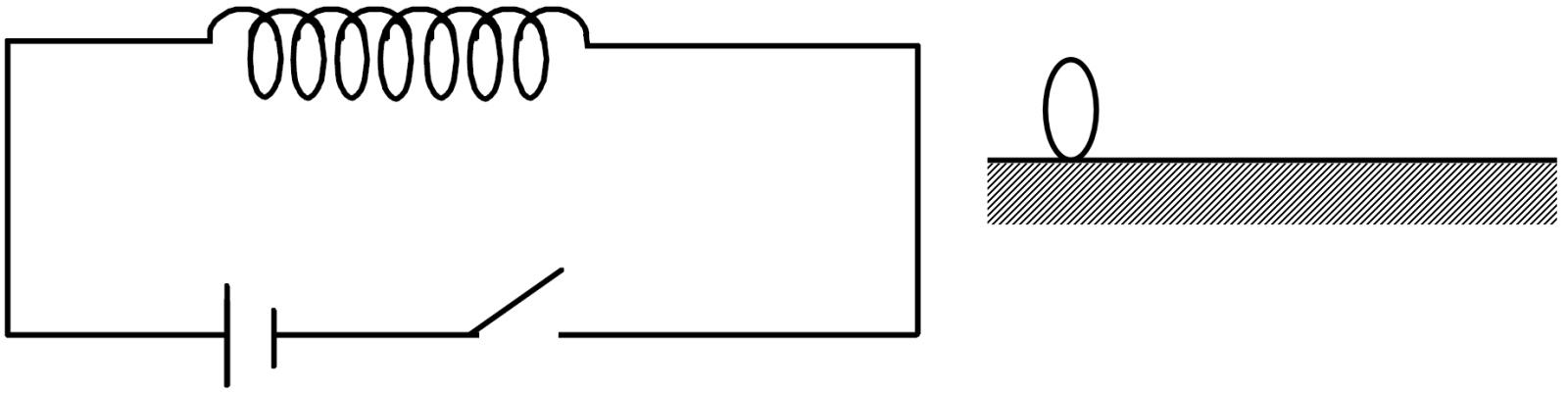
Figure shows a horizontal solenoid connected to a battery and a switch. A copper ring is placed on a frictionless track, the axis of the ring being along the axis of the solenoid. As the switch is closed, the ring will:
- A
- B
Move towards the solenoid.
- ✓
Move away from the solenoid.
- D
Move towards the solenoid or away from it depending on which terminal (positive or negative) of the battery is connected to the left end of the solenoid.
AnswerCorrect option: C. Move away from the solenoid.
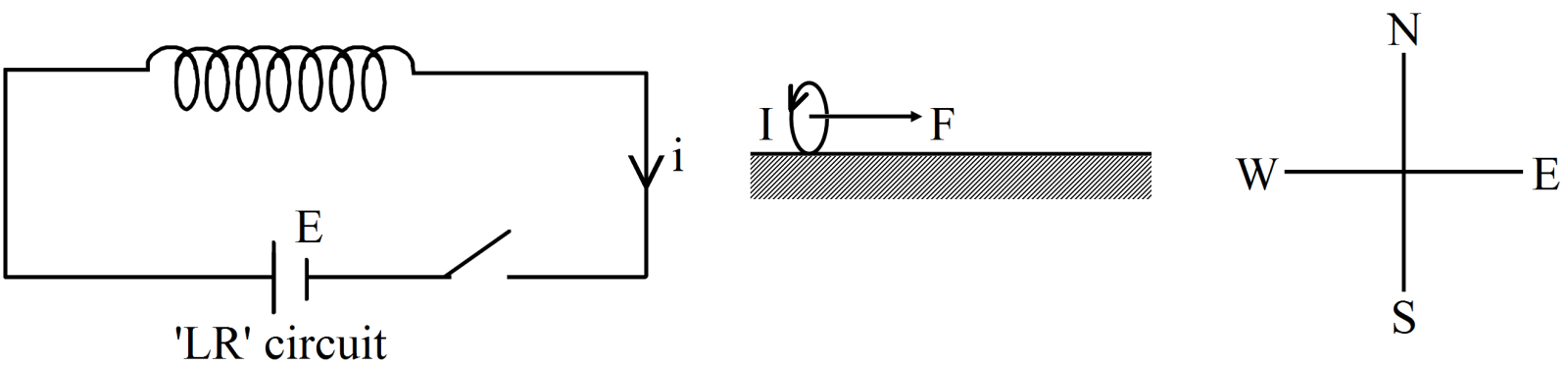
$\text{e}=-\text{L}\frac{\text{di}}{\text{dt}}$
Current flow in the CKt is clock wise direction, due to Mutual Induction current flow in the loop anti clockwise direction. The net force applied on the loop in east direction. So we can say that the ring will move away from the solenoid.
View full question & answer→MCQ 1311 Mark
A rod of legth l rotates with a uniform angular velocity $\omega$ about its perpendicular bisector. A uniform magnetic field $B$ exists parallel to the axis of rotation. The potential difference between the two ends of the rod is:
AnswerCorrect option: A. $\text{zero}$
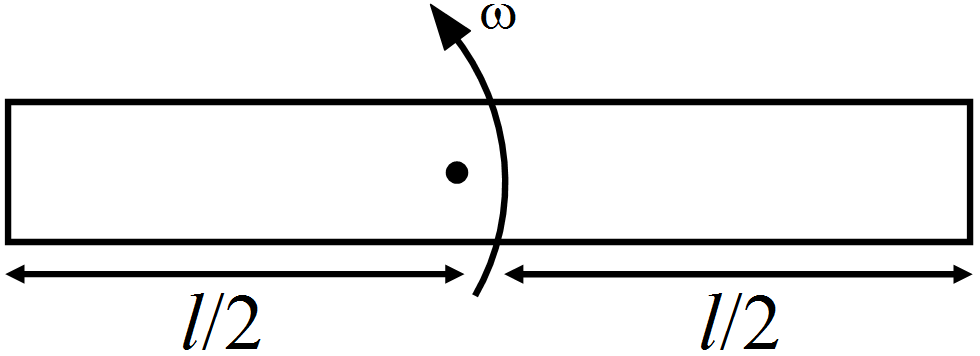
Emf at both end is same $=\frac{1}{8}\text{Bwl}^2$
So the potential difference between the two ends of therod is zero. View full question & answer→MCQ 1321 Mark
Coils in the resistance boxes are made from doubled up insulated wires.
- ✓
to cancel the effect of self induction
- B
to nullify the heating effect
- C
to nullify the Peltier effect
- D
to reduce effective length of the wire
AnswerCorrect option: A. to cancel the effect of self induction
The wire is doubled back on itself. As a result, there are equal and opposite currents in each section of the coil.
Therefore, the coil has no net magnetic field and no net induced $e.m.f.$
Thus, it is done to minimize the inductance of coils.
View full question & answer→MCQ 1331 Mark
The induction coil works on the principle of.
- A
Self$-$induction
- ✓
- C
- D
Fleming's right hand rule
AnswerInduction coil works on the principle of mutual induction that an emf or current is induced in the second coil if the magnetic flux due to first coil linked with the second coil changes.
View full question & answer→MCQ 1341 Mark
A car moves up a plane road. The induced emf in the axle connecting the two wheels is maximum when it moves.
AnswerInduced emf in the axle $= Blv$
$v -$ velocity of car
$l -$ length of car
$B -$ component of magnetic field perpendicular to both $l$ and $v.$
That is $B$ is the vertical component of magnetic field.
Vertical component of magnetic field is maximum at the poles.
Therefore emf induced in the axle will be maximum at the poles.
View full question & answer→MCQ 1351 Mark
A rod of length l rotates with a small but uniform angular velocity $\omega$ about its perpendicular bisector. A uniform magnetic field $B$ exists parallel to the axis of rotation. The potential difference between the centre of the rod and an end is:
- A
$\text{zero}$
- ✓
$\frac{1}{8}\omega\text{Bl}^2$
- C
$\frac{1}{2}\omega\text{Bl}^2$
- D
$\text{B}\omega\text{l}^2$
AnswerCorrect option: B. $\frac{1}{8}\omega\text{Bl}^2$
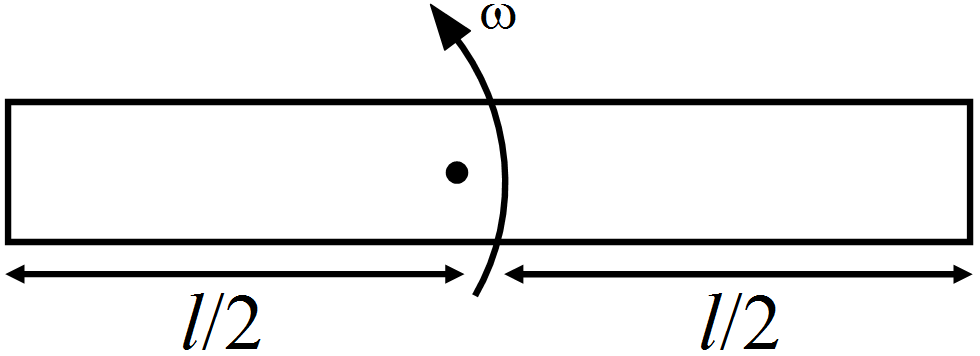
Take a small element dx at a distance of $'x'$ centre
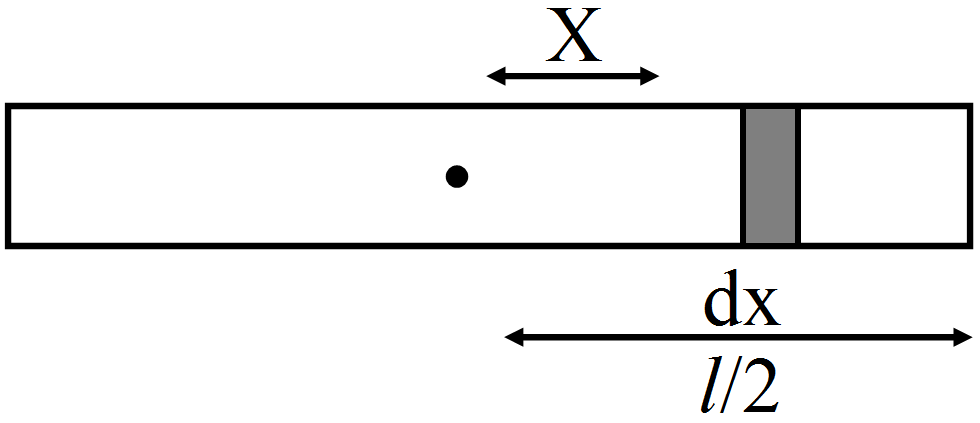
$\text{Þ}\text{d}\in\int_{0}^{\frac{1}{2}}\text{B}\omega\text{x}\text{dx}=\frac{\text{B}\omega\text{x}^2}{2}\Big|_{0}^{\frac{1}{2}}$
$\in=\frac{1}{8}\omega\text{Bl}^2$
View full question & answer→MCQ 1361 Mark
Which of following can induce the maximum induced voltage?
- A
$1$ amp $dc.$
- B
$1$ amp $1 Hz.$
- ✓
$1$ amp $100 Hz.$
- D
$20$ amp $dc.$
AnswerCorrect option: C. $1$ amp $100 Hz.$
If we apply a high$-$frequency supply of the same peak voltage to the coil, the current still is being delayed by $90o$ but the time it requires to reach its maximum value has been reduced due to the increase in frequency. Because the frequency is inversely proportional to time $(T).$ Hence, the rate of change of the flux within the coil has also increased due to the increase in frequency. Hence, the induced $\text{EMF}$ is maximum in case of $1$ amp $100 \ Hz$ supply source in the coil.
View full question & answer→MCQ 1371 Mark
The coefficient of mutual inductance between two coils depends on.
- A
- B
separation between the two coils
- C
orientation of the two coils
- ✓
AnswerThe flux linked with two coils will depend upon the angle between the two coils. If their planes are parallel, then magnetic flux from one would completely pass through the other. If the planes are perpendicular, no flux due to any of the coils would flow through the other.
The size of the two coils may be different which will affect the number of lines crossing the coil. The medium, if magnetic, will concentrate the field lines. Thus, all parameters would affect the inductance between them.
View full question & answer→MCQ 1381 Mark
The coefficient of self induction of a coil is given by.
- ✓
$\text{L}=\Big(-\frac{\text{dI}}{\text{dt}}\Big)$
- B
$\text{L}=-\frac{\text{edI}}{\text{dt}}$
- C
$\text{L}=\frac{\text{dI}}{\text{edt}}$
- D
$\text{L}=\frac{\text{dI}}{\text{dt}}\text{e}^2$
AnswerCorrect option: A. $\text{L}=\Big(-\frac{\text{dI}}{\text{dt}}\Big)$
Inductance is the property of a conductor by which a change in current flowing through it induces $($creates$)$ a voltage $($electromotive force$)$ in both the conductor itself $($self$-$inductance$)$ and in any nearby conductors $($mutual inductance$)$. By Lenz's law the induced voltage opposed the the change in current. Hence inductance is defined as.$\text{L}=\Big(-\frac{\text{dI}}{\text{dt}}\Big)$
View full question & answer→MCQ 1391 Mark
Two coils $P$ and $Q$ are lying parallels and very close to each other. Coil $P$ is connected to an $AC$ source whereas $Q$ is connected to a sensitive galvanometer. On pressing key $K.$
- A
small variations are observed in the galvanometer for applied $50 \ Hz$ voltage
- ✓
deflections in the galvanometer can be observed for applied voltage of $1 \ Hz$ to $2 \ Hz.$
- C
no deflection in the galvanometer will be observed
- D
constant deflection will be observed in the galvanometer for $50 \ Hz$ supply voltage
AnswerCorrect option: B. deflections in the galvanometer can be observed for applied voltage of $1 \ Hz$ to $2 \ Hz.$
Upon connecting to the $AC$ source, a current starts to flow in the coil $ P$. This current induces a current in the galvanometer coil $Q$ due to mutual inductance because of the flux linkages. This induced current causes a deflection in the galvanometer.
View full question & answer→MCQ 1401 Mark
If a magnet is plugged into a coil, then the magnitude of induced emf does not depend upon:
- A
the number of turns in the coil
- B
the medium of the core of the coil
- C
the insertion speed of the magnet
- ✓
the strength of the magnet
AnswerCorrect option: D. the strength of the magnet
The magnitude of induced emf is given by $\text{e}=\frac{\text{N}\phi}{\text{dt}}=\text{NB}\frac{\text{ds}}{\text{dt}}$
Which depends upon number of turns$(N)$, magnetic field intensity $(B)$ which depends upon medium, rate of change of area$(ds/dt)$
which depends upon insertion speed of magnet. It is independent of resistance of coil.
View full question & answer→MCQ 1411 Mark
A boat is moving due east in a region where the earth's magnetic field is $5.0 \times 10^{-5} NA ^{-1} m^{-1}$ due north and horizontal. The boat carries a vertical aerial $2 m$ long. If the speed of the boat is $1.50 ms^{-1}$, the magnitude of the induced emf in the wire of aerial is:
- A
$1 \ mV$
- B
$0.75 \ mV$
- C
$0.50 \ mV$
- ✓
$0.15 \ mV$
AnswerCorrect option: D. $0.15 \ mV$
Induced emf is given by:
$\varepsilon= Bvl$
On putting the values we get
$=5 \times 10^{-5} \times 1.50 \times 2$
$=0.15 \ mV$
View full question & answer→MCQ 1421 Mark
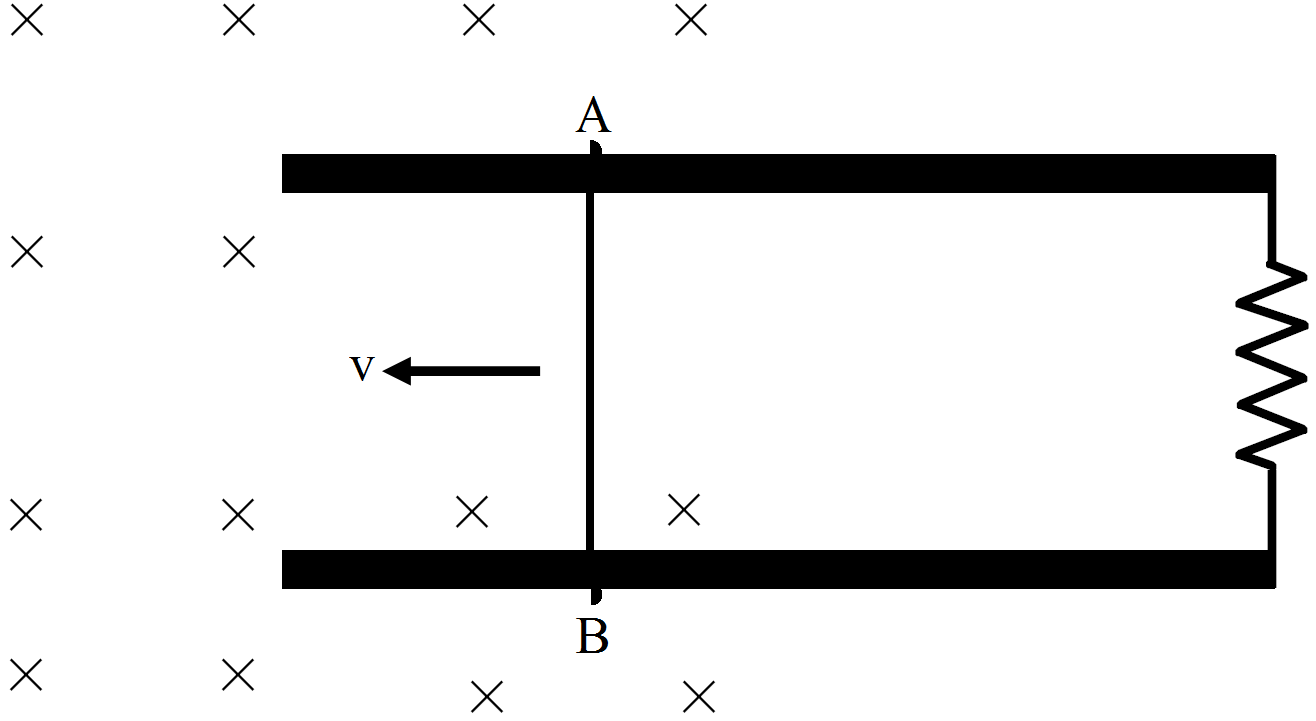
Consider the situation shown in figure. The wire $AB$ is slid on the fixed rails with a constant velocity. If the wire $AB$ is replaced by a semicircular wire, the magnitude of the induced current will:
- A
- ✓
- C
- D
Increase or decrease depending on whether the semicircle bulges towards the resistance or away from it.
Answer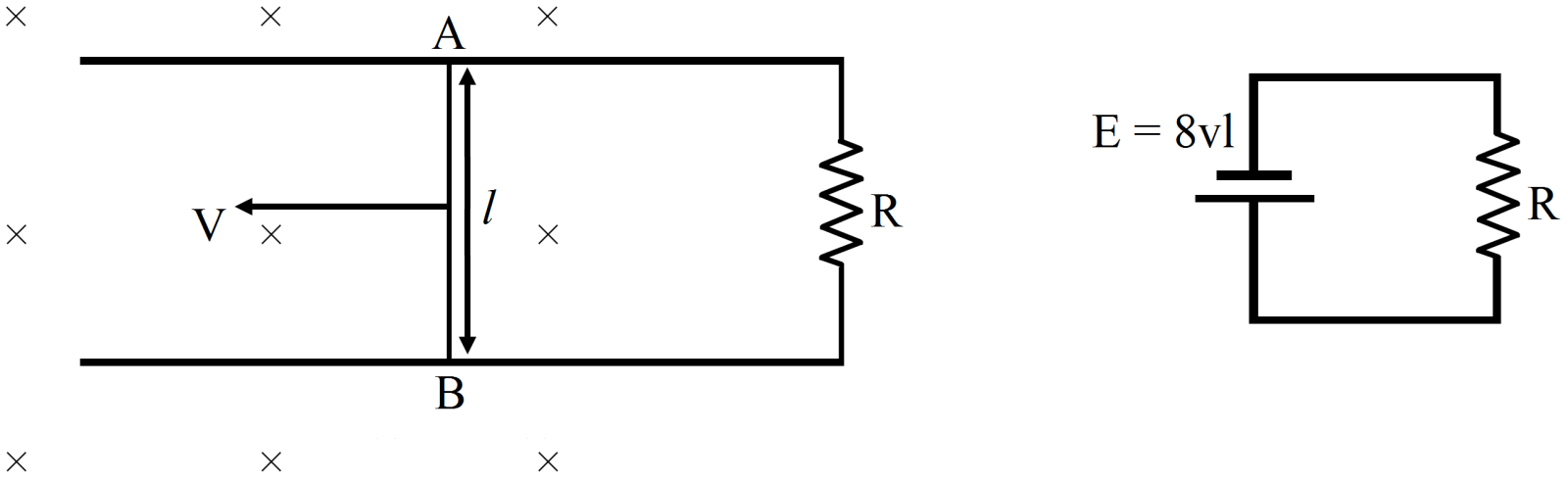
$E = Bvl$
If the wire $AB$ is replaced by a semicircular wire, the magnitude of the induced current will be same. Because it is depend on the velcoty $\&$ lenght of the wire. View full question & answer→MCQ 1431 Mark
Flux $\phi ($in water$)$ in a closed circuit of resistance $10\Omega$ varies with time t $($in $\sec)$ according to the equation $\phi=6\text{t}^2-5\text{t}+1.$ What is the magnitude of the induced current at $t = 0.25s?$
- A
$1.2 A$
- B
$0.8 A$
- C
$0.6 A$
- ✓
$0.2 A$
AnswerCorrect option: D. $0.2 A$
$\text{emf}=-\frac{\text{d}\phi}{\text{dt}}=-12\text{t}+5$
$\text{Current}=-\frac{\text{emf}}{10}=-1.2\text{t}+0.5$
$\text{Current at t}=0.25\text{s},$
$=1.2\times0.25+0.5=0.2\text{A}$
View full question & answer→MCQ 1441 Mark
A coil of insulating wire is connected to battery. If it is moved towards a galvanometer then its point gets deflected because.
- A
the coil behaves like a magnet
- ✓
induced current is produced in the coil
- C
the number of turns in the galvanometer coil remains constant
- D
AnswerCorrect option: B. induced current is produced in the coil
Upon connecting to the battery, a current starts to flow in the insulated wire. This current induces a current in the galvanometer coil due to mutual inductance because of the flux linkages. This induced current causes a deflection in the galvanometer .
View full question & answer→MCQ 1451 Mark
The value of coefficient of mutual induction for the arrangement of two coils shown in the figure will be:
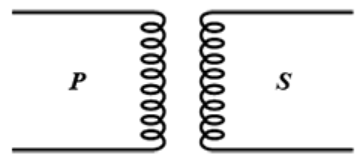
AnswerThe mutual inductance between two coils depends upon the manner, in which, two coils are placed relative to each other. In the given figure, the magnetic flux linked with a coil due to current in another coil, seems to be zero, therefore coefficient of mutual inductance will be zero.
View full question & answer→MCQ 1461 Mark
A circular coil expands radially in a region of magnetic field and no electromotive force is produced in the coil. This can be because
- A
The magnetic field is constant.
- B
The magnetic field is in the same plane as the circular coil and it may or may not vary.
- C
The magnetic field has a perpendicular (to the plane of the coil) component whose magnitude is decreasing suitably.
- ✓
AnswerSolution:
Key concept: As we know whenever the number of magnetic lines of force (magnetic flux) passing through a circuit changes an e.m.f is produced in the circuit called induced e.m.f. The induced e.m.f persists only as long as there is a change or cutting of flux.
The induced e.m.f is given by rate of change of magnetic flux linked with the circuit, i.e., $\text{e}=\frac{-\text{d}\phi}{\text{dt}}$.
According to the problem there is no electromotive force produced in the coil. Then the various arrangement are to be thought of in such a way that the magnetic flux linked with the coil does not change even if the coil is placed and expanded in magnetic field.
When circular coil expands radially in a region of magnetic field such that the magnetic field is in the same plane as the circular coil or we can say that direction of magnetic field is perpendicular to the direction of area (increasing) so that their dot product is always zero and hence change in magnetic flux is also zero.
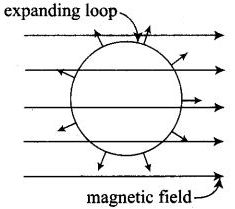
Or
The magnetic field has a perpendicular (to the plane of the coil) component whose-magnitude is decreasing suitably in such a way that the dot product of magnetic field and surface area of plane of coil remain constant at every instant.
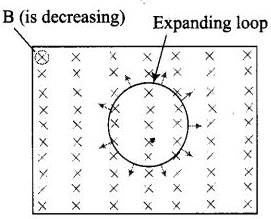
View full question & answer→MCQ 1471 Mark
In the arrangement shown in given Figure, there are two coils wound on a non$-$conducting cylindrical rod. Initially the key is not inserted. Then the key is inserted and later removed. Then,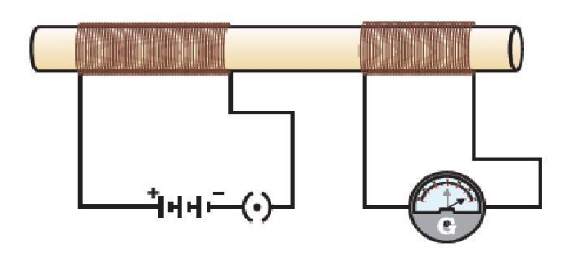
- A
the deflection in the galvanometer remains zero throughout
- B
there is a momentary deflection in the galvanometer but it dies out shortly and there is no effect when the key is removed
- C
there are momentary galvanometer deflections that die out shortly; the deflections are in the same direction
- ✓
there are momentary galvanometer deflections that die out shortly; the deflections are in opposite directions
AnswerCorrect option: D. there are momentary galvanometer deflections that die out shortly; the deflections are in opposite directions
View full question & answer→MCQ 1481 Mark
Two circular loops of equal radii are placed coaxially at some separation. The first is cut and a battery is inserted in between to drive a current in it. The current $c \sim $anges slightly because of the variation in resistance with temperature. During this period, the two loops:
- ✓
- B
- C
Do not exert any force on each other.
- D
Attract or repel each other depending on the sense of the current.
AnswerDue to Mutual induction, current is generated in second loop and that causes the two loops attract each other.
View full question & answer→MCQ 1491 Mark
The resistance coils in a resistance box are made of double folded wire so that their.
- ✓
self induction effect in nullified
- B
self inductance is maximum
- C
- D
AnswerCorrect option: A. self induction effect in nullified
Presence of inductance increases the impedance more than the actual resistance value. Therefore to reduce the chance of occurrence of inductance in the resistor coils, they are double folded, so that current in opposite direction cancel the induced flux linkages if any and hence inductance is nullified.
View full question & answer→MCQ 1501 Mark
Electromagnetic induction is the:
- A
charging of a body with a positive charge
- ✓
production of current by relative motion between a magnet and a coil
- C
rotation of the coil of an electric motor
- D
generation of magnetic field due to a current carrying solenoid
AnswerCorrect option: B. production of current by relative motion between a magnet and a coil
Electromagnetic induction is the production of current by relative motion between a magnet and a coil.The phenomenon of producing electric current in a conductor by moving it perpendicular to a magnetic field or vice $-$ versa, is called electro magnetic induction.
View full question & answer→