MCQ
Assertion : Electric conduction in gases is possible at normal pressure.
Reason : The electric conduction in gases depends only upon the potential difference between the electrodes.
  • A
    If both assertion and reason are true and the reason is the correct explanation of the assertion.
  • B
    If both assertion and reason are true but reason is not the correct explanation of the assertion.
  • C
    If assertion is true but reason is false.
  • If the assertion and reason both are false.
Answer

Correct option: D.
If the assertion and reason both are false.
  If the assertion and reason both are false.

Need a full question paper?

Generate a complete, print-ready paper with questions like this in minutes — across 16+ boards, with answer keys.

Start Generating Free

Similar questions

An $AC$ source is rated $220V, 50Hz.$ The average voltage is calculated in a time interval of $0.01s$, It:
Two bullets are fired simultaneously, horizontally and with different speeds from the same place. Which bullet will hit the ground first?
Match List $I$ with List $II$.

List $I$ (Spectral Lines of Hydrogen for transitions from) List $II$ (Wavelengths ($nm$))
$A$ $n_2=3 \text { to } n_1=2$ $I$ $410.2$
$B$ $n_2=4 \text { to } n_1=2$ $II$ $434.1$
$C$ $n_2=5 \text { to } n_1=2$ $III$ $656.3$
$D$ $n_2=6 \text { to } n_1=2$ $IV$ $486.1$

Choose the correct answer from the options given below:

The continuous part of $X$-ray spectrum is a result of the
In a compound microscope cross-wires are fixed at the point
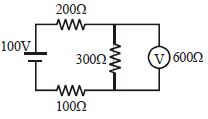
The reading of voltmeter is :- .............. $V$
Two long and parallel wires are at a distance of 0.1 m and a current of 5 A is flowing in each of these wires. The force per unit length due to these wires will be
The electric field of a plane electromagnetic wave is given by

$\overrightarrow{\mathrm{E}}=\mathrm{E}_{0} \frac{\hat{\mathrm{i}}+\hat{\mathrm{j}}}{\sqrt{2}} \cos (\mathrm{kz}+\omega \mathrm{t})$ At $\mathrm{t}=0,$ a positively charged particle is at the point $(\mathrm{x}, \mathrm{y}, \mathrm{z})=\left(0,0, \frac{\pi}{\mathrm{k}}\right) .$ If its instantaneous velocity at $(t=0)$ is $v_{0} \hat{\mathrm{k}},$ the force acting on it due to the wave is

When the length of a microscope tube increases, its magnifying power
Given below are two statements:

Statement $I :$ An electric dipole is placed at the centre of a hollow sphere. The flux of electric field through the sphere is zero but the electric field is not zero anywhere in the sphere.

Statement $II :$ If $R$ is the radius of a solid metallic sphere and $Q$ be the total charge on it. The electric field at any point on the spherical surface of radius $r ( < R )$ is zero but the electric flux passing through this closed spherical surface of radius $r$ is not zero.

In the light of the above statements, choose the correct answer from the options given below: