Questions

2 Marks Questions

Take a timed test

16 questions · self-marked practice — reveal the answer and mark yourself.

Question 12 Marks
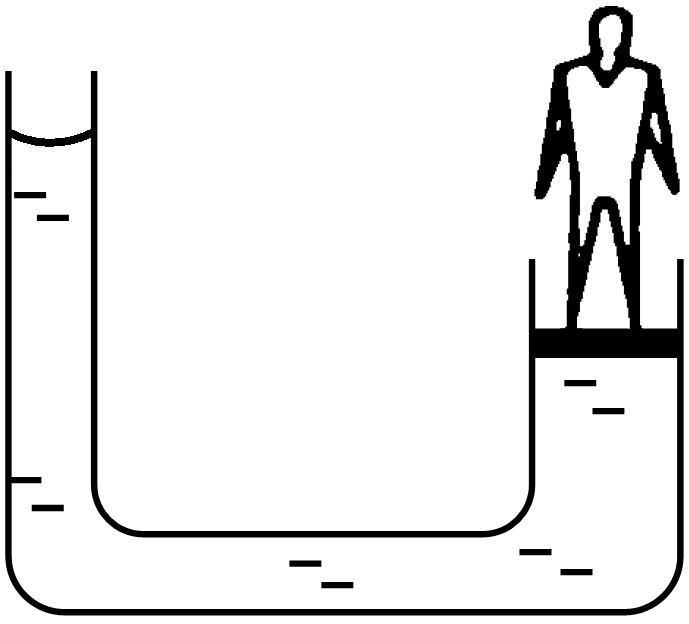
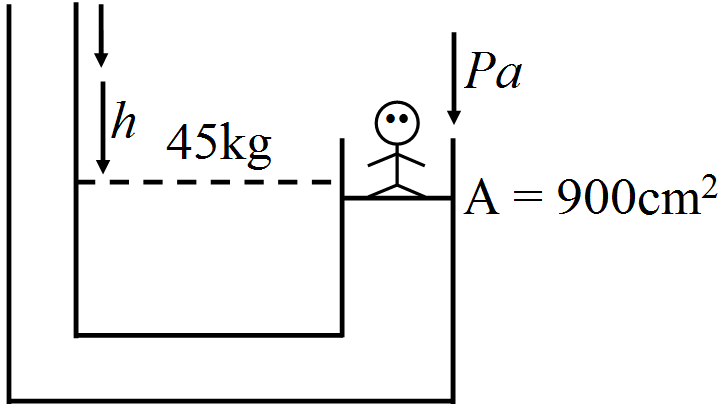
The area of cross-section of the wider tube shown in  is 900cm2. If the boy standing on the. Piston weighs 45kg, find the difference in the levels of water in the two tubes.

Answer
Given:

Area of the wider tube, A = 900cm2

Weight of the boy, m = 45kg

Density of water, p - 103kgm-3

Let h nbe the difference in the levels of water in the tubes and pa be the atmospheric pressure.

As per the figure, we have:

$\text{Pa}+\text{hpg}=\text{pa}+\frac{\text{mg}}{\text{A}} $

$\Rightarrow \text{hpg}=\frac{\text{mg}}{\text{A}}$

$\Rightarrow \text{h}=\frac{\text{m}}{\text{pA}}$

$\Rightarrow \text{h}=-\frac{\text{m}}{1000\times \text{A}}$

$=\frac{4}{1000\times900\times10^{-4}}$

$=\frac{1}{2}\text{m}=50\text{cm}$

View full question & answer
Question 22 Marks
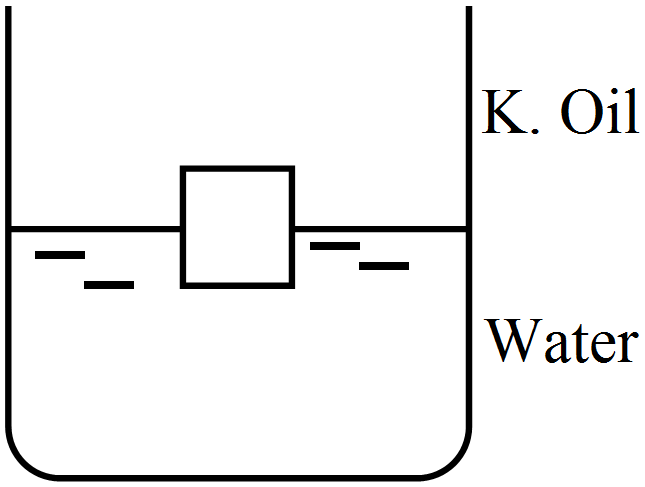
A cube of ice floats partly in water and partly in K. oil  Find the ratio of the volume of ice immersed in water to that in K.oil. Specific gravity of K. oil is 0.8 and that of ice is 0.9.

Answer

Let the volume of ice in water be a mo and the volume of ice in K. oil

be bm2 Therefore, Total Volume = a + b

Density of ice = density of water at 4°C Specific Gravity.

$\therefore$ Density of the ice = 0.9 × 1000kg/m2

Density of Ice = 900kg/m2

Therefore, total mass of the ice cube = (a + b) × 900kg

Therefore, Its weight = (a + b) × 900 × 10

By the law of the Flotation, the total force of buoyancy by the water

and the Kerosene oil will be equal to the weight of the ice cube.

 $\therefore$ The total force of buoyancy = a × 1000 + Y × 800kg

(a + b) × 900 = a × 1000 + b × 800

900a + 900b = 1000a + 800b

100a = 100b

$\therefore$ a = b

Hence, the ratio of there volume is 1 : 1.

View full question & answer
Question 32 Marks
A solid sphere of radius 5cm floats in water. If a maximum load of 0.1kg can be put on it without wetting the load, find the specific gravity of the material of the sphere.
Answer

$\text{w}_1+\text{w}_2=\text{u}\cdot$

$\Rightarrow\text{mg}+\text{v}\times\rho_\text{s}\times\text{g}=\text{v}\times\rho_\text{w}\times\text{g}$

$\Rightarrow1-\rho_\text{s}=0.19$

$\Rightarrow\rho_\text{s}=1-(0.19)=0.8\text{gm}/\text{cc}$

(where $\rho_\text{s}$ = density of sphere in gm/cc)

so, specific gravity of the material is 0.8.

View full question & answer
Question 42 Marks
A hollow spherical body of inner and outer radii 6cm and 8cm respectively floats half submerged in water. Find the density of the material of the sphere.
Answer

Let the density of the spherical body is Pg/cm

By the Principle of the Flotation,

Weight of the spherical body = Weight of the fluid displaced.

$\therefore$ Volume of the spherical body × density of spherical body × g = Volume of body displaced in water × density of water × g

Volume of the spherical body = $\frac{4}{\pi}\big(\text{R}^3-\text{r}^3\big)$

$=\frac{4}{3}\times\frac{22}{7}\times\big(8^3-6^3\big) $

$=\frac{4}{3\pi}\big(8^3-6^3\big)$

Volume of the spherical body displaced in water = Outer volume $=\frac{\text{outer}\ \text{volume}}{2}=\frac{4}{3\pi}\big(8^3\big)$

Also, density of water $=1\text{g}/\text{cm}^3.$

$\therefore\frac{4}{3\pi}\big(\text{R}^3-\text{r}^3\big)\times\rho=\frac{\Big[\frac{4}{3\pi}\big(\text{R}^3\big)\Big]}{2}\times1$

$\therefore\frac{4}{3\pi}\big(8^3-6^3\big)\times\rho=\frac{2}{3\pi}\big(8^3\big)$

$2\big(8^3-6^3\big)\times\rho=(8^3)$

$2\times296\rho=-512$

$\text{p}=0.8648\text{g}/\text{cm}^3$

$\therefore\text{p}=864.8\text{kg}/\text{m}^3.$

Hence, the density of the material of the spherical body =864.8Kg/m3.

Hope it helps.

View full question & answer
Question 52 Marks
Suppose the tube in the previous problem is kept vertical with A upward but the other conditions remain the same. The separation between the cross- sections at A and B is $\frac{15}{16}\text{cm}.$ Repeat parts (a), (b) and (c) of the previous problem. Take g = 10m/s2.
Answer

Now, a. We know volume rate of the flow does not depends upon the the height of the pipe, since pipe. 

Velocity of the fluid will remains unchanged.

  1. $\text{At}\ \text{A},$

$\text{Area}\times\text{velocity}=1\text{cm}^3/\text{s}.$

$\frac{4}{100}\text{cm}^2\times\text{velocity}=1$

$\therefore\text{velocity}=25\text{cm}/\text{seconds}.$

  1. $\text{At}\ \text{B},$

$\text{Area}\times\text{velocity}=1\text{cm}^3/\text{s}.$

$\frac{2}{100}\times\text{velocity}=50\text{cm}/\text{seconds}.$

$\text{velocity}=50\text{cm}/\text{seconds}.$

  1. Pressure difference, will be affected, this is because, there will be the gravitational work also which will be included.

Using the Bernoulli's equation,

Using the Bernoulli's Equation,

$\text{p}_1+\text{h}_1\rho\text{g}+\frac{1}{2}\rho\text{v}_1^2=\text{p}_2+\text{h}_2\rho\text{g}+\frac{1}{2}\rho\text{v}_2^2$

$\therefore\text{p}_1-\text{p}_2=\frac{1}{2}\rho\big(\text{v}_2^2-\text{v}_1^2\big)+\rho\text{g}(\text{h}_2-\text{h}_1)$

$\therefore\text{p} _1-\text{p}_2=\frac{1}{2}\times1\times\big(50^2-25^2\big)+1\times1000\Big(-\frac{15}{16}\Big)$

View full question & answer
Question 62 Marks
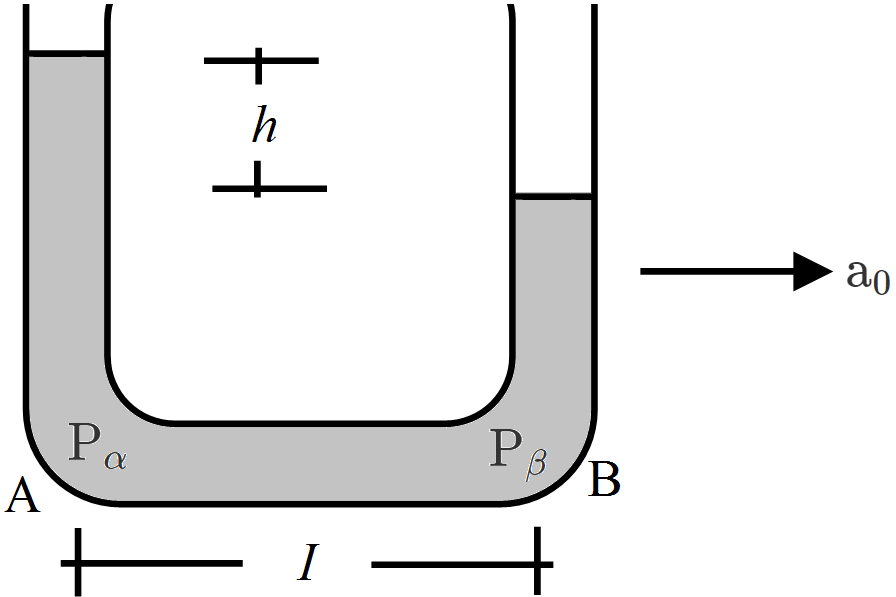
A U- tube containing a liquid is accelerated horizontally with a constant acceleration a0. If the separation between the vertical limbs is 1, find the difference in the heights of the liquid in the two arms.
Answer

Let the pressure at the base of the back limb at A = P, and the pressure at the base of the front limb at B = Ps. The separation between the vertical limbs AB = (given). When the U- tube is accelerated at an acceleration a, the difference of pressure between horizontal points A and B is given as,

$\text{P}_\text{a}-\text{P}_\beta=\text{l}\rho\text{a}_0$

where p is the density of the liquid. Due to this pressure difference, the liquid in limb A will rise to a heighth more than in limb B. The pressure difference due to this height difference balances the difference of pressure between points A and B.

The pressure due to thhis height $\text{h}=\rho\text{gh},$ Equating we get,

$\rho\text{gh}=\text{p}_\text{a}-\text{p}_\beta=\text{l}\rho\text{a}_0$

$\Rightarrow\text{gh}=\text{la}_0$

$\text{h}=\text{a}_0\text{l}/\text{g}$

View full question & answer
Question 72 Marks
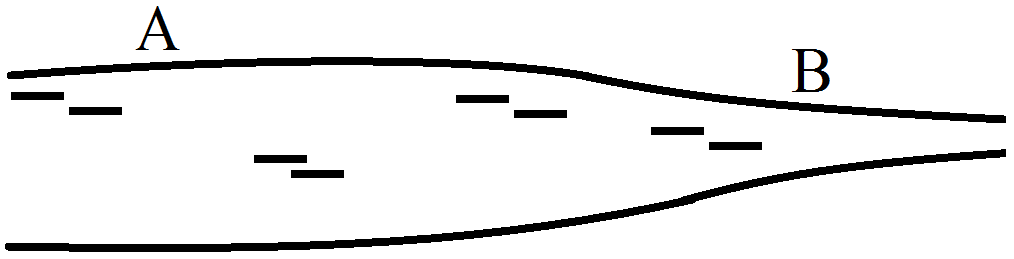
Water flows through a horizontal tube of variable cross-section. The area of cross-section at A and B are 4mm2 and 2mm2 respectively. If 1cc of water enters per second through A, find,
  1. The speed ofwater at A.
  2. The speed of water at B.
  3. Thepressure difference PA - PB.

Answer

Given:

Volume rate of the flow of water = 1cc/sec.

= 1cm/sec.

Since, Volume rate of the flow of water is constant throughout the Horizontal pipe, therefore,

  1. $\text{At}\ \text{A},$

$\text{Area}\times\text{velocity}=1\text{cm}^3/\text{s}.$

$\frac{4}{100}\text{cm}^2\times\text{velocity}=1$

$\therefore\text{velocity}=25\text{cm}/\text{seconds}.$

  1. $\text{At}\ \text{B},$,

$\text{Area}\times\text{velocity}=1\text{cm}^3/\text{s}.$

$\frac{2}{100}\times\text{velocity}=1$

$\text{velocity}=50\text{cm}/\text{seconds}.$

  1. Using the Bernoulli's equation,

$\text{p}_1+\text{h}_1\text{pg}+\frac{1}{2}\rho\text{v}_1^2 =\text{p}_2+\text{h}_2\rho\text{g}+\frac{1}{2}\rho\text{v}_2^2$

$\therefore\text{p}_1-\text{p}_2=\frac{1}{2}\rho\big(\text{v}_2^2-\text{v}_1^2\big)+\rho\text{g} \big(\text{h}_2-\text{h}_1\big)$

$\therefore\text{p}_1-\text{p}_2=\frac{1}{2}\rho\big(\text{v}_2^2-\text{v}_1^2\big)$ $\big[\because$ in case of the horizontal tube, height difference is zero.$\big]$

$\therefore\text{p}_1=\text{p}_2=\frac{1}{2}\times1\times\big(50^2-25^2\big)$

$\therefore\text{p}_1-\text{p}_2=937.5\ \text{dyne}/\text{cm}^2$

$\therefore\text{p}_1-\text{p}_2=93.75\ \text{pa}.$

View full question & answer
Question 82 Marks
A wooden block of mass 0.5kg and density 800kg/m3 is fastened to the free end of a vertical spring of spring constant 50N/m fixed at the bottom. If the entire system is completely immersed in water, find.
  1. The elongation (or compression) of the spring in equilibrium and.
  2. The time-period of vertical oscillations of the block when it is slightly depressed and released.
Answer
  1. When the system is completely Immersed in a liquid, then Upthrust and the spring force acts vertically upwards, but the weight of the object acts downwards,

Thus, In the State of the Equilibrium, we can say that,

Spring force + Upthrust = Weight

$\text{Kx}+\text{v}\rho\text{g}=\text{mg}$

$\therefore\text{Kx}=\text{mg}-\text{v}\rho\text{g}$

$\therefore\text{Kx}=0.5\times10-\frac{0.5}{800}\times1000\times10$

$\therefore\text{Kx}=5-\frac{50}{8}$

$\text{Kx}=-1.25$ [Minus sign means upward direction]

$\therefore\text{x}=0.025\text{m}$ or 2.5cm.

  1. Let the block be depressed by 'a' cm.

The force on the block by the spring = 50a N

Hence the acceleration $=\frac{50\text{a}}{0.5}$

$=100\text{a}\ \text{m}/\text{s}^2$

Now, $\omega^2\text{a}=100$

$\therefore\omega=10\text{s}^{-1}$

Using the formula,

$\text{T}=\frac{2\pi}{\omega}$

$\therefore\text{T}=\frac{2\pi}{10}$

$\therefore\text{T}=\frac{\pi}{5}$ seconds or 0.63 seconds.

Hence, the time period of the S.H.M. is $\frac{\pi}{5}$ or 0.63 seconds.

View full question & answer
Question 92 Marks
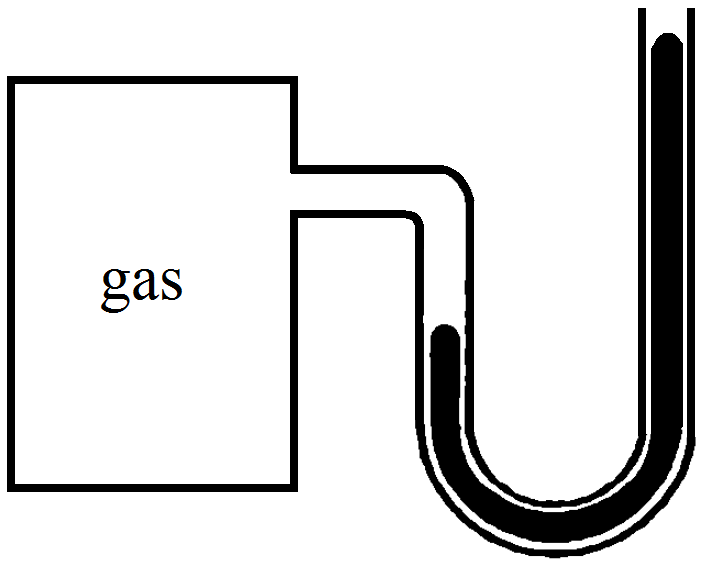
The heights of mercury surfaces in the two arms of the manometer shown in figure are 2cm and 8cm. Atmospheric pressure = 1. 01 x 105N/rn2. Find.

  1. Thepressure of the gas in the cylinder and.
  2. The pressure of mercury at the bottom of the U tube.

Answer
  1. Since, the tube is opened from the top, this means, total pressure of the gas will be equal to the pressure due to the mercury column + tmospheric Pressure.

$\therefore$ Pressure of the gas in cylinder = Atmospheric Pressure + Pressure due to the mercury column.

Now, Pressure due to the mercury column = ρg(h2 - h1)

where, ρ is the density of the mercury = 13.6g/cm3,

g is the acceleration due to gravity = 9.8m/s² = 980cm/s2, h₂ is 8 cm and h1 is 2cm.

$\therefore$ Total Pressure of the gas = 1 atm + (8 - 2) × 13.6 × 980

= 1.013 × 10⁵Pa + 6 × 13.6 × 980 dyne/cm²

= 101300 + 7996.8Pa.

= 181268Pa.

= 1.8 × 10⁵Pa.

  1. The pressure of the mercury at the bottom of the U -tube.

= The pressure of mercury column on the open side + Atmospheric pressure.

= 13.6 × 10⁶/1000 × 9.8 × 0.08 + 1.013 × 105

= 1.12 × 10⁵Pa.

View full question & answer
Question 102 Marks
A ferry boat has internal volume 1m3  and weight 50kg.
  1. Neglecting the thickness of the wood, find the fraction of the volume of the boat immersed in water.
  2. If aleak develops in the bottom and water starts coming in, what fraction of the boat's volume will be filled with water before water starts coming in from the sides?
Answer
  1. The volume of the boat immersed in water will be that volume of water which weight = 50kg. Since the density of water = 1000kg/m?, this volume will be 

$=\frac{50}{1000}\text{m}^3=\frac{1}{20}\text{m}^3\cdot$

Hence the fraction of the volume of the boat immersed in water $=\frac{\big(\frac{1}{20}\text{m}^3\big)}{\big(1\text{m}^3\big)}=\frac{1}{20}\cdot$

  1. In the leak condition, when the outer water level comes to the top of the side of the boat, the total volume of water displaced is equal to the internal volume of the

boat = 1m3. The force of buoyancy = weight of this water = 1000kg.

This force balances the weight of the boat plus the weight of the water inside. If the weight of the water inside be Xkg, then X + 50 = 1000Kg

$\Rightarrow\text{x}=950\text{Kg}$

Hence the volume of inside water$=\frac{50}{1000}\text{m}^3=0.950\text{m}^3$

The inside water volume fraction $=\frac{\big(0.950\text{m}^3\big)}{1\text{m}^3}$

$=\frac{19}{20}\cdot$

View full question & answer
Question 112 Marks
The surface of water in a water tank on the top of a house is 4m above the tap level Find the pressure of water at the tap when the tap is closed Is it necessary to specify that the tap is closed? Take g = 10m/s2.
Answer

Given conditions,

density (p) = 1000Kg/m2.

acceleration due to the gravity (g) = 10m/s2.

height (h) = 4m

Using the Formula,

P = pgh.

$\therefore$ P = 1000 × 10 × 4N/m2.

P = 40000N/m2.

Hence, the pressure is 40,000

View full question & answer
Question 122 Marks
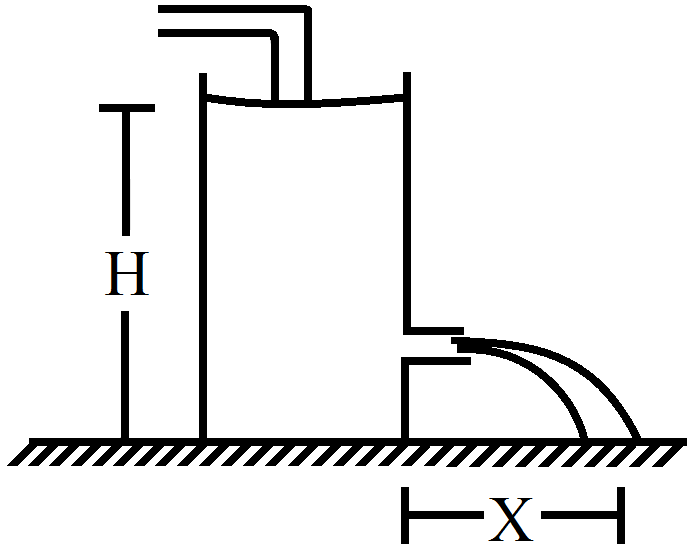
Water level is maintained in a cylindrical vessel upto a fixed height H. The vessel is kept on a horizontal plane. At what height above the bottom should a hole be made in the vessel so that the water stream coming out of the hole strikes the horizontal plane at the greatest distance from the vessel.

Answer

Let the hole be at a height h from the bottom. The height of the water above the hole = H - h. The speed of the water at the hole

$\text{v}=\sqrt{\{2\text{g}(\text{h}-\text{h})\}}$

Let the time taken by the water to strike the floor is t. Then for the vertical fall,

$\text{h}=0\times\text{t}+\frac{1}{2}\text{gt}^2$

$\Rightarrow\text{t}^2=2\text{h}/\text{g}$

$\Rightarrow\text{t}=\sqrt{(2\text{h}/\text{g})}$

Let the distance of the striking point from the hole be X. Then,

$\text{X}=\text{v}\times\text{t}=\sqrt{2\text{g}(\text{H}-\text{h})}\times\sqrt{(2\text{h}/\text{g})}$

$=\sqrt{\{2^2\times(\text{H}-\text{h})\text{h}\}}=2\sqrt{(\text{H}-\text{h})}\text{h}$

$\Rightarrow\text{X}=2\sqrt{(\text{H}-\text{h})}\times\sqrt{\text{h}}$ For maximum $\text{x},\frac{\text{dx}}{\text{dh}}=0$

$2\times\Bigg[\sqrt{(\text{H}-\text{h})}\big]\times\frac{\text{d}\sqrt{\text{h}}}{\text{dh}}+_\sqrt{\text{h}}\times\frac{\text{d}\sqrt{(\text{H}-\text{h})}}{\text{dh}}\Bigg]=0$

$\Rightarrow\sqrt{(\text{H}-\text{h})}\times\Big\{\frac{1}{2\sqrt{\text{h}}}\Big\}+\sqrt{\text{h}}\times\frac{1}{\Big\{2\sqrt{(\text{H}-\text{h})\times(-1)}\Big\}}=0$

$\Rightarrow\sqrt{(\text{H}-\text{h})}\times\Big\{\frac{1}{2\sqrt{\text{h}}}\Big\}+\sqrt{\text{h}}\times\frac{1}{\big\{2\sqrt{(\text{H}-\text{h})}\times(-1)\big\}}=0$

$\Rightarrow\frac{\sqrt{(\text{H}-\text{h})}}{(\sqrt{\text{h}})}=\frac{\sqrt{\text{h}}}{\big\{\sqrt{(\text{H}-\text{h})}\big\}}$

$\Rightarrow\text{H}-\text{h}=\text{h}$

$\Rightarrow2\text{h}=\text{H}$

$\Rightarrow\text{h}=\frac{\text{H}}{2}$

Hence the required height of the hole from the bottom for the greatest horizontal distance of water to strike is half the height of the water level.
View full question & answer
Question 132 Marks
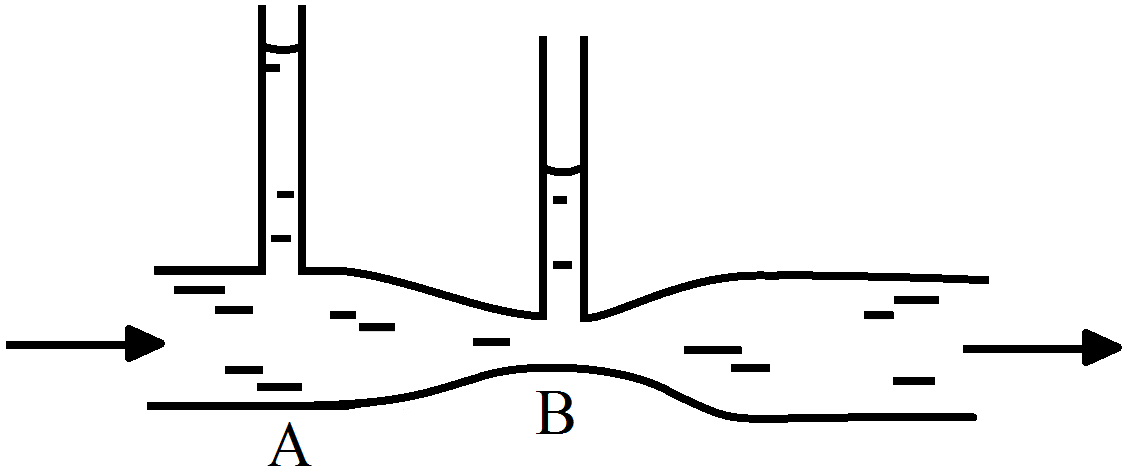
Water flows through a horizontal tube as shown in  If the difference of heights of water column in the vertical tubes is 2cm, and the areas of cross-section at A and B are 4cm2 and 2cm2 respectively, find the rate of flow of water across any section.

Answer

The height difference $=2\text{cm}=0.02\text{m}$

The difference of pressure between A and B $=\text{p}_\text{a}-\text{p}_\beta=\rho\text{gh}$

$=\frac{1}{2}\rho \text{Va}^2=\text{p}_\beta+\frac{1}{2}\rho \text{V}\beta^2$

$=1000\times10\times0.02=200\text{N}/\text{m}^2$

Let the rate of flow of water be Qcc/s i.e. $=\text{Q}\times10^{-6}\text{m}^3/\text{s}$

Area of the cross-section at $\text{A}=4\text{cm}^2=\frac{4}{10000}\text{m}^2$

The speed at $\text{A}=\text{v}_\text{a}=\frac{\text{Q}\times10^{-6}}{\Big(\frac{4}{10000}\Big )}\text{m}/\text{s}=\frac{\text{Q}}{400}\text{m}/\text{s}$

Area of the cross-section at $\text{B}=2\text{cm}^2=\frac{2}{10000}\text{m}^2$

The speed at $\text{B}=\text{v}_\beta=\frac{\text{Q}\times10^{-6}}{\Big(\frac{2}{10000}\Big)}\text{m}/\text{s}=\frac{\text{Q}}{200}\text{m}/\text{s}$

Since the height of both the points are the same, from Bernoulli's theorem,

$\text{p}_\text{a}+\frac{1}{2}\rho\text{V}\text{a}^2=\text{p}\beta+\frac{1}{2}\rho\text{V}\beta^2$

$\Rightarrow\text{p}_\text{a}-\text{p}_\beta=\frac{1}{2}\rho\big(\text{V}\beta^2-\text{V}\text{a}^2\big)$

$=\frac{1}{2}\times1000\times\text{Q}^2\Big\{\Big(\frac{1}{2000}\Big)^2-\Big(\frac{1}{400}\Big)^2\Big\}$

$\Rightarrow\text{p}_\text{a}-\text{p}_\beta=\Big(\frac{1}{20}\Big)\times\text{Q}^2\Big\{\frac{1}{4}-\frac{1}{16}\Big\}=\frac{3\text{q}^2}{320}$

$\Rightarrow200=\frac{3\text{Q}^2}{320}$

$\Rightarrow\text{Q}^2=200\times\frac{320}{3}=21333$

$\Rightarrow\text{Q}=146\text{cc}/\text{s}$

View full question & answer
Question 142 Marks
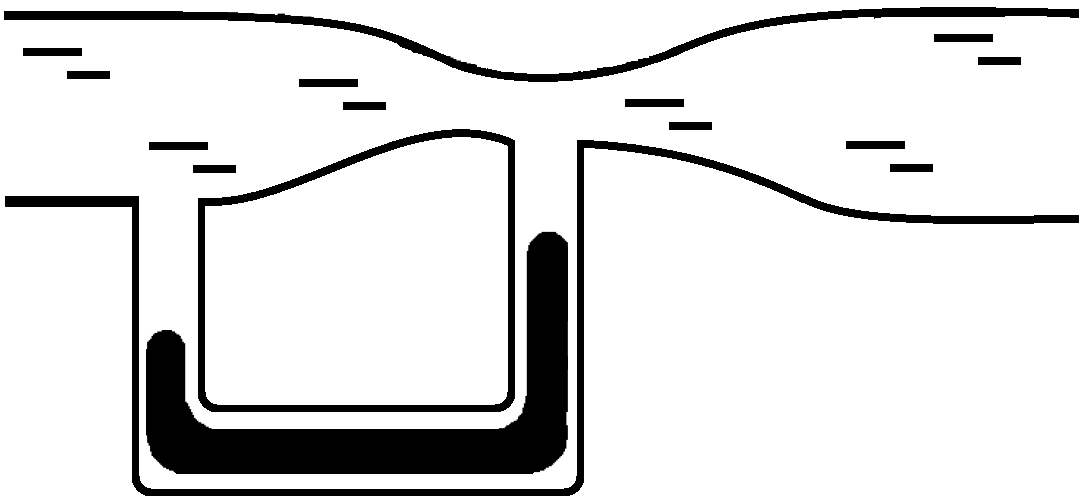
Water flows through the tube shown in  The areas of cross-section of the wide and the narrow portions of the tube are 5cm2 and 2cm2 respectively. The rate of flow of water through the tube is 500cm3/s. Find the difference of mercury levels in the U-tube.

Answer

The Discharge $\text{Q}=500\text{cm}^3/\text{s},$

The speed at the wide section $\text{V}_\text{a}=\frac{500}{5}=100\text{cm}/\text{s}=1\text{m}/\text{s}$

The speed at the narrow section $\text{V}_\beta=\frac{500}{2}=250\text{cm}/\text{s}=2.5\text{m}/\text{s}$

Let the difference in height levels of mercury $=\text{h}$

The pressure difference at the two points $=\rho'\text{gh}$

If the pressure at the wide section $=\text{p}_\text{a}$ and at the narrow section $=\text{p}\beta$ then from the Bernoulli's theorem

$\text{p}_\text{a}+\frac{1}{2}\rho\text{V}\text{a}^2=\text{p}_\beta+\frac{1}{2}\rho\text{V}\beta^2$

$\Rightarrow\frac{1}{2}\rho\big(\text{V}\beta^2-\text{V}\text{a}^2\big)=\text{p}_\text{a}-\text{p}_\beta$

$\Rightarrow\frac{1}{2}\times1000\times\big(2.5^2-1^2\big)=\rho'\text{gh}=13600\times9.8\times\text{h}$

$\Rightarrow\text{h}=10\times\frac{(6.25-1)}{(2\times136\times9.8)}\text{m}$

$\Rightarrow\text{h}=52.5\times\frac{100}{2665.6}\text{cm}$

$\Rightarrow\text{h}=\frac{5250}{2665.6}$

$=1.97\text{cm}$

View full question & answer
Question 152 Marks
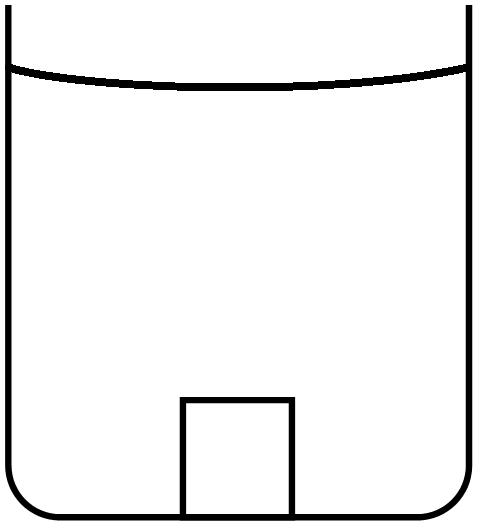
A metal piece of mass 160g lies in equilibrium inside a glass of water The piece touches the bottom of the glass at a small number of points. If the density of the metal is 8000kg/m3, find the normal force exerted by the bottom of the glass on the metal piece.

Answer

Given mass of the metal piece, m = 160g = 0.160kg

Density of metal = 8000kg/m3

Here we can say that the weight of the metal piece = buoyant force(FB) + Normal force

i.e. weight of the metal piece = mg

Buoyant force, FB = Volume of water displaced by metal × Pwater × g

mg = FB + Normal force

Normal force = mg - FB

= m × g - V × Pwater × g

Volume of water displaced by metal. = $=\frac{\text{m}}{\text{pwater}}=\frac{0.160}{8000}=0.00002$ 

Normal force = (0.160 × 9.8) - (0.00002 × 1000 × 9.8)

= 1.568 - 0.196

= 1.372N

= 1.4N

View full question & answer
Question 162 Marks
If water be used to construct a barometer, what would be the height of water column at standard atmospheric pressure (76cm of mercury)?
Answer

The Pressure will be same whether the mercury is used or water is

used, there is only a difference in density of liquid and height of

Fluid.

For mercury, height is 76cm.

$\therefore\text{presure}=\text{h}\rho\text{g}$

$=7\times13.6\times\text{g}$

where 13.6g/cm2 is the density of Mercury.

Now, let the height of the water column be h m.

$\therefore\text{P}=\text{h} \times\rho\text{g},$ where density of water is 1g/cm2.

$\therefore\text{p}=\text{h}\times76\times13.6$

$\Rightarrow\text{h}=1033.6\text{cm}$

$\therefore\text{h}=10.336\text{m}$

View full question & answer
2 Marks Questions - Physics STD 12 Science Questions - Vidyadip