Questions

5 Marks Questions

Take a timed test

15 questions · self-marked practice — reveal the answer and mark yourself.

Question 15 Marks
Two metre scales, one of steel and the other of aluminium, agree at 20°C. Calculate the ratio aluminium-centimetre/ steel-centimetre at:
  1. 0°C,
  2. 40°C
  3. 100C. $\alpha$ for steel = 1.1 × 10-5 °C-1 and for aluminium= 2.3 × 10⁻⁵ °C-1.
Answer
$\text{L}_{\text{s}\text{t}}=\text{L}_{\text{Al}}\ \text{at}\ 20^\circ\text{C}$

$\alpha_\text{Al}=2.3\times10^{-5}/^\circ\text{C}$

so, $\text{Lo}_{\text{st}}(1-\alpha_{\text{st}}\times20)=\text{Lo}_\text{Al}(1-\alpha_{\text{Al}}\times20)$

$\alpha_\text{st}=1.1\times10^{-5}/^\circ\text{C}$

  1. $\frac{\text{Lo}_\text{st}}{\text{Lo}_\text{Al}}=\frac{(1-\alpha_\text{Al}\times20)}{(1-\alpha_\text{st}\times20)}$

$=\frac{1-2.3\times10^{-5}\times20}{1-1.1\times10^{-5}\times20}$

$=\frac{0.99954}{0.99978}=0.999$

  1. $\frac{\text{Lo}_{40\text{st}}}{\text{Lo}_{40\text{Al}}}=\frac{(1-\alpha_\text{Al}\times40)}{(1-\alpha_\text{st}\times40)}$

$=\frac{1-2.3\times10^{-5}\times20}{1-1.1\times10^{-5}\times20}$

$=\frac{0.99954}{0.99978}=0.999$

$=\frac{\text{Lo}_\text{Al}}{\text{Lo}_\text{st}}\times\frac{1+2.3\times10^{-5}\times10}{273}$

$=\frac{0.99977\times1.00092}{1.00044}$

$=1.0002496\approx1.00025$

$\frac{\text{Lo}_\text{100Al}}{\text{Lo}_\text{100st}}=\frac{(1+\alpha_\text{Al}\times100)}{(1+\alpha_\text{st}\times100)}$

$=\frac{0.99977\times1.00092}{1.00011}=1.00096$
View full question & answer
Question 25 Marks
A metre scale is made up of steel and measures correct length at 16°C. What will be the percentage error if this scale is used:
  1. On a summer day when the temperature is 46°C.
  2. On a winter day when the temperature is 6°C? Coefficient of linear expansion of steel = 11 × 10-6°C-1.
Answer
  1. Length at 16°C = L

L = ?

T1 = 16°C

T2 = 46°C

$\alpha=1.1\times10^{-5/^\circ}\text{C}$

$\Delta\text{L}=\text{L}\alpha\Delta\theta=\text{L}\times1.1\times10^{-5}\times30$

$\%\ \text{of error}$  $=\Big(\frac{\Delta\text{L}}{\text{L}}\times100\Big)\%$

$=\Big(\frac{\text{L}\alpha\Delta\theta}{2}\times100\Big)\%$

$=1.1\times10^{-5}\times30\times100\%=0.33\%$

  1. $\text{T}_2=6^\circ\text{C}$

$\%\ \text{of error}$ $=\Big(\frac{\Delta\text{L}}{\text{L}\times100}\Big)\%$

$=\Big(\frac{\text{L}\alpha\Delta\theta}{\text{L}}\times100\Big)\%$

$=-1.1\times10^{-5}\times10\times100=-0.011\%$

View full question & answer
Question 35 Marks
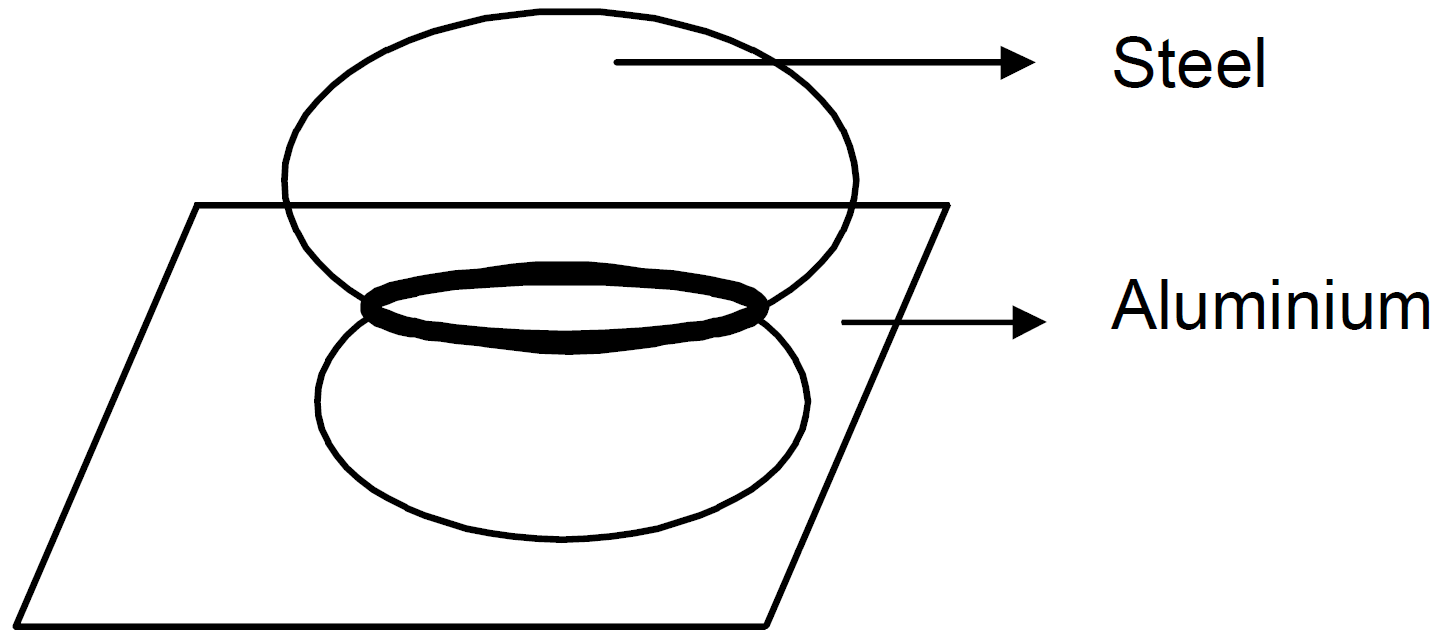
An aluminium plate fixed in a horizontal position has a hole of diameter 2.000cm. A steel sphere of diameter 2.005cm rests on this hole. All the lengths refer to a temperature of 10°C. The temperature of the entire system is slowly increased. At what temperature willl the ball fall down? Coefficient of linear expansion of aluminium is 23 × 10-6 °C-1 and that of steel is 11 × 10-6 °C-1.
Answer

Given

$\text{d}_{\text{st}}=2.005\text{cm},$

$\alpha_\text{s}=11\times10^{-6}/^\circ\text{C}$

$\text{d}_\text{Al}=2.000\text{cm}$

$\alpha_\text{Al}=23\times10^{-6}/^\circ\text{C}$

$\text{d's}=2.005(1+\alpha_\text{s}\Delta\text{T})$ (where $\Delta\text{T}$ is change in temp.)

$\Rightarrow\text{d's}=2.005+2.005\times11\times10^{-6}\Delta\text{T}$

$\Rightarrow\text{d'}_\text{Al}=2(1+\alpha_\text{Al}\Delta\text{T})$

$=2+2\times23\times10^{-6}\Delta\text{T}$

The two will slip i.e the steel ball with fall when both the diameters become equal.

So,

$\Rightarrow2.005+2.005\times11\times10^{-6}\Delta\text{T}$

$=2+2\times23\times10^{-6}\Delta\text{T}$

$\Rightarrow(46-22.055)10^{-6}\times\Delta\text{T}$

$=0.005$

$\Rightarrow\Delta\text{T}=\frac{0.005\times10^6}{23.945}=208.81$

Now $\Delta\text{T}=\text{T}_2-\text{T}_1=\text{T}_2-10^\circ\text{C}\ [\therefore\text{T}_1=10^\circ\text{C}\ \text{given}]$

$\Rightarrow\text{T}_2=\Delta\text{T}+\text{T}_1=208.81+10=281.81$

View full question & answer
Question 45 Marks
Two steel rods and an aluminium rod of equal length l0 and equal cross section are joined rigidly at their ends as shown in the figure below. All the rods are in a state of zero tension at 0°C. Find the length of the system when the temperature is raised to $\theta$. Coefficient of linear expanaion of aluminium and steel are $\alpha_\text{a}$ and $\alpha_\text{s}$respectively. Young's modulus of aluminium is Ya and of steel is Ys.

Answer

Let the final length of the system at system of temp. $0^\circ\text{C}=\ell_0$

Initial length of the system $=\ell_0$

When temp. changes by $\theta$.

Strain of the system $=\ell_1-\frac{\ell_0}{\ell_\theta}$

But the total strain of the system $\frac{\text{total stress of system}}{\text{total young's modulus of system}}$

Now, total stress = Stress due to two steel rod + Stress due to Aluminium

$=\gamma_\text{s}\alpha_\text{s}\theta+\gamma_\text{s}\ \text{ds}\ \theta+\gamma_\text{al}\ \text{at}\ \theta=2\%\ \alpha_\text{s}\ \theta+\gamma2\text{A}\ell\theta$

Now young' modulus of system $=\gamma_\text{s}+\gamma_\text{s}+\gamma_\text{al}=2\gamma_\text{s}+\gamma_\text{al}$

$\therefore$ Strain of system $=\frac{2\gamma_\text{s}\alpha_\text{s}\theta+\gamma_\text{s}\alpha_\text{al}\theta}{2\gamma_\text{s}+\gamma_\text{al}}$

$\Rightarrow\frac{\ell_\theta-\ell_0}{\ell_0}$

$=\frac{2\gamma_\text{s}\alpha_\text{s}\theta+\gamma_\text{s}\alpha_\text{al}\theta}{2\gamma_\text{s}+\gamma_\text{al}}$

$\Rightarrow\ell_\theta=\ell_0\bigg[\frac{1+\alpha_\text{al}\gamma_\text{al}+2\alpha_\text{s}\gamma_\text{s}\theta}{\gamma_\text{al}+2\gamma_\text{s}}\bigg]$

View full question & answer
Question 55 Marks
A glass vessel measures exactly 10cm × 10cm × 10cm at 0°C. It is filled completely with mercury at this temperature. When the temperature is raised to 10°C, 1.6cm3 of mercury overflows. Calculate the coefficient of volume expansion of mercury. Coefficient of linear expansion of glass = 6.5 × 10⁻⁶ °C.
Answer
$\text{V}_0=10\times10\times10=1000\ \text{CC}$

$\Delta\text{T}=10^\circ\text{C},$

$\text{V}'_\text{Hg}-\text{V}'_\text{g}=1.6\text{cm}^3$

$\alpha_\text{g}=6.5\times10^{-6}\ /^\circ\text{C}$

$\gamma_\text{Hg}=?,$

$\gamma_\text{g}=3\times6.5\times10^{-6}\ /^\circ\text{C}$

$\text{V}'_\text{Hg}=\text{V}_\text{Hg}(1+\gamma_\text{Hg}\Delta\text{T})\ ...(1)$

$\text{V}'_\text{g}=\text{v}_\text{g}(1+\gamma_\text{g}\Delta\text{T})\ ...(2)$

$\text{V}'_\text{Hg}-\text{V}'_\text{g}$

$=\text{V}_\text{Hg}-\text{V}_\text{g}+\text{V}_{\text{Hg}\gamma\text{Hg}}\Delta\text{T}-\text{V}_{\text{g}\gamma\text{g}}\Delta\text{T}$

$\Rightarrow1.6=1000\times\gamma_\text{Hg}\times10-1000\times6.5\times3\times10^{-6}\times10$

$\Rightarrow\gamma_\text{Hg}=\frac{1.6+6.3\times3\times10^{-2}}{10000}$

$=1.789\times10^{-4}\approx1.8\times10^{-4}\ /^\circ\text{C}$

View full question & answer
Question 65 Marks
A glass window is to be fit in an aluminium frame. The temperature on the working day is 40°C and the glass window measures exactly 20cm × 30cm. What should be the size of the aluminium frame so that there is no stress on the glass in winter even if the temperature drops to 0°C ? Coefficients of linear expansion for glass and aluminium are 9.0 × 10⁻⁶ °C-1 and 24 × 10-6 °C-1 respectively.
Answer
The final length of aluminium should be equal to final length of glass.
Let the initial length o faluminium = l
$\text{l}(1-\alpha_\text{Al}\Delta\text{T})=20(1-\alpha_0\Delta\theta)$
$\Rightarrow\text{l}(1-24\times10^{-6}\times40)$
$=20(1-9\times10^{-6}\times40)$
$\Rightarrow\text{l(1-0.00096)}=20(1-0.00036)$
$\Rightarrow\text{l}=\frac{20\times0.99964}{0.99904}=20.012\text{cm}$
Let initial breadth of aluminium = b
$\text{b}(1-\alpha_\text{Al}\Delta\text{T})=30(1-\alpha_0\Delta\theta)$
$\Rightarrow\text{b}=\frac{30\times(1-9\times10^{-6}\times40)}{(1-24\times10^{-6}\times40)}$
$=\frac{30\times0.99964}{0.99964}=30.018\text{cm}$
View full question & answer
Question 75 Marks
The volume of a glass vessel is 1000 cc at 20°C. What volume of mercury should be poured into it at this temperature so that the volume of the remaining space does not change with temperature? Coefficients of cubical expansion of mercury and glass are 1.8 × 10-4 °C and 9·0 × 10-6 °C-1 respectively.
Answer
$\text{V}_\text{g}=1000\ \text{CC},$
$\text{V}_\text{Hg}=?$
$\text{T}_1=20^\circ\text{C}$
$\gamma_\text{Hg}=1.8\times10^{-4}\ /^\circ\text{C}$
$\gamma_\text{g}=9\times10^{-6}\ /^\circ\text{C}$
$\Delta\text{T}$ remains constant
Volume of remaining space $=\text{V}'\text{g}-\text{V}'_\text{Hg}$
Now 
$\text{V}'_\text{g}=\text{V}_\text{g}(1+\gamma_\text{g}\Delta\text{T})\ ...(1)$
$\text{V}'_\text{Hg}=\text{V}_\text{Hg}(1+\gamma_\text{Hg}\Delta\text{T})\ ...(2)$
Subtracting (2) from (1)
$\text{V}'_\text{g}-\text{V}_\text{Hg}$
$=\text{V}_\text{g}-\text{V}_\text{Hg}+\text{V}_{\text{g}\gamma\text{g}}\Delta\text{T}-\text{V}_{\text{Hg}\gamma\text{Hg}}\Delta\text{T}$
$\Rightarrow\frac{\text{V}_\text{g}}{\text{v}_\text{Hg}}=\frac{\gamma_\text{Hg}}{\gamma_\text{g}}$
$\Rightarrow\frac{1000}{\text{V}_\text{g}}=\frac{1.8\times10^{-4}}{9\times10^{-6}}$
$\Rightarrow\text{V}_\text{Hg}=\frac{9\times10^{-3}}{1.8\times10^{-4}}$
$=500\ \text{CC}$
View full question & answer
Question 85 Marks
A metre scale made of steel reads accurately at 20°C. In a sensitive experiment, distances accurate up to 0.055mm in 1m are required. Find the range of temperature in which the experiment can be performed with this metre scale. Coefficient of linear expansion of steel = 11 × 10-6 °C-1.
Answer
$\text{T}_1=20^\circ\text{C},$

$\Delta\text{L}=0.055\text{mm}=0.55\times10^{-3}\text{m}$

$\text{t}_2=?$

$\alpha_\text{st}=11\times10^{-6}/^\circ\text{C}$

We know,

$\Delta\text{L}=\text{L}_0\alpha\Delta\text{T}$

In our case,

0.055 × 10-3 = 1 × 1.1 × 10-6 × (T+ T2)

0.055 = 11 × 10-3 × 20 ± 11 × 10-3 × T2

T=  20 + 5 = 25°C or 20 – 5 = 15°C

The expt. Can be performed from 15 to 25°C

View full question & answer
Question 95 Marks
An aluminium can of cylindrical shape contains 500cmof water. The area of the inner cross section of the can is 125cm2. All measurements refer to 10°C. Find the rise in the water level if the temperature increases to 80°C. The coefficient of linear expansion of aluminium = 23 × 10-6 °C-1 and the average coefficient of volume expansion of water = 3.2 × 10⁻⁴ °C-1 respectively.
Answer
Volume of water = 500cm3
Area of cross section of can = 125m2
Final Volume of water
$=500(1+\gamma\Delta\theta)=500\Big[1+3.2\times10^{-4}\times(80-10)\Big]$
$=511.2\text{cm}^3$
The aluminium vessel expands in its length only so area expansion of base cab be neglected.
Increase in volume of water = 11.2cm3
Considering a cylinder of volume = 11.2cm3
Height of water increased $=\frac{11.2}{125}=0.089\text{cm}$
View full question & answer
Question 105 Marks
A circular disc made of iron is rotated about its axis at a constant velocity to $\omega$. Calculate the percentage change in the linear speed of a particle of the rim as the disc is slowly heated from 20°c to 50°C keeping the angular velocity constant. Coefficient of linear expansion of iron = 1.2 × 10⁻⁵ °C-1.
Answer
$\text{T}_1=20^\circ\text{C},$
$\text{T}_2=50^\circ\text{C},$
$\Delta\text{T}=30^\circ\text{C}$
$\omega$ remains constant
  1. $\omega=\frac{\text{V}}{\text{R}}$
  2. $\omega=\frac{\text{V}'}{\text{R}'}$
Now, $\text{R}'=\text{R}(1+\alpha\Delta\theta)$
$=\text{R}+\text{R}\times1.2\times10^{-5}\times30=1.00036\text{R}$
From (I) and (II)
$\frac{\text{V}}{\text{R}}=\frac{\text{V}'}{\text{R}'}=\frac{\text{V}'}{1.00036\text{R}}$
$\Rightarrow\text{V}'=1.00036\text{V}$
$\%\ \text{of change}$ $=\frac{(1.00036\text{V}-\text{V})}{\text{V}}\times100$
$=0.00036\times100=3.6\times10^{-2}$
View full question & answer
Question 115 Marks
The densities of wood and benzene at 0°C are 880kg m-3 and 900kg m-3 respectively. The coefficients of volume expansion are 1.2 × 10⁻³ °C-1 for wood and 1.5 × 10⁻³ °C-1 for benzene. At what temperature will a piece of wood just sink in benzene?
Answer
$\text{f}\omega =880\text{Kg/m}^3,$
$\text{f}_\text{b}=900\text{km/m}^3$
$\text{T}_1=0^\circ\text{C},$
$\gamma_\omega=1.2\times10^{-3}\ /^\circ\text{C},$
$\gamma_\text{b}=1.5\times10^{-3}\ /^\circ\text{C}$
The sphere begins t sink when,
(mg)sphere = displaced water
$\Rightarrow\text{Vf'}_\omega\text{g}=\text{Vf'}_\text{b}\text{g}$
$\Rightarrow\frac{\text{f}_\omega}{1+\gamma_\omega\Delta\theta}=\frac{\text{f}_\text{b}}{1+\gamma_\text{b}\Delta\theta}$
$\Rightarrow\frac{880}{1+1.2\times10^{-3}}=\frac{900}{1+1.5\times10^{-3}\Delta\theta}$
$\Rightarrow880+880\times1.5\times10^{-3}(\Delta\theta)$
$\Rightarrow900+900\times1.2\times10^{-3}(\Delta\theta)$
$\Rightarrow(880\times1.5\times10^{-3}-900\times1.2\times10^{-3})(\Delta\theta)=20$
$\Rightarrow(1320-1080)\times10^{-3}(\Delta\theta)=20$
$\Rightarrow\Delta\theta=83.3^\circ\text{C}\approx83^\circ\text{C}$
View full question & answer
Question 125 Marks
A resistance thermometer reads R =$20.0\Omega$, $27.5\Omega$, and $50.0\Omega$ at the ice point (0°C), the steam point (100°C) and the zinc point (420°C) respectively. Assuming that the resistance varies with temperature as$\text{R}_\theta=\text{R}_0(1+\alpha\theta+\beta\theta^2)$, find the values of $\text{R}_0,$ $\alpha \ \text{and}\ \beta.$ Here $\theta$ represents the temperature on Celsius scale.
Answer
R at ice point $(\text{R}_0)=20\Omega$
R at steam point $(\text{R}_{100})=27.5\Omega$
R at Zinc point $(\text{R}_{420})=50\Omega$
$\text{R}_\theta=\text{R}_0\Big(1+\alpha\theta+\beta\theta^2\Big)$
$\Rightarrow\text{R}_{100}=\text{R}_0+\text{R}_0\alpha\theta+\text{R}_0\beta\theta^2$
 $\Rightarrow\frac{\text{R}_{100}-\text{R}_0}{\text{R}_0}=\alpha\theta+\beta\theta^2$
$\Rightarrow\frac{27.5-20}{20}=\alpha\times100+\beta\times10000$
$\Rightarrow\frac{7.5}{20}=100\alpha+10000\beta$ 
$\text{R}_{420}=\text{R}_0\Big(1+\alpha\theta+\beta\theta^2\Big)$
$\Rightarrow\frac{50-\text{R}_0}{\text{R}_0}=\alpha\theta+\beta\theta^2$
$\Rightarrow\frac{50-20}{20}=420\times\alpha+176400\times\beta$
$\Rightarrow\frac{3}{2}=420\alpha+176400\beta$
$\Rightarrow\frac{7.5}{20}=100\alpha+10000\beta$
$\Rightarrow\frac{3}{2}=420\alpha+176400\beta$
Solving (i) and (ii), we get
$\alpha=3.8\times10^{-3\circ}\text{C}^{-1}$
$\beta=-5.6\times10^{-7\circ}\text{C}^{-1}$
Therefore, resistance R0 is $20\Omega$ and the value of $\alpha$ is $3.8\times10^{-3\circ}\text{C}^{-1}$ and that of $\beta$ is $-5.6\times10^{-7\circ}\text{C}^{-1}$
View full question & answer
Question 135 Marks
A torsional pendulum consists of a solid disc connected to a thin wire$\Big(\alpha=2.4\times10^{-5}\ ^\circ\text{C}^{-1}\Big)$at its centre. Find the percentage change in the time period between peak winter (5°C) and peak summer (45°C).
Answer
Let the initial m.I. at 0°C be $\text{I}_0$
$\text{T}=2\pi\sqrt\frac{\text{I}}{\text{K}}$
$\text{I}=\text{I}_0(1+2\alpha\Delta\theta)$ (from above question)
At 5°C, $\text{T}_1=2\pi\sqrt\frac{\text{I}_0(1+2\alpha\Delta\theta)}{\text{K}}$
$=2\pi\sqrt\frac{\text{I}_0(1+2\alpha\Delta5)}{\text{k}}$
$=2\pi\sqrt\frac{\text{I}_0(1+10\alpha)}{\text{K}}$
At 45°C, $\text{T}_2=2\pi\sqrt\frac{\text{I}_0(1+2\alpha45)}{\text{K}}$
$2\pi\sqrt\frac{\text{I}_0(1+90\alpha)}{\text{K}}$
$\frac{\text{T}_2}{\text{T}_1}=\sqrt\frac{1+90\alpha}{1+10\alpha}$
$=\sqrt\frac{1+90\times2.4\times10^{-5}}{1+10\times2.4\times10^{-5}}\sqrt\frac{1.00216}{1.00024}$
% change $=\Big(\frac{\text{T}_2}{\text{T}_1}-1\Big)\times100$
$=0.0959\%=9.6\times10^{-2}\%$
View full question & answer
Question 145 Marks
A pendulum clock gives correct time at 20°C at a place where g = 9.800m s-2. The pendulum consists of a light steel rod connected to a heavy ball. It is taken to a different place where g = 9.788m s-2. At what temperature will it give correct time ? Coefficient of linear expansion of steel = 12 × 10-6 °C-1.
Answer
$\text{g}_1=9.8\text{m/s}^2,$
$\text{T}_1=2\pi\frac{\sqrt{\text{l}_1}}{\text{g}_1}$
$\text{g}_2=9.788\text{m/s}^2$
$\text{T}_2=2\pi\frac{\sqrt{\text{l}}_1}{\text{g}_2}=2\pi\frac{\sqrt{l_1(1+\Delta\text{T})}}{\text{g}}$
$\alpha_{\text{steel}}=12\times10^{-6}/^ \circ\text{C}$
$\text{T}_1 = 20^\circ\text{C}$
$\text{T}_2=?$
$\text{T}_1=\text{T}_2$
$\Rightarrow2\pi\frac{\sqrt{\text{l}_1}}{\text{g}_1}$
$=2\pi\frac{\sqrt{{\text{l}_1}(1+\Delta\text{T})}}{\text{g}_2}$
$\Rightarrow\frac{\text{l}_1}{\text{g}_1}=\frac{\text{l}_1(1+\Delta\text{T})}{\text{g}_2}$
$\Rightarrow\frac{1}{9.8}=\frac{1+12\times10^{-6}\times\Delta\text{T}}{9.788}$
$\Rightarrow\frac{9.788}{9.8}=1+12\times10^{-6}\times\Delta\text{T}$
$\Rightarrow\frac{9.788}{9.8}-1=12\times10^{-6}\times\Delta\text{T}$
$\Rightarrow\Delta\text{T}=\frac{-0.00122}{12\times10^{-6}}$
$\Rightarrow\text{T}_2-20=-101.6$
$\Rightarrow\text{T}_2=-101.6+20=-81.6\approx-82^\circ\text{C}$
View full question & answer
Question 155 Marks
Can the bulb of a thermometer be made of an adiabatic wall?
Answer
The bulb of a thermometer plays an important role in measuring the temperature of the surrounding body. It is put in contact with the body whose temperature is to be measured. The bulb attains the temperature of the body, which allows calibration of temperature. If the bulb is made of an adiabatic wall, then no heat will be transferred through the wall and the bulb cannot attain thermal equilibrium with the surrounding body. Therefore, the bulb cannot be made of an adiabatic wall.
View full question & answer