Question
A torsional pendulum consists of a solid disc connected to a thin wire$\Big(\alpha=2.4\times10^{-5}\ ^\circ\text{C}^{-1}\Big)$at its centre. Find the percentage change in the time period between peak winter (5°C) and peak summer (45°C).

Answer

Let the initial m.I. at 0°C be $\text{I}_0$
$\text{T}=2\pi\sqrt\frac{\text{I}}{\text{K}}$
$\text{I}=\text{I}_0(1+2\alpha\Delta\theta)$ (from above question)
At 5°C, $\text{T}_1=2\pi\sqrt\frac{\text{I}_0(1+2\alpha\Delta\theta)}{\text{K}}$
$=2\pi\sqrt\frac{\text{I}_0(1+2\alpha\Delta5)}{\text{k}}$
$=2\pi\sqrt\frac{\text{I}_0(1+10\alpha)}{\text{K}}$
At 45°C, $\text{T}_2=2\pi\sqrt\frac{\text{I}_0(1+2\alpha45)}{\text{K}}$
$2\pi\sqrt\frac{\text{I}_0(1+90\alpha)}{\text{K}}$
$\frac{\text{T}_2}{\text{T}_1}=\sqrt\frac{1+90\alpha}{1+10\alpha}$
$=\sqrt\frac{1+90\times2.4\times10^{-5}}{1+10\times2.4\times10^{-5}}\sqrt\frac{1.00216}{1.00024}$
% change $=\Big(\frac{\text{T}_2}{\text{T}_1}-1\Big)\times100$
$=0.0959\%=9.6\times10^{-2}\%$

Need a full question paper?

Generate a complete, print-ready paper with questions like this in minutes — across 16+ boards, with answer keys.
Start Generating Free

Similar questions

Find the typical de Broglie wavelength associated with a He atom in helium gas at room temperature (27ºC) and 1 atm pressure; and compare it with the mean separation between two atoms under these conditions.
A paperweight in the form of a hemisphere of radius 3.0cm is used to hold down a printed page. An observer looks at the page vertically through the paperweight. At what height above the page will the printed letters near the centre appear to the observer?
The initial pressure and volume of a given mass of a gas $\Big(\frac{\text{C}_\text{P}}{\text{C}_\text{V}}=\gamma\Big)$ are P0 and V0. The gas can exchange heat with the surrounding.
  1. It is slowly compressed to a volume $\frac{\text{V}_0}{2}$ and then suddenly compressed to $\frac{\text{V}_0}{4}.$ Find the final pressure.
  2. If the gas is suddenly compressed from the volume V0 to $\frac{\text{V}_0}{2}$ and then slowly compressed to $\frac{\text{V}_0}{4},$ what will be the final pressure?
Two long, straight wires, each carrying a current of 5A, are placed along the X and Y-axes respectively. The currents point along the positive directions of the axes. Find the magnetic fields at the points (a) (1m, 1m), (b) (-1m, 1m), (c) (-1m,-1m) and (d) (1m, -1m),
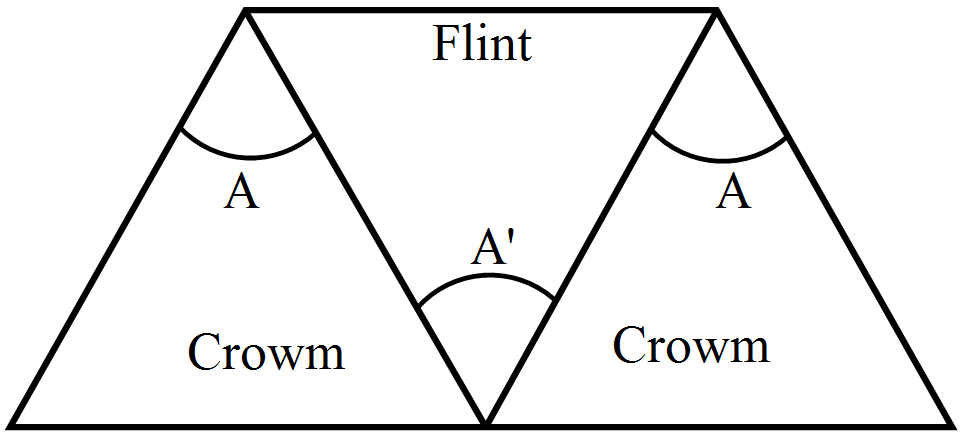
Three thin prisms are combined as shown in figure. The refractive indices of the crown glass for red, yellow and violet rays are $\mu_\text{r},\mu_\text{y}$ and $\mu_\text{v}$ respectively and those for the flint glass are $\mu'_\text{r},\mu'_\text{y}$ and $\mu'_\text{v}$ respectively. Find the ratio $\frac{\text{A}'}{\text{A}}$ for which.

  1. There is no net angular dispersion.
  2. There is no net deviation in the yellow ray.
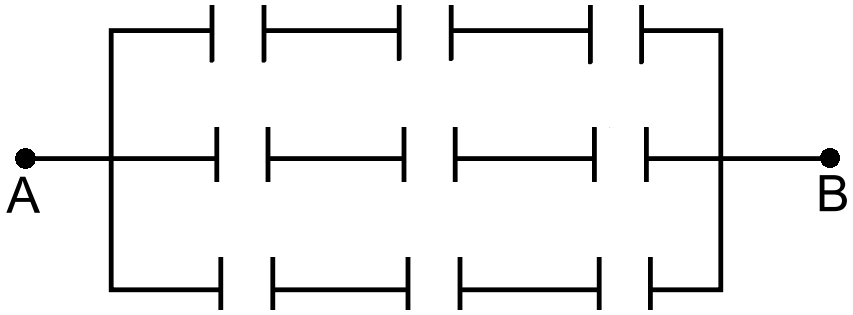
Each of the capacitors shown in figure has a capacitance of $2\mu\text{F}.$ Find the equivalent capacitance of the assembly between the points A and B. Suppose, a battery of emf 60 volts is connected between A and B. Find the potential difference appearing on the individual capacitors.

  1. A point object is placed on the principal axis of a convex spherical surface of radius of curvature R, which separates the two media of refractive indices n1 and n(n2 > n1). Draw the ray diagram and deduce the relation between the object distance (u), image distance (v) and the radius of curvature (R) for refraction to take place at the convex spherical surface from rarer to denser medium.
  2. A converging lens has a focal length of 20 cm in air. It is made of a material of refractive index 1.6. If it is immersed in a liquid of refractive index 1.3, find its new focal length.
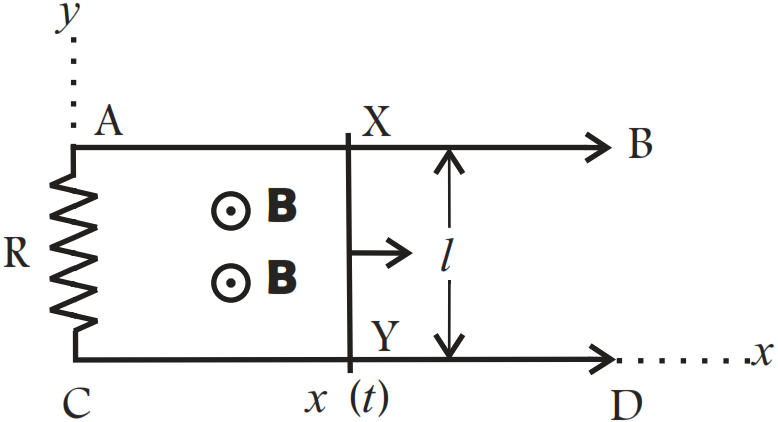
A conducting wire XY of mass m and neglibile resistance slides smoothly on two parallel conducting wires as shown in Fig. The closed circuit has a resistance R due to AC. AB and CD are perfect conductors. There is a magnetic field $\text{B}=\text{B}(\text{t})\hat{\text{k}}$.

  1. Write down equation for the acceleration of the wire XY.
  2. If B is independent of time, obtain v(t), assuming v(0) = u0.
  3. For (b), show that the decrease in kinetic energy of XY equals the heat lost in R.
Do permeability and relative permeability have the same dimensions?
Consider the Atwood machine of the previous problem. The larger mass is stopped for a moment 2.0s after the system is set into motion. Find the time elapsed before the string is tight again.