Questions

4 Marks Questions

🎯

Test yourself on this topic

6 questions · timed · auto-graded

Question 14 Marks
Explain energy generation in stars through the process of nuclear fusion and explain proton. proton cycle.
Answer
→ Sun continuously emits energy due to thermonuclear fusion. The interior of the Sun has a temperature of $1.5 \cdot 10^7 K$.
→ The thermonuclear fusion process in the Sun is known as proton-proton cycle.
→ This process is a multi-step process in which the hydrogen is burned into helium. Thus the fuel in the Sun is the hydrogen in its core.
→ The proton-proton cycle is represented by the following sets of reactions:
$
\begin{array}{l}
{ }_1^1 H+{ }_1^1 H \rightarrow{ }_1^2 H+e^{+}+v+0.42 MeV \ldots \text {(i) } \\
e^{+}+e^{-} \rightarrow Y+Y+1.02 MeV \ldots \text { (ii) } \\
{ }_1^2 H+{ }_1^1 H \rightarrow{ }_2^3 He+\gamma+5.49 MeV \ldots \text { (iii) } \\
{ }_2^3 He+{ }_2^3 He \rightarrow{ }_2^4 He+{ }_1^1 H+{ }_1^1 H+12.86 MeV ...(iv)
\end{array}
$
→ In this reaction, the first three reactions must occur twice and in the fourth reaction two light helium nuclei unite to form ordinary helium nucleus.
→ If we consider the combination
2 (i) +2 (ii) +2 (iii) + (iv), the net effect is
$
4_1 H^1+2 e^{-} \rightarrow{ }_2 He^4+2 v+6 y+26.7 MeV
$
OR
$
4_1 H^1+4 e^{-} \rightarrow\left[{ }_2 He^4+2 e^{-}\right]+2 v+6 y+26.7 MeV
$
→ Thus four hydrogen atoms combine to form an $_2 He ^4$ atom with a release of 26.7 MeV of energy.
View full question & answer
Question 24 Marks
A beam of light consisting of two wavelengths, 4500Å and 6000Å is used to obtain interference fringes in a Young's double slit experiment.
(a) Find the distance of the third dark fringe on the screen from the central maximum for wavelength 4500Å .
(b) What is the least distance from the central maximum where the bright fringe due to 4500Å coincides with dark fringe due to 6000Å.
(Here width of slit $d =0.15 cm$, distance between slit and screen $D=90 cm$ )
Answer
$
\begin{array}{l}
\lambda_1=4500 A^{\circ}=450 nm \\
\lambda_2=6000 A^{\circ}=600 nm
\end{array}
$
(a) $n =3$ (Dark Fringe)
$
D=90 cm \quad d=0.15
$
Path difference for constructive intafarence $= n \lambda$ where $n =0,1,2,3 \ldots$
$
\begin{array}{l}
\text { but Path difference }=\frac{x d}{D} \\
\frac{x d}{D}=n \lambda
\end{array}
$
$\lambda$ For wave length
$
\begin{array}{l}
\frac{x d}{D}=n \lambda_1 \\
\therefore x=\frac{n \lambda_1 D}{d} \\
x=\frac{3 \times 450 \times 10^{-9} \times 90 \times 10^{-2}}{0.15 \times 10^{-2}} \\
=8.10 \times 10^8 \\
=8.10 \times 10^{-2} m \\
x=0.810 mm
\end{array}
$
(b) Suppose, at some minimum distance x on the screen, from its central bright fringe $n _1$ th order bright fringe of light with wave lenght $\lambda_1=450 nm$ superposes on the $n _2$ th order bright fringe of light with wave length $\lambda_2=600 nm$
Hence, the path difference for both is same.
$
\begin{array}{l}
\therefore n_1 \lambda_1=n_2 \lambda_2 \\
\therefore \frac{n_1}{n_2}=\frac{\lambda_2}{\lambda_1}=\frac{600}{450} \\
\therefore \frac{n_1^2}{n_2}=\frac{4}{3} \ldots(1)
\end{array}
$
(/ least) distance we must take the values of $n _1$ and $n _2$ minimum which must satisfy the above equation.
$
\begin{array}{l}
\lambda_1 \text { for the light having wave lenght put differance }=n_1 \lambda_1 \\
\text { but path difference }=\frac{x d}{D} \\
\therefore \frac{x d}{D}=n_1 \lambda_1 \\
\therefore x=\frac{n \lambda_1 D}{d} \\
=\frac{4 \times 450 \times 10^{-9} \times 90 \times 10^{-2}}{0.15 \times 10^{-2}} \\
=1.08 \times 10^{-9} \\
=1.08 \times 10^{-3} m \\
x=1.08 mm
\end{array}
$Thas, both are bright fringes will superpose on each other at distance 1.08 mm from the central maximum.
View full question & answer
Question 34 Marks
Derive $\delta=i+e- A$ for a Prism. Also derive an expression for the refractive index of material of the Prism.
Answer

Image
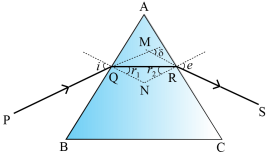
→ Figure shows the cross section of a prism.
→ The path of a light passing through this prism is PQRS .
→ The angle of incidence is $i$ and the angle of refraction is $r$ at the first side $A B$.
→ The angle incidence is $r_2$ and the angle of emergence (angle of refraction) is $e$.
→ Angle between the direction of emergent ray RS and incident ray $P Q$ is called angle of deviation ( $\delta$ ).
→ In $\square A Q N R m \angle AQN = m \angle ARN =90^{\circ}$.
→ The sum of remaining two angles is $180^{\circ}$.
$
\therefore \angle A+\angle QNR=180^{\circ} \ldots
$
→ For $\triangle QNR$,
$
r_1+r_2+\angle QNR=180^{\circ} \ldots
$
→ Comparing equation (1) and (2),
$
\begin{array}{l}
\therefore \angle A+\angle QNR=r_1+r_2+\angle QNR \\
\therefore A=r_1+r_2 \ldots \text { (3) }
\end{array}
$
→ For $\triangle QMR , \delta$ is the exterior angle.
$
\therefore \delta=\angle MQR+\angle MRQ . .
$
but $i=r_1+\angle MQR$
$
\therefore \angle MQR=i-r_1
$
and same way $\angle MRQ =e-r_2$.
→ Substituting these two values in equation (4),
$
\begin{array}{l}
\therefore \delta=i-r_1+e-r_2 \\
\therefore \delta=i+e-\left(r_1+r_2\right)
\end{array}
$
→ From equation (3),
$
\therefore \delta=i+e-A
$
Image
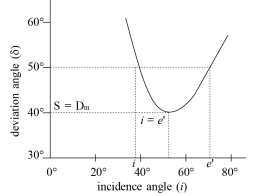
→ The graph of deviation angle versus incidence angle is shown in figure.
→ The graph shows that for a single value of deviation angle ( $\delta$ ) there are two values of incidence angle $i$ and hence also of $e$.
→ From the symmetry it can be said that angle of deviation $\delta$ remains the same if angle of incidence $i$ and angle of emergent $e$ are interchanged. Even if the path of ray can be traced back, resulting in the same angle of deviation.
→ From the graph, for a particular value of $i=e$ the angle of incidence, a single value of deviation is obtained. At the minimum deviation, $D _m$, the refracted ray becomes parallel to its base.
→ So when $\delta= D _m$ and $i=e$, then $r_1=r_2$.
→ For prism, $A =r_1+r_2$
$
\begin{array}{l}
\therefore A=2 r_1 \\
\therefore r_1=\frac{A}{2}
\end{array}
$
→ and from $\delta=i+e- A$,
$
\begin{array}{l}
D_m=2 i-A \\
2 i=D_m+A \\
A+D_m \\
i=\frac{. .(2)}{2}
\end{array}
$
→ Applying Snell's law at incident point Q ,
$
n_1 \sin i=n_2 \sin r_1
$
→ Substituting value of $r_1$ and $i$ from equation (1) and (2),
$
\begin{array}{l}
\therefore n_1 \sin \left(\frac{A+D_{m}}{2}\right)=n_2 \sin \left(\frac{A}{2}\right) \\
\therefore \frac{n_2}{n_1}=\frac{\sin \left(\frac{A+D_m}{2}\right)}{\sin \frac{A}{2}} \\
\therefore n_{21}=\frac{\sin \left(\frac{A+D_m}{2}\right)}{\sin \frac{A}{2}}
\end{array}
$
→ which is the formula to find the refractive index of the material of the prism.
View full question & answer
Question 44 Marks
Explain AC circuit with only an inductor.
Answer
→ As shown in fig., an AC source is connected to pure inductor. (A pure inductor means an inductor having negligibly small resistance.)
→ Let the voltage across the source be
$
v=v_m \sin \omega t
...(1)$
→ Using the kirchhoff's loop rule for the AC circuit shown in the fig.,
$
v-L \frac{d i}{d t}=0
...(2)$
→ From equation (2),
$
\begin{array}{l}
\therefore \quad v=L \frac{d i}{d t} \\
\therefore \quad v_m \sin \omega t=L \frac{d i}{d t} \\
\therefore \quad \frac{d i}{d t}=\frac{v_m}{L} \sin \omega t
...(3)\end{array}
$
→ To obtain the current, we integrate equation (3)
$
\begin{array}{l}
\therefore \quad \int \frac{d i}{d t} d t=\int \frac{v_m}{L} \sin (\omega t) d t \\
\therefore \quad i=-\frac{v_m}{\omega L} \cos (\omega t)+\text { constant }
\end{array}
$
→ The integration constant has the dimension of current and is time-independent. Since the source has an emf which oscillates symmetrically about zero, so that no constant or time-independent component of the current exists. Therefore, the integration constant is zero.
$
\therefore \quad i=-\frac{v_m}{\omega L} \cos \omega t
$
$
\therefore \quad i=\frac{v_m}{\omega L} \sin \left(\omega t-\frac{\pi}{2}\right)
$
$\therefore \quad i=i_m \sin \left(\omega t-\frac{\pi}{2}\right)...(4)$
$i_m=\frac{ U _m}{\omega L}$ Amplitude of the current
→ The quantity $\omega L$ is analogous to the resistance and is called inductive reactance, denoted by $X _{ L }$ :
$
\therefore \quad X_L=\omega L
$
Unit of $X _{ L }$ is ohm ( $\Omega$ ).
→ From eq. (1) and (4), it can be said that current lags the voltage by $\frac{\pi}{2} rad$. [or onequarter $\frac{1}{4}$ cycle].
View full question & answer
Question 54 Marks
Derive formula of torque acting on a rectangular current carrying coil placed in a uniform magnetic field in such a way that its magnetic moment makes an angle $\theta$ with the magnetic field.
Answer
→ A steady charge Q produces an electric field (from chapter-1) E.
→ The electric field on point at a distance $r$ from the point charge Q is
$
\therefore \overrightarrow{E}=\frac{1}{4 \pi \varepsilon_0} \cdot \frac{Q}{r^2} \cdot \hat{r}\left(\text { or } \frac{KQ}{r^2} \hat{r}\right)
$
Where, $\hat{r}$ is unit vector in the direction of the electric field.
→ The force exerted by the electric field on a point charge in this electric field is :
$
\overrightarrow{F}=q \overrightarrow{E}=\frac{1}{4 \pi \varepsilon_0} \cdot \frac{q Q}{r^2} \cdot \hat{r}
$
→ An electric field conveys energy and momentum and not instantaneously but takes finite timeto propagate.
→ Apart from being dependent on every point in space, the electric field can vary with time.
→ If more than one electric field converge near a point, the resultant electric field at the point is equal to the vector sum of all the electric field.
→ Just as static charges produce an electric field, moving charges or current produces a magnetic field denoted by $\overrightarrow{ B }(\vec{r})$.
→ Similar to electric field, the magnetic field can also be defined at every point in space and it also follows the principle of superposition.
View full question & answer
Question 64 Marks
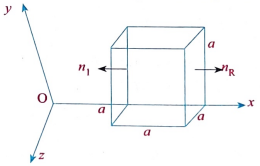
The electric field components in figure are
Image

$E _x=a x^{\frac{1}{2}}, E _y=0, E _z=0$ in which $a =800 NC ^{-1} m^{-\frac{1}{2}}$. Calculate
(a) The flux through the cube.
(b) The charge within the cube.
Assume $a=0.1 m$.
Answer
$
\begin{aligned}
E_x= & a x^{\frac{1}{2}} E_y=0 E_z=0 \\
& a=800 N / C m^{\frac{1}{2}} a=0.1 m
\end{aligned}
$
(a) Here, the electric field is only in the direction of X -axis. Hence, for all the unshaded faces in the fig., the angle between
electric field $\overrightarrow{ E }$ and area vector $\Delta \overrightarrow{ S }$ becomes $90^{\circ}\left(\frac{\pi}{2}\right)$,
therefore flux associated with those surfaces becomes zero.
→ The magnitude of electric field at the left face is,
From, $E _{ L }= a x^{\frac{1}{2}}$
$E _{ L }= a a^{\frac{1}{2}}$ (For the left side $x=a$ )
→ The magnitude of electric field at the right face is,
From, $E _{ R }= a x^{\frac{1}{2}}$
$E _{ R }= a ^{(2 a)^{\frac{1}{2}}}$ (For the right face $x=2 a$ )
→ Total electric (Net) flux through the cube,
$
\begin{array}{l}
\varphi=\varphi_{L}+\varphi_{R} \\
\therefore \varphi=\overrightarrow{E}_{L} \cdot \overrightarrow{S}+\overrightarrow{E}_{R} \cdot \overrightarrow{S} \\
\therefore \varphi=E_{L} S \cos \pi+E_{R} S \cos 0 \\
\therefore \varphi=\left(\alpha a^{\frac{1}{2}}\right)\left(a^2\right) \cos \pi+\left(\alpha(2 a)^{\frac{1}{2}}\right)\left(a^2\right) \cos 0 \\
\therefore \varphi=-a a^{\frac{5}{2}}+\sqrt{2} \alpha a^{\frac{5}{2}} \\
\therefore \varphi=\alpha a^{\frac{5}{2}}(-1+\sqrt{2}) \\
\therefore \varphi=(800)^{(0.1)^{\frac{5}{2}}}(-1+1.414) \\
\therefore \varphi=1.05 \frac{N m^2}{C}
\end{array}
$
(b) Total (Net) electric charge in the cube,
$\begin{array}{l}\varphi=\frac{q}{\varepsilon_0} \\ \therefore q=\varphi \varepsilon_0 \\ =1.05 \cdot 8.85 \cdot 10^{-12} \\ \therefore q=9.29 \cdot 10^{-12} C \end{array}$
View full question & answer
4 Marks Questions - Physics STD 12 Science Questions - Vidyadip