Question
Explain AC circuit with only an inductor.

Answer

→ As shown in fig., an AC source is connected to pure inductor. (A pure inductor means an inductor having negligibly small resistance.)
→ Let the voltage across the source be
$
v=v_m \sin \omega t
...(1)$
→ Using the kirchhoff's loop rule for the AC circuit shown in the fig.,
$
v-L \frac{d i}{d t}=0
...(2)$
→ From equation (2),
$
\begin{array}{l}
\therefore \quad v=L \frac{d i}{d t} \\
\therefore \quad v_m \sin \omega t=L \frac{d i}{d t} \\
\therefore \quad \frac{d i}{d t}=\frac{v_m}{L} \sin \omega t
...(3)\end{array}
$
→ To obtain the current, we integrate equation (3)
$
\begin{array}{l}
\therefore \quad \int \frac{d i}{d t} d t=\int \frac{v_m}{L} \sin (\omega t) d t \\
\therefore \quad i=-\frac{v_m}{\omega L} \cos (\omega t)+\text { constant }
\end{array}
$
→ The integration constant has the dimension of current and is time-independent. Since the source has an emf which oscillates symmetrically about zero, so that no constant or time-independent component of the current exists. Therefore, the integration constant is zero.
$
\therefore \quad i=-\frac{v_m}{\omega L} \cos \omega t
$
$
\therefore \quad i=\frac{v_m}{\omega L} \sin \left(\omega t-\frac{\pi}{2}\right)
$
$\therefore \quad i=i_m \sin \left(\omega t-\frac{\pi}{2}\right)...(4)$
$i_m=\frac{ U _m}{\omega L}$ Amplitude of the current
→ The quantity $\omega L$ is analogous to the resistance and is called inductive reactance, denoted by $X _{ L }$ :
$
\therefore \quad X_L=\omega L
$
Unit of $X _{ L }$ is ohm ( $\Omega$ ).
→ From eq. (1) and (4), it can be said that current lags the voltage by $\frac{\pi}{2} rad$. [or onequarter $\frac{1}{4}$ cycle].

Need a full question paper?

Generate a complete, print-ready paper with questions like this in minutes — across 16+ boards, with answer keys.
Start Generating Free

Similar questions

Consider a coin of Example 1.20. It is electrically neutral and contains equal amounts of positive and negative charge of magnitude 34.8kC. Suppose that these equal charges were concentrated in two point charges seperated by,
  1. 1cm $\Big(\sim\frac{1}{2}\times\text{diagonalof theone paisa coin}\Big)$,
  2. 100m (~ length of a long building), and
  3. 106m (radius of the earth). Find the force on each such point charge in each of the three cases. What do you conclude from these results?
Suppose you are inside the water in a swimming pool near an edge. A friend is standing on the edge. Do you find your friend taller or shorter than his usual height?
Out of the two magnetic materials, 'A' has relative permeability slightly greater than unity while 'B' has less than unity. Identify the nature of the materials 'A' and 'B'. Will their susceptibilities be positive or negative?
Obtain the relation of phase between instantaneous current and voltage with the help of phase diagram for series LCR circuit.
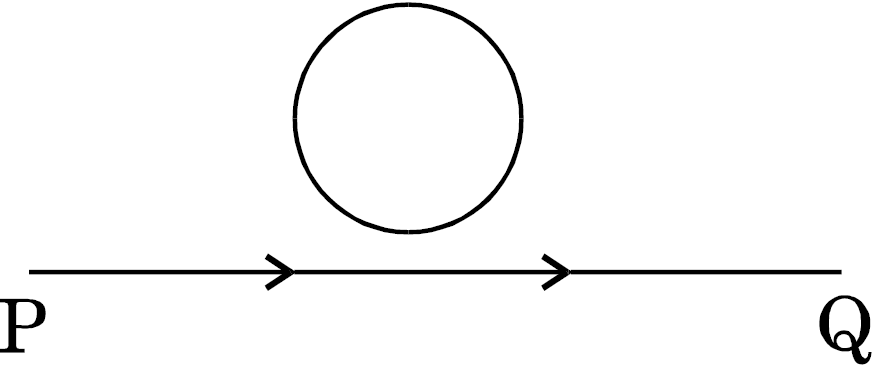
A conducting loop is held above a current carrying wire ‘PQ’ as shown in the figure. Depict the direction of the current induced in the loop when the current in the wire PQ is constantly increasing.

Coulomb's law states that the electrostatic force of attraction or repulsion acting between two stationary point charges is given by:

$\text{F}=\frac{1}{4\pi\in_0}\frac{\text{q}_1\text{q}_2}{\text{r}^2}$

Where F denotes the force between two charges q1 and q2 separated by a distance r in free space, $\in_0$ is a constant known as permittivity of free space. Free space is vacuum and may be taken to be air practically. If free space is replaced by a medium, then $\in_0$ is replaced by $(\in_0\text{k})$ or $(\in_0\in_\text{r})$ where k is known as dielectric constant or relative permittivity.

  1. In coulomb's law, $\text{F}=\text{k}\frac{\text{q}_1\text{q}_2}{\text{r}^2}$ then on which of the following factors does the proportionality constant k depends?
  1. Electrostatic force acting between the two charges.
  2. Nature of the medium between the two charges.
  3. Magnitude of the two charges.
  4. Distance between the two charges.
  1. Dimensional formula for the permittivity constant $\in_0$ of free space is:
  1. [ML-3 T4 A2]
  2. [M-1 L3 T2 A2]
  3. [M-1 L-3 T4 A2]
  4. ML-3 T4 A-2]
  1. The force of repulsion between two charges of 1C each, kept 1m apart in vaccum is:
  1. $\frac{1}{9\times10^9}\text{N}$

  2. 9 × 109N
  3. 9 × 107N
  4. $\frac{1}{9\times10^{12}}\text{N}$

  1. Two identical charges repel each other with a force equal to 10 mgwt when they are 0.6m apart in air.(g = 10m s-2). The value of each charge is:
  1. 2mC
  2. 2 × 10-7mC
  3. 2 nC
  4. $2\mu\text{C}$
  1. Coulomb's law for the force between electric charges most closely resembles with:
  1. Law of conservation of energy.
  2. Newton's law of gravitation.
  3. Newton's 2nd law of motion.
  4. Law of conservation of charge.
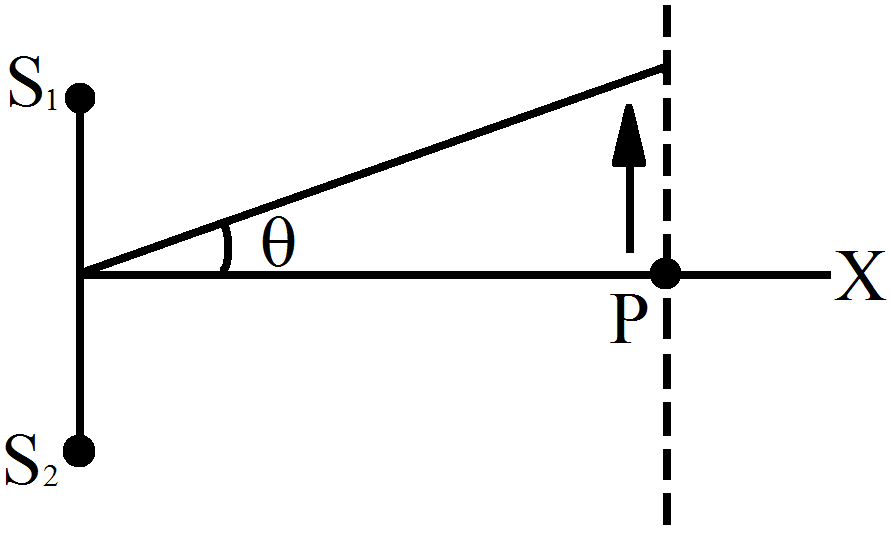
Two speakers S1 and S2, driven by the same amplifier, are placed at y = 1.0m and y = -1.0m figure, The speakers vibrate in phase at 600Hz. A man stands at a point on the X-axis at a very large distance from the origin and starts moving parallel to the Y-axis. The speed of sound in air is 330m/s.

  1. At what angle $\theta$ will the intensity of sound drop to a minimum for the first time?
  2. At what angle will he hear a maximum of sound intensity for the first time?
  3. If he continues to walk along the line, how many more maxima can he hear?

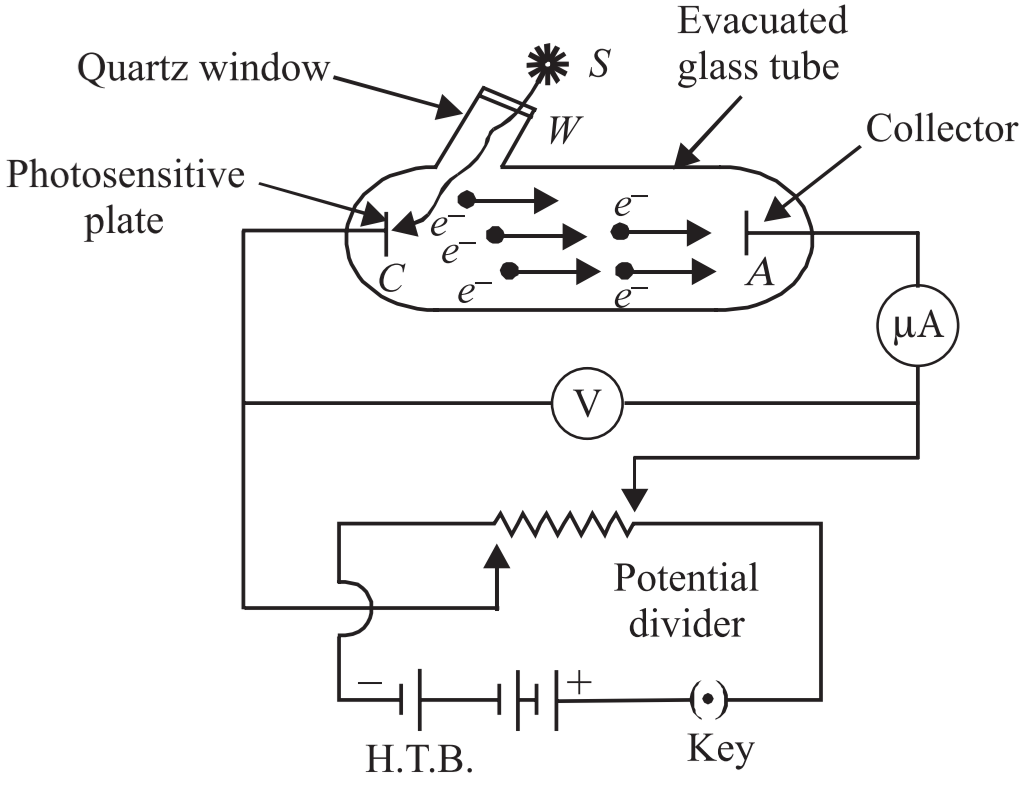
To study photoelectric effect, an emitting electrode C of a photosensitive material is kept at negative potential and collecting electrode A is kept at positive potential in an evacuated tube. When light of sufficiently high frequency falls on emitting electrode, photoelectrons are emitted which travel directly to collecting electrode and hence an electric current called photoelectric current starts flowing in the circuit, which is directly proportional to the number of photoelectrons emitted by emitting electrode C.

While demonstrating the existence of electromagnetic waves, Hertz found that high voltage sparks passed across the metal electrodes of the detector loop more easily when the cathode was illuminated by ultraviolet light from an arc lamp. The ultraviolet light falling on the metal surface caused the emission of negatively charged particles, which are now known to be electrons, into the surrounding space and hence enhanced the high voltage sparks.

  1. Cathode rays were discovered by:
  1. Maxwell Clerk James.
  2. Heinrich Hertz.
  3. William Crookes.
  4. J. J. Thomson.
  1. Cathode rays consists of:
  1. Photons
  2. Electrons
  3. Pistons
  4. $\alpha$-particles

  1. Who discovered the charge on an electron for the frist time?
  1. Millikan
  2. Thomson
  3. Kelvin
  4. Coulomb
  1. The dual nature oflight is exhibited by:
  1. Diffraction and photoelectric effect.
  2. Photoelectric effect.
  3. Refraction and interference.
  4. Diffraction and reflection.
  1. ln the phenomenon of electric discharge through gases at low pressure, the coloured glow in the tube appears as a result of:
  1. Collisions between the charged particles emitted from the cathode and the atoms of the gas.
  2. Collision between different electrons of the atoms of the gas.
  3. Excitation of electrons in the atoms.
  4. Collision between the atoms of the gas.
Out of the two magnetic materials, 'A' has relative permeability slightly greater than unity while 'B' has less than unity. Identify the nature of the materials 'A' and 'B'. Will their susceptibilities be positive or negative?