Questions

2 Marks Questions

Take a timed test

6 questions · self-marked practice — reveal the answer and mark yourself.

Question 12 Marks
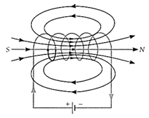
Depict the field-line pattern due to a current-carrying solenoid of finite length.
i. In what way do these lines differ from those due to an electric dipole?
ii. Why can't two magnetic field lines intersect each other?
Answer
Image

i. The magnetic lines of force of a solenoid form closed loops while the electric lines of force of an electric dipole start from the positive charge and end at the negative charge.
ii. Such curves are called magnetic lines of force. No two such lines of force can intersect. If they do so, then there will be two tangents and hence two directions of the magnetic field at the point of intersection which is impossible.
View full question & answer
Question 22 Marks
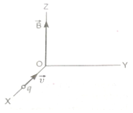
As shown in figure, a charge q moving along the X -axis with a velocity $\vec{v}$ is subjected to a uniform magnetic field $\vec{B}$ acting along the Z-axis as it crosses the origin O.
Image
i. Trace its trajectory.
ii. Does the charge gain kinetic energy, as it enters the magnetic field? Justify your answer.
View full question & answer
Question 32 Marks
In the first excited state of the hydrogen atom, its radius is found to be $21.2 \times 10^{-11} m$. Calculate its Bohr radius in the ground state. Also, calculate the total energy of the atom in the second excited state.
Answer
$r _0=21.2 \times 10^{-11} m$
First excited state means, $n = 2$
$ r _0= n ^2 r _1$
 or $r_1=\frac{r_0}{n^2}$
$r_1=\frac{21.2 \times 10^{-11}}{4} m$
$=5.3 \times 10^{-11} m$
$E=-\frac{13.6}{n^2}=-3.4 eV$,
hence total energy of atom is given by $: -3.4 eV$
View full question & answer
Question 42 Marks
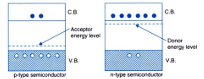
Draw the energy band diagram of (i) n-type, and (ii) p-type semiconductors at temperature T > 0 K. In the case of n-type Si-semiconductor, the donor energy level is slightly below the bottom of conduction band whereas in p-type semiconductor, the acceptor energy level is slightly above the top of valence band. Explain, giving examples, what role do these energy levels play in conduction and valence bands.
Answer
Energy band diagrams of n-type and p-type semiconductors are shown below: 
Image

n the case of n-type semiconductors, The Donor energy level decreases the energy gap between the conduction band and the valence band, electrons from donor impurity atoms will move into the conduction band with a very small supply of energy. Hence, the conduction band will, therefore, have electrons as majority charge carriers. In the case of p-type semiconductor, a very small supply of energy can cause an electron from its valence band to jump to the acceptor energy level. Hence, the valence band will have a dominant density of holes which shows that holes are the majority charge carriers in p-type semiconductors.
View full question & answer
Question 52 Marks
A straight solenoid of length $50 \ cm$ has $1000$ turns and a mean cross$-$sectional area of $2 \times 10^{-4} m^2$. It is placed with its axis at $30^{\circ}$, with a uniform magnetic field of $0.32 T .$ Find the torque acting on the solenoid when a current of $2 A$ is passed through it.
Answer
Torque of solenoid is given by $\tau=\ce{MB} \sin \theta$
$=\ce{(NIA)} B \sin \theta$
$=1000 \times 2 \times 2 \times 10^{-4} \times 0.32 \times \frac{1}{2}$
$=0.064 \ Nm$
View full question & answer
Question 62 Marks
Gamma rays and radio waves travel with the same velocity in free space. Distinguish between them in terms of their origin and the main application.
Answer


Gamma rays

Radio waves

Origin

Nuclear decay

Lightning

From hottest and most energetic objects in the universe, such as neutron stars, pulsars, supernova explosions, and regions around black holes

From broadcast radio towers, cell phones and radars.

Application

In radiotherapy, sterilisation and disinfection

In fixed and mobile radio communication, radar and other navigation systems, communication satellites, computer networks

View full question & answer