Questions

M.C.Q (1 Marks)

Take a timed test

12 questions · 3 auto-graded MCQ + 9 self-marked written.

MCQ 11 Mark
Magnifying power of a microscope depends on
  • A
    focal length of eyepiece and objective.
  • B
    colour of light.
  • C
    focal length of objective and color of light.
  • D
    focal length of eyepiece and color of light.
Answer
(a) focal length of eyepiece and objective.
Explanation: Magnification $\frac{m \times 1}{f_o f_e}$
So, magnifying power of a microscope depends on focal length of eyepiece and objective only.
View full question & answer
MCQ 21 Mark
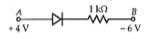
Consider the junction diode as ideal. The value of current flowing through $AB$ is 
Image
  • $10^{-2} A$
  • B
    $0 A$
  • C
    $10^{-1} A$
  • D
    $10^{-3} A$
Answer
Correct option: A.
$10^{-2} A$
An ideal diode does not offer any resistance during forward biasing.
$\therefore I =\frac{V_A-V_B}{R}$
$=\frac{4-(-6)}{1000} A$
$=10^{-2} A$
View full question & answer
MCQ 31 Mark
The attractive force between 2 charges is related to the distance between them as
  • A
    r
  • B
    $\frac{1}{r^2}$
  • C
    $r^{\frac{1}{2}}$
  • D
    $\frac{1}{r}$
Answer
(b) $\frac{1}{r^2}$
Explanation: According to Coulomb's law the force between two charges is inversely proportional to the square of distance between the two charges. So $F \alpha \frac{1}{ r ^2}$.
View full question & answer
MCQ 41 Mark
What happens to fringe width in the Young's double slit experiment, if it is performed in glycerine instead of air?
  • A
    The fringes shrink
  • B
    The fringes disappear
  • C
    The fringes remain unchanged
  • D
    The fringes get enlarged
Answer
(a) The fringes shrink 
Explanation: The fringes shrink 
View full question & answer
MCQ 51 Mark
The value of $1$ Bohr magneton is: $[$Given $h =6.62 \times 10^{-34} Js , e =1.6 \times 10^{-19} C$ and $m _{ e }=9.1 \times 10^{-31} \ kg ]$
  • A
    $7.27 \times 10^{-24} Am ^2$
  • $9.27 \times 10^{-24} Am ^2$
  • C
    $10.57 \times 10^{-24} Am ^2$
  • D
    $8.57 \times 10^{-24} Am ^2$
Answer
Correct option: B.
$9.27 \times 10^{-24} Am ^2$
$1$ Bohr magneton
$=\frac{e h}{4 \pi m_e}$
$=\frac{1.6 \times 10^{-19} \times 6.62 \times 10^{-34}}{4 \pi \times 9.1 \times 10^{-31}}$
$=9.27 \times 10^{-24} Am ^2$
View full question & answer
MCQ 61 Mark
Inductance plays the role of
  • A
    inertia
  • B
    friction
  • C
    force
  • D
    source of emf
Answer
(a)  inertia 
Explanation:  inertia 
View full question & answer
MCQ 71 Mark
A wire of length L carrying current i is placed perpendicular to the magnetic induction B. The total force on the wire is
  • A
    LB/i
  • B
    iL/B
  • C
    iLB
  • D
    iB/L
Answer
(c) iLB
Explanation: Magnitude of the Force experienced by a current carrying conductor placed in a magnetic field is $I L B \sin \theta$.
If the angle between the directions of the current and the magnetic field is $90^{\circ}, F = iLB$
View full question & answer
MCQ 81 Mark
In electrolytic capacitors positive terminal is
  • A
    one on which aluminium oxide film is not formed
  • B
    one on which aluminium oxide film is formed
  • C
    none of the these
  • D
    either of the two terminals
Answer
(b) one on which aluminium oxide film is formed
Explanation: Aluminium electrolytic capacitors have the Aluminium foil anode (positive terminal) which is etched and covered with a layer of Aluminium Oxide which acts as a dielectric. The whole assembly is covered using a paper separator soaked in electrolyte such as, Borax or Glycol and covered by Aluminium foil which acts as cathode (negative electrode)  
View full question & answer
MCQ 91 Mark
A Rowland ring of mean radius 15 cm has 3500 turns of wire wound on a ferromagnetic core of relative permeability 800. What is the magnetic field B in the core for a magnetising current of 1.2A?
  • A
    3.48T
  • B
    5.48T
  • C
    4.08T
  • D
    4.48T
Answer
(d) 4.48 T
Explanation: $B=\frac{\mu_{ o } \mu_r N i}{2 \pi r}=\frac{4 \pi \times 10^{-7} \times 800 \times 3500 \times 1.2}{2 \pi \times 15 \times 10^{-2}}=4.48 T$
View full question & answer
MCQ 101 Mark
The frequency of light in a material is $2 \times 10^{14} Hz$ and wavelength is $5,000 A$. The refractive index of the material will be
  • A
    1.40
  • B
    3.00
  • C
    1.50
  • D
    1.33
Answer
(b) $3 \cdot 00$
Explanation: Here, $\lambda=5,000 Å \times 10^{-7} m$ and $\nu=2 \times 10^{14} Hz$
Therefore, speed of light in the material, 
$v =\nu \lambda=2 \times 10^{14} \times 5 \times 10^{-7}=10^8 ms^{-1}$
Hence, the refractive index of the material, 
$\mu=\frac{c}{v}=\frac{3 \times 10^8}{10^8}=3$
View full question & answer
MCQ 111 Mark
If the temperature of cold junction of a thermocouple is lowered, then the neutral temperature:
  • A
    becomes zero
  • B
    increases
  • C
    decreases
  • D
    remains the same
Answer
(d) remains the same
Explanation: Neutral temperature is independent of temperature of cold junction.
View full question & answer
MCQ 121 Mark
If $\mu_c$ and $\mu_h$ are electron and hole mobility, $E$ be the applied electric field, the current density $j$ for intrinsic semiconductor is equal to
  • $n_i e\left(\mu_e+\mu_h\right) E$
  • B
    $\frac{n_i e\left(\mu_e+\mu_h\right)}{E}$
  • C
    $n_i e\left(\mu_e-\mu_h\right) E$
  • D
    $\frac{E}{n_i e\left(\mu_e+\mu_h\right)}$
Answer
Correct option: A.
$n_i e\left(\mu_e+\mu_h\right) E$
$I = I _e+ I _{ h }$
$=e n_e A v_e+e n_h A v_h$
$=e A\left(n_e \mu_e+n_h \mu_h\right) E$
$j =\frac{I}{A}=e n_i\left(\mu_e+\mu_h\right) E$
View full question & answer
M.C.Q (1 Marks) - Physics STD 12 Science Questions - Vidyadip