Question 13 Marks
$(II) \ (a)$ Define electric flux and write its SI unit.
$(b)$ Use Gauss᾿s law to obtain the expression for the electric field due to a uniformly charged infinite plane sheet of charge.
$(b)$ Use Gauss᾿s law to obtain the expression for the electric field due to a uniformly charged infinite plane sheet of charge.
Answer
View full question & answer→$(a)$ Definition of electric flux and its $SI$ unit
$(b)$ Electric field due to an infinite plane sheet of charge.
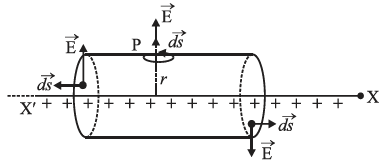
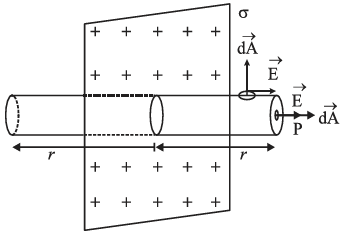
Let us consider an infinite thin plane sheet of positive charge having a uniform surface charge density $\sigma$. Let $P$ be the point where electric field $E$ is to be found. Let us imagine a cylindrical gaussian surface of length $2r$ and containing $P$ as shown. The net flux through the cylindrical gaussian surface.
$ \phi =\oint \vec{E} \cdot \overrightarrow{d A}$
$ =\int_{ RCF } \vec{E} \cdot \overrightarrow{d A}+\int_{L C F} \vec{E} \cdot \overrightarrow{d A}+\int_{C S} \vec{E} \cdot \overrightarrow{d A}$$=\int_{RCF} E d A \cos 0^{\circ}+\int_{LCF} E d A \cos 0^{\circ}+\int_{CS} E d A \cos 90^{\circ}$
$=EA+EA+0$
$\phi=2 EA ...(1)$
Here $A$ is the area of cross$-$section of each circular face i.e. $\text{LCF}$ and $\text{RCF}$.
The total charge enclosed by the gaussian cylinder
$=\sigma A ...(2)$
Using Gauss's theorem, from $(1)$ and $(2),$
$2 EA =\frac{\sigma A}{\varepsilon_0}$
$E =\frac{\sigma}{2 \varepsilon_0}$
$(b)$ Electric field due to an infinite plane sheet of charge.
Let us consider an infinite thin plane sheet of positive charge having a uniform surface charge density $\sigma$. Let $P$ be the point where electric field $E$ is to be found. Let us imagine a cylindrical gaussian surface of length $2r$ and containing $P$ as shown. The net flux through the cylindrical gaussian surface.
$ \phi =\oint \vec{E} \cdot \overrightarrow{d A}$
$ =\int_{ RCF } \vec{E} \cdot \overrightarrow{d A}+\int_{L C F} \vec{E} \cdot \overrightarrow{d A}+\int_{C S} \vec{E} \cdot \overrightarrow{d A}$$=\int_{RCF} E d A \cos 0^{\circ}+\int_{LCF} E d A \cos 0^{\circ}+\int_{CS} E d A \cos 90^{\circ}$
$=EA+EA+0$
$\phi=2 EA ...(1)$
Here $A$ is the area of cross$-$section of each circular face i.e. $\text{LCF}$ and $\text{RCF}$.
The total charge enclosed by the gaussian cylinder
$=\sigma A ...(2)$
Using Gauss's theorem, from $(1)$ and $(2),$
$2 EA =\frac{\sigma A}{\varepsilon_0}$
$E =\frac{\sigma}{2 \varepsilon_0}$