Question
State Gauss᾿s theorem in electrostatics. Using this theorem, derive an expression for the electric field due to an infinitely long straight wire of linear charge density $\lambda$.
Answer

(I) Gauss’s theorem: The flux of electric field through any closed surface is $\frac{1}{\varepsilon_0}$ times the total charge enclosed by the closed surface.
$\phi=\frac{q}{\varepsilon_0}$ ..(1)
By definition, the total electric flux through the closed surface is given by
$\phi=\oint \vec{E} \cdot \overrightarrow{d s}$
$\therefore$ From (1) and (2), Gauss's theorem may be expressed as follows
$\phi=\oint \vec{E} \cdot \overrightarrow{d s}=\frac{q}{\varepsilon_0}$
The surface integral of electric field over a closed surface is equal to $\frac{1}{\varepsilon_0}$ times the total charge enclosed by the surface.
Application of Gauss’s theorem
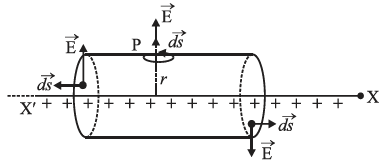
To find electric field due to a line charge let us consider an infinitely long line charge placed along XX’ axis with linear charge density λ. Our aim is to find electric field intensity at a point P distant r from the line charge. We draw a cylindrical surface of radius r and length l coaxial with the line charge. The net flux through the cylindrical gaussian surface i.e.

Image

$
\begin{aligned}
\phi= & \phi \vec{E} \cdot \overrightarrow{d s}=\int_{L C F} \vec{E} \cdot \overrightarrow{d s}+\int_{C s} \vec{E} \cdot \overrightarrow{d s}+\int_{R C F} \vec{E} \cdot \overrightarrow{d s} \\
& \quad=\int_{L C F} E d s \cos 90^{\circ}+\int_{C s} E d s \cos 0^{\circ}+\int_{R C F} E d s \cos 90^{\circ} \\
& \phi=\int_{C s} E d s \cos 0^{\circ}=E \cdot 2 \pi r l
\end{aligned}
$
The charge enclosed by the gaussian surface is q = N
Using Gauss’s theorem from equations (1) and (2)
$E(2 \pi r l)=\frac{\lambda l}{\varepsilon_0} \Rightarrow E=\frac{\lambda}{2 \pi \varepsilon_0 r}$

Need a full question paper?

Generate a complete, print-ready paper with questions like this in minutes — across 16+ boards, with answer keys.
Start Generating Free

Similar questions

The magnetic field of a beam emerging from a filter facing a floodlight is given by $B_0 = 12 \times 10^{-8}\sin (1.20 \times 10^7z - 3.60 \times 10^{15}t) T.$ What is the average intensity of the beam?
How many time constants will elapse before the current in a charging RC circuit drops to half of its initial value? Answer the same question for a discharging RC circuit.
An electron and a proton possess equal kinetic energy. Which of these has the greater de Broglie wavelength?
A galvanometer coil has a resistance of 12 Ω and the metre shows full scale deflection for a current of 3 mA. How will you convert the metre into a voltmeter of range 0 to 18 V?
A beam of monochromatic radiation is incident on a photosensitive surface. Answer the following questions giving reasons.
i. Do the emitted photoelectrons have the same kinetic energy?
ii. Does the kinetic energy of the emitted electrons depend on the intensity of incident radiation?
iii. On what factors does the number of emitted photoelectrons depend?
Explain the difference between conductor, insulator and semiconductor on the basis of energy band in solids.
A nearsighted person cannot see beyond 25cm. Assuming that the separation of them glass from the eye is 1cm, find the power of lens needed to see distant objects.
You are given a 2μF parallel plate capacitor. How would you establish an instantaneous displacement current of 1mA in the space between its plates?
How does the resolving power of a compound microscope get affected on:
  1. Decreasing the diameter of its objective?
  2. Increasing the focal length of its objective?
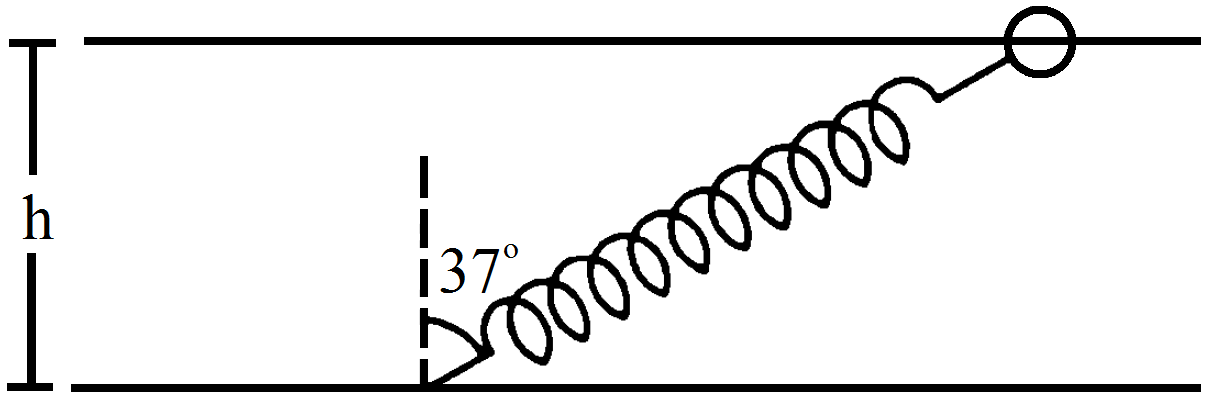
One end of a spring of natural length h and spring constant k is fixed at the ground and the other is fitted with a smooth ring of mass m which is allowed to slide on a horizontal rod fixed at a height h (figure). Initially, the spring makes an angle of 37° with the vertical when the system is released from rest. Find the speed of the ring when the spring becomes vertical.