Questions

5 Marks Questions

Take a timed test

6 questions · self-marked practice — reveal the answer and mark yourself.

Question 15 Marks
$(II)$ A compound microscope consists of an objective lens of focal length $2.0 \ cm$ and an eyepiece of focal length $6.25 \ cm$ separated by a distance of $15 \ cm$. How far from the objective should an object be placed in order to obtain the final image at
$(a)$ the least distance of distinct vision $(25 \ cm)$ and
$(b)$ infinity? What is the magnifying power of the microscope in each case?
Answer
$(II) \ (a)$ For eyepiece, $v_e=-25 \ cm, f_e=6.25 \ cm, u_e= ?$
$\text { Using } \frac{1}{f}=\frac{1}{v}-\frac{1}{u}$
$\frac{1}{u_e}=\frac{1}{v_e}-\frac{1}{f_e}=\frac{1}{-25}-\frac{1}{6.25}=\frac{-1}{5}$
$u_e=-5 \ cm$
Therefore the image formed by the objective is formed at a distance of $10 \ cm$ towards the eyepiece.
Hence for the objective $v_0=+10 \ cm, f_0=2 \ cm, v_0=?$
$\frac{1}{u_0}=\frac{1}{v_0}-\frac{1}{f_0}=\frac{1}{10}-\frac{1}{2}$
$u_0=-2.5 \ cm$
Therefore the magnifying power $M =\frac{v_0}{\left|u_0\right|}\left(1+\frac{D}{f_e}\right)=\frac{10}{2.5}\left(1+\frac{25}{6.25}\right)=20$
$(b)$ When the final image is formed at infinity the object for the eyepiece must lie at its principal focus.
Therefore the distance of the image formed by the objective from its optical center,
$v_0=15-6.25=8.75 \ cm$
$\frac{1}{u_0}=\frac{1}{v_0}-\frac{1}{f_0}=\frac{1}{8.75}-\frac{1}{2}=\frac{6.75}{17.50}$
$u_0=\frac{-17.5}{6.75}=-2.6 \ cm$
$M =\frac{v_0}{\left|u_0\right|} \cdot \frac{D}{f_e}=\frac{8.75}{2.6} \times \frac{25}{6.25}=13.5$
View full question & answer
Question 25 Marks
$(I) (a)$ A giant refracting telescope at an observatory has an objective lens of focal length $15 m$. If an eyepiece of focal length $1.0 \ cm$ is used, what is angular magnification of the telescope in normal adjustment?
$(b)$ If this telescope is used to view the moon, what is the diameter of the image of the moon formed by the objective lens? The diameter of the moon is $3.48 \times 10^6 m$ and the radius of lunar orbit is $3.8 \times 10^8 m$.
Answer
$(I)$ Given $f_0=15 m, f_e=1 \ cm=0.01 m$
$(i)$ Angular magnification of the telescope $M =\frac{f_0}{f_e}=\frac{15}{0.01}=1500$
$(ii)$ Let d be the diameter of moon᾿s image formed by the objective lens.
Therefore, Angle subtended by the moon at the objective lens
$\alpha=\frac{\text { diameter of the moon }}{\text { Radius of lunar orbit }}=\frac{3.48 \times 10^6}{3.8 \times 10^8}$
Similarly, the angle subtended by moon᾿s image $($formed by the objective$)$ at the objective
$\alpha=\frac{\text { diameter of moon's image }}{f_0}=\frac{d}{15}$
Comparing equations $(1)$ and $(2)$ we have
$\frac{d}{15}=\frac{3.48 \times 10^6}{3.8 \times 10^8}$
$d=\frac{3.48 \times 10^6}{3.8 \times 10^8} \times 15$
$=0.137 m$
$=13.7 \ cm$
View full question & answer
Question 35 Marks
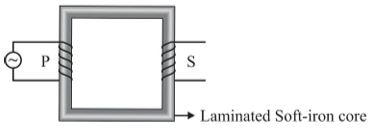
(II) (a) With the help of a diagram, explain the principle of a device which changes a low ac voltage into a high voltage . Deduce the expression for the ratio of secondary voltage to the primary voltage in terms of the ratio of the number of turns of primary and secondary winding. For an ideal transformer, obtain the ratio of primary and secondary currents in terms of the ratio of the voltages in the secondary and primary coils.
(b) Write any two sources of the energy losses which occur in actual transformers.
(c) A step-up transformer converts a low input voltage into a high output voltage. Does it violate law of conservation of energy? Explain.
Answer
(II) (a)TRANSFORMER
Use: It is a device which converts low ac voltage at high current into high ac voltage at low current and vice – versa.
Principle: It consists of two coils P and S wound on a closed soft iron core. The coil which is fed from the ac supply is called primary coil (P) and the other connected to the load is called secondary coil (S). The core of the transformer is made of soft -iron to reduce hysteresis loss and is laminated to reduce eddy current losses.
Working: When an alternating emf $e_p$ is impressed on the primary winding it sends an ac current through it which sets up an alternating magnetic flux in the core. This induces an alternating emf $e_s$ in the secondary. If $N_p$ and $N _{ s }$ are the number of turns in primary and secondary coil, their linkages with the flux are

$\phi_{ P }= N _{ P } BA$ B → Magnetic induction
$\phi_{ s }= N _{ s } BA$ A → Area of cross section

The magnitude of the emf induced in the secondary
$e_{ s }=\frac{d \phi_s}{d t}=N_s A \frac{d B}{d t}$ ..(1)
The changing flux also induces an emf in the primary, whose magnitude
$e_p=\frac{d \phi_p}{d t}=N_p A \frac{d B}{d t}$ ..(2)
From equations (1) and (2)
$\frac{\text { emf induced in secondary }}{\text { voltage applied to primary }}=\frac{e_s}{e_p}=\frac{N_s}{N_p}$ ..(3)
$\frac{N_s}{N_p}=$ turns ratio or transformation ratio.
If $N_s>N_{p_1} e_S>e_P \rightarrow$ Such a transformer is called step-up transformer
If $N_{ S }<N_{ P }, e_{ s }<e_{ P } \rightarrow$ Such a transformer is called step-down transformer
In an ideal transformer
Instantaneous output power = instantaneous input power
$e_s i_{ s }=e_p l_p$ ..(4)
From equations (3) and (4)
$\frac{e_s}{e_g}=\frac{i_p}{i_s}=\frac{N_s}{N_g}$
In a step- up transformer $N_{ s }>N_{ p }, e_{ s }>e_{ p }$ but $i_{ s }<i_{ p }$ In a step-down transformer $N_{ s }<N_\rho, e_{ s }<e_p$ but $i_{ s }>i_{ p }$
At the generating station a step-up transformer is used for stepping up the voltage and at the various receiving substations a step-down transformer is used

Image

(b) The two sources of energy losses are eddy current losses and flux leakage losses.
(c) There is no violation of the principle of the conservation of energy in a step up transformer. When output voltage increases the output current decreases automatically keeping the power the same.
View full question & answer
Question 45 Marks
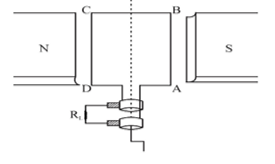
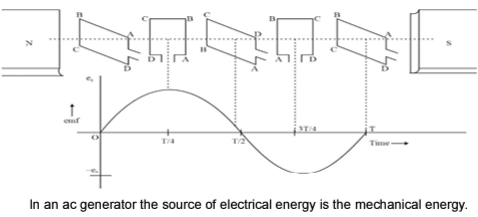
$(I)$ Explain briefly, with the help of a labelled diagram, the basic principle of the working of an a.c. generator. In an a.c. generator, coil of $N$ turns and area $A$ is rotated at an angular velocity $ω$ in a uniform magnetic field $B$. Derive an expression for the instantaneous value of the emf induced in coil. What is the source of energy generation in this device?
Answer
$(I) AC$ Genera
It is a device used to convert mechanical energy into electrical energy
Principle: It is based on the principle of electromagnetic induction. When a closed coil is rotated rapidly in a strong magnetic field, the magnetic flux linked with the coil changes continuously. Hence an emf is induced in the coil and a current flows in it. In fact, the mechanical energy expended in rotating the coil appears as electrical energy in the coil.
Construction: Main Parts
$1.$ Armature: It is a rectangular coil $\text{ABCD}$ having a large number of turns of insulated copper wire wound on a soft$-$iron core. The use of soft$-$iron core increases the magnetic flux linked with the armature.
$2.$ Field Magnet: It a strong electromagnet having concave pole pieces $N$ and $S.$ The armature is rotated between these pole pieces about an axis perpendicular to the magnetic field.
$3.$ Slip Rings: The leads from the armature coil $\text{ABCD}$ are connected to two copper rings $R1$ and $R2$ called the ‘slip rings’. These rings are concentric with the axis of the armature coil and rotate with it.
$4.$​​​​​​​ Brushes: These are two carbon pieces $B1$ and $B2$ called brushes which remain stationary pressing against the slip rings $R1$ and $R2$ respectively. The brushes are connected to an external circuit.
Working Theory : When the coil $\text{ABCD}$ is rotated inside the field, an emf is induced between its two ends. Let the plane of the coil be at right angles to the magnetic field at $t = 0$ and angular speed of the rotation of the coil be $ω.$ Then at time $t, \theta = ωt.$ The magnetic flux linked with the coil at time $t$ is
$\phi=n BA \cos \omega t$
Induced emf $e=\frac{-d \phi}{d t}=\frac{-d}{d t}[n B A \cos \omega t]$
$\Rightarrow e=n BA \omega \sin \omega t$
$e=e_0 \sin \omega t \quad$ Where $e_0=n BA \omega$ is the peak value of emf.
The current in the external load is given by
$i=\frac{e_{s} \sin \omega t}{R_L}$
$i=i_0 \sin \omega t$
Here $i_0$ is the peak value of the current

Image

Image
View full question & answer
Question 55 Marks
(II) (a) Using Kirchhoff'᾿s laws obtain the equation of the balanced state in Wheatstone bridge.
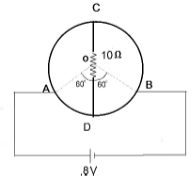
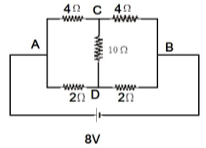
b) A wire of uniform cross-section and resistance of 12 ohm is bent in the shape of circle as shown in the figure. A resistance of 10 ohms is connected to diametrically opposite ends C and D. A battery of emf 8V is connected between A and B. Determine the current flowing through arm AD.

Image
Answer
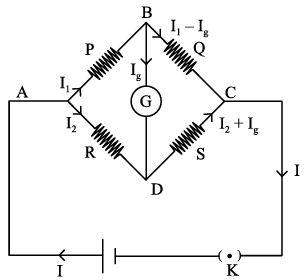
(II) (a) The Wheatstone bridge is as shown in the figure

Image
Applying Kirchhoff’s II law to mesh ABDA
$I_1 P+l_0 G-l_2 R=0$ ..(1)
For the mesh BCDB
$\left(I_1-I_0\right) Q+\left[-\left(I_2+I_0\right) S\right]+\left[-I_0 G\right]=0$ ..(2)
When the bridge is balanced, no current flows through the galvanometer
$Ig =0$ ..(3)
$\therefore$ From equations (1) and (2) and (3)
$I_1 P=I_2 R$ ..(4)
$l _1 Q = I _2 S$ ..(5)
From equations (4) and (5), P/Q = R/S.

(b).

Image
This circuit is balanced wheat stone bridge that can be drawn as below,

Image

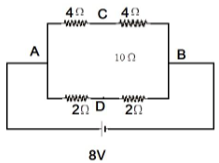
As it is balanced wheatston bridge ,so circuit will be as below

Image

$V_{A B}=8 V$, hence Current through $A D B=\frac{8}{4}=2 A$
View full question & answer
Question 65 Marks
(I) (a) Write two limitations of ohm’s law. Plot their I-V characteristics.
(b) A heating element connected across a battery of 100 V having an internal resistance of $1 \Omega$ draws an initial current of 10 A at room temperature 20.0 °C which settles after a few seconds to a steady value. What is the power consumed by battery itself after the steady temperature of 320.0 °C is attained? Temperature coefficient of resistance averaged over the temperature range involved is $3.70 \times 10^{-4}{ }^{\circ} C ^{-1}$.
Answer
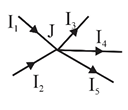
(I) (a) Kirchhoff’s I Law : The algebraic sum of all the currents meeting at a point in an electrical circuit is always equal to zero.

Image

$\left[+l_1\right]+\left[+I_2\right]+\left[-I_3\right]+\left[-l_4\right]+\left[-I_5\right]=0$
OR $l_1+I_2=I_3+l_4+I_5$
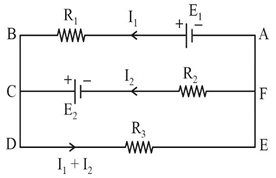
Kirchhoff’s II Law : The algebraic sum of the changes in potential around any closed resistor loop must be zero.

Image

closed mesh ABCFA
$\left[+E_1\right]\left[-I_1 R_1\right]+\left[-E_2\right]+\left[+I_2 R\right]=0$ ..(1)
closed mesh FCDEF
$\left[+E_2\right]+\left[-\left(I_1+I_2\right)\right] R_3+\left[-I_2 R_2\right]=0$ ..(2)

(b) $I=\frac{\varepsilon}{R_0+r} \quad$ Where $R_0$ is resistor at room tempere $20^{\circ}$
$\begin{array}{c}\Rightarrow R_0=\frac{\varepsilon}{L}-1 \\ \text { OR } \quad R_0=\frac{100}{10}-1=R_0=9 \Omega\end{array}$
Now Final temperature is $320^{\circ} C$
$\begin{aligned} R & =R_0(1+\alpha \Delta T) \\ & =9\left(\left(1+3.7 \times 10^{-4} \times 300\right)\right. \\ & =10 Ohm \end{aligned}$
$\begin{aligned} \text { Power Consumed by cell }(P) & =t^2 r \\ & =\left(\frac{t}{k_0+r}\right)^2 \times r \quad \text { Watt } \\ & =\left(\frac{100}{11}\right)^2=82.64 W\end{aligned}$
View full question & answer