Question
(I) (a) Write two limitations of ohm’s law. Plot their I-V characteristics.
(b) A heating element connected across a battery of 100 V having an internal resistance of $1 \Omega$ draws an initial current of 10 A at room temperature 20.0 °C which settles after a few seconds to a steady value. What is the power consumed by battery itself after the steady temperature of 320.0 °C is attained? Temperature coefficient of resistance averaged over the temperature range involved is $3.70 \times 10^{-4}{ }^{\circ} C ^{-1}$.
Answer

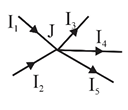
(I) (a) Kirchhoff’s I Law : The algebraic sum of all the currents meeting at a point in an electrical circuit is always equal to zero.

Image

$\left[+l_1\right]+\left[+I_2\right]+\left[-I_3\right]+\left[-l_4\right]+\left[-I_5\right]=0$
OR $l_1+I_2=I_3+l_4+I_5$
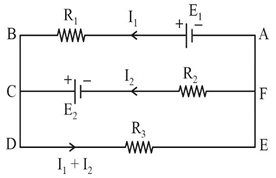
Kirchhoff’s II Law : The algebraic sum of the changes in potential around any closed resistor loop must be zero.

Image

closed mesh ABCFA
$\left[+E_1\right]\left[-I_1 R_1\right]+\left[-E_2\right]+\left[+I_2 R\right]=0$ ..(1)
closed mesh FCDEF
$\left[+E_2\right]+\left[-\left(I_1+I_2\right)\right] R_3+\left[-I_2 R_2\right]=0$ ..(2)

(b) $I=\frac{\varepsilon}{R_0+r} \quad$ Where $R_0$ is resistor at room tempere $20^{\circ}$
$\begin{array}{c}\Rightarrow R_0=\frac{\varepsilon}{L}-1 \\ \text { OR } \quad R_0=\frac{100}{10}-1=R_0=9 \Omega\end{array}$
Now Final temperature is $320^{\circ} C$
$\begin{aligned} R & =R_0(1+\alpha \Delta T) \\ & =9\left(\left(1+3.7 \times 10^{-4} \times 300\right)\right. \\ & =10 Ohm \end{aligned}$
$\begin{aligned} \text { Power Consumed by cell }(P) & =t^2 r \\ & =\left(\frac{t}{k_0+r}\right)^2 \times r \quad \text { Watt } \\ & =\left(\frac{100}{11}\right)^2=82.64 W\end{aligned}$

Need a full question paper?

Generate a complete, print-ready paper with questions like this in minutes — across 16+ boards, with answer keys.

Start Generating Free

Similar questions

Consider a circular ring of radius r, uniformly charged with linear charge density $\lambda.$ Find the electric potential at a point on the axis at a distance x from the centre of the ring. Using this expression for the potential, find the electric field at this point.
Describe Davisson and Germer’s experiment to demonstrate the wave nature of electrons. Draw a labelled diagram of apparatus used.
During a thunderstorm the ‘live' wire of the transmission line fell down on the ground. A group of boys passing through noticed it and some of them wanted to place the wire by the side. As they were approaching the wire and trying to lift it, Bari noticed it and immediately pushed them away to prevent them from touching the wire. Two of them got hunt in the process. Bari took them to a doctor to get medical aid.
Based on the above paragraph, answer the following:
  1. Write two values which Bari displayed during the incident.
  2. Why is it that a bird can sit over a suspended ‘live' wire without any harm whereas touching it on the ground can give a fatal shock?
  3. The electric power from a power plant is set up to a very high voltage before transmitting it to distant consumers. Write the reason for it.
An electron falls through a distance of $1.5 \ cm$ in a uniform electric field of magnitude $2.0 \times 10^4 N C ^{-1} \ [$Fig. $1.10(a)]$. The direction of the field is reversed keeping its magnitude unchanged and a proton falls through the same distance $[$Fig. $1.10(b)]$. Compute the time of fall in each case. Contrast the situation with that of 'free fall under gravity'.
Image
The radii of curvature of a lens are +20cm and +30cm. The material of the lens has a refracting index 1.6. Find the focal length of the lens.
  1. If it is placed in air.
  2. If it is placed in water $(\mu=1.33).$
Find out magnetic force on parallel current carrying conductors and also state their special conditions.
Establish the relation between electric field and potential gradient.
Compare and contrast the nature of $\alpha-, \beta-$ and $\gamma-$radiations.
Two metal spheres, one of radius R and the other of radius 2R, both have same surface charge density $\sigma$. They are brought in contact and separated. What will be new surface charge densities on them?
In a Young's double slit experiment using monochromatic light, the fringe pattern shifts by a certain distance on the screen when a mica sheet of refractive index 1.6 and thickness 1.964 micron $(1$ micron $= 10^{-6}m)$ is introduced in the path of one of the interfering waves. The mica sheet is then removed and the distance between the screen and the slits is doubled. It is found that the distance between the successive maxima now is the same as the observed fringe-shift upon the introduction of the mica sheet. Calculate the wavelength of the monochromatic light used in the experiment.