Questions

4 Marks Questions

🎯

Test yourself on this topic

14 questions · timed · auto-graded

Question 14 Marks
 For the past some time, Aarti had been observing some erratic body movement, unsteadiness and lack of coordination in the activities of her sister Radha, who also used to complain of severe headache occasionally. Aarti suggested to her parents to get a medical check-up of Radha. The doctor thoroughly examined Radha and diagnosed that she has a brain tumour.
  1. What, according to you, are the values displayed by Aarti?
  2. How can radioisotopes help a doctor to diagnose brain tumour? 
Answer
  1. keen observer/helpful/concerned/responsible/respectful towards elders.
  2. The doctor can trace and observe, the difference between the movement of an appropriate radio-isotope through a normal brain and a brain having tumor in it.
View full question & answer
Question 24 Marks
 For the past some time, Aarti had been observing some erratic body movement, unsteadiness and lack of coordination in the activities of her sister Radha, who also used to complain of severe headache occasionally. Aarti suggested to her parents to get a medical check-up of Radha. The doctor thoroughly examined Radha and diagnosed that she has a brain tumour.
  1. What, according to you, are the values displayed by Aarti?
  2. How can radioisotopes help a doctor to diagnose brain tumour? 
Answer
  1. keen observer/helpful/concerned/responsible/respectful towards elders.
  2. The doctor can trace and observe, the difference between the movement of an appropriate radio-isotope through a normal brain and a brain having tumor in it.
View full question & answer
Question 34 Marks
 For the past some time, Aarti had been observing some erratic body movement, unsteadiness and lack of coordination in the activities of her sister Radha, who also used to complain of severe headache occasionally. Aarti suggested to her parents to get a medical check-up of Radha. The doctor thoroughly examined Radha and diagnosed that she has a brain tumour.
  1. What, according to you, are the values displayed by Aarti?
  2. How can radioisotopes help a doctor to diagnose brain tumour? 
Answer
  1. keen observer/helpful/concerned/responsible/respectful towards elders.
  2. The doctor can trace and observe, the difference between the movement of an appropriate radio-isotope through a normal brain and a brain having tumor in it.
View full question & answer
Question 44 Marks
Why is it found experimentally difficult to detect neutrinos in nuclear $\beta$-decay?
Answer
Neutrinos are neutral (chargeless), (almost) massless particles that hardly interact with matter.

Alternate Answer

The neutrinos can penetrate large quantity of matter without any interaction

Alternate Answer

Neutrinos are chargeless and (almost) massless particles.

View full question & answer
Question 54 Marks
The half-life of 226Ra is 1602y. Calculate the activity of 0.1g of RaCl2 in which all the radium is in the form of 226Ra. Taken atomic weight of Ra to be 226g/mol-1 and that of Cl to be 35.5g/mol-1.
Answer
$\text{t}_{\frac{1}{2}}=1602\text{Y};\text{ Ra}=226\text{g/mole};\text{ Cl}=35.5\text{g/mole}.$
1 mole RaCl2 = 226 + 71 = 297g
297g = 1 mole of Ra.
$0.1\text{g}=\frac{1}{297}\times0.1\text{ mole of Ra}=\frac{0.6\times6.023\times10^{23}}{297}\\=0.02027\times10^{22}$
$\lambda=\frac{0.693}{\text{t}_{\frac{1}{2}}}=1.371\times10^{-11}$
Activity $\lambda\text{N}=1.371\times10^{-11}\times2.027\times10^{20}$
$=2.779\times10^{9}=2.8\times10^9$ disintegrations/second.
View full question & answer
Question 64 Marks
A sample contains a mixture of 108Ag and 110Ag isotopes each having an activity of 8.0 × 10⁸ disintegration per second. 110Ag is known to have larger half-life than 108Ag. The activity A is measured as a function of time and the following data are obtained.
Time (s) Activity (A) (108 disinte- grations s-1)
Time (s) Activity (A) (108 disinte-grations s-1)
20 11.799 200 3.0828
40 9.1680 300 1.8899
60 7.4492 400 1.1671
80 6.2684 500 0.7212
100 5.4115    
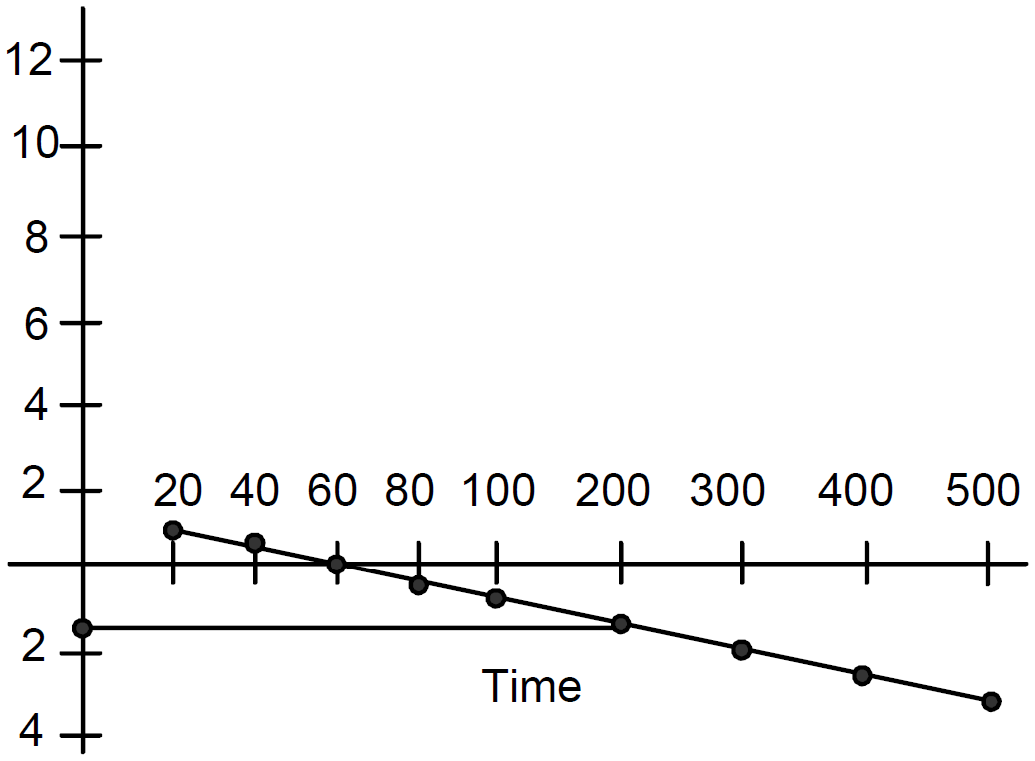
  1. Plot ln $\Big(\frac{\text{A}}{\text{A}_0}\Big)$ versus time.
  2. See that for large values of time, the plot is nearly linear. Deduce the half-life of 110Ag from this portion of the plot.
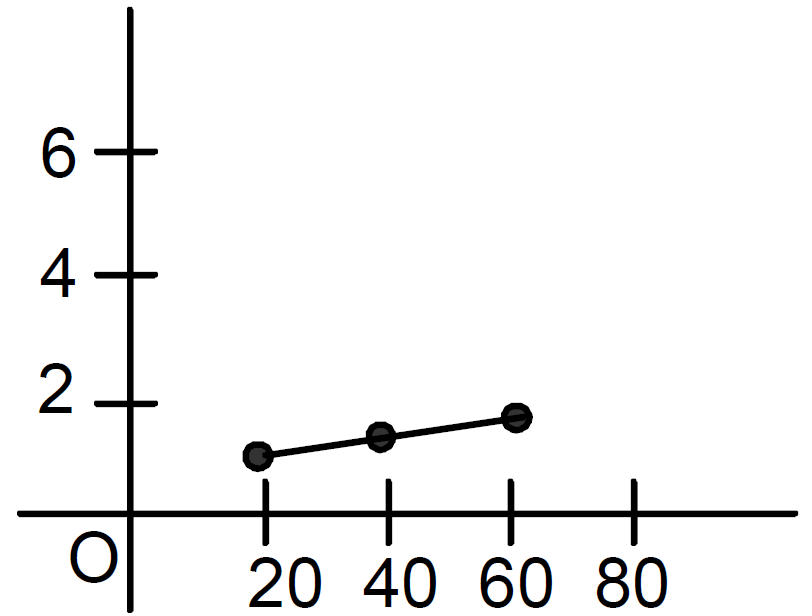
  3. Use the half-life of 110Ag to calculate the activity corresponding to 108Ag in the first 50s.
  4. Plot In $\Big(\frac{\text{A}}{\text{A}_0}\Big)$ versus time for 108Ag for the first 50s.
  5. Find the half-life of 108Ag.
Answer
Activities of sample containing 108Ag and 110Ag isotopes = 8.0 × 10⁸ disintegration/sec.

  1. Here we take A = 8 × 10⁸ dis./sec
  1. ​​​​​$\text{ln}\Big(\frac{\text{A}_1}{\text{A}_{0_{1}}}\Big)=\text{ln}\Big(\frac{11.79}{8}\Big)=0.389$

  2. $\text{ln}\Big(\frac{\text{A}_2}{\text{A}_{0_{2}}}\Big)=\text{ln}\Big(\frac{9.1680}{8}\Big)=0.1362$

  3. $\text{ln}\Big(\frac{\text{A}_3}{\text{A}_{0_{3}}}\Big)=\text{ln}\Big(\frac{7.4492}{8}\Big)=-0.072$

  4. $\text{ln}\Big(\frac{\text{A}_4}{\text{A}_{0_{4}}}\Big)=\text{ln}\Big(\frac{6.2684}{8}\Big)=-0.244$

  5. $\text{ln}\Big(\frac{5.4115}{8}\Big)=-0.391$

  6. $\text{ln}\Big(\frac{3.0828}{8}\Big)=-0.954$

  7. $\text{ln}\Big(\frac{1.8899}{8}\Big)=-1.443$

  8. $\text{ln}\Big(\frac{1.167}{8}\Big)=-1.93$

  9. $\text{ln}\Big(\frac{0.7212}{8}\Big)=-2.406$

  1. ​​​​​​​The half life of 110Ag from this part of the plot is 24.4s.
  2. Half life of 110Ag = 24.4s.

$\therefore\text{decay constant}\lambda=\frac{0.693}{24.4}=0.0284\Rightarrow\text{t}=50\text{sec,}$

The activity $\text{A = A}_{0}\text{e}^{-\lambda\text{t}}=8\times10^8\times\text{e}^{-0.0284\times50}=1.93\times10^8$

  1.  

  1. The half life period of 108Ag from the graph is 144s.
View full question & answer
Question 74 Marks
The density of nuclear matter is the ratio of the mass of a nucleus to its volume. As the volume of a nucleus is directly proportional to its mass number A, so the density of nuclear matter is independent of the size of the nucleus. Thus, the nuclear matter behaves like a liquid of constant density. Different nuclei are like drops of this liquid, of different sizes but of same density. Let A be the mass number and R be the radius of a nucleus. If m is the average mass of a nucleon, then.

Mass of nucleus = mA

$\text{Volume of nucleus }=\frac{4}{3}\pi\text{R}^3=\frac{4}{3}\pi\big(\text{R}_0\text{A}\frac{1}{3}\big)=\frac{4}{3}\pi\text{R}^3_0\text{A}$

$\therefore\text{Nuclear density},\rho\text{nu}=\frac{\text{Mass of nucleus}}{\text{Volume of nucleus}}\text{or}\ \rho\text{nu}$

$=\frac{\text{MA}}{\frac{4}{3}\pi\text{R}_0^3\text{A}}=\frac{3\text{m}}{4\pi\text{R}_0^3}$

Clearly, nuclear density is independent of mass number A or the size of the nucleus. The nuclear mass density is of the order 1017kg m-3 This density is very large as compared to the density of ordinary matter, say water, for which $\rho$ = 1.0 × 103kg m-3

  1. The nuclear radius of $_8^{16}\text{O}$ is 3 × 10-15m. The density of nuclear matter is.
  1. 2.9 × 1034kg m-3
  2. 1.2 × 1017kg m-3
  3. 16 × 1027kg m-3
  4. 2.4 × 1017kg m-3
  1. What is the density of hydrogen nucleus in SI units? Given Ro= 1.1 fermi and mP = 1.007825 amu.
  1. 1.2 × 1017kg m-3
  2. 3.0 × 1034kg m-3
  3. 1.99 × 1011kg m-3
  4. 7.85 × 1017kg m-3
  1. Density of a nucleus is.
  1. More for lighter elements and less for heavier elements.
  2. More for heavier elements and less for lighter elements.
  3. Very less compared to ordinary matter.
  4. A constant.
  1. The nuclear mass of $_{23}^{56}\text{Fe}$ is 55.85 amu. The its nuclear density is.
  1. 5.0 × 1019kg m-3
  2. 1.5 × 1019kg m-3
  3. 2.9 × 1017kg m-3
  4. 9.2 × 1026kg m-3
  1. If the nucleus of $_{13}^{27}\text{Al}$ has s a nuclear radius of about 3.6 fm, then $_{52}^{125}\text{Te}$ would have its radius approximately as.
  1. 9.6fm
  2. 12fm
  3. 4.8fm
  4. 6fm
Answer
  1. (d) 2.4 × 1017kg m-3

Explanation:

Here R = 3 × 10-15m

Nuclear mass = 16 amu = 16 × 1.66 × 10-27kg

$\rho_\text{nu}=\frac{\text{Nuclear mass}}{\text{Nuclear volume}}=\frac{16\times1.66\times10^{27}}{\frac{4}{3}\pi(3\times10^{-15})^3}$

= 2.359 × 10¹⁷kg m-3 = 2.4 × 10¹⁷kg m-3

  1. (a) 1.2 × 1017kg m-3

Explanation:

$\text{Density}\ \rho=\frac{3\text{m}}{4\pi\text{R}_0^3}=\frac{3\times1.007825\times1.66\times10^{-27}}{4\times\frac{22}{7}\times(1.1\times10^{-15})^3}$

= 2.98 × 10¹⁷kg m-3

  1. (d) A constant.

Explanation:

$\text{Density}=\frac{\text{Mass}}{\text{Volume}}=\frac{\text{Am}_\text{p}}{\frac{4}{3}\pi\big(\text{R}_0\text{A}\frac{1}{3}\big)}$

$=\frac{\text{m}_\text{p}}{\frac{4}{3}\pi\text{R}_0^3}$

Where mp = 1.6 × 10⁻²⁷kg3 = 2.3 × 10¹⁷kg m-3, which is a constant.

  1. (c) 2.9 × 1017kg m-3

Explanation:

Given, mass of mFe = 55.85amu

= 55.85 × 1.66 × 10-21kg = 9.27 × 10⁻²⁶kg

Nuclear radius $=\text{R}_0\text{A}\frac{1}{3}=1.1\times10^{-15}\times(56)\frac{1}{3}\text{m}$ 

[$\therefore$ A = 56]

$\rho_\text{nu}=\frac{\text{Nuclear mass}}{\text{Nuclear volume}}=\frac{\text{m}_\text{fe}}{\frac{4}{3}\pi\text{R}^3}$

$=\frac{9.27\times10^{26}}{\frac{4\pi}{3}\times\big(1.1\times10^{-15}\big)^3\times56}=2.9\times10^{17}\text{Kg}\text{ m}^{-3}$

  1. (d) 6fm

Explanation:

Here A1. = 27, A2 = 125, R1 = 3.6fm

$\text{As},\frac{\text{R}_2}{\text{R}_1}=\bigg(\frac{\text{A}_2}{\text{A}_1}\bigg)^\frac{1}{3}=\bigg(\frac{125}{27}\bigg)^\frac{1}{3}=\frac{5}{3}$

$\therefore\text{R}_2=\frac{5}{3}\text{R}_1=\frac{5}{3}\times3.6=6\text{fm}$

View full question & answer
Question 84 Marks

The nucleus was first discovered in 1911 by Lord Rutherford and his associates by experiments on scattering of $\alpha$-particles by atoms. He found that the scattering results could be explained, if atoms consist of a small, central, massive and positive core surrounded by orbiting electrons. The experimental results indicated that the size of the nucleus is of the order of 10-14m and is thus 10000 times smaller than the size of atom.

  1. Ratio of mass of nucleus with mass of atom is approximately.
  1. 1
  2. 10
  3. 103
  4. 1010
  1. Ratio of mass of nucleus with mass of atom is approximately.
  1. 1 : 2 : 3
  2. 1 : 1 : 1
  3. 1 : 1 : 2
  4. 1 : 2 : 4
  1. Nuclides with same neutron number but different atomic number are.
  1. Isobars
  2. Isotopes
  3. Isotones
  4. none of these
  1. If R is the radius and A is the mass number, then log R versus log A graph will be.
  1. A straight line
  2. A straight line
  3. An ellipse
  4. None of these.
  1. The ratio of the nuclear radii of the gold isotope $_{79}^{197}\text{Au}$ and silver isotope $_{47}^{107}\text{Au}$ is.
  1. 1.23
  2. 0.216
  3. 2.13
  4. 3.46
Answer
  1. (a) 1

Explanation

As nearly 99.9% mass of atom is in nucleus 

$\therefore\frac{\text{Mass of nucleus}}{\text{Mass of atom}}=\frac{99.9}{100}=0.99\approx1$

  1. (a) 1 : 2 : 3

Explanation:

Since, the nuclei of deuterium and tritium are isotopes of hydrogen, they must contain only one proton each. But the masses of the nuclei of hydrogen, deuterium and tritium are in the ration of 1 : 2 : 3, because of presence of neutral matter in deuterium and tritium nuclei.

  1. (c) Isotones
  2. (a) A straight line

Explanation:

$\text{R}=\text{R}_0\text{A}\frac{1}{3}$

$\text{log}\text{ R}=\text{log}\text{ R}_0+\frac{1}{3}\text{log}\text{A}$

On comparing the above equation of straight tine; y = mx + c. So, the graph between log A and log R is a straight line also.

  1. (a) 1.23

Explanation

Here, A1 = 197 and A2 = 107

$\therefore\frac{\text{R}_1}{\text{R}_2}=\Big(\frac{\text{A}_1}{\text{A}_2}\Big)^\frac{1}{3}=1.225=1.23$

View full question & answer
Question 94 Marks
A piece of wood from the ruins of an ancient building was found to have a 14C activity of 12 disintegrations per minute per gram of its carbon content. The 14C activity of the living wood is 16 disintegrations per minute per gram. How long ago did the tree, from which the wooden sample came, die? Given half-life of 14C is 5760 years.
Answer
Key concept:

Carbon dating: Radiocarbon dating (also referred to as carbon dating or carbon-14 dating) is a method tor determining the age of an object containing organic material by using the properties of radiocarbon -14(14C), a radioactive isotope of carbon.

Radiocarbon, or carbon 14, is an isotope of the element carbon that is unstable and weakly radioactive. The stable isotopes are carbon 12 and carbon 13.

Carbon 14 is continually being formed in the upper atmosphere by the effect of cosmic ray neutrons on nitrogen 14 atoms. It is rapidly oxidized in air to form carbon dioxide and enters the global carbon cycle.

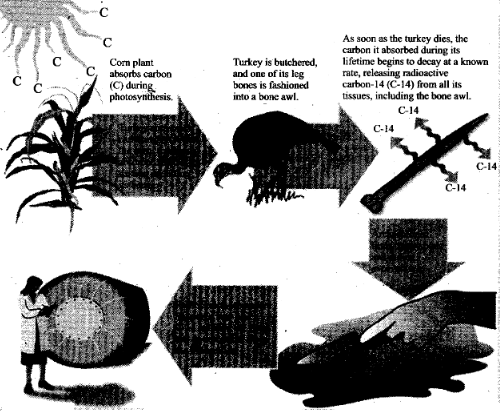
Plants and animals assimilate carbon 14 from carbon dioxide throughout their lifetimes. When they die, they stop exchanging carbon with the biosphere and their carbon 14 content then starts to decrease at a rate determined by the law of radioactive decay.

Radiocarbon dating is essentially a method designed to measure residual radioactivity. By knowing how much carbon 14 is left in a sample, the age of the organism when it died can be known. It must be noted though that radiocarbon dating results indicate when the organism was alive but not when a material from that organism was used.

It is given that

The 14C activity of a piece of wood from the ruins of an ancint building,

R = 12dis/min per g

The 14C activity of the living wood, R0 = 16dis/min per g

Half-life of 14$\text{T}_\frac{1}{2}=5760\text{yr}$

Let t be the span of the tree.

According to radioactive decay law,

$\text{R}=\text{R}_0\text{e}^{-\lambda\text{t}\text{ or }}\frac{\text{R}}{\text{R}_0}=\text{e}^{-\lambda\text{t}}\text{ or }\text{e}^{\lambda\text{t}}=\frac{\text{R}_0}{\text{R}}$

Taking log on both sides,

$\lambda\text{t}\log_\text{e}\text{e}=\log_\text{e}\frac{\text{R}_0}{\text{R}}\Rightarrow\ \lambda\text{t}=\Big(\log_{10}\frac{16}{12}\Big)\times2.303$

$\text{t}=\frac{2.303(\log4-\log3)}{\lambda}=\frac{2.303(\log4-\log3)\text{T}_\frac{1}{2}}{0.6931}$

$=\frac{2.303(0.6020-4.771)\times5760}{0.6931}=2391.20\text{yr}$

View full question & answer
Question 114 Marks
When subatomic particles undergo reactions, energy is conserved, but mass is not necessarily conserved. However, a particle's mass “contributes” to its total energy, in accordance with Einstein's famous equation, E = mc2 In this equation, E denotes the energy carried by a particle because of its mass. The particle can also have additional energy due to its motion and its interactions with other particles. Consider a neutron at rest and well separated from other particles. It decays into a proton, an electron and an undetected third particle as given here: Neutron → proton + electron + ???

The given table summarizes some data from a single neutron decay. Electron volt is a unit of energy. Column 2 shows the rest mass of the particle times the speed of light squared.

Particle
Mass × c2 (MeV)
Kinetic energy (MeV)
Neutron
940.97
0.00
Proton
939.67
0.01
Electron
0.51
0.39
  1. From the given table, which properties of the undetected third particle can be calculate?
  1. Total energy, but not kinetic energy.
  2. Kinetic energy, but not total energy.
  3. Both total energy and kinetic energy.
  4. Neither total energy nor kinetic energy.
  1. Assuming the table contains no major errors, what can we conclude about the (mass × c2) of the undetected third particle?
  1. It is 0. 79 MeV
  2. It is 0.39 MeV
  3. It is less than or equal to 0.79 MeV; but we cannot be more precise.
  4. It is less than or equal to 0.40 MeV; but we cannot be more precise.
  1. Could this reaction occur?

Proton → neutron + other particles

  1. Yes, if the other particles have much more kinetic energy than mass energy.
  2. Yes, but only if the proton has potential energy (due to interactions with other particles). 
  3. No, because a neutron is more massive than a proton.
  4. No, because a proton is positively charged while a neutron is electrically neutral.
  1. How much mass has to be converted into energy to produce electric power of 500MW for one hour?
  1. 2 × 10-5kg
  2. 1 × 10⁻⁵kg
  3. 3 × 10⁻⁵kg
  4. 4 × 10⁻⁵kg
  1. The equivalent energy of 1g of substance is.
  1. 9 × 10¹³J
  2. 6 × 10¹²J
  3. 3 × 10¹³J
  4. 6 × 10¹³J
Answer
  1. (a) Total energy, but not kinetic energy.

Explanation:

As just shown, energy conservation allows us to calculate the third particle's total energy. But we do not know what percentage of that total is mass energy. 

  1. (d) It is less than or equal to 0.40 MeV, but we cannot be more precise.

Explanation:

According to the passage, subatomic reactions do not conserve mass. So, we cannot find the third particle's mass by setting $\text{m}_\text{neutron}$equal to $\text{m}_\text{proton}+\text{m}_\text{electron}+\text{E}_\text{thrid particle}$

The neutron has energy 940.97 MeV. The proton has energy 939.67 MeV + 0.01 MeV = 939.69 MeV. The electron has energy 0.51 MeV + 0.39 MeV = 0.90 MeV. Therefore, the third particle has energy.

$\text{E}_\text{third particle}=\text{E}_\text{neutron}-\text{E}_\text{proton}-\text{E}_\text{electron}$

= 940.97 - 939.67 - 0.90 = 0.40 MeV 

We just found the third particle's total energy, the sum of its mass energy and kinetic energy. Without more information, we cannot figure out how much of that energy is mass energy.

  1. (b) Yes, but only if the proton has potential energy (due to interactions with other particles). 
  2. (a) 2 × 10-5kg

Explanation:

Here, P = 500MW = 5 × 10⁸W,

t = 1h = 3600s

Energy produced, E = P × t = 5 × 108 × 3600 = 18 × 1011J

$\text{As}\ \text{E}=\Delta\text{mc}^2$

$\therefore\Delta\text{m}=\frac{\text{E}}{\text{c}^2}=\frac{18\times10^{11}}{(3\times10^8)^2}$

$=\frac{18\times10^{11}}{(3\times10^8)^{16}}=2\times10^{-5}\text{kg}$

  1. (a) 9 × 10¹³J

Explanation:

Using, E = mc2

Here, m = 1g = 1 × 10⁻³kg, c = 3 × 10⁸m s-1

$\therefore$ E = 10-3 × 9 × 1016 = 9 × 1013J

View full question & answer
Question 124 Marks
A heavy nucleus breaks into comparatively lighter nuclei, which are more stable compared to the original heavy nucleus. When a heavy nucleus like uranium is bombarded by slow moving neutrons, it splits into two parts, releasing large amount of energy. The typical fission reaction of $_{92}\text{U}^{235}$.
$_{92}\text{U}^{235}+\ _0\text{n}^1\rightarrow\ _{56}\text{Ba}^{141}+\ _{36}\text{kr}^{92}+\ 3_0\text{n}^1+\ 200\text{ MeV}$
The fission of $_{92}\text{U}^{235}$ approximately released 200 MeV of energy.
  1. If 200 MeV energy is released in the fission of a single nucleus of $_{92}^{235}\text{U}$, the fissions which are required to produce a power of 1kW is.
  1. 3.125 × 10¹³
  2. 1.52 × 106
  3. 3.125 × 1012
  4. 3.125 × 10¹⁴
  1. The release in energy in nuclear fission is consistent with the fact that uranium has
  1. More mass per nucleon than either of the two fragments.
  2. More mass per nucleon as the two fragment.
  3. Exactly the same mass per nucleon as the two fragments.
  4. Less mass per nucleon than either of two fragments.
  1. When $_{92}\text{U}^{235}$ undergoes fission, about 0.1% of the original mass is converted into energy. The energy released when 1kg of $_{92}\text{U}^{235}$ undergoes fission is.
  1. 9 × 1011J
  2. 9 × 1013J
  3. 9 × 1015J
  4. 9 × 1018J
  1. A nuclear fission is said to be critical when multiplication factor or K.
  1. K = 1
  2. K > 1
  3. K < 1
  4. K = 0
  1. Einstein's mass-energy conversion relation E = mc2 is illustrated by.
  1. Nuclear fission
  2. $\beta-\text{decay}$
  3. Rocket propulsion
  4. Steam engine
Answer
  1. (a) 3.125 × 10¹³

Explanation:

Let the number of fissions per second be n. Energy released per second

= n × 200MeV = n × 200 × 1.6 × 10-13J

Energy required per second = power × time

= 1kW × Is = 1000J

n × 200 × 1.6 × 10-13 = 1000 or 

$\text{n}=\frac{1000}{3.2\times10^{-11}}$

$=\frac{10}{3.2}\times10^{13}=3.125\times10^{13}$

  1. (a) More mass per nucleon than either of the two fragments.
  2. (b) 9 × 1013J

Explanation:

As only 0.1% of the original mass is converted into energy, hence out of 1kg mass 1g is converted into energy.

Energy released during fission $\text{E}=\triangle\text{mc}^2$

= 1g × (3 × 108 m s-1)2 = 10-3 × 9 × 1016J = 9 × 10¹³J

  1. (a) K = 1
  2. (a) Nuclear fission
View full question & answer
Question 134 Marks
Neutrons and protons are identical particle in the sense that their masses are nearly the same and the force, called nuclear force, does into distinguish them. Nuclear force is the strongest force. Stability of nucleus is determined by the neutron proton ratio or mass defect or packing fraction. Shape of nucleus is calculated by quadrupole moment and spin of nucleus depends on even or odd mass number. Volume of nucleus depends on the mass number. Whole mass of the atom (nearly 99%) is centered at the nucleus.
  1. The correct statements about the nuclear force is/ are.
  1. Change independent.
  2. Short range force.
  3. Non-conservative force.
  4. All of these.
  1. The range of nuclear force is the order of.
  1. 2 × 10⁻¹⁰m
  2. 1.5 × 10-20m
  3. 1.2.× 10-4m
  4. 1.4 × 10-15m
  1. A force between two protons is same as the force between proton and neutron. The nature of the force is.
  1. Electrical force.
  2. Weak nuclear force.
  3. Gravitational force.
  4. Strong nuclear force.
  1. Two protons are kept at a separation of 40 A. Fn is the nuclear force and Fe is the electrostatic force between them. Then.
  1. Fn << Fe
  2. Fn = Fe 
  3. Fn >> Fe
  4. Fn = Fe
  1. AD the nucleons in an atom are held by.
  1. Nuclear forces
  2. Van der Waal's forces
  3. Tensor forces
  4. Coulomb forces
Answer
  1. (d) All of these.

Explanation:

All options are basic properties of nuclear forces. So, all options are correct.

  1. (d) 1.4 × 10-15m

Explanation:

The nuclear force is of short range and the range of nuclear force is the order of 1.4 × 10⁻¹⁵m. Now, volume $\infty\text{R}^3\infty\text{A}$

  1. (d) Strong nuclear force.
  2. (a) Fn << Fe

Explanation:

Nuclear force is much stronger than the electrostatic force inside the nucleus i.e., at distances of the order of fermi. At 40 A, nuclear force is ineffective and only electrostatic force of repulsion is present. This is very high at this distance because nuclear force is not acting now and the gravitational force is very feeble. Fnuclear << Felcctrostatic in this case.

  1. (a) Nuclear forces
View full question & answer
Question 144 Marks
In the year 1939, German scientist Otto Hahn and Strassmann discovered that when an uranium isotope was bombarded with a neutron, it breaks into two intermediate mass fragments. It was observed that, the sum of the masses of new fragments formed were less than the mass of the original nuclei. This difference in the mass appeared as the energy released in the process. Thus, the phenomenon of splitting of a heavy nucleus (usually A > 230) into two or more lighter nuclei by the bombardment of proton, neutron $\alpha$-particle, etc. with liberation of energy is called nuclear fission.
$\ _{92}\text{U}^{235}+\ _0\text{n}^{1}\rightarrow_{92}\text{U}^{236} \rightarrow\ _{56}\text{B}^{114}+\ _{36}\text{Kr}^{89}\ +3\ _{0}\text{n}^{1} + \text{Q}$
$\big[\because \ _{92}\text{U}^{236}= \text{Unstable nucleus}\big]$
  1. Nuclear fission can be explained on the basis of.
  1. Millikan's oil drop method
  2. Liquid drop model
  3. Shell model
  4. Bohr's model.
  1. For sustaining the nuclear fission chain reaction in a sample (of small size) of $_{92}^{235}\text{U}$ it is desirable to slow down fast neutrons by.
  1. Friction
  2. Elastic damping/ scattering
  3. Absorption
  4. None of these.
  1. Which of the following is/ are fission reaction(s)?
  1. $_0^1\text{n}\ +\ _{92}^{235}\text{U}\rightarrow\ _{92}^{235}\text{U}\rightarrow\ _{51}^{133}\text{Sb}+\ _{41}^{99}\text{nb}+\ 4_1^0\text{n}$
  2. $_0^1\text{n}\ +\ _{92}^{235}\text{U}\rightarrow\ _{54}^{1.40}\text{Xe}+\ _{38}^{94}\text{Sr}\ +2_0^1\text{n}$
  3. $_1^2\text{H}\ +\ _1^2\text{H}\rightarrow\ _2^3\text{He}+\ _0^1\text{n}$
  1. Both II and III
  2. Both I and III
  3. Only II
  4. Both I and II
  1. On an average, the number of neutrons and the energy of a neutron released per fission of a uranium atom are respectively.
  1. 2.5 and 2 keV
  2. 3 and 1 keV
  3. 2.5 and 2 MeV
  4. 2 and 2 keV
  1. In any fission process, ratio of mass of daughter nucleus to mass of parent nucleus is.
  1. Less than I
  2. Greater than I
  3. Equal to I
  4. Depends o the mass of parent nucleus.
Answer
  1. (b) Liquid drop model
  2. (b) Elastic damping/ scattering

Explanation:

Fast neutrons are slowed down by elastic scattering with light nuclei as each collision takes away nearly 50% of energy.

  1. (d) Both I and II

Explanation:

Reactions I and II represent fission of uranium isotope $_{92}^{235}\text{U}$ when bombarded with neutrons that breaks it into two intermediate mass nuclear fragments. However, reaction III represents two deuterons fuses together to from the light isotope of helium.

  1. (c) 2.5 and 2 MeV

Explanation:

On an average 2.5 neutrons are released per fission of the uranium atom. The energy of the neutron released per fission of the uranium atom is 2 MeV.

  1. (a) Less than I

Explanation:

In fission process, when a parent nucleus breaks into daughter products, then some mass is lost in the form of energy. Thus, mass of fission products < mass of parent nucleus.

$\Rightarrow\frac{\text{Mass of fission products}}{\text{Mass of parent nucleus}}<1$

View full question & answer