Questions · Page 4 of 11

M.C.Q (1 Marks)

Question 1511 Mark

The power of an achromatic convergent lens of two lenses is + 2D. The power of convex lens is + 5D. The ratio of dispersive power of convex and concave lens will be

(a) 5 : 3   

(b) 3 : 5

(c) 2 : 5    

(d) 5 : 2

Answer

(b) 3 : 5

View full question & answer
Question 1521 Mark

The focal lengths of convex lens for red and blue light are 100 cm and 96.8 cm respectively. The dispersive power of material of lens is

(a) 0.325

(b) 0.0325

(c) 0.98   

(d) 0.968

Answer

(b) 0.0325

View full question & answer
Question 1531 Mark

Spherical aberration in a lens

(a) Is minimum when most of the deviation is at the first surface

(b) Is minimum when most of the deviation is at the second surface

(c) Is minimum when the total deviation is equally distributed over the two surface

(d) Does not depend on the above consideration

Answer

(c) Is minimum when the total deviation is equally distributed over the two surface

View full question & answer
Question 1541 Mark

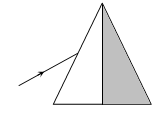
A light ray is incident upon a prism in minimum deviation position and suffers a deviation of 34°.  If the shaded half of the prism is knocked off, the ray will

(a) Suffer a deviation of 34°

(b) Suffer a deviation of 68°

(c) Suffer a deviation of 17°

(d) Not come out of the prism

Answer

(c) Suffer a deviation of 17°

View full question & answer
Question 1551 Mark

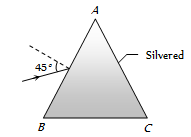
A prism ABC of angle 30° has its face AC silvered. A ray of light incident at an angle of 45° at the face AB retraces its path after refraction at face AB and reflection at face AC. The refractive index of the material of the prism is

(a) 1.5

(b)  

(c)  

(d)  

Answer

(c)  

View full question & answer
Question 1561 Mark

A spectrum is formed by a prism of dispersive power ‘ω’. If the angle of deviation is ‘δ’, then the angular dispersion is

(a) ω/δ   

(b) δ / ω

(c) 1/ ωδ

(d) ω δ

Answer

(d) ω δ

View full question & answer
Question 1571 Mark

When light rays are incident on a prism at an angle of 45°, the minimum deviation is obtained. If refractive index of the material of prism is , then the angle of prism will be

(a) 30°

(b) 40°

(c) 50°

(d) 60°

Answer

(d) 60°

View full question & answer
Question 1581 Mark

Fraunhofer lines are obtained in

(a) Solar spectrum

(b) The spectrum obtained from neon lamp

(c) Spectrum from a discharge tube

(d) None of the above

Answer

(a) Solar spectrum

View full question & answer
Question 1591 Mark

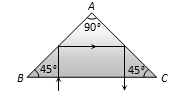
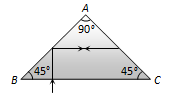
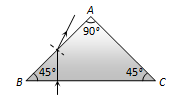
The refractive index of a material of a prism of angles 45°– 45° – 90° is 1.5. The path of the ray of light incident normally on the hypotenuse side is shown in

(a)

(b)

(b)

(d)

Answer

(a)

View full question & answer
Question 1601 Mark

A prism (μ = 1.5) has the refracting angle of 30°. The deviation of a monochromatic ray incident normally on its one surface will be (sin 48° 36’ = 0.75)

(a) 18° 36’

(b) 20° 30’

(c) 18°

(d) 22°1’

Answer

(a) 18° 36’

View full question & answer
Question 1611 Mark

We use flint glass prism to disperse polychromatic light because light of different colours

(a) Travel with same speed

(b) Travel with same speed but deviate differently due to the shape of the prism

(c) Have different anisotropic properties while travelling through the prism

(d) Travel with different speeds

Answer

(c) Have different anisotropic properties while travelling through the prism

View full question & answer
Question 1621 Mark

The critical angle between an equilateral prism and air is 45°. If the incident ray is perpendicular to the refracting surface, then

(a) After deviation it will emerge from the second refracting surface

(b) It is totally reflected on the second surface and emerges out perpendicularly from third surface in air

(c) It is totally reflected from the second and third refracting surfaces and finally emerges out from the first surface

(d) It is totally reflected from all the three sides of prism and never emerges out

Answer

(b) It is totally reflected on the second surface and emerges out perpendicularly from third surface in air

View full question & answer
Question 1631 Mark

Formula for dispersive power is (where symbols have their usual meanings)

(a)  

(b)

(c)   

(d)

Answer

(b)

View full question & answer
Question 1641 Mark

Which source is associated with a line emission spectrum

(a) Electric fire

(b) Neon street sign

(c) Red traffic light

(d) Sun

Answer

(b) Neon street sign

View full question & answer
Question 1651 Mark

The dispersive power of the material of lens of focal length 20 cm is 0.08. The longitudinal chromatic aberration of the lens is

(a) 0.08 cm

(b) 0.08/20 cm

(c) 1.6 cm

(d) 0.16 cm

Answer

(c) 1.6 cm

View full question & answer
Question 1661 Mark

A thin equiconvex lens is made of glass of refractive index 1.5 and its focal length is 0.2 m, if it acts as a concave lens of 0.5 m focal length when dipped in a liquid, the refractive index of the liquid is

(a)  

(b)  

(c)  

(d)  

Answer

(b)  

View full question & answer
Question 1671 Mark

If the focal length of a double convex lens for red light is  its focal length for the violet light is

(a)   

(b) Greater than  

(c) Less than  

(d)  

Answer

(c) Less than  

View full question & answer
Question 1681 Mark

A combination of two thin lenses of the same material with focal lengths  and , arranged on a common axis minimizes chromatic aberration, if the distance between them is

(a)  

(b)

(c) ( 

(d)  

Answer

(b)

View full question & answer
Question 1691 Mark

The focal length of the field lens (which is an achromatic combination of two lenses) of telescope is 90 cm. The dispersive powers of the two lenses in the combination are 0.024 and 0.036. The focal lengths of two lenses are

(a) 30 cm and 60 cm

(b) 30 cm and – 45 cm

(c) 45 cm and 90 cm  

(d) 15 cm and 45 cm

Answer

(b) 30 cm and – 45 cm

View full question & answer
Question 1701 Mark

A glass hemisphere of radius 0.04 m and R.I. of the material 1.6 is placed centrally over a cross mark on a paper (i) with the flat face; (ii) with the curved face in contact with the paper. In each case the cross mark is viewed directly from above. The position of the images will be

(a) (i) 0.04 m from the flat face; (ii) 0.025 m from the flat face

(b) (i) At the same position of the cross mark; (ii) 0.025 m below the flat face

(c) (i) 0.025 m from the flat face; (ii) 0.04 m from the flat face

(d) For both (i) and (ii) 0.025 m from the highest point of the hemisphere

Answer

(b) (i) At the same position of the cross mark; (ii) 0.025 m below the flat face

View full question & answer
Question 1711 Mark

A concave lens and a convex lens have same focal length of 20 cm and both put in contact this combination is used to view an object 5 cm long kept at 20 cm from the lens combination. As compared to object the image will be

(a) Magnified and inverted

(b) Reduced and erect

(c) Of the same size and erect 

(d) Of the same size and inverted

Answer

(c) Of the same size and erect 

View full question & answer
Question 1721 Mark

Lens used to remove long sightedness (hypermetropia) is

(a) Concave lens 

(b) Plano-concave lens 

(c) Convexo-concave lens

(d) Convex lens 

Answer

(d) Convex lens 

View full question & answer
Question 1731 Mark

If two lenses of +5 diopters are mounted at some distance apart, the equivalent power will always be negative if the distance is

(a) Greater than 40 cm

(b) Equal to 40 cm

(c) Equal to 10 cm

(d) Less than 10 cm

Answer

(a) Greater than 40 cm

View full question & answer
Question 1741 Mark

The plane faces of two identical plano-convex lenses each having focal length of 40 cm are pressed against each other to form a usual convex lens. The distance from this lens, at which an object must be placed to obtain a real, inverted image with magnification one is

(a) 80 cm

(b) 40 cm

(c) 20 cm

(d) 162 cm

Answer

(b) 40 cm

View full question & answer
Question 1751 Mark

For a normal eye, the least distance of distinct vision is

(a) 0.25 m

(b)  0.50 m 

(c) 25 m 

(d)  Infinite 

Answer

(a) 0.25 m

View full question & answer
Question 1761 Mark

When light rays from the sun fall on a convex lens along a direction parallel to its axis

(a) Focal length for all colours is the same

(b) Focal length for violet colour is the shortest

(c) Focal length for yellow colour is the longest

(d) Focal length for red colour is the shortest

Answer

(b) Focal length for violet colour is the shortest

View full question & answer
Question 1771 Mark

Two lenses of power + 12 and – 2 diopters are placed in contact. The combined focal length of the combination will be

(a) 8.33 cm

(b) 1.66 cm

(c) 12.5 cm

(d) 10 cm

Answer

(d) 10 cm

View full question & answer
Question 1781 Mark

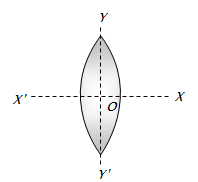
An equiconvex lens is cut into two halves along (i) XOX¢ and (ii) YOY¢ as shown in the figure.  Let f, f ¢, f ¢¢ be the focal lengths of the complete lens, of each half in case (i), and of each half in case (ii), respectively

Choose the correct statement from the following


(a)  

(b)  

(c)

(d)  

Answer

(d)  

View full question & answer
Question 1791 Mark

A bi-convex lens made of glass (refractive index 1.5) is put in a liquid of refractive index 1.7. Its focal length will

(a) Decrease and change sign

(b) Increase and change sign

(c) Decrease and remain of the same sign

(d) Increase and remain of the same sign

Answer

(b) Increase and change sign

View full question & answer
Question 1801 Mark

Match the List I with the List II from the combinations shown

(I)

Presbiopia

(A)

Sphero-cylindrical lens

(II)

Hypermetropia

(B)

Convex lens of proper power may be used close to the eye

(III)

Astigmatism

(C)

Concave lens of suitable focal length

(IV)

Myopia

(D)

Bifocal lens of suitable focal length

(a) I-A; II-C; III-B; IV-D

(b) I-B; II-D; III-C; IV-A

(c) I-D; II-B; III-A; IV-C

(d) I-D; II-A; III-C; IV-B

Answer

(c) I-D; II-B; III-A; IV-C

View full question & answer
Question 1811 Mark

A thin glass (refractive index 1.5) lens has optical power of -5D in air. It's optical power in a liquid medium with refractive index 1.6 will be

(a) 25 D   

(b) – 25 D

(c) 1 D     

(d) None of these

Answer

(d) None of these

View full question & answer
Question 1821 Mark

A convex lens is in contact with concave lens. The magnitude of the ratio of their focal length is 2/3. Their equivalent focal length is 30 cm. What are their individual focal lengths

(a) – 75, 50

(b) – 10, 15

(c) 75, 50

(d) – 15, 10

Answer

(d) – 15, 10

View full question & answer
Question 1831 Mark

A combination of two thin convex lenses of focal length 0.3 m and 0.1 m will have minimum spherical and chromatic aberrations if the distance between them is

(a) 0.1 m

(b) 0.2 m

(c) 0.3 m 

(d) 0.4 m

Answer

(b) 0.2 m

View full question & answer
Question 1841 Mark

The radius of the convex surface of plano-convex lens is 20 cm and the refractive index of the material of the lens is 1.5. The focal length of the lens is

(a) 30 cm

(b) 50 cm

(c) 20 cm

(d) 40 cm

Answer

(d) 40 cm

View full question & answer
Question 1851 Mark

A plano-convex lens is made of refractive index of 1.6. The radius of curvature of the curved surface is 60 cm. The focal length of the lens is

(a) 400 cm

(b) 200 cm

(c) 100 cm

(d) 50 cm

Answer

(c) 100 cm

View full question & answer
Question 1861 Mark

At what distance from a convex lens of focal length 30 cm, an object should be placed so that the size of the image be 1/2 of the object

(a) 30 cm

(b) 60 cm

(c) 15 cm

(d) 90 cm

Answer

(d) 90 cm

View full question & answer
Question 1871 Mark

A plano-convex lens of refractive index 1.5 and radius of curvature 30 cm is silvered at the curved surface. Now this lens has been used to form the image of an object. At what distance from this lens an object be placed in order to have a real image of the size of the object

(a) 20 cm

(b) 30 cm

(c) 60 cm

(d) 80 cm

Answer

(a) 20 cm

View full question & answer
Question 1881 Mark

In order to obtain a real image of magnification 2  using a converging lens of focal length 20 cm, where should an object be placed

(a) 50 cm

(b) 30 cm

(c) – 50 cm

(d) – 30 cm

Answer

(d) – 30 cm

View full question & answer
Question 1891 Mark

A point object is placed at the center of a glass sphere of radius 6 cm and refractive index 1.5. The distance of the virtual image from the surface of the sphere is

(a) 2 cm

(b) 4 cm

(c) 6 cm  

(d) 12 cm

Answer

(c) 6 cm  

View full question & answer
Question 1901 Mark

A thin plano-convex lens acts like a concave mirror of focal length 0.2 m when silvered from its plane surface. The refractive index of the material of the lens is 1.5. The radius of curvature of the convex surface of the lens will be

(a) 0.4 m             

(b) 0.2 m

(c) 0.1 m 

(d) 0.75 m

Answer

(b) 0.2 m

View full question & answer
Question 1911 Mark

The refractive index of a prism for a monochromatic wave is   and its refracting angle is 60°. For minimum deviation, the angle of incidence will be

(a) 30°

(b) 45°

(c) 60°

(d) 75°

Answer

(b) 45°

View full question & answer
Question 1921 Mark

A beam of parallel rays is brought to a focus by a plano-convex lens. A thin concave lens of the same focal length is joined to the first lens. The effect of this is

(a) The focal point shifts away from the lens by a small distance

(b) The focus remains undisturbed

(c) The focus shifts to infinity

(d) The focal point shifts towards the lens by a small distance

Answer

(c) The focus shifts to infinity

View full question & answer
Question 1931 Mark

A film projector magnifies a 100 cm2 film strip on a screen. If the linear magnification is 4, the area of magnified film on the screen is

(a) 1600 cm2

(b) 400 cm2 

(c) 800 cm2

(d) 200 cm2

Answer

(a) 1600 cm2

View full question & answer
Question 1941 Mark

In a parallel beam of white light is incident on a converging lens, the colour which is brought to focus nearest to the lens is

(a) Violet

(b) Red

(c) The mean colour

(d) All the colours together

Answer

(a) Violet

View full question & answer
Question 1951 Mark

An achromatic combination of lenses produces

(a) Coloured images

(b) Highly enlarged image

(c) Images in black and white

(d) Images unaffected by variation of refractive index with wavelength

Answer

(d) Images unaffected by variation of refractive index with wavelength

View full question & answer
Question 1961 Mark

When the convergent nature of a convex lens will be less as compared with air

(a) In water

(b) In oil

(c) In both (a) and (b)

(d) None of these

Answer

(c) In both (a) and (b)

View full question & answer
Question 1971 Mark

If aperture of lens is halved then image will be

(a) No effect on size 

(b) Intensity of image decreases

(c) Both (a) and (b)

(d) None of these

Answer

(c) Both (a) and (b)

View full question & answer
Question 1981 Mark

The chromatic Aberration in lenses becomes due to

(a) Disimilarity of main axis of rays

(b) Disimilarity of radii of curvature

(c) Variation of focal length of lenses with wavelength

(d) None of these

Answer

(c) Variation of focal length of lenses with wavelength

View full question & answer
Question 1991 Mark

The sun makes 0.5o angle on earth surface.  Its image is made by convex lens of 50 cm focal length.  The diameter of the image will be     

(a) 5 mm

(b) 4.36 mm

(c) 7 mm

(d) None of these

Answer

(b) 4.36 mm

View full question & answer
Question 2001 Mark

A lens of power + 2 diopters is placed in contact with a lens of power – 1 diopoter.  The combination will behave like

(a) A divergent lens of focal length 50 cm

(b) A convergent lens of focal length 50 cm

(c) A convergent lens of focal length 100 cm

(d) A divergent lens of focal length 100 cm

Answer

(c) A convergent lens of focal length 100 cm

View full question & answer