Questions

Answer the following (3 mark each)

🎯

Test yourself on this topic

8 questions · timed · auto-graded

Question 13 Marks
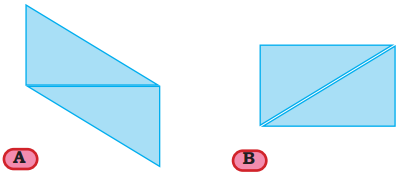
Measure the sides of each of these two quadrilaterals A and B. What do you notice?
Are there any pairs of sides that are equal? Which pairs are equal—adjacent or opposite?
Answer
Quadrilaterals whose opposite sides are equal are called parallelograms.
What types of angles do quadrilaterals A and B have? Which angles are equal in each of the above parallelograms?
In parallelogram A, opposite angles are equal.
In parallelogram B, all angles are equal and are right angles. Such a parallelogram is called a rectangle.
A rectangle is a special type of parallelogram.
View full question & answer
Question 23 Marks
How many different 4-sided shapes (quadrilaterals) can you make?
Image
Here are three possible shapes.
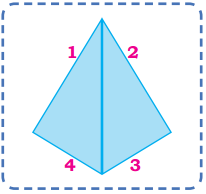
Have you made a shape like the one shown on the right?
Answer

Image
This shape is called a kite.
What do you notice about the sides of a kite?
Side 1 = Side 2.
Similarly, Side 3 = Side 4.
These sides are called adjacent sides.
Here are two other possible quadrilaterals that are not kites.
View full question & answer
Question 33 Marks
Can five squares fit together around a point without any gaps or overlaps? Why or why not?
Answer
No, five square cannot fit together perfectly around a point without any gaps or overlaps. Because, each angle of a square is a right angle. For shapes to fit perfectly around a point without gaps or overlaps (i.e., to form a tessellation around that point), the sum of the angles of the shapes meeting at that point must exactly equal to 4 right angles.
If we place five squares around a point, the sum of their angles would be 5 right angles which is greater than 4 right angles, so the squares would overlap.
View full question & answer
Question 43 Marks
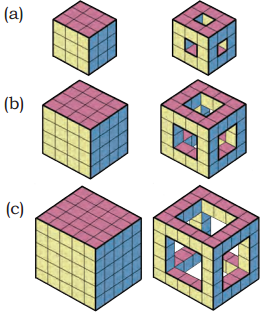
Here are some big solid cube frames. Howr many small cubes have been removed from each cube?
Image
Answer
(a) The full cube has 3 × 3 × 3 = 27 small cubes.
After removing the small cubes only the big cube frame are available, which has 20 small cubes.
So, total removed cubes = 27-20
= 7 cubes.
(b) The full cube has 4 × 4 × 4 = 64 small cubes.
After removing the small cubes the big cube frame has 32 small cubes.
So, total removed cubes = 64 – 32
= 32 cubes.
(c) The full cube has 5 × 5 × 5 = 125 small cubes.
After removing the small cubes the big cube frame has 44 small cubes.
So, total removed cubes = 125 – 44
= 81 cubes.
View full question & answer
Answer the following (3 mark each) - MATHS STD 5 Questions - Vidyadip