Question 12 Marks
$HCF$ of co-prime numbers $4$ and $15$ was found as follows:
$4 = 2$ $\times$ $2$ and $15 = 3$ $\times$ $5$
since there is no common factor, so $H.C.F.$ of $4$ and $15$ is $0$. Is the answer correct? If not, what is the correct $H.C.F$.
AnswerNo! the answer is not correct. The correct answer is as follows:
H.C.F of 4 and 15 is 1.
View full question & answer→Question 22 Marks
Find the $H.C.F$ of the numbers: $18, 54, 81.$
AnswerFactors of $18$ are $1, 2, 3, 6, 9$ and $18.$
Factors of $54$ are $1, 2, 3, 6, 9, 18, 27$ and $54.$
Factors of $81$ are $1, 3, 9, 27$ and $81.$
$\therefore $ Common factors of $18, 54$ and $81$ are $1, 3$ and $9.$
Highest of these common factors is $9.$
$\therefore H.C.F$ of $18, 54$ and $81$ is $9.$
View full question & answer→Question 32 Marks
Find the H.C.F of the numbers: $91, 112, 49.$
AnswerFactors of $91$ are $1,7,13$ and $91.$
Factors of $112$ are $1,2,4,7,8,14,16,28,56$ and $112.$
Factors of $49$ are $1, 7$ and $49.$
$\therefore $ Common factors of $91, 112$ and $49$ are $1$ and $7$.
Highest of these common factors is $7.$
$\therefore H.C.F.$ of $91, 112$ and $49$ is $7.$
View full question & answer→Question 42 Marks
Find the $H.C.F$ of the numbers: $70, 105, 175$
AnswerFactors of $70$ are $1, 2, 5, 7, 10, 14, 35$ and $70.$
Factors of $105$ are $1, 3, 5, 7, 15, 21, 35$ and $105.$
Factors of $175$ are $1, 5, 7, 25, 35$ and 175.
$\therefore $ Common factors of $70, 105$ and $175$ are $1,5,7$ and $35.$
Highest of these common factors is $35.$
$\therefore H.C.F$ of $70, 105$ and $175$ is $35.$
View full question & answer→Question 52 Marks
Find the $H.C.F$ of the numbers: $34, 102.$
AnswerFactors of $34$ are $1, 2, 17$ and $34.$
Factors of $102$ are $1, 2, 3, 6, 17, 34, 51$ and $102.$
$\therefore $ Common factors of $34$ and $102$ are $1, 2, 17$ and $34.$
Highest of these common factors is $34$. So $HCF$ of $34$ and $102$ is $34$
View full question & answer→Question 62 Marks
Find the $H.C.F$ of the numbers: $36, 84.$
AnswerFactors of $36$ are $1,2,3,4,6,9,12,18$ and $36.$
Factors of $84$ are $1,2,3,4,6,7,12,14,21,28,42$ and $84.$
$\therefore $ Common factors of $36$ and $84$ are $1, 2, 3, 4, 6$ and $12.$
Highest of these common factors is $12.$
$\therefore H.C.F.$ of $36$ and $84$ is $12.$
View full question & answer→Question 72 Marks
Find the $H.C.F$ of the numbers: $27, 63$
AnswerFactors of $27$ are $1, 3, 9$ and $27.$
Factors of $63$ are $1, 3, 7, 9, 21$ and $63.$
$\therefore $ Common factors of $27$ and $63$ are $1, 3$ and $9.$
Highest of these common factors is $9.$
$\therefore H.C.F.$ of $27$ and $63$ is $9.$
View full question & answer→Question 82 Marks
Find the $H.C.F$ of the numbers: $18, 60$
AnswerFactors of $18$ are $1, 2, 3, 6, 9$ and $18.$
Factors of $60$ are $1, 2, 3, 4, 5, 6, 10, 12, 15, 20, 30$ and $60.$
$\therefore $ Common factors of $18$ and $60$ are $1, 2, 3$ and $6.$
Highest of these common factors is $6.$
$\therefore $ $H.C.F.$ of $18$ and $60$ is $6.$
View full question & answer→Question 92 Marks
Find the $H.C.F$ of the numbers: $30, 42$
Answer$30, 42$
Factors of $30$ are $1, 2, 3, 5, 6, 10, 15$ and $30.$
Factors of $42$ are $1, 2, 3, 6, 7, 14, 21$ and $42.$
$\therefore $ Common factors of $30$ and $42$ are $1, 2, 3$ and $6.$
Highest of these common factors is $6.$
$\therefore H.C.F.$ of $30$ and $42$ is $6.$
View full question & answer→Question 102 Marks
Find the $H.C.F$ of the numbers: $12, 45, 75.$
AnswerFactors of $12$ are $1,2,3,4,6$ and $12.$
Factors of $45$ are $1,3,5,9,15$ and $45.$
Factors of $75$ are $1,3,5,15,25$ and $75.$
$\therefore $ Common factors of $12, 45$ and $75$ are $1$ and $3.$
Highest of these common factors is $3.$
$\therefore H.C.F$ of $12, 45$ and $75$ is $3.$
View full question & answer→Question 112 Marks
Find the $H.C.F$ of numbers:$18, 48$
Answer$18, 48$
Factors of $18$ are $1, 2, 3, 6, 9$ and $18.$
Factors of $48$ are $1, 2, 3, 4, 6, 8, 12, 16, 24$ and $48.$
$\therefore $ Common factors of $18$ and $48$ are $1, 2, 3$ and $6.$
Highest of these common factors is $6.$
$\therefore H.C.F.$ of $18$ and $48$ is $6.$
View full question & answer→Question 122 Marks
The sum of two consecutive odd numbers is divisible by $4$. Verify this statement with the help of some examples.
Answer$Ex.1 :$ Take two consecutive odd numbers $5$ and $7.$
Sum of these numbers $= 5 + 7 = 12$
$12$ is divisible by $4.$
$Ex.2 : 13$ and $15.$
Sum of $13$ and $15 = 13 + 15 = 28$
$28$ is divisible by $4$.So sum of two consective odd numbers is divisible by $4$
View full question & answer→Question 132 Marks
Find all the prime factors of $1729$ and arrange them in ascending order. Now state the relation, if any; between two consecutive prime factors.
Answer
| $7$ |
$1729$ |
| $13$ |
$247$ |
| $19$ |
$19$ |
| |
$1$ |
$\therefore$ $1729 = 7$ $\times$ $13$ $\times$ $19.$
All the prime factors of $1729$ are $7, 13$ and $19.$
When arranged in ascending order,
these are: $7, 13, 19.$
We observe that $13 - 7 = 6$
$19 - 13 = 6$
The difference of two consecutive prime factors is $6.$ View full question & answer→Question 142 Marks
Write the smallest $5$-digit number and express it into the forms of prime factors.
AnswerThe smallest five-digit number is $10000.$
| $2$ |
$10000$ |
| $2$ |
$5000$ |
| $2$ |
$2500$ |
| $2$ |
$1250$ |
| $5$ |
$625$ |
| $5$ |
$125$ |
| $5$ |
$25$ |
| $5$ |
$5$ |
| |
$1$ |
$\therefore 10000 = 2 \times 2 \times 2 \times 2 \times 5 \times 5 \times 5 \times 5$
View full question & answer→Question 152 Marks
Write the greatest $4$ -digit number and express it in terms of its prime factors.
AnswerThe greatest four-digit number is $9999.$
| $3$ |
$9999$ |
| $3$ |
$3333$ |
| $11$ |
$1111$ |
| $101$ |
$101$ |
| |
$1$ |
$\therefore 9999 = 3 \times 3 \times 11 \times 101$
View full question & answer→Question 162 Marks
Here are two different factor trees for $60$. Write the missing numbers.
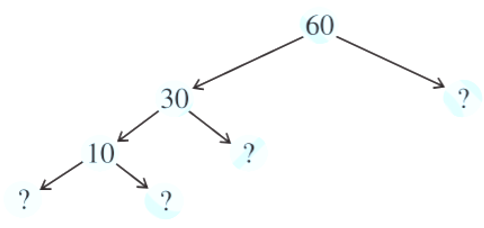
AnswerAs we know that $60 = 30 \times 2$
$30 = 10 \times 3$
$10 = 5 \times 2$
So, the Missing numbers are: $2, 5, 3$ and $2.$
View full question & answer→Question 172 Marks
$18$ is divisible by both $2$ and $3$. It is also divisible by $2 \times 3 = 6$. Similarly, a number is divisible by both $4$ and $6$. Can we say that the number must also be divided by $4 \times 6 = 24$? If not, give an example to justify your answer.
AnswerNo, we cannot say that the number will be divisible by $4 \times 6 = 24$, if it is divisible by both $4$ and 6 because $4$ and $6$ are not co-prime numbers (they have two common factors $1$ and $2$)
$Ex. 36$ is divisible by both $4$ and $6.$
But, $36$ is not divisible by $24.$
View full question & answer→Question 182 Marks
Find if the numbers $81$ and $16$ are co-prime or not.
Answer$81$ and $16$
Factors of $81$ are $1, 3, 9, 27$ and $81$
Factors of $16$ are $1, 2, 4, 8$ and $16.$
$\therefore$ Common factor of $81$ and $16$ is $1.$
$\because$ $81$ and $16$ have only $1$ as the common factor.
$\therefore$ $81$ and $16$ are co-prime numbers.
View full question & answer→Question 192 Marks
Find if the numbers $216$ and $215$ are co-prime or not.
Answer$216$ and $215$
Factors of $216$ are $1, 2, 3, 4, 6, 8, 9, 12, 18, 24, 27, 36, 54, 72, 108$ and $216.$
Factors of $215$ are $1,5$ and $43$
$\therefore$ Common factors of $216$ and $215$ is $1.$
$\because$ $216$ and $215$ have only $1$ as the common factor.
$\therefore$ $216$ and $215$ are co-prime numbers.
View full question & answer→Question 202 Marks
Find if the numbers $17$ and $68$ are co-prime or not.
Answer$17$ and $68 :$
$1$ $\times$ $17=17$
Factors of $17$ are $1$ and $17.$
$1 \times 68 =68 ; 2 \times 34=68 ; 4 \times 17= 68$
Factors of $68$ are $1, 2, 4, 17, 34$ and $68.$
$\therefore$ Common factors of $17$ and $68$ are $1$ and $17.$
$\because$ $17$ and $68$ have two common factors.
$\therefore$ $17$ and $68$ are not co-prime numbers.
View full question & answer→Question 212 Marks
Find if the numbers $30$ and $415$ are co-primes or not.
Answer$1 \times 30=30 ; 2 \times 15=30 ; 3 \times10=30 ; 5 \times 6=30$
Factors of $30$ are $1, 2, 3, 5, 6, 10, 15$ and $30.$
$1 \times 415=415 ; 5 \times 83=415$
Factors of $415$ are $1, 5, 83$ and $415.$
$\therefore$ Common factors of $30$ and $415$ are $1$ and $5.$
$\because 30$ and $415$ have two common factors.
$\therefore 30$ and $45$ are not co-prime numbers.
View full question & answer→Question 222 Marks
Find if the numbers $15$ and $37$ are co-primes or not.
Answer$1 \times 15=15 ; 3 \times 5=15$
Factors of $15$ are $1, 3, 5$ and $15.$
$1 \times 37=37$
Factors of $37$ are $1$ and $37.$
$\therefore$ Common factor of $15$ and $37$ is $1$.
$\because 15$ and $37$ have only $1$ as the common factor.
$\therefore 15$ and $37$ are co-prime numbers.
View full question & answer→Question 232 Marks
Find if the numbers $18$ and $35$ are co-primes or not.
Answer$1 \times 18=18 ; 2\times 9=18 ; 3 \times 6= 18$
Factors of $18$ are $1, 2, 3, 6, 9$ and $18.$
$1 \times 35=35 ; 5 \times7= 35$
Factors of $35$ are $1, 5, 7$ and $35.$
\therefore Common factor of $18$ and $35$ is $1.$
$\because 18$ and $35$ have only $1$ as the common factor.
$\therefore 18$ and $35$ are co-prime numbers.
View full question & answer→Question 242 Marks
Write all the numbers less than $100$ which are common multiples of $3$ and $4.$
AnswerMultiples of $3$ are $3, 6, 9, 12, 15, 18, 21, 24, 27, 30, 33, 36, 39, 42, 45, 48, 51, 54, 57, 60, 63, 66, 69, 72, 75, 78, 81, 84, 87, 90, 93, 96, 99, 102, 105, 108, .....$
Multiples of $4$ are $4, 8, 12, 16, 20, 24, 28, 32, 36, 40, 44, 48, 52, 56, 60, 64, 68, 72, 76, 80, 84, 88, 92, 96, 100, 104, 108, .....$
$\therefore $ Common multiples of $3$ and $4$ are $12, 24, 36, 48, 60, 72, 84, 96, 108, ....$
$\therefore $ All the numbers less than $100$ which are common multiples of $3$ and $4$ are $12, 24, 36, 48, 60, 72, 84$ and $96.$
View full question & answer→Question 252 Marks
Find first three common multiples of $12$ and $18.$
AnswerMultiples of $12$ are $12, 24, 36, 48, 60, 72, 84, 96, 108, 120, 132, 144, .....$
Multiples of $18$ are $18, 36, 54, 72, 90, 108, 126, 144, ....$
$\therefore $ Common multiples of $12$ and $18$ are $36, 72, 108, 144, ....$
$\therefore $ First three common multiples of $12$ and $18$ are $36, 72$ and $108.$
View full question & answer→Question 262 Marks
Find first three common multiples of $6$ and $8.$
Answer$6$ and $8$
Multiples of $6$ are $6, 12, 18, 24, 30, 36, 42, 48, 54, 60, 66, 72, 78, 84, 90, 96, ....$
Multiple of $8$ are $8, 16, 24, 32, 40, 48, 56, 64, 72, 80, 88, 96, ....$
$\therefore $ Common multiples of $6$ and $8$ are $24, 48, 72, 96, ......$
$\therefore $ First three common multiples of $6$ and $8$ are $24, 48$ and $72.$
View full question & answer→Question 272 Marks
Find the common factors of $5, 15$ and $25$
Answer$1 \times 5 = 5$
Factors of $5$ are $1$ and $5.$
$1 \times 15 = 15 ; 3 \times 5 = 15$
Factors of $15$ are $1, 3$ and $5.$
$1 \times 25 = 25 ; 5 \times 5 = 25$
Factors of $25$ are $1, 5$ and $25.$
Hence, the common factors of $5, 15$ and $25$ are $1$ and $5.$
View full question & answer→Question 282 Marks
Find the common factors of $4, 8$ and $12$
Answer$1 \times 4=4 ; 2 \times 2=4$
Factors of $4$ are $1, 2$ and $4.$
$1 \times8 = 8 ; 2 \times 4 = 8$
Factors of $8$ are $1, 2, 4$ and $8.$
$1 \times 12 = 12 ; 2 \times 6 = 12 ; 3 \times 4 = 12$
Factors of $12$ are $1, 2, 3, 4, 6$ and $12.$
Hence, the common factors of $4, 8$ and $12$ are $1, 2$ and $4.$
View full question & answer→Question 292 Marks
Find the common factors of $56$ and $120$
Answer$1 \times 56 = 56 ; 2 \times 28 = 56 ; 4 \times 14 = 56 ; 7 \times 8 = 56$
Therefore Factors of $56$ are $1, 2, 4, 7, 8, 14, 28$ and $56.$
$1 \times 120 = 120 ;$
$2 \times 60 = 120 ;$
$ 3 \times 40 = 120 ;$
$ 4 \times 30 = 120 ; $
$5 \times 24 = 120 ; $
$6 \times 20 = 120 ; $
$8 \times 15 = 120 ;$
$10 \times 12 = 120.$
Therefore Factors of $120$ are $1, 2, 3, 4, 5, 6, 8, 10, 12, 15, 20, 24, 30, 40, 60$ and $120$.
Hence, the common factors of $56$ and $120$ are $1, 2, 4$ and $8.$
View full question & answer→Question 302 Marks
Find the common factors of $35$ and $50$
Answer$1 \times 35 = 35 ; 5 \times 7 = 35 .$
Therefore Factors of $35$ are $1, 5, 7$ and $35.$
$1 \times 50 = 50 ; 2 \times 25 = 50 ; 5 \times 10 = 50$
Therefore Factors of $50$ are $1, 5, 10, 25$ and $50.$
Hence, the common factors of $35$ and $50$ are $1$ and $5.$
View full question & answer→Question 312 Marks
Find the common factors of $15$ and $25$
Answer$1 \times 15 = 15; 3 \times 5 = 15.$
Therefore Factors of $15$ are $1, 3, 5$ and $15.$
$1 \times 25 = 25; 5 \times 5 = 25.$
Therefore Factors of $25$ are $1, 5$ and $25.$
Hence, the common factors of $15$ and $25$ are $1$ and $5.$
View full question & answer→Question 322 Marks
Find the common factors of $20$ and $28$
Answer$20$ and $28$
$1 \times 20 = 20 ; 2 \times 10 = 20 ; 4 \times 5 = 20.$
Therefore Factors of $20$ are $1, 2, 4, 5, 10$ and $20.$
$1 \times 28 = 28 ; 2 \times 14 = 28 ; 7 \times 4 = 28.$
Therefore Factors of $28$ are $1, 2, 4, 7, 14$ and $28.$
Hence, the common factors of $20$ and $28$ are $1, 2$ and $4.$
View full question & answer→Question 332 Marks
Write digit in the blank space of number so that the number is divisible by $11 : 8__9484$
AnswerSum of the given digits (at odd places) from the right $= 4 + 4 +$ required digit $= 8 +$ required digit.
Sum of the given digits (at even places) from the right $= 8 + 9 + 8 = 25$
Difference of the sums $=25 -$ ($8$ +required digit)$=17 -$ required digit
For the above difference to be divisible by $11$, required digit $= 6$ because $17 - 6 = 11$, which is divisible by $11$.
Hence, the required number is $869484.$
View full question & answer→Question 342 Marks
Write digit in the blank space of the number so that the number is divisible by $11 : 92$__$389$
Answer$92$__$389$
Sum of the given digits (at odd places) from the right $= 9 + 3 + 2 = 14$
Sum of the given digits (at even places) from the right $= 8 +$ required digit $+ 9$ = required digit $+ 17$
Difference of these sums = required digit $+ 3$
For the above difference to be divisible by $11$, required digit $= 8$ because $8+3=11$ which is divisible by $11$
Hence, the required number is $928389.$
View full question & answer→Question 352 Marks
Write the smallest digit and the largest digit in the blank space of number so that the number is divisible by $3 : 4765\_\_\ 2.$
Answer$1.$ Smallest digit
Sum of the given digits $= 4 + 7 + 6 + 5 + 2 = 24$
$\because$ $24$ is divisible by $3$
$\therefore$ Smallest digit is $0.$
$2.$ Largest digit
The largest digit is $9$ because $24 + 9 = 33$ which is divisible by $3.$
View full question & answer→Question 362 Marks
Using divisibility tests, determine if $639210$ is divisible by $6.$
AnswerA number is divisible by $6$ if it is divisible by $2 \ \& \ 3$ both.
$i.$ Divisible by $2$
$\because$ Unit's digit $= 0$
$\therefore$ $639210$ is divisible by $2.$
$ii.$ Divisibility by $3$
Sum of the digit $= 6 + 3 + 9 + 2 + 1 + 0 = 21,$
which is divisible by $3$
$\therefore$ $639210$ is divisible by $3$
Since, $639210$ is divisible by $2$ and $3$ both, so it is divisible by $6.$
View full question & answer→Question 372 Marks
Using divisibility tests, determine if $1790184$ is divisible by $6.$
AnswerA number is divisible by $6$, if it is divisible by $2\ \&\ 3$ both.
$i.\ $Divisibility by $2$
$\because$ Unit's digit $= 4$
$\therefore 1790184$ is divisible by $2.$
$ii.\ $Divisibility by $3$
Sum of the digits $= 1 + 7 + 9 + 0 + 1 + 8 + 4 = 30,$
which is divisible by $3$
$\therefore 1790184$ is divisible by $3$
Since, $1790184$ is divisible by $2$ and $3$ both, so it is divisible by $6.$
View full question & answer→Question 382 Marks
Using divisibility tests, determine if number $438750$ is divisible by $6.$
AnswerA number is divisible by $6$, if it is divisible by $2\ \&\ 3$ both.
$i.\ $Divisibility by $2.$
$\because$ Unit's digit $= 0$
$\therefore$ $438750$ is divisible by $2$.
$ii.\ $Divisibility by $3.$
Sum of the digits $= 4 + 3 + 8 + 7 + 5 + 0 = 27,$
which is divisible by $3$
$\therefore$ $438750$ is divisible by $3$
Since, $438750$ is divisible by $2$ and $3$ both, so it is divisible by $6.$
View full question & answer→Question 392 Marks
Using divisibility test, determine if number $901352$ is divisible by $6.$
Answer$i.\ $Divisibility by $2.$
$\because$ Unit's digit $= 2$
$\therefore$ $901352$ is divisibility by $2.$
$ii.\ $Divisibility by $3.$
Sum of the digits $= 9 + 0 + 1 + 3 + 5 + 2 = 20.$
which is not divisible by $3.$
$\therefore$ $901352$ is not divisible by $3.$
Since, $901352$ is divisible by $2$ but not by $3$, so it is not divisible by $6.$
View full question & answer→Question 402 Marks
Using divisibility test, determine if number $4335$ is divisible by $6.$
AnswerA number is divisible by $6$, if it is divisible by $2\ \& \ 3$ both.
$i.\ $Divisibility by $2$
$\because$ Unit's digit $= 5$, which is not any of the digits from $0, 2, 4, 6$ or $8.$
$\therefore$ $4335$ is not divisible by $2.$
$ii.\ $Divisibility by $3$
Sum of the digits $4 + 3 + 3 + 5 = 15$ which is divisible by $3.$
So $4335$ is also divisible by $3.$
$\therefore$ $4335$ is not divisible by $6$ because it is divisible by $3$ but not by $2.$
View full question & answer→Question 412 Marks
Using divisibility test, determine if number $1258$ is divisible by $6$
Answer
A number is divisible by $6$, if it is divisible by $2$ and $3$ both.
$i.\ $Divisibility by $2.$
$\because$ Unit's digit $= 8.$
$\therefore$ $1258$ is divisible by $2.$
$ii.\ $Divisibility by $3.$
Sum of the digits $= 1 + 2 + 5 + 8 = 16,$
which is not divisible by $3.$
Since, $1258$ is divisible by $2$ but not by $3,$
so $1258$ is not divisible by $6.$
View full question & answer→Question 422 Marks
Using divisibility tests, determine if number $297144$ is divisible by $6.$
AnswerWe know that a number is divisible by 6 if it is divisible by $2$ and $3$ both.
$i.\ $Divisibility by $2.$
$\because$ Unit's digit $= 4$
$\therefore$ $297144$ is divisible by $2.$
$ii.\ $Divisibility by $3.$
Sum of the digits $= 2 + 9 + 7 + 1 + 4 + 4 = 27,$
which is divisible by $3.$
$\therefore$ $297144$ is divisible by $3.$
Since, $297144$ is divisible by $2$ and $3$ both, so it is divisible by $6.$
View full question & answer→Question 432 Marks
Using divisibility tests, determine if the number $1700$ is divisible by
$a.\ 5$
$b.\ 10$
Answer$i.\ $Divisibility by $5$.
The last digit $= 0$
$\therefore$ $1700$ is divisible by $5$ because a no. is divisible by $5$ if it has $0$ or $5$ in its ones place.
$ii.\ $Divisibility by $10.$
The last digit $= 0$
$\therefore$$1700$ is divisible by $10$ because a no. is divisible by $10$ if it has $0$ in the ones place.
View full question & answer→Question 442 Marks
Using divisibility tests, determine if the number $31795072$ is divisible by
$a.\ 4$
$b.\ 8$
Answer$i.\ $Divisibility by $4.$
The number formed by last two digits $= 72$
$\text { (4) } 72(18)$
$\frac{4}{32}$
$\frac{32}{0}$
$\because$ Remainder is $0.$
$\therefore 72$ is divisible by $4.$
$\therefore 31795072$ is divisible by $4$ because a no. is divisible by $4$ if the no. formed by its last two digits is divisible by $4.$
$ii.\ $Divisibility by $8.$
The number formed by last three digits $= 072 = 72$
$(8) 72(9)$
$\frac{72}{0}$
$\because$ Remainder is $0.$
$\therefore 72$ is divisible by $8$.
$\therefore 31795072$ is divisible by $8$ because a no. is divisible by $8$ if no. formed by its last three digits is divisible by $8.$
View full question & answer→Question 452 Marks
Using divisibility tests, determine if the number $21084$ is divisible by
$a.\ 4$
$b.\ 8$
Answer$i.$ Divisibility by $4$
The number formed by last two digits $= 84$
$4)84(21$
$\underline {8}$
$4$
$\underline{4}$
$0$
$84$ is divisible by $4$
So $21084$ is also divisible by $4$ because a no. is divisible by $4$ if the no. formed by its last two digits $($ i.e ones and tens $)$ is divisible by $4.$
$ii.$ Divisibility by $8$
The number formed by last three digits $= 084 = 84 (8)84(10)$
$\underline {8}$
$4$
$\underline{0}$
$4$
$\because$ Remainder is not $0.$
$\therefore$ $84$ is not divisible by $8.$
$\therefore$ $21084$ is not divisible by $8$ because a no. is divisible by $8$ only if the no. formed by its last three digits is divisible by $8.$
View full question & answer→Question 462 Marks
Using divisibility tests, determine if the no.$14560$ is divisible by
$a.\ 4$
$b.\ 8$
Answer$i.$ Divisibility by $4.$
The number formed by last two digits $= 60.$
$4)60(15$
$\underline {4}$
$20$
$\underline{20}$
$0$
$\because$ Remainder is $0.$
$\therefore$ $60$ is divisible by $4.$
$\therefore$ $14560$ is divisible by $4$ because a no. is divisible by $4$ only if the no. formed by its last two digits $($ i.e ones and tens $)$ is divisible by $4.$
$ii.$ Divisibility by $8.$
The number formed by last three digits $= 560$
$8)560(70$
$\underline {56}$
$0$
$\underline{0}$
$0$
$\because$ Remainder is $0.$
$\therefore$ $560$ is divisible by $8.$
$\therefore$ $14560$ is divisible by $8$ because a no. is divisible by $8$ if the no.
formed by its last three digits is divisible by $8.$
View full question & answer→Question 472 Marks
Using divisibility tests, determine if the number $12159$ is divisible by
$a.\ 4$
$b.\ 8$
Answer
$i.$ Divisibility by $4$
The number formed by last two digit $= 59$
$(4)59(14)$
$\underline {4}$
$19$
$\underline{16}$
$3$
$\because$ Remainder is not $0$
$\therefore$ $59$ is not divisible by $4.$
$\therefore$ $12159$ is not divisible by $4$ because a no. is divisible by $4$ only if its last two digits are divisible by $4.$
$i.$ Divisible by $8$
The number formed by last three digits $= 159$.
$(8)159(19)$
$\underline {8}$
$79$
$\underline{72}$
$7$
$\because$ Remainder is not $0$
$\therefore$ $159$ is not divisible by $8.$
$\therefore$ $12159$ is not divisible by $8$ because a no. is divisible by $8$ only if its last three digits are divisible by $8$.
View full question & answer→Question 482 Marks
Using divisibility tests, determine if the number $6000$ is divisible by
$a.\ 4$
$b.\ 8$
Answer$(i)$ Divisibility by $4.$
The number formed by last two digits $= 00,$
which is divisible by $4$
$\therefore 6000$ is divisible by $4$ because a no. is divisible by $4$ if the no. formed by its last two digits (i.e ones and tens) is divisible by $4.$
$(ii)$ Divisibility by $8.$
The number formed by last three digits $= 000,$
which is divisible by $8.$
$\therefore 6000$ is divisible by $8$ because a no. is divisible by $8$ if the no. formed by its last three digits is divisible by $8$.
View full question & answer→Question 492 Marks
Using divisibility tests, determine if the number $5500$ is divisible by
$a.\ 4$
$b.\ 8$
Answer$i.$ Divisibility by $4.$
The number formed by last two digits $= 00,$ which is divisible by $4.$
$\therefore \ 5500$ is divisible by $4$ because a no. is divisible by $4$ if, no. formed by its last two digits $($ i.e ones and tens$)$ is divisible by $4.$
$ii$ Divisible by $8.$
The number formed by last three digits $= 500.$
$(8)500(62)$
$\underline {48}$
$20$
$\underline{16}$
$4$
$\because$ Remainder is not $0$
$\therefore$ $500$ is not divisible by
$\therefore$$5500$ is not divisible by $8$ because a no. is divisible by $8$ if , the no.formed by its last three digits is divisible by $8.$
View full question & answer→Question 502 Marks
Using divisibility tests, determine if the number $726352$ is divisible by
$a.\ 4$
$b.\ 8$
Answer
$a.$ Divisibility by $4$
The number formed by last two digits $= 52$
$4)52(13$
$\underline {4}$
$12$
$\underline{12}$
$0$
$\because$ Remainder is $0$
$\therefore$ $52$ is divisible by $4$
$\therefore 726352$ is divisible by $4$ because a no. is divisible by $4$ if the no. formed by its last two digits i.e (ones and tens) is divisible by $4$
$b.$ Divisibility by $8.$
The number formed by last three digits $= 352$
$8)352(44$
$\underline {32}$
$32$
$\underline{32}$
$0$
$\because$ Remainder is $0$
$\therefore$ $352$ is divisible by $8.$
$\therefore$ $726352$ is divisible by $8$ because a no. with four or more digits is divisible by $8$ if the no. formed by its last three digits is divisible by $8.$
View full question & answer→Question 512 Marks
Using divisibility tests, determine if the number $2150$ is divisible by
$a.\ 4$
$b.\ 8$
Answer
$i.$ Divisibility by $4.$
The number formed by last two digits $= 50$
$4)50(12$
$\underline {4}$
$10$
$\underline{8}$
$2$
$\because$ Remainder is not $0.$
$\therefore$ $50$ is not divisible by $4.$
$\therefore$ $2150$ is not divisible by $4$ because a no. is divisible by $4$ only if the no. formed by its last two digits $($i.e ones and tens $)$ is divisible by $4.$
$ii.$ Divisibility by $8.$
The number formed by last three digits $= 150$
$8)150(18$
$\underline {8}$
$70$
$\underline{64}$
$6$
$\because$ Remainder is not $0.$
$\therefore$ $150$ is not divisible by $8.$
$\therefore$ $2150$ is not divisible by $8$ because a no. is divisible by $8$ only if the no. formed by its last three digits is divisible by $8.$
View full question & answer→Question 522 Marks
Using divisibility tests, determine if the number $572$ is divisible by
$a.\ 4$
$b.\ 8$
Answer$572$
$i.$ Divisibility by $4.$
The number formed by last two digits $= 72$
$4)72(18$
$ \underline {4}$
$ 32$
$ \underline{32}$
$ 0$
$\because$ Remainder is $0.$
$\therefore 72$ is divisible by $4.$
$\therefore 572$ is divisible by $4$ because a no. is divisible by $4$ if the no. formed by its last two digits $($i.e ones and tens $)$ is divisible by $4.$
$ii.$ Divisibility by $8.$
The number is $572$
$8)572(71$
$ \underline {56}$
$ 12$
$ \underline{8}$
$ 4$
$\because$ Remainder is not $0.$
$\therefore 572$ is not divisible by $8.$ View full question & answer→Question 532 Marks
Is $26$ a prime or not.
AnswerHere,
$26 = 1 \times 26$
$26 = 13 \times 2$
$26 = 2 \times 13$
$26 = 26 \times 1$
Clearly, $26$ has four factors $1, 2, 13,$ and $26.$ So, it’s not a prime number and hence it is a composite number.
View full question & answer→Question 542 Marks
Is $37$ a prime or not.
AnswerHere,
$37 = 1 \times 37$
Prime numbers are the numbers that can be divided by $1$ and by the number itself.
Here, $37$ has only two factors $1$ and $37.$ So, it is a prime number.
View full question & answer→Question 552 Marks
Is $51$ a prime number or not$?$
AnswerHere,
$51 = 1 \times 51$
$51 = 3 \times 17$
$51 = 17 \times 3$
$51 = 51 \times 1$
Since $51$ has four factors $1, 3, 17$, and $51.$ Therefore it is a composite number and not a prime number.
View full question & answer→Question 562 Marks
Is $23$ a prime number or not$?$
Answer
| $2$ |
$63, 70, 77$ |
| $3$ |
$63, 35, 77$ |
| $3$ |
$21, 35, 77$ |
| $5$ |
$7, 35, 77$ |
| $7$ |
$7, 7, 77$ |
| $11$ |
$1, 1, 1, 1$ |
| |
$1, 1, 1$ |
$\therefore L.C.M.$ of $63, 70$ and $77 = 2 \times 3 \times 3 \times 5 \times 7 \times 11$
$= 6930$
Hence, the minimum distance each should cover so that all cover the distance in complete steps is $6930\ cm.$ View full question & answer→Question 572 Marks
Find all the multiples of $9$ upto $100.$
AnswerThe multiples of $9$ are
$9 \times 1 = 9$
$9 \times 2 = 18$
$9 \times 3 = 27$
$9 \times 4 = 36$
$9 \times 5 = 45$
$9 \times 6 = 54$
$9 \times 7 = 63$
$9 \times 8 = 72$
$9 \times 9 = 81$
$9 \times 10 = 90$
$9 \times 11 = 99$
$9 \times 12 = 108$
Since $108$ is greater than $100$ therefore all the multiples of $9$ upto $100$ are $9, 18, 27, 36, 45, 54, 63, 72, 81, 90$ and $99.$
View full question & answer→Question 582 Marks
Match the items in column $1$ with the items in column $2.$
| Column 1 |
Column 2 |
| $(i) 35$ |
$(a)$ Multiple of $8$ |
| $(ii) 15$ |
$(b)$ Multiple of $7$ |
| $(iii) 16$ |
$(c)$ Multiple of $70$ |
| $(iv) 20$ |
$(d)$ Factor of $30$ |
| $(v) 25$ |
$(e)$ Factor of $50$ |
| |
$(f)$ Factor of $20$ |
View full question & answer→Question 592 Marks
Write first five multiples of $9.$
AnswerFirst five multiplies of $9$ are obtained as follows;
$1 \times 9 = 9$
$2 \times 9 = 18$
$3 \times 9 = 27$
$4 \times 9 = 36$
$5 \times 9 = 45$
So,
First five multiplies are $9, 18, 27, 36$ and $45.$
View full question & answer→Question 602 Marks
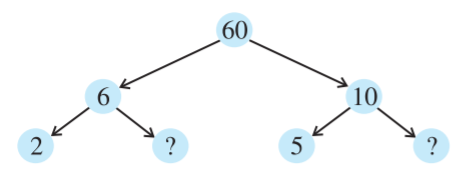
Here are two different factor trees for $60.$ Write the missing numbers.
AnswerFirst five multiplies of $8$ are obtained as follows;
$1 \times 8 = 8$
$2 \times 8 = 16$
$3 \times 8 = 24$
$4 \times 8 = 32$
$5 \times 8 = 40$
So,
The first five multiplies of $8$ are, $8, 16, 24, 32$ and $40.$
View full question & answer→Question 612 Marks
Write all the prime numbers less than $15.$
AnswerBy observing the Sieve Method, we can easily get the required prime numbers as: $2, 3, 5, 7, 11$ and $13$
View full question & answer→Question 622 Marks
Write first five multiples of $6$
AnswerThe required multiples of $6$ are: $6 \times 1 = 6, 6 \times 2 = 12, 6 \times 3 = 18, 6 \times 4 = 24, 6 \times 5 = 30$ i.e. $6, 12, 18, 24$ and $30$
View full question & answer→Question 632 Marks
In a morning walk, three persons step off together. Their steps measure $80 \ cm, 85 \ cm$ and $90 \ cm$ respectively. What is the minimum distance each should walk so that all can cover the same distance in complete steps$?$
AnswerSince, the distance covered by each one of the persons is required to be the same as well as minimum. So, for the required minimum distance, each should walk the lowest common multiple of the measures of their steps. Thus, we have to find find the $LCM$ of $80, 85$ and $90.$
The $LCM$ of $80, 85$ and 90 is $12240.$
The required minimum distance is $12240 \ cm.$
View full question & answer→Question 642 Marks
Find the $LCM$ of $20, 25$ and $30.$
AnswerWe can find the $LCM$ as follows:
| $2$ |
$20$ |
$25$ |
$30$ |
| $2$ |
$10$ |
$25$ |
$15$ |
| $3$ |
$5$ |
$25$ |
$15$ |
| $5$ |
$5$ |
$25$ |
$5$ |
| $5$ |
$1$ |
$5$ |
$1$ |
| |
$1$ |
$1$ |
$1$ |
So, $LCM = 2 \times 2 \times 3 \times 5 \times 5 = 300$ View full question & answer→