Questions

[3 Marks Each] QUE-ANS

Take a timed test

4 questions · self-marked practice — reveal the answer and mark yourself.

Question 13 Marks
What are the similarities and distinguishing features in the life cycles of a mosquito and a frog?
Answer
Similarities
$\rightarrow $ Both begin life as eggs.
$\rightarrow $ Both have a larval stage (tadpole in frogs, larvae in mosquitoes) that is aquatic. Distinguishing Features
Mosquitoes have four stages
Egg $\rightarrow $ Larva $\rightarrow $ Pupa $\rightarrow $ Adult
Respiration: Larvae and pupae breathe through siphons. Frog has four stages
Egg $\rightarrow $ Tadpole $\rightarrow $ Froglet $\rightarrow $ Adult
Respiration: Tadpoles have gills, adults have lungs and can respire through their skin.
View full question & answer
Question 23 Marks
The table (See $NCERT$ Textbook, Page $204$) shows some data. Study the data and try to find out examples appropriate for the conditions given in the second and third columns. If you think that an example for any of the conditions given below is not possible, explain why?
S. no. Does it grow? Does it respire? Example Remarks
$1.$ No No    
$2.$ No Yes    
$3.$ Yes No    
$4.$ Yes Yes    
Answer
S. no. Does it grow? Does it respire? Example Remarks
$1.$ No No Rock Non-living, No growth or respiration
$2.$ No Yes Virus Viruses are non-living outside host cells but respire in host
$3.$ Yes No Crystals (salt). Non-living can perform tasks but does not respire
$4.$ Yes Yes Humans, Plants Living beings
 
 
View full question & answer
Question 33 Marks
List the similarities and differences in life cycles of plants and animals.
Answer
Similarities in Life Cycles of Plants and Animals Differences in Life Cycles of Plants and Animals
 $(i)$ Development Stage: Both have distinct stages of development (e.g., germination, flowering in plants; egg, larva, adult in animals).  $(i)$ Respiration: While both respire, the mechanisms differ; animals use lungs or gills, plants use stomata and lenticels.
 $(ii)$ Growth: Both plants and animals grow from a small initial stage (seed or embryo) into a mature form.  $(ii)$ Growth Patterns: Plants exhibit indeterminate growth (can grow throughout their life), while animals have determinate growth (stop growing after reaching maturity).
 $(iii)$ Reproduction: Both undergo process to produce offspring (seeds for plants and young ones for animals).  $(iii)$ Reproductive Structures: Animals have specialized organs for reproduction, while plants use flowers, cones, or spores.
View full question & answer
Question 43 Marks
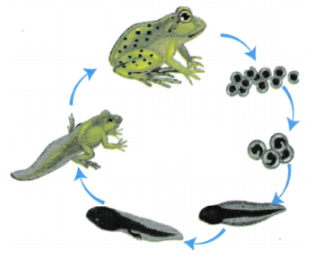
Explain the life cycle of a frog.
Answer
The life cycle of a frog begins with a fertilized egg. The fertilized egg develops into a tadpole. The fertilized egg and tadpole stages are found in the water in the spring. The tadpole develops into an immature froglet, then it is transformed via the process of metamorphosis into an adult frog. The tail is absorbed and the external gills are replaced by lungs. The adult frog lives on land and in the water and breathes air.
Image
View full question & answer