Questions

3 Marks Question

Take a timed test

22 questions · self-marked practice — reveal the answer and mark yourself.

Question 13 Marks
An item was sold for ₹ 540 at a loss of 5%. What was its cost price?
Answer
Given, SP of an item = ₹ 540; Loss %= 5%
Let the CP of an item be ₹ x.
Then, loss=5% of CP of an item = $\frac{5}{100}$ $\times$$x=$ ₹ $\frac{5 x}{100}$
Now, SP=CP-Loss
$\therefore$ 540=$\left(x-\frac{5 x}{100}\right)$
$\Rightarrow$ 540 = $\left(\frac{100 x-5 x}{100}\right)$
$\Rightarrow$ 540 = $\frac{95 x}{100}$
$\Rightarrow 95 x=540 \times 100$
$\Rightarrow$ $x=\frac{540 \times 100}{95}$= ₹ $\frac{10800}{19}$
= ₹ $568 \frac{8}{19}$ or ₹ 568.42.
Hence, CP of an item is ₹ 568.42.
View full question & answer
Question 23 Marks
An article was sold for ₹ 250 with a profit of 5%. What was its cost price?
Answer
Given, SP of an article = ₹ 250; Profit %=5%
Let CP of an article be ₹ x.
Then, profit = 5% of CP of an article = $\frac{5}{100} \times x=\frac{5 x}{100}$
Now, SP of an article = CP + Profit
$\therefore\quad$$250=x+\frac{5 x}{100}$
$\Rightarrow\quad$$\frac{250}{1}=\frac{100 x+5 x}{100}$
$\Rightarrow\quad$ $105 x=250 \times 100$
$\Rightarrow\quad$ $x=\frac{250 \times 100}{105}$
$\Rightarrow\quad$$x=\frac{5000}{21}$ = ₹ 238.10
Hence, CP of an article is ₹ 238.10.
View full question & answer
Question 33 Marks
If angles of a triangle are in the ratio 2 : 3 : 4. Find the value of each angle.
Answer
Given, angles of a triangle are in the ratio 2 : 3 : 4.
Sum of the ratios = 2 + 3 + 4 = 9
We know that sum of all angles of a triangle is $180^{\circ}.$
$\begin{array}{l}\therefore \text {Measure of first angle}=\frac{2}{9} \times 180^{\circ}=40^{\circ} \\ \text {Measure of second angle}=\frac{3}{9} \times 180^{\circ}=60^{\circ} \\ \text {and measure of third angle}=\frac{4}{9} \times 180^{\circ}=80^{\circ}\end{array}$
Hence, the measure of all the angles of a triangle are $40^{\circ}$, $60^{\circ}$ and $80^{\circ}$.
Alternate Method
Let measure of the angles of a triangle be 2x, 3x and 4x.
We know that sum of all the angles of a triangle is $180^{\circ}.$
$\therefore 2 x+3 x+4 x=180^{\circ}$
$\Rightarrow 9 x=180^{\circ}$
$\Rightarrow x=\frac{180^{\circ}}{9}$
$=20^{\circ}$
Hence, the angles are $2 x=2 \times 20^{\circ}=40^{\circ}$,
$3 x=3 \times 20^{\circ}=60^{\circ}$
$\text{and}\quad4 x=4 \times 20^{\circ}=80^{\circ}$
View full question & answer
Question 43 Marks
(i) $35 \%+$ _____________ $\%=100 \%$
(ii) $64 \%+20 \%+$ _____________ $\%=100 \%$
(iii) $45 \%=100 \%-$ _____________ $\%$
(iv) $70 \%=$ _____________ $\%-30 \%$
Answer
(i) Here, 35% means that 35 parts out of 100 parts.
Then, remaining parts $=(100-35)\%=65\%$
Hence, $35\%+ 65\% = 100\%$
Alternate Method:
Let the missing percentage number be x.
$35\%+x\%=100\%\Rightarrow x\% 100\%-35\%-65\%$
Hence, the missing percentage number is 65.
(ii) Here, $64 \%$ means that 64 parts out of 100 parts and $20 \%$ means 20 parts out of 100 parts.
$\begin{aligned} \text {Then, remaining parts} & =[100-(64+20)] \% \\ & =(100-84) \%=16 \%\end{aligned}$
Hence, $64 \%+20 \%+16 \%=100 \%$
(iii) Here, $45 \%$ means 45 parts out of 100 parts and $100 \%$ means 100 parts out of 100 parts.
$\text {Then, remaining parts}=(100-45) \%=55 \% $
$\text {Hence, }  45 \%=100 \%-55 \%$
(iv) Here, $70 \%$ means that 70 parts out of 100 parts.
Then, remaining parts $=(100-70) \%=30 \%$
Hence, $70 \%=100 \%-30 \%$
View full question & answer
Question 53 Marks
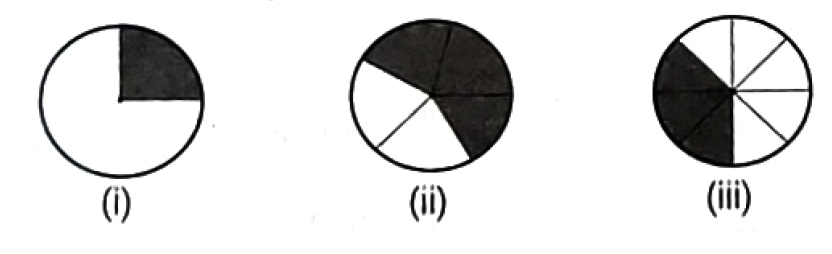
Estimate what part of the figures is coloured and hence find the per cent which is coloured
Image
Answer
(i) Total parts = 4 and coloured part = 1
$\therefore$ Coloured parts of the figure in fraction $=\frac{1}{4}$
Now, required per cent of coloured parts
$=\left(\frac{1}{4} \times 100\right) \%=25 \%$
(ii) Total parts = 5 and coloured parts = 3
$\therefore$ Coloured parts of the figure in fraction $=\frac{3}{5}$
Now, required per cent of coloured parts
$=\left(\frac{3}{5} \times 100\right) \%=(3 \times 20) \%=60\%$
(iii) Total parts = 8 and coloured parts = 3
$\therefore$ Coloured parts of the figure in fraction $=\frac{3}{8}$
Now, required per cent of coloured part
$=\left(\frac{3}{8} \times 100\right) \%$
$=\left(\frac{3}{2} \times 25\right) \%=\left(\frac{75}{2}\right) \%=37.5 \%$
View full question & answer
Question 63 Marks
I buy a TV for ₹ 10000 and sell it at a profit of 20%. How much money do I get for it?
Answer
Given, CP of a TV = ₹ 10000; Profit per cent = 20%
$\therefore$ Profit 20% of CP of a TV
$=\frac{20}{100}$$\times 10000=20 \times 100$ = ₹ 2000
$\therefore$ SP of a TV = CP of a TV+ Profit = ₹ 10000 + ₹ 2000
= ₹ 12000
Hence, I got ₹ 12000 on selling a TV.
Alternate Method
By 20% profit means, if CP is ₹ 100, then profit is ₹ 20.
$\therefore$ SP = ₹ (100 + 20) = ₹ 120
Now, where CP is ₹ 100, then SP is ₹ 120.
$\therefore$ When CP is ₹ 10000, then.
SP= $\frac{120}{100} \times 10000=120 \times 100$ = ₹ 12000
Hence, I got ₹ 12000 on selling a TV.
View full question & answer
Question 73 Marks
Arun bought a car for ₹ 350000. The next year, the price went upto ₹ 370000. What was the percentage of price increase?
Answer
Original price of the car = ₹ 350000
Increased price of the car = ₹ 370000
Then, increase in price ₹(370000 - 350000) = ₹ 20000
$\therefore$ Percentage Increase In Price
$=\left(\frac{\text {Increase in price}}{\text {Original price}} \times 100\right) \%$
$=\left(\frac{20000}{350000} \times 100\right)\%$
$=\frac{40}{7} \%=5 \frac{5}{7} \%$
Hence, the percentage increase in price of $15 \frac{5}{7} \%.$
View full question & answer
Question 83 Marks
In a furniture shop, 24 tables were bought at the rate of ₹ 450 per table. The shopkeeper sold 16 of them at the rate of ₹ 600 per table and the remaining at the rate of ₹ 400 per table. Find his gain or loss per cent.
Answer
As per the given information in question,
cost price per table = ₹ 450
Number of tables = 24
So, cost price of 24 tables = $24 \times 450=$ ₹ $10800$
Number of tables sold at rate ₹ $600=16$
Selling price of 16 tables $=16 \times 600=$ ₹ $9600$
$\therefore$ Remaining tables $=24-16=8$
$\because$ 8 tables sold at ₹ 400.
Selling price for 8 tables $=8 \times 400=$ ₹ $3200$
Total selling price $=9600+3200=$ ₹ $12800$
$\therefore$ Profit or Gain = ₹ 12800 - ₹ 10800 = ₹ 2000
Now, Gain percentage $=\frac{\text { Gain }}{\text { Total Cost Price }} \times 100$
$\begin{array}{l}=\frac{2000}{10800} \times 100 \\ =\frac{2000}{108}=18.51 \%\end{array}$
Hence, his gain is 18.51%.
View full question & answer
Question 93 Marks
800 kg of mortar consists of 55% sand, 33% cement and rest lime. What is the mass of lime in mortar?
Answer
Percentage of sand in mortar = 55%
Percentage of cement in mortar = 33%
So, Percentage of lime in mortar
= (100 - 55 - 33)%
= (100 - 88)% = 12%
Weight of mortar = 800kg
$\therefore\quad$Mass of lime in mortar =12% of 800 kg
=$\frac{12}{100} \times 800$=$12 \times 8=96$kg
Hence, weight of lime in mortar is 96 kg.
View full question & answer
Question 103 Marks
45% of the population of a town are men and 40% are women. What is the percentage of children?
Answer
Percentage of men in town = 45%
Percentage of women in town = 40%
So, percentage of children in town
=(100-45-40)%
=(100 - 85)% = 15%
Hence, 15% population of a town are children.
View full question & answer
Question 113 Marks
A tea merchant blends green tea and lemon tea in the ratio of 5 : 4, introducing a new variety of tea which is mix green herbal and lemon.
The cost of green tea is ₹ 200 per kg and that of lemon tea is ₹ 300 per kg. If he sells the blended tea at the rate of ₹ 275 per kg, find out the percentage of his profit or loss. What value depict here?
Answer
Given, ratio of blended two varieties of tea
(green tea: lemon tea) = 5 : 4
Cost of green tea = ₹ 200 per kg.
Cost of lemon tea = ₹ 300 per kg.
SP of blended tea = ₹ 275 per kg.
According to the ratio,
Let green tea be 5x kg and lemon tea be 4x kg.
So, cost of green tea $=5 x \times 200=$ ₹ $1000 x$
Cost of lemon tea $=4 x \times 300=$ ₹ $1200 x$
Total $C P=$ ₹ $(1000 x+1200 x)=$ ₹ $2200 x$
Total quantity $=(4 x+5 x) kg =9 x kg$
So, for 9x kg
$\therefore$ SP of blended tea $=$ ₹ $275 \times 9 x \Rightarrow S P=$ ₹ $2475 x$
$\because C P < S P$
So, there is profit on blended tea.
Profit $=$ ₹ $(2475 x-2200 x)=$ ₹ $275 x$
Profit $\%=\frac{\text { Profit }}{C P} \times 100=\frac{275 x}{2200 x} \times 100=\frac{275}{22}$
$=12.5 \%$
Hence, there is $12.5 \%$ profit on blended tea (new variety).
The merchant has very innovative idea for boosting tea market with a special flavour of tea, which gives customer many health benefits.
View full question & answer
Question 123 Marks
A memorial trust donates ₹ 500000 to a school, the interest on which is to be used for awarding 3 scholarships to students obtaining first three positions in the school examination every year. If the donation earns an interest of 12% per annum and the values of second and third scholarships are ₹ 20000 and ₹ 15000 respectively. Find out the value of the first scholarship. What type of value depicted from donation to a school?
Answer
Donation Amount = ₹ $500000$
Rate of interest for each year = 12% per annum
Time period = 1yr
Interest received after 1 yr $=\frac{500000 \times 12 \times 1}{100}$
$=5000 \times 12=$ ₹ $60000$
Scholarship amount for second position $=$ ₹ $ 20000$
Scholarship amount for third position $=$ ₹ $15000$
$\therefore$ Remaining amount for first position student
$= 60000-(20000 +15000)$
$=60000-35000$
$=$ ₹ $25000$
The value depicted from donation to a school is the company/trust/persons are very helping towards needed people of societies.
View full question & answer
Question 133 Marks
Divide ₹10000 in two parts, so that the simple Interest on the first part for 4 yr at 12% per annum may be equal to the simple interest on the second part for 4.5 yr at 16% per annum.
Answer
Given, money = ₹ 10000
Divide ₹ 10000 in two parts such that SI on first part for 4 yr at 12% per annum may be equal to the SI on second part for 4.5 yr at 16%.
Let first part = ₹ x
$\therefore \quad$ Second part $=$ ₹ $(10000-x)$
For first part ( $x$ ), $P_1= x,$ ₹ $T_1=4 y r, R_1=12 \%$
$SI _1=\frac{P_1 \times R_1 \times T_1}{100}=\frac{x \times 12 \times 4}{100}$
For second part ( $10000-x$ ),
$P_2=$ ₹ $(10000-x), T_2=4.5 yr , R_2=16 \%$
$\therefore \quad SI _2=\frac{P_2 \times R_2 \times T_2}{100}$
$=\frac{(10000-x) \times 16 \times 45}{100}$
According to the question,
$\because SI _1= SI _2$
Then, $\frac{x \times 12 \times 4}{100}=\frac{(10000-x) \times 16 \times 4.5}{100}$
$48 x=(10000-x) \times 16 \times 4.5$
$\Rightarrow \frac{48 x}{4.5 \times 16}=(10000-x)$
$\Rightarrow \frac{48 x \times 10}{45 \times 16}=10000-x$
$\Rightarrow \frac{2}{3} x=10000-x$
$\Rightarrow \frac{2}{3} x+x=10000$
$\Rightarrow \frac{5 x}{3}=10000$
$\Rightarrow x=10000 \times \frac{3}{5}=6000$
First part $=x=$ ₹ $6000$
Second part $=10000-x=$ ₹ $10000-$ ₹ $6000=$ ₹ $4000$
Hence, two parts of the sum are ₹ $6000$ and ₹ $4000$.
View full question & answer
Question 143 Marks
Due to budget deficit in a State Government, the State Government imposing an entertainment tax on various type of entertainment programmes, 250 tickets of ₹ 400 and 500 tickets of ₹ 100 were sold. If the entertainment tax is 40% on ticket of ₹ 400 and 20% on ticket of ₹ 100, then find how much entertainment tax was collected from the programme and what value depict here?
Answer
Given, 250 tickets of ₹ 400 were sold.
$\therefore$ SP of 250 tickets $=250 \times 400$ = ₹ 100000
$\because$500 tickets of ₹ 100 were sold.
$\therefore$ SP of 500 tickets $=500 \times$ ₹ $100=$ ₹ 50000
Tax on ₹ 400 ticket is 40%.
So, tax amount = 40% of ₹ 100000  $=\frac{40}{100} \times$ ₹ $100000$
$=$ ₹ 40000
Tax on ₹ 100 ticket is 20%.
So, tax amount $=$ 20% of ₹ 50000
$=\frac{20}{100} \times$ ₹ $50000=$ ₹ $10000$
$\therefore$ Total entertainment tax collected
$=$ ₹ $(40000+10000)=$ ₹ $50000$
Hence, ₹ $50000$ as entertainment tax was collected from the programme.
It is a good idea to impose entertainment tax on some special types of entertainment programmes and get money from tax.
View full question & answer
Question 153 Marks
Out of 20000 voters in a constituency, 60% voted. Find the percentage of voters who did not vote. Can you find how many actually did not vote?
Answer
Total number of voters = 20000
Percentage of voters who vote = 60%
Percentage of voters who did not vote = (100 - 60)% = 40%
$\therefore\quad$Number of voters who did not vote
= $\frac{40}{100} \times 20000$=$40 \times 200=8000$
Hence, 8000 voters did not vote.
View full question & answer
Question 163 Marks
6400 were lent to Feroz and Rashmi each at 15% perannum for $3 \frac{1}{2}$ yr and 5 yr respectively. What is the difference in the interest paid by them?
Answer
Given, Feroz lent ₹ 6400 for $3 \frac{1}{2}$ yr at $15 \%$ rate.
$P_1= 6400, T_1=3 \frac{1}{2}=\frac{7}{2} yr , R_1=15 \%$
$SI _1=\frac{P_1 \times R_1 \times T_1}{100}=\frac{6400 \times 15 \times 7}{100 \times 2}=$ ₹ $3360$
Rashmi lent ₹ 6400 for 5 yr at 15%.
$P_2=$ ₹ $6400, R_2=15 \%, T_2=5 yr$
$SI _2=\frac{P_2 \times R_2 \times T_2}{100}=\frac{6400 \times 15 \times 5}{100}=$ ₹ $4800$
$\therefore$ Difference between SI's $=$ ₹ $(4800-3360)=$ ₹ $1440$
Hence, the difference in interest paid by them is ₹ 1440.
View full question & answer
Question 173 Marks
A man sold two radios for ₹ 5000 each. On one he gets a gain of 10% and on other a loss of 10%. Find his total gain or loss per cent in the whole transactions.
Answer
Selling price of each radio = ₹ 5000
Let the cost price of each radio be ₹ x.
10% profit on one radio
i.e. $\frac{110}{100} \times x=5000$
$\Rightarrow$ $x=\frac{5000}{110} \times 100=\frac{50000}{11}=$ ₹ $4545.45$
$10 \%$ loss on other radio i.e. $\frac{90}{100} \times x=5000$
$x=\frac{5000 \times 100}{90}=\frac{50000}{9}=$ ₹ $5555.55$
Total cost price $=$ ₹ $4545.45 +$ ₹ $55555.55 =$ ₹ $10101$
Loss =Total cost price - Total selling price
$=$ ₹ $10101 -$ ₹ $10000=$ ₹ $101$ $\quad[\because$ Total selling price $=2 \times 5000=10000]$
$\therefore$ Loss $\%=\frac{\text { Loss }}{\text { Cost price }} \times 100$
$=\frac{101}{10101} \times 100=\frac{10100}{10101}=0.9 \%=1 \%$
Hence, 1% loss in the whole transactions.
View full question & answer
Question 183 Marks
Arun divides ₹ 10000 between his sons, Anil and Ajay In the ratio 5 : 3. Find the share of each of them.
Answer
As per the given information in the question,
total amount = ₹ 10000
Amount divided between Anil and Ajay is in the ratio 5 : 3
Share of anil =$\frac{5}{8} \times 10000=5 \times 1250 \quad[\because 5+3=8]$
= ₹ 6250
Share of ajay = $\frac{3}{8} \times 10000$=$3 \times 1250$ = ₹ 3750
Hence, share of Anil and Ajay are ₹ 6250 and ₹ 3750, respectively.
View full question & answer
Question 193 Marks
Calculate the per cent that represents the unshaded region in the figure.
Image
Answer
Given, total parts =$10 \times 10=100$
$\because$ Shaded parts $=60$
$\therefore$ Per cent of shaded parts $=60 \%$
Then, per cent of unshaded parts = (100 - 60)% = 40%
Hence, the unshaded region is 40%.
View full question & answer
Question 203 Marks
Chalk contains 10% calcium, 3% carbon and 12% oxygen. Find the amount of carbon and calcium in (in grams) $2 \frac{1}{2}$kg of chalk.
Answer
Percentage of calcium in chalk = 10%
Percentage of carbon in chalk = 3%
Percentage of oxygen in chalk = 12%
$\because\quad$Weight of chalk =$2 \frac{1}{2}$kg =$\frac{5}{2}$kg = 2.5kg
=$2.5 \times 1000$g= 2500g
$\therefore\quad$Amount of carbon in chalk = 3% of 2500 g
=$\frac{3}{100} \times 2500$
=$25 \times 3=75$
$\therefore\quad$Amount of calcium in chalk = 10% of 2500 g
$=\frac{10}{100} \times 2500$
$=10 \times 25=250$ g
Hence, amount of carbon and calcium is 75 g and 250 g respectively.
View full question & answer
Question 213 Marks
The strength of a school is 2000. If 40% of the students are girls, then how many boys are there in the school?
Answer
As per the given information in the question,
the strength of school = 2000
Percentage of girls in school = 40%
Percentage of boys in school = 100% - 40%= 60%
Number of boys in school= $\frac{60}{100} \times 2000$
=$60 \times 20=1200$
Hence, number of boys in school is 1200.
View full question & answer
Question 223 Marks
(i) Out of 32 students, 8 are absent. What per cent of the students are absent?
(ii) There are 25 radios, 16 of them are out of order. What per cent of radios are out of order?
(iii) A shop has 500 parts, out of which 5 are defective. What per cent are defective?
(iv) There are 120 voters, 90 of them voted yes. What per cent voted yes?
Answer
(i) Given, total number of students = 32
Number of absent students = 8
$\therefore$ Percentage of absent students
$=\left(\frac{\text { Number of absent students }}{\text { Total number of students }} \times 100\right) \% $
$ =\left(\frac{8}{32} \times 100\right) \%=25 \%$
Hence, 25% of the students are absent.
(ii) Total number of radios = 25
Number of radios which are out of order = 16
$\therefore$ Percentage of radios which are out of order
$=\left(\frac{\text { Number of radios which are out of order }}{\text { Total number of radios }} \times 100\right) \% $
$ =\left(\frac{16}{25} \times 100\right) \%=(16 \times 4) \%=64 \%$
Hence, 64% of radios are out of order.
(iii) Total number of parts = 500
Number of defective parts = 5
$\therefore$ Percentage of defective parts
$ =\left(\frac{\text {Number of defective parts}}{\text {Total number of parts}} \times 100\right) \% $
$ =\left(\frac{5}{500} \times 100\right) \%=1 \%$
Hence, 1% parts are defective.
(iv) Total number of voters = 120
Number of voters voted yes = 90
$\therefore$ Percentage of voters voted yes
$=\left(\frac{\text { Number of voters voted yes }}{\text { Total number of voters }} \times 100\right) \% $
$ =\left(\frac{90}{120} \times 100\right) \% $
$ =(3 \times 25) \%=75 \%$
Hence, 75% of voters voted yes.
View full question & answer