Questions

5 Marks Questions

Take a timed test

19 questions · self-marked practice — reveal the answer and mark yourself.

Question 15 Marks
Simplify and write in exponential form.
$\left(\right.$ e.g. $\left.11^6÷11^2=11^4\right)$
(i) $2^9÷2^3$ (ii) $10^8÷10^4$ (iii) $9^{11}÷9^7$
(iv) $20^{15}÷20^{13}$ (v) $7^{13}÷7^{10}$
Answer
(i) $2^9÷2^3=2^{9-3}=2^6$ $\left[\because a^m÷a^n=a^{m-n}\right]$
(ii) $10^8÷10^4=10^{8-4}=10^4$
(iii) $9^{11}÷9^7=9^{11-7}=9^4$
(iv) $20^{15}÷20^{13}=20^{15-13}=20^2$
(v) $7^{13}÷7^{10}=7^{13-10}=7^3$
View full question & answer
Question 25 Marks
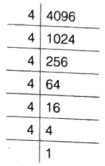
Find five examples, where a number is expressed in exponential form. Also, identify the base and the exponent in each case.
(i) 4096 (il) 216 (iii) 15625 (iv) 1331 (v) 196
View full question & answer
Question 35 Marks
Express the following in usual form.
(i) $8.01 \times 10^7$
(ii) $1.75 \times 10^3$
Answer
(i) Given, $8.01 \times 10^7$
$\because \quad 10^7=10000000$
and $\quad 8.01=801 \times 10^{-2}$
So, $8.01 \times 10^7=801 \times 10^{-2} \times 10^7$
$=801 \times 10^5$
$=801 \times 100000 \quad\left\{\because 10^5=100000\right\}$
$=80100000$
(ii) Given, $175 \times 10^3$
$\because \quad 1.75=1.75 \times 10 \times 10 \times 10$
So, $1.75 \times 10^3=1750$
View full question & answer
Question 45 Marks
If $\frac{p}{q}=\left(\frac{3}{2}\right)^2 \div\left(\frac{9}{4}\right)^0$, then find the value of $\left(\frac{p}{q}\right)^3$.
Answer
Given, $\frac{p}{q}=\left(\frac{3}{2}\right)^2 \div\left(\frac{9}{4}\right)^0$
$\because\left(\frac{9}{4}\right)^0=\left\{\left(\frac{3}{2}\right)^2\right\}^0=\left(\frac{3}{2}\right)^{2 \times 0}=\left(\frac{3}{2}\right)^0$
Now, $\left(\frac{3}{2}\right)^2 \div\left(\frac{3}{2}\right)^0$
Let $a=\frac{3}{2}$
So, $\quad \frac{p}{q}=\left(\frac{3}{2}\right)^{2-0}=\left(\frac{3}{2}\right)^2 \quad\left[\because a^m÷a^n=a^{m-n}\right]$
Now, $\left(\frac{P}{q}\right)^3=\left\{\left(\frac{3}{2}\right)^2\right\}^3=\left(\frac{3}{2}\right)^{2 \times 3}=\left(\frac{3}{2}\right)^6$
$=\frac{3 \times 3 \times 3 \times 3 \times 3 \times 3}{2 \times 2 \times 2 \times 2 \times 2 \times 2}=\frac{729}{64}$
View full question & answer
Question 65 Marks
Find the value of $n$, where $n$ is an integer and $2^{n-5} \times 6^{2 n-4}=\frac{1}{12^4 \times 2}$
Answer
Given, $2^{n-5} \times 6^{2 n-4}=\frac{1}{12^4 \times 2}$
$\because 6^{2 n-4}=(2 \times 3)^{2 n-4}=2^{2 n-4} \times 3^{2 n-4}$
and $12^4=(3 \times 4)^4=(3 \times 2 \times 2)^4=3^4 \times 2^4 \times 2^4$
So, $2^{n-5} \times 2^{2 n-4} \times 3^{2 n-4}=\frac{1}{3^4 \times 2^4 \times 2^4 \times 2^1}$
$\Rightarrow \quad 2^{n-5+2 n-4} \times 3^{2 n-4}=\frac{1}{3^4 \times 2^{4+4+1}}$ $\left[\because a^m \times a^n=a^{m+n}\right]$
$\Rightarrow \quad 2^{3 n-9} \times 3^{2 n-4}=\frac{1}{3^4 \times 2^9}$
$\Rightarrow \quad 2^{3 n-9} \times 3^{2 n-4}=3^{-4} \times 2^{-9} \quad\left[\because a^{-m}=\frac{1}{a^m}\right]$
$\because \quad a^m=a^n \quad \Rightarrow \quad m=n$
So, $3 n-9=-9$
$3 n=-9+9=0$
$\Rightarrow \quad n=0$
View full question & answer
Question 75 Marks
Find $m$, so that $\left(\frac{2}{9}\right)^3 \times\left(\frac{2}{9}\right)^6=\left(\frac{2}{9}\right)^{2 m-1}$.
Answer
Given, $\left(\frac{2}{9}\right)^3 \times\left(\frac{2}{9}\right)^6=\left(\frac{2}{9}\right)^{2 m-1}$
We know that
$a^m \times a^n=a^{m+n}$
Let $a=\frac{2}{9}$
So, $\left(\frac{2}{9}\right)^3 \times\left(\frac{2}{9}\right)^6=\left(\frac{2}{9}\right)^{3+6}=\left(\frac{2}{9}\right)^{2 m-1}$
$\Rightarrow \quad\left(\frac{2}{9}\right)^9=\left(\frac{2}{9}\right)^{2 m-1}$
If $a^m=a^n$, then $m=n$
So, $\quad 9=2 m-1 \Rightarrow 9+1=2 m$
$\therefore \quad m=\frac{10}{2}=5$
View full question & answer
Question 85 Marks
Assume $x$ and $y$ are two negative numbers. The result of the multiplication of $x$ and $y$ with the same positive power is greater than the multiplication of $x$ and $y$ with the same negative power. Give an example to support this statement.
Answer
Let $x=-2$ and $y=-3$
Now,
Case I Using positive power, we get
$(-2)^2 \times(-3)^2=6^2=36$
Case II Using negative power, we get
$(-2)^{-2} \times(-3)^{-2}=6^{-2}=\frac{1}{6^2}=\frac{1}{36}$
Here, $\frac{1}{36}<36$
$\therefore$ The result of the multiplication of $x$ and $y$ with the same positive power is greater than the multiplication of $x$ and $y$ with the same negative power.
View full question & answer
Question 95 Marks
If $2^{n+2}-2^{n+1}+2^n=c \times 2^n$, then find the value of $c$.
Answer
Given, $2^{n+2}-2^{n+1}+2^n=c \times 2^n$
$\Rightarrow 2^{n+2}=2^n \times 2^2, 2^{n+1}=2^n \times 2^1$
So, $2^n \times 2^2-2^n \times 2^1+2^n=c \times 2^n$
On taking $2^n$ common from both sides, we get
$2^n\left(2^2-2^1+1\right)=c \times 2^n$
$\Rightarrow \quad\left(2^2-2^1+1\right)=c$
$\therefore \quad c=4-2+1 \quad\left[\because 2^2=2 \times 2=4,2^1=2\right]$
$=2+1=3$
View full question & answer
Question 105 Marks
If distance between Earth and Moon is 384000000 m and distance between the Sun and the Earth is 146900000000 m , then which have more distance moon or Sun from Earth. Explain it with the help of standard form of number.
Answer
Distance between Earth and Moon $=384000000 m$
$=384 \times 10^6$
$=3.84 \times 10^3 m$....(i)
and distance between Sun and Earth $=146900000000$
$=1469 \times 10^8$.....(ii)
On comparing Eqs. (i) and (ii), we get
$3.84 \times 10^8<1469 \times 10^8 \quad[\because 3.84<1469]$
So, distance between Sun and Earth is more than distance between Earth and Moon.
View full question & answer
Question 115 Marks
If the radius of Sun is 700000000 m and radius of Earth is 6400000 m , then write the value of $\frac{\text { Radius of Earth }}{\text { Radius of Sun }}$.
Answer
$\because$ Radius of Sun $=700000000=7 \times 10^8 m$
and radius of Earth $=6400000=64 \times 10^5 m$
$=2^6 \times 10^5 m$
Then, $\frac{\text { Radius of Earth }}{\text { Radius of Sun }}=\frac{2^6 \times 10^5}{7 \times 10^8}=\left(\frac{64}{7}\right) \times 10^{-3}$
$=9.14 \times 10^{-3}$ (approx)
View full question & answer
Question 125 Marks
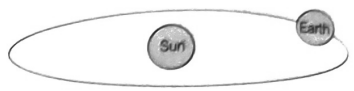
A light year is the distance that light can travel in one year.
1 light year $=9460000000000 km$
(i) Express one light year in scientific notation.
(ii) The average distance between Earth and Sun is $1.496 \times 10^8 km$. Is the distance between Earth and the Sun greater than, less than or equal to one light-year?
Image
Answer
(i) 1 light year $=9460000000000 km$
$=946 \times 10^{10}=\frac{946}{100} \times 10^{10} \times 100$
$=9.46 \times 10^{12} km$
(ii) Average distance between Earth and Sun
$=1.496 \times 10^8 km$
$\therefore$ Distance between Earth and Sun
$\begin{array}{l}=\frac{1.496}{10000} \times 10^8 \times 10^4 \\ =0.0001496 \times 10^{12} km\end{array}$
$\Rightarrow \quad 9.46>0.0001496$
So, the distance between Earth and Sun is less than one light year.
View full question & answer
Question 135 Marks
In our own planet, Earth, 361419000 sq km of area is covered by water and 148647000 sq km of area is covered by land. Find the approximate ratio of area covered with water to area covered by land by converting these numbers into scientific notation. What value depict here?
Answer
Area covered by water $=361419000 km^2$
Area covered by land $=148647000 km^2$
Conversion of area into scientific notation,
$361419000=361419 \times 10^3$
$\because \quad 361419=3.61419 \times 10^5$
$\begin{array}{lr}\text { So, } & 3.61419 \times 10^5 \times 10^3=3.61419 \times 10^8 \\ \text { and } & 148647000=148647 \times 10^3\end{array}$
$\Rightarrow \quad 148647=1.48647 \times 10^5$
So, $\quad 1.48647 \times 10^5 \times 10^3=1.48647 \times 10^8$
Let $\quad 3.61419 \times 10^8 \approx 3.6 \times 10^8$
and $\quad 1.48647 \times 10^8=1.5 \times 10^8$
$\therefore$ Ratio of water toland $=\frac{3.6}{1.5}=12 \cdot 5$
The value depicted here is that we should use scientific method for easy calculation.
View full question & answer
Question 145 Marks
What's the error? A student said that $\frac{3^5}{9^5}$ is the same as $\frac{1}{15}$. What mistake has the student made?
Answer
We have, $\frac{3^5}{9^5}=\frac{3^5}{\left(3^2\right)^5} \quad\left[\because 9=3 \times 3=3^2\right]$
$=\frac{3^5}{3^{10}}=\frac{1}{3^{10-5}}=\frac{1}{3^5} \quad\left[\because \frac{a^m}{b^n}=a^{m-n}\right]$
So, $\frac{1}{15}$ is not same as $\frac{1}{3^5}$ student has multiplied the base by its exponent. This is the error.
View full question & answer
Question 155 Marks
If $\frac{p}{q}=\left(\frac{-2}{3}\right)^9÷\left(\frac{-2}{3}\right)^8$, then find the value of $\left(\frac{p}{q}\right)^2$.
Answer
Given, $\frac{p}{q}=\left(\frac{-2}{3}\right)^9÷\left(-\frac{2}{3}\right)^8$
$\because \quad a^m÷a^n=a^{m-n}$
Let $a=\left(-\frac{2}{3}\right)$
So, $\quad \frac{p}{q}=\left(\frac{-2}{3}\right)^{9-8}=\left(\frac{-2}{3}\right)^1=\frac{-2}{3}$
$\therefore \quad\left(\frac{p}{q}\right)^2=\left(\frac{-2}{3}\right)^2=\frac{(-2) \times(-2)}{3 \times 3}=\frac{4}{9}$
Hence, the value of $\left(\frac{P}{q}\right)^2$ is $\frac{4}{9}$.
View full question & answer
Question 165 Marks
Using laws of exponents simplify the following.
$\frac{\left(-\frac{3}{4}\right)^4 \times\left(\frac{125}{27}\right)}{\left(\frac{5}{3}\right)^2 \times\left(\frac{9}{16}\right)}$
Answer
Given, $\frac{\left(-\frac{3}{4}\right)^4 \times\left(\frac{125}{27}\right)}{\left(\frac{5}{3}\right)^2 \times\left(\frac{9}{16}\right)}$
$\because \frac{125}{27}=\frac{5 \times 5 \times 5}{3 \times 3 \times 3}=\frac{5^3}{3^3}$ and $\frac{9}{16}=\frac{(-3) \times(-3)}{4 \times 4}=\frac{(-3)^2}{4^2}$
So, $\frac{\left(-\frac{3}{4}\right)^4 \times \frac{5^3}{3^3}}{\left(\frac{5}{3}\right)^2 \times \frac{(-3)^2}{4^2}}=\frac{\left(-\frac{3}{4}\right)^4 \times\left(\frac{5}{3}\right)^3}{\left(\frac{5}{3}\right)^2 \times\left(-\frac{3}{4}\right)^2} \quad\left[\because \frac{a^n}{b^n}=\left(\frac{a}{b}\right)^n\right]$
$=\left(\frac{-3}{4}\right)^{4-2} \times\left(\frac{5}{3}\right)^{3-2} \quad\left[\because a^m÷a^n=a^{m-n}\right]$
$=\left(\frac{-3}{4}\right)^2 \times\left(\frac{5}{3}\right)^1$
$=\frac{(-3) \times(-3)}{4 \times 4} \times \frac{5}{3}=\frac{9}{16} \times \frac{5}{3}=\frac{3 \times 5}{16}=\frac{15}{16}$
View full question & answer
Question 175 Marks
If $2^{1998}-2^{1997}-2^{1996}+2^{1995}=k \cdot 2^{1995}$, then find the value of $k$.
Answer
Given, $\quad 2^{1998}-2^{1997}-2^{1996}+2^{1995}=k \cdot 2^{1995}$
$\Rightarrow 2^{1995+3}-2^{1995+2}-2^{1995+1}+2^{1995} \times 1=k \cdot 2^{1995}$
$\Rightarrow 2^{1995}\left[2^3-2^2-2^1+1\right]=k \cdot 2^{1995}$
$\Rightarrow \quad 2^{1995}[8-4-2+1]=k \cdot 2^{1995}$
$\Rightarrow \quad 3=\frac{k \cdot 2^{1995}}{2^{1995}}$
$\Rightarrow \quad 3=k$
So, the value of $k$ is 3 .
View full question & answer
Question 185 Marks
Find the value of x, such that
$\left(\frac{1}{5}\right)^5 \times\left(\frac{1}{5}\right)^{19}=\left(\frac{1}{5}\right)^{8 x}$
Answer
Given, $\left(\frac{1}{5}\right)^5 \times\left(\frac{1}{5}\right)^{19}=\left(\frac{1}{5}\right)^{8 x}$
$\Rightarrow \quad\left(\frac{1}{5}\right)^{5+19}=\left(\frac{1}{5}\right)^{8 x} \quad\left[\because a^m \times a^n=a^{m+n}\right]$
$\Rightarrow \quad\left(\frac{1}{5}\right)^{24}=\left(\frac{1}{5}\right)^{8 x}$
Since, bases are equal, by equating their exponents, we get
$8 x=24$
$\therefore \quad x=\frac{24}{8}=3$
View full question & answer
Question 195 Marks
Express the number appearing in the following statements in standard form.
(i) The distance between Earth and Moon is 384,000,000 m.
(ii) Speed of light in vacuum is 300,000,000 m/s.
(iii) Diameter of the Earth is 1,27,56,000 m.
(iv) Diameter of the Sun is 1,400,000,000 m.
(v) In a Galaxy there are on an average 100,000,000,000 stars.
(vi) The universe is estimated to be about 12,000,000,000 years old.
(vii) The distance of the Sun from the centre of the Milky Way Galaxy is estimated to be
300,000,000,000,000,000,000 m.
(viii) 60,230,000,000,000,000,000,000 molecules are contained in a drop of water weighing 1.8 gm.
(ix) The Earth has 1,353,000,000 cubic km of sea water.
(x) The population of India was about 1,027,000,000 in March, 2001.
Answer
As we know that in standard form; any number is expressed as a decimal number between 1.0 and 10.0 multiplied by a power of 10 . Therefore,
(i) The distance between Earth and Moon
$\begin{array}{l}=384000000 \\ =3.84 \times 100000000 \\ =3.84 \times 10^8\end{array}$
Hence, the required standard form of 384000000 m is $3.84 \times 10^8 m$.
(ii) Speed of light in vacuum $=300000000$
$\begin{array}{l}=3.0 \times 100000000 \\ =3 \times 10^8\end{array}$
Hence, the required standard form of $300000000 m / s$ is $3 \times 10^8 m / s$.
(iii) Diameter of the Earth $=12756000$
$\begin{array}{l}=1.2756 \times 10000000 \\ =1.2756 \times 10^7\end{array}$
Hence, the required standard form of 12756000 m is $1.2756 \times 10^7$.
(iv) Diameter of the Sun $=1400000000$
$=1.4 \times 1000000000=1.4 \times 10^9$
Hence, the required standard form of 1400000000 m is $1.4 \times 10^9 m$.
(v) In a Galaxy, average number of stars
$\begin{array}{l}=100000000000 \\ =1.0 \times 100000000000 \\ =1 \times 10^{11}\end{array}$
Hence, the required standard form of 100000000000 is $10 \times 10^{11}$.
(vi) Estimated age of universe $=12000000000$
$=1.2 \times 10000000000$
Hence, the required standard form of 12000000000 years is $1.2 \times 10^{10}$ years.
(vii) Estimated distance of the Sun from the centre of the Milky Way Galaxy $=300000000000000000000$
$=3.0 \times 100000000000000000000$
$=3 \times 10^{20}$
Hence, the required standard form of 300000000000000000000 is $3 \times 10^{20} m$.
(viii) Number of molecules in a drop of water weighing 1.8 gm
$=60230000000000000000000$
$\begin{array}{l}=6.023 \times 10000000000000000000000 \\ =6.023 \times 10^{22}\end{array}$
Hence, the required standard form of 60230000000000000000000 is $6.023 \times 10^2$.
(ix) Quantity of sea water on the Earth
$\begin{array}{l}=1353000000 \\ =1.353 \times 1000000000 \\ =1.353 \times 10^9\end{array}$
Hence, the required standard form of 1353000000 is $1.353 \times 10^9$ cubic km .
(x) Population of India in March, $2001=1027000000$
$=1.027 \times 10^9$
Hence, the standard form of 1027000000 is $1.027 \times 10^9$. 
View full question & answer