Questions

2 Marks Questions

🎯

Test yourself on this topic

32 questions · timed · auto-graded

Question 12 Marks
Among two supplementary angles, the measure of the larger angle is $44^{\circ}$ more than the measure of the smaller. Find their measures.
Answer
Let the smaller angle be $x$.
Therefore, its supplement larger angle $=(x+44)^{\circ}$
Since, the sum of two supplement angles is $180^{\circ}$.
$
\begin{array}{lr}
\therefore x+(x+44)^{\circ}=180^{\circ} \\
\Rightarrow x+x+44^{\circ}=180^{\circ} \\
\Rightarrow 2 x+44^{\circ}=180^{\circ}
\end{array}
$
On transposing $44^{\circ}$ from LHS to RHS, we get
$
2 x=180^{\circ}-44^{\circ} \Rightarrow 2 x=136^{\circ}
$
On dividing both sides by 2, we get
$
\begin{aligned}
\frac{2 x}{2} =\frac{136^{\circ}}{2} \\
\Rightarrow x=68^{\circ}
\end{aligned}
$
Hence, the smaller angle is $68^{\circ}$
and its supplement larger angle $=68^{\circ}+44^{\circ}=112^{\circ}$
View full question & answer
Question 22 Marks
What will be the measure of the supplement of each one of the following angles?
$90^{\circ}$
Answer
Let the supplement angle of $90^{\circ}$ be $x$.
We know that the sum of two supplementary angles is $180^{\circ}$.
$
\begin{aligned}
\therefore & x+90^{\circ} =180^{\circ} \\
\Rightarrow & x=180^{\circ}-90^{\circ} =90^{\circ}
\end{aligned}
$
Hence, the supplement angle of $90^{\circ}$ is $90^{\circ}$.
View full question & answer
Question 32 Marks
What will be the measure of the supplement of each one of the following angles?
(i) $100^{\circ}$
Answer
Let the supplement angle of $100^{\circ}$ be $x$.
We know that the sum of two supplementary angles is $180^{\circ}$.
$
\begin{array}{l}
\therefore x+100^{\circ}=180^{\circ} \\
\Rightarrow x
=180^{\circ}-100^{\circ}=80^{\circ} .\end{array}
$
Hence, the supplement angle of $100^{\circ}$ is $80^{\circ}$.
View full question & answer
Question 72 Marks
Image
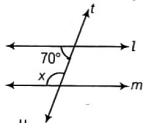
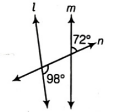
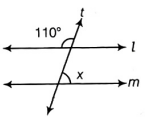
If $/ \| m$, What is $\angle x$ ?
Answer
Given, $l \| m$ and $t$ is a transversal.
We know that the sum of pairs of interior angles on the same side of the transversal is supplementary.
$
\begin{array}{lrl}
\therefore \angle x+70^{\circ}=180^{\circ} \\
\Rightarrow \angle x=180^{\circ}-70^{\circ} =110^{\circ}
\end{array}
$
View full question & answer
Question 82 Marks
Image
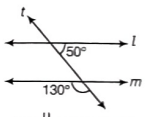
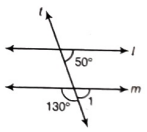
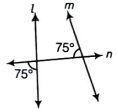
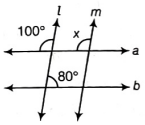
Is / || m? Why?
Answer
$\begin{array}{rlrl}\text { Since }\angle 1+130^{\circ}=180^{\circ}\end{array} \quad$ [by linear pair] $]$
Image
and corresponding angles are euqal i.e. $50^{\circ}$.
$
\therefore l \| m
$
View full question & answer
Question 92 Marks
Image
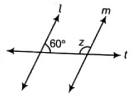
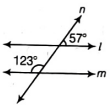
Lines /||m, t is a transversal, $\angle z=$ ?
Answer
Given, $l \| m$ and $t$ is a transversal.
We know that the sum of pair of interior angles on the same side of the transversal is supplementary.
$
\begin{array}{lr}
\therefore\angle z+60^{\circ}=180^{\circ} \\
\Rightarrow \angle z=180^{\circ}-60^{\circ}=120^{\circ}
\end{array}
$
View full question & answer
Question 102 Marks
If a line is a transversal to three lines, how many points of intersection are there?
Answer
If three lines have a transversal, then they have three points of intersection.
Image
View full question & answer
Question 112 Marks
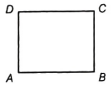
Draw any rectangle and find the measures of angles at the four vertices made by the intersecting lines.
Answer
Let $A B C D$ be the rectangle.
$A B C D$ is a parallelogram with $\angle A=90^{\circ}$.
We have, $\angle C=\angle A=90^{\circ}$
[opposite angles of a parallelogram are equal]
Image
Again, $\angle A+\angle B=180^{\circ}$
[ $\because \angle A$ and $\angle B$ are adjacent angles of a parallelogram]
$
\begin{array}{lr}
\Rightarrow 90^{\circ}+\angle B=180^{\circ} \\
\Rightarrow \angle B=180^{\circ}-90^{\circ}=90^{\circ} \\
\therefore \angle D=\angle B=90^{\circ}
\end{array}
$
[ $\because$ opposite angles of a parallelogram are equal]
Hence, $\angle A=\angle B=\angle C=\angle D=90^{\circ}$
View full question & answer
Question 122 Marks
Find examples from your surroundings, where lines Intersect at right angles.
Answer
Some examples from our surrounding, where lines intersect at right angles, are given below
(i) Corners of the wall
(ii) Sides of a box
(iii) Edges of a blackboard
(iv) Edges of a paper sheet
View full question & answer
Question 132 Marks
The difference in the measures of two complementary angles is $12^{\circ}$. Find the measures of the angles.
Answer
Let one angle be $x$.
Therefore, other complement angle be $90^{\circ}-x$.
[ $\because$ sum of two complementary angles is $90^{\circ}$ ]
Given, difference of two complementary angles $=12^{\circ}$
$\therefore \quad x-\left(90^{\circ}-x\right)=12^{\circ}$
$\Rightarrow \quad x-90^{\circ}+x=12^{\circ}$
$\Rightarrow \quad 2 x=12^{\circ}+90^{\circ}$
$
\Rightarrow 2 x=102^{\circ}
$
[on transposing ( $-90^{\circ}$ ) from LHS to RHS]
On dividing both sides by 2 , we get
$
\frac{2 x}{2}=\frac{102}{2} \Rightarrow x=51^{\circ}
$
$\therefore$ One angle $=51^{\circ}$
and its complement angle $=90^{\circ}-51^{\circ}=39^{\circ}$
Hence, the required complementary angles are $51^{\circ}$ and $39^{\circ}$.
View full question & answer
Question 142 Marks
What is the measure of the complement of each of the following angles?
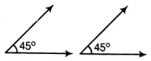
(i) $45^{\circ}$
Answer
Let the complement angle of $45^{\circ}$ be $x$.
We know that the sum of two complementary angles is $90^{\circ}$.
$\begin{aligned}
\therefore x+45^{\circ}=90^{\circ} \\
\Rightarrow x=90^{\circ}-45^{\circ}=45^{\circ}
\end{aligned}$
[transposing $45^{\circ}$ to RHS]
Hence, the complement angle of $45^{\circ}$ is $45^{\circ}$.
View full question & answer
Question 152 Marks
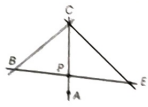
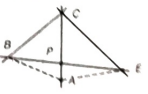
In the adjoining figure, AC and BE intersect at P.
ACand BCintersect at C AC and ECintersect at C Try to find another ten pairs of Intersecting line segments.
Image
Should any two lines or line segments necessarily Intersect? Can you find two pairs of non-intersecting line segments in the figure?
Can two lines intersect in more than one point? Think about it.
View full question & answer
Question 162 Marks
Can two obtuse angles be complement to each other?
Answer
No, two obtuse angles can never be complement to each other because their sum cannot be $90^{\circ}$, as an obtuse angle has its measure greater than $90^{\circ}$.
e.g. $105^{\circ}$ and $135^{\circ}$ are two obtuse angles.
Their sum $=105^{\circ}+135^{\circ}=240^{\circ} \neq 90^{\circ}$
Therefore, two obtuse angles cannot be complement to each other.
View full question & answer
Question 172 Marks
Can two acute angles be complement to each other?
Answer
Yes, two acute angles can be complement to each other, if their sum is $90^{\circ}$.
e.g. $30^{\circ}$ and $60^{\circ}$ are two acute angles.
Their sum $=30^{\circ}+60^{\circ}=90^{\circ}$
Therefore, two acute angles can be complement to each other.
View full question & answer
Question 212 Marks
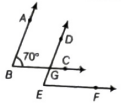
In the given figure, the arms of two angles are parallel. If $\angle A B C=70^{\circ}$, then find
Image
(i) $\angle D G C$$\quad$(ii) $\angle D E F$
Answer
(i) Given, $\angle A B C=70^{\circ}$
Since, $A B \| D E$ and $B C$ is a transversal.
$
\therefore \angle D G C=\angle A B C=70^{\circ}
$
[corresponding angles] ...(i)
Hence, the value of $\angle D G C$ is $70^{\circ}$.
(ii) Since, $B C \| E F$ and $D E$ is a transversal.
$
\therefore \angle D E F=\angle D G C=70^{\circ} \text { [corresponding angles] }
$
Hence, the value of $\angle D E F$ is $70^{\circ}$.
View full question & answer
Question 242 Marks
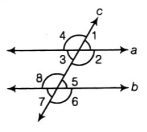
In the adjoining figure, identify
Image
(i) the pairs of corresponding angles.
(ii) the pairs of alternate interior angles.
(iii) the pairs of interior angles on the same side of the transversal.
(iv) the vertically opposite angles.
Answer
(i) Pairs of corresponding angles are$
\angle1, \angle 5 ; \angle 2, \angle 6 ; \angle 3, \angle 7 ; \angle 4, \angle 8 .
$
(ii) Pairs of alternate interior angles are $\angle 2, \angle 8 ; \angle 3, \angle 5$.
(iii) Pairs of interior angles on the same side of the transversal are $\angle 2, \angle 5 ; \angle 3, \angle 8$.
(iv) Vertically opposite angles are $\angle 1, \angle 3 ; \angle 2, \angle 4 ; \angle 5, \angle 7 ; \angle 6, \angle 8$.
View full question & answer
Question 252 Marks
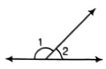
In the given figure, $\angle 1$ and $\angle 2$ are supplementary angles. If $\angle 1$ is decreased, what changes should take place in $\angle 2$, so that both the angles still remain supplementary.
Image
Answer
We know that the two angles are supplementary, if their sum is $180^{\circ}$.
$
\therefore\angle 1+\angle 2=180^{\circ}
$$\qquad$[given]
Now, if $\angle 1$ is decreased, then $\angle 2$ should be increased, so that both the angles still remain supplementary.
i.e.$\qquad\angle 1+\angle 2=180^{\circ}
$
View full question & answer
Question 262 Marks
Find the angle which is equal to its supplement
Answer
Let the angle be $x$.
Therefore, its supplement be $180^{\circ}-x$.
Since, the angle is equal to its supplement.
$
\therefore x=180^{\circ}-x
$
On transposing $x$ from RHS to LHS, we get
$
x+x=180^{\circ} \Rightarrow 2 x=180^{\circ}
$
On dividing both sides by 2 , we get
$
\therefore\frac{2 x}{2}=\frac{180^{\circ}}{2}=90^{\circ}
$
Hence, the required angle is $90^{\circ}$.
View full question & answer
Question 272 Marks
Find the angle, which is equal to its complement.
Answer
Let the angle be $x$.
Therefore, its complement be $90^{\circ}-x$.
Since, the angle is equal to its complement.
$
x=90^{\circ}-x
$
On transposing $x^{\circ}$ from RHS to LHS, we get
$
\begin{array}{rlrl}
x+x=90^{\circ} \\
\Rightarrow 2 x =90^{\circ}
\end{array}
$
On dividing both sides by 2 , we get
$
\begin{array}{rlrl}
\frac{2 x}{2}=\frac{90^{\circ}}{2} \\
\Rightarrow x=45^{\circ}
\end{array}
$
Hence, the required angle is $45^{\circ}$.
View full question & answer
Question 282 Marks
Find the angle which is double of its supplement.
Answer
Let $x$ be an angle.
So, its supplement $=180^{\circ}-x$
$\therefore$ As per the given condition in the question,
$x=2\left(180^{\circ}-x\right)=2 \times 180^{\circ}-2 \times x$
$
\begin{array}{l}
\Rightarrow \quad x=360^{\circ}-2 x \\
\Rightarrow x+2 x=360^{\circ} \\
\Rightarrow \quad 3 x=360^{\circ} \\
\Rightarrow \quad x=\frac{360^{\circ}}{3}=120^{\circ} \\
\Rightarrow \quad x=120^{\circ}
\end{array}
$
Thus, the required angle is $120^{\circ}$.
View full question & answer
Question 292 Marks
Two supplementary angles are in the ratio $3: 7$, find the angles.
Answer
Let the two supplementary angles be $3 x$ and $7 x$.
$
\therefore 3 x+7 x=180^{\circ}
$
$\left[\because\right.$ the sum of two supplementary angles $=180^{\circ}$ ]
$
\begin{array}{l}
\Rightarrow 10 x=180^{\circ} \\
\Rightarrow x=\frac{180^{\circ}}{10} \Rightarrow x=18^{\circ}
\end{array}
$
So, the angles are $3 \times 18=54^{\circ}$ and $7 \times 18=126^{\circ}$
View full question & answer
Question 302 Marks
Find an angle whose supplement is $\frac{2}{3}$ of it.
Answer
Let $x$ be an angle, whose supplement is $\frac{2}{3}$ of it.
We know that sum of supplementary angles is $180^{\circ}$.
$\begin{aligned}\text { So, } x+\frac{2}{3} x =180^{\circ} \\
\frac{3 x+2 x}{3}=180^{\circ} \Rightarrow \frac{5 x}{3}=180^{\circ} \\
\Rightarrow x=\frac{180^{\circ} \times 3}{5}=36^{\circ} \times 3=108^{\circ} \\
\Rightarrow x=108^{\circ}
\end{aligned}
$
View full question & answer
Question 312 Marks
Two complementary angles are in the ratio $2: 7$, find the angles.
Answer
Let the two complement angles be $2 x$ and $7 x$.
$
\begin{array}{ll}
\therefore 2 x+7 x=90^{\circ} \\
{\left[\because \text { the sum of two complement angles }=90^{\circ}\right]} \\
\Rightarrow 9 x=90^{\circ} \Rightarrow x=10^{\circ}
\end{array}
$
So, the angles are $2 \times 10^{\circ}=20^{\circ}$ and $7 \times 10^{\circ}=70^{\circ}$
View full question & answer
Question 322 Marks
Find an angle which is $2 / 3$ of its complement.
Answer
Let $x$ be the complement of an angle, then the angle will be $\frac{2}{3} x$.
We know that sum of complementary angles is $90^{\circ}$.
$
\begin{array}{lc}
\text { So, } x+\frac{2}{3} x=90^{\circ} \Rightarrow \frac{3 x+2 x}{3}=90^{\circ} \\
\Rightarrow 5 x=270^{\circ} \\
\Rightarrow x=\frac{270^{\circ}}{5}=54^{\circ} \\
\Rightarrow x=54^{\circ} \\
\therefore \frac{2}{3} \times 54^{\circ}=2 \times 18^{\circ}=36^{\circ}
\end{array}
$
Hence, complement angle of $54^{\circ}$ is $36^{\circ}$.
View full question & answer
2 Marks Questions - MATHS STD 7 Questions - Vidyadip