Questions

5 Marks Questions

🎯

Test yourself on this topic

10 questions · timed · auto-graded

Question 15 Marks
Sort the following expressions in increasing order:
(a) 245.05 × 0.942368
(b) 245.05 × 7.9682
(c) 245.05 ÷ 7.9682
(d) 245.05 ÷ 0.942368
(e) 245.05
(f) 7.9682
Answer
Let A = 245.05, B = 0.942368, C = 7.9682
We note that B < 1 and C > 1
(a) Now A × B = 245.05 × 0.942368 < 245.05
(∴ Multiplying a number by a value less than 1 results in a smaller number)
(b) A × C = 245.05 × 7.9682 > 245.05
(Multiplying a number by a value greater than 1 results in a larger number)
(c) A ÷ C = 2.4505 ÷ 7.9682 < 245.05
(Dividing a number by a value greater than 1 results in a smaller number)
(d) A ÷ B = 245.05 ÷ 0.942368 > 245.05
(Dividing a number by a value greater than 1 results in a larger number)
(e) Now, expression less than 245.05
∴ 0.942368 is closer to 1 than 7.9682 is to 1.
0.942368 will result in a value closer to 245.05 than dividing by 7.9682.
∴ (c) < (a)
Again, 0.942368 is closer to 1 than 7.9682 is to 1.
∴ Dividing by 0.942368 will result in a value closer to 245.05 than multiplying by 7.9682.
∴ (d) < (b)
Also, (f) 7.9682 is significantly smaller than 245.05; it will be the smallest value.
(f) ∴ 7.9682 < (e) 245.05 ÷ 7.9682
Combining all, we get (f), (c), (a), (e),(d), (b).
View full question & answer
Question 25 Marks

Find the missing cells if each cell represents a ÷ b:

$b \downarrow a \rightarrow$1517151.715.171.51715170
3741    
3.7  4.1  
0.37     
0.037 4100   
370     
Answer

Here table given here represents division, where the value in each cell is the result of dividing the number in the corresponding ‘a’ column b the number in the corresponding row ‘b’.
Given 1517 ÷ 37 = 41
$\frac{151.7}{3.7}=41$
$\frac{15.17}{0.37}=41$
$\frac{1.517}{37}=0.041$

$b \downarrow a \rightarrow$1517151.715.171.51715170
37414.10.410.041410
3.7410414.10.414100
0.3741004104.14.141000
0.0374100041004104.1410000
3704.10.410.0410.004141
View full question & answer
Question 35 Marks
Find the following quotients given that 756 ÷ 36 = 21:
(a) 75.6 ÷ 3.6
(b) 7.56 ÷ 0.36
(c) 756 ÷ 0.36
(d) 75.6 ÷ 360
(e) 7560 ÷ 3.6
(f) 7.56 ÷ 0.36
Answer
(a) Given $756 \div 36=21$ $\quad$...(i)
Here $\frac{75.6}{3.6}=\frac{756 \times 10}{36 \times 10}=\frac{756}{36}=21$ [Using (i)]
(b) Here $\frac{7.56}{0.36}=\frac{756 \times 100}{36 \times 100}=\frac{756}{36}=21$ [Using (i)]
(c) Here $\frac{756}{0.36}=\frac{756 \times 100}{36}=21 \times 100=2100$ [Using (i)]
(d) Here $\frac{75.6}{360}=\frac{756}{360 \times 10}=\frac{756}{360 \times 10}$
$=\frac{21}{100}=0.21$ [Using (i)]
(e) Here $\frac{7560}{3.6}=\frac{7560}{36} \times 10=\frac{756}{36} \times 10 \times 10$
$=21 \times 10 \times 10=2100$ [Using (i)]
(f) Here $\frac{7.56}{0.36}=\frac{756 \times 100}{36 \times 100}=\frac{756}{36}=21$ [Using (i)]
View full question & answer
Question 45 Marks
The following problem was set by Sridharacharya in his book, Patiganita.''$6 \frac{1}{4}$ is divided by $2 \frac{1}{2}$, and $60 \frac{1}{4}$ is divided by $3 \frac{1}{2}$ Tell the quotients separately.'' Can you try to solve by converting the fractions into decimals?
Answer
Given $6 \frac{1}{4}=6+\frac{1}{4}=6+0.25=6.25$
and $\quad 2 \frac{1}{2}=2+\frac{1}{2}=2+0.5=2.5$
$60 \frac{1}{4}=60+\frac{1}{4}=60+0.25=60.25$
$3 \frac{1}{2}=3+0.5=3.5$
Now $6 \frac{1}{4}$ is divided by $2 \frac{1}{2}$.
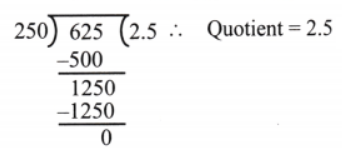
$\Rightarrow \quad \frac{6.25}{2.5}=\frac{625 \times 10}{25 \times 100}=\frac{625}{250}$
Image
Also $60 \frac{1}{4}$ is divided by $3 \frac{1}{2}$.
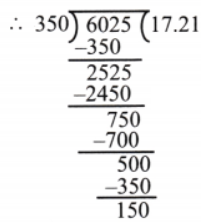
$\Rightarrow \frac{60.25}{3.5}=\frac{6025 \times 10}{35 \times 100}=\frac{6025}{350}$
Image
∴ Quotient = 17.21
View full question & answer
Question 55 Marks
Fill in the following blanks appropriately:
1cm = 10mm1 kg = 1000g1l = 1000ml
1m = 100cm1 g = 1000mg
1km = 1000m

5.5km =_______m35cm =_______ m14.5cm =_______ mm
68g =_______ kg9.02m =_______ mm125.5ml =_______ l
Answer
Here, (i) 1 km = 1000 m
∴ 5.5 km = 5.5 × 1000 = 5500 m
(ii) 1 m = 100 cm
$\therefore 35 cm=\frac{35}{100}=0.35 m$
(iii) 1 cm = 10 mm
$\therefore 14.5 cm=14.5 \times 10=145 mm$
(iv) 1 kg = 1000 g
$\therefore 68 g=\frac{68}{1000}=0068 kg$
(v) 1 m = 1000 mm
∴ 9.02 m = 9.02 × 1000 = 9020 mm
(vi) 1 l = 1000 ml
$\therefore 125.5 ml =\frac{125.5}{1000}=0.1255 I$
5.5 km
= 5500m
35 cm
= 0.35m
14.5 cm
= 145mm
68 g
= 0.068kg
9.02 m
= 9020mm
125.5 ml
= 0.1255l
View full question & answer
Question 65 Marks
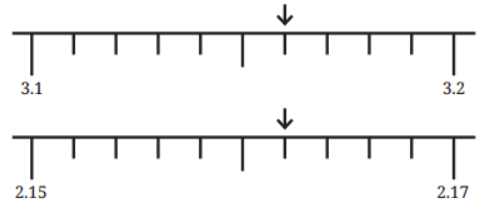
Write the decimal number at the arrow mark:
Image
Answer
(i) Here number line is divided into 10 equal parts.
Difference between 3.2 and 3.1 = 3.2 – 3.1 = 0.1
Value of each mark $=\frac{0.1}{10}=0.01$
Now the arrow is on the sixth mark after 3.1
∴ Decimal number at the arrow mark = 3.1 + 6 × 0.01
= 3.1 + 0.06
= 3.16
(ii) Here number line is divided into 10 equal parts between 2.15 and 2.17.
∴ Difference between 2.17 and 2.15 = 2.17 – 2.15 = 0.02
Value of each mark $=\frac{0.02}{10}=0.002$
Arrow is on the sixth mark after 2.15
∴ Decimal number at the arrow mark = 2.15 + 6 × 0.002
= 2.150 + 0.012
= 2.162
View full question & answer
Question 85 Marks
Find the quotients:
(a) 2.46 ÷ 1.5 = _______
(b) 2.46 ÷ 0.15 = _______
(c) 2.46 ÷ 0.015 = _______
Is the quotient obtained in 24.6 ÷ 1.5 the same as the quotient obtained in 2.46 ÷ 0.15?
Answer
Converting 2.46 ÷ 1.5 into fraction
$\frac{2.46}{1.5}=\frac{246 \times 10}{15 \times 100}=\frac{246}{150}$
Image
∴ Quotient = 1.64
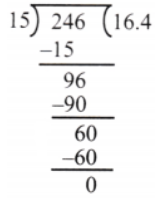
(b) Converting 2.46 ÷ 0.15 into a fraction, we get
$\frac{2.46}{0.15}=\frac{246 \times 100}{15 \times 100}=\frac{246}{15}$
Image
∴ Quotient = 16.4
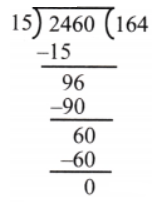
(c) Converting 2.46 ÷ 0.015 into a fraction, we get
$\frac{2.46}{0.015}=\frac{246 \times 1000}{15 \times 100}=\frac{2460}{15}$
Image
∴ Quotient = 164
Now $\frac{24.6}{1.5}=\frac{246 \times 10}{15 \times 10}=\frac{246}{15}$
and $\frac{2.46}{0.15}=\frac{246 \times 100}{15 \times 100}=\frac{246}{15}$
Both are the same.
Hence quotient obtained in 24.6 ÷ 1.5 is the same as the quotient obtained in 2.46 ÷ 0.15.
View full question & answer
Question 95 Marks
Given that 18 × 12 = 216, find the products:
(a) 18 × 1.2
(b) 18 × 0.12
(c) 1.8 × 1.2
(d) 0.18 × 0.12
(e) 0.018 × 0.012
(f) 1.8 × 12
In which of the cases above is the product less than 1?
Answer
(a) Here 18 × 12 = 216 …..(i)
Now 18 × 1.2 $=\frac{18 \times 12}{10}$ [Using (i)]
$=\frac{216}{10}$
= 21.6 (1 decimal place)
(b) 18 × 0.12 $=\frac{18 \times 12}{100}$ [Using (i)]
$=\frac{216}{100}$
= 2.16 (2 decimal places)
(c) $1.8 \times 1.2=\frac{18}{10} \times \frac{12}{10}=\frac{216}{100}$ [Using (i)]
= 2.16 (2 decimal places)
(d) 0.18 × 0.12 $=\frac{18}{100} \times \frac{12}{100}=\frac{216}{100 \times 100}$ [Using (i)]
= 0.0216 (4 decimal places)
(e) 1.8 × 12 $=\frac{18 \times 12}{10}=\frac{216}{10}$ [Using (i)]
= 21.6 (1 decimal place)
When multiplying two numbers positive if both numbers are less than 1, their product will also be less than 1.
In (d) and (e) product is less than 1.
View full question & answer
Question 105 Marks
Find the quotient by converting the denominator into 1, 10, 100, or 1000 and verify the solution by the long division method (division by place value):
$\frac{18}{5}$
Answer
Given $\frac{18}{5}$
To convert the denominator 5 into 10, multiply both the numerator and Dr by 2.
$\frac{18 \times 2}{5 \times 2}=\frac{36}{10}=3.6$
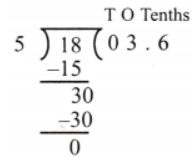
Verification
18 ÷ 5
Dividing 1 ten and 8 ones into 5 equal parts.
1 < 5
It means we need to regroup 1 ten as 10 ones,
i.e., 10 + 8 = 18 ones
18 ones ÷ 5
3 ones remain.
To divide 3 ones into 5 equal parts.
Regroup the 3 ones as 30 Tenths. (Place a decimal while regrouping ones into tenths).
30 Tenths ÷ 5 = 6
Then, 18 ÷ 5 = 3.6
Image
Hence verified.
View full question & answer