Questions

5 Marks Questions

🎯

Test yourself on this topic

9 questions · timed · auto-graded

Question 15 Marks
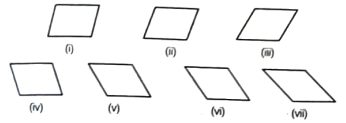
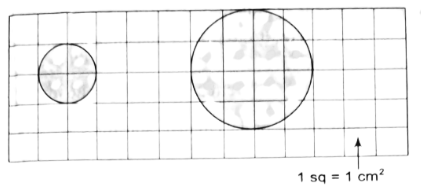
Draw circles of different radii on a graph paper. Find the area by counting the number of squares. Also, find the area by using the formula. Compare the two answers.
View full question & answer
Question 25 Marks
Answer
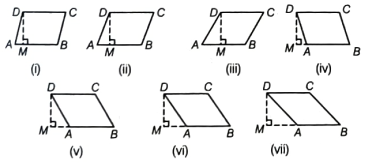
Firstly, on counting the squares enclosed within the figures of the parallelogram, we find in each case these are 15 in numbers. So, the area of each parallelogram = 15 sq units, base = 5 units and height = 3 units in each case. Now, draw a perpendicular $D M$ to the base $A B$ or produced $A B$ (if necessary) in each figure as shown below.
Image
For figure (i), in $\triangle A M D$, using Pythagoras theorem,
$
\begin{aligned}
A D & =\sqrt{M D^2+A M^2} \\
& =\sqrt{3^2+1^2}=\sqrt{9+1}=\sqrt{10} \text { units } \\
\therefore \text { Perimeter } & =2(A D+A B)=2(\sqrt{10}+5) \text { units }
\end{aligned}
$
For figure (ii),
$
\begin{aligned}
A D & =\sqrt{M D^2+A M^2} \\
& =\sqrt{3^2+2^2}=\sqrt{9+4}=\sqrt{13} \text { units }
\end{aligned}
$
$\therefore$ Perimeter $=2(\sqrt{13}+5)$ units
For figure (iii),
$
\begin{aligned}
A D & =\sqrt{M D^2+A M^2}=\sqrt{3^2+3^2} \\
& =\sqrt{9+9}=\sqrt{18}=3 \sqrt{2} \text { units }
\end{aligned}
$
$\therefore$ Perimeter $=2(3 \sqrt{2}+5)$ units
For figure (iv),
$
\begin{aligned}
A D & =\sqrt{M D^2+A M^2}=\sqrt{3^2+1^2} \\
& =\sqrt{9+1}=\sqrt{10} \text { units }
\end{aligned}
$
$\therefore$ Perimeter $=2(\sqrt{10}+5)$ units
For figure (v),
$
\begin{aligned}
A D & =\sqrt{M D^2+A M^2}=\sqrt{3^2+2^2} \\
& =\sqrt{9+4}=\sqrt{13} \text { units }
\end{aligned}
$
$\therefore$ Perimeter $=2(\sqrt{13}+5)$ units
For figure (vi),
$
\begin{aligned}
A D & =\sqrt{M D^2+A M^2}=\sqrt{3^2+3^2} \\
& =\sqrt{9+9}=\sqrt{18}=3 \sqrt{2} \text { units }
\end{aligned}
$
$\therefore$ Perimeter $=2(3 \sqrt{2}+5)$ units
For figure (vii),
$
\begin{aligned}
A D & =\sqrt{M D^2+A M^2} \\
& =\sqrt{3^2+4^2}=\sqrt{9+16} \\
& =\sqrt{25}=5 \text { units } \\
\therefore \text { Perimeter} & =2(5+5)=20 \text { units }
\end{aligned}
$
Hence, the required complete table is as follows
ParallelogramBaseHeightAreaPerimeter
(i)5 units3 units5 $\times$ 3 $=$ 15
sq units
$2(\sqrt{10}+5)$ units
(ii)5 units3 units5 $\times$ 3 $=$ 15
sq units
$2(\sqrt{13}+5)$ units
(iii)5 units3 units5 $\times$ 3 $=$ 15
sq units
$2(3 \sqrt{2}+5)$ units
(iv)5 units3 units5 $\times$ 3 $=$ 15
sq units
$2(\sqrt{10}+5)$ units
(v)5 units3 units5 $\times$ 3 $=$ 15
sq units
$2(\sqrt{13}+5)$ units
(vi)5 units3 units5 $\times$ 3 $=$ 15
sq units
$2(3 \sqrt{2}+5)$ units
(vii)5 units3 units5 $\times$ 3 $=$ 15
sq units
20 units
 
View full question & answer
Question 35 Marks
From a circular card sheet of radius 14 cm , two circles of radius 3.5 cm and a rectangle of length 3 cm and breadth 1 cm are removed. (as shown in the adjoining figure). Find the area of the remaining sheet. $\left(\right.$ take $\left.\pi=\frac{22}{7}\right)$
Image
Answer
Given, radius of circular card sheet $=14 cm$
$\therefore$ Area of circular card sheet $=\pi \times(\text { Radius })^2$
$
\begin{array}{l}
=\frac{22}{7} \times(14)^2=\frac{22}{7} \times 14 \times 14 \\
=616 cm^2
\end{array}
$
Area of circle of radius $3.5 cm=\frac{22}{7} \times(3.5)^2$
$
\begin{array}{l}
=\frac{22}{7} \times 3.5 \times 3.5 \\
=\frac{269.5}{7} \\
=38.5 cm^2
\end{array}
$
$\therefore$ Area of two circles $=2 \times 38.5=77 cm^2$
Now, length of rectangle, $l=3 cm$
and breadth of rectangle, $b=1 cm$
$\therefore$ Area of the rectangle $=$ Length $\times$ Breadth
$
=3 \times 1=3 cm^2
$
Now, area of remaining sheet $=$ Area of circular card sheet $-$ (Area of two circles $+$ Area of rectangle)
$
\begin{array}{l}
=616-(77+3) \\
=(616-80) \\
=536 cm^2
\end{array}
$
Hence, the area of remaining card sheet is $536 cm^2$.
View full question & answer
Question 45 Marks
Find the missing values.
S.No.BaseHeightArea of the triangle
(i)15 cm...$87 cm^2$
(ii)...31.4 mm$1256 cm^2$
(iii)22 cm...$170.5 cm^2$
Answer
(i) Given, base of the triangle $=15 cm$
and area of the triangle $=87 cm^2$
We know that area of the triangle
$=\frac{1}{2} \times$ Base $\times$ Height
$\therefore \frac{1}{2} \times$ Base $\times$ Height $=87 \Rightarrow \frac{1}{2} \times 15 \times$ Height $=87$
$\Rightarrow \quad \text { Height }=\frac{2 \times 87}{15}=\frac{174}{15}=11.6 cm$
Hence the height of the triangle is 11.6 cm.
(ii) Given, height of the triangle $=31.4 mm$
and area of the triangle $=1256 mm^2$
We know that area of the triangle
$=\frac{1}{2} \times$ Base $\times$ Height
$\begin{array}{l}\therefore \quad \frac{1}{2} \times \text { Base } \times \text { Height }=1256 \\\Rightarrow \quad \frac{1}{2} \times \text { Base } \times 31.4=1256 \\\Rightarrow \text { Base }=\frac{2 \times 1256}{31.4}=\frac{2512}{31.4}=80 mm\end{array}$
Hence, the base of the triangle is 80 mm .
(iii) Given, base of the triangle $=22 cm$
and area of the triangle $=170.5 cm^2$
We know that area of the triangle
$=\frac{1}{2} \times$ Base $\times$ Height
$\begin{array}{l}\Rightarrow \quad \frac{1}{2} \times \text { Base } \times \text { Height }=170.5 \\ \Rightarrow \quad \frac{1}{2} \times 22 \times \text { Height }=170.5 \\ \Rightarrow \quad \text { Height }=\frac{2 \times 170.5}{22}=15.5 cm\end{array}$
Hence, the height of the triangle is 15.5 cm.
On putting the missing values, the complete table is
S.No.BaseHeightArea of the triangle
(i)15 cm11.6 cm$87 cm^2$
(ii)80 mm31.4 mm$1256 cm^2$
(iii)22 cm15.5 cm$170.5 cm^2$
View full question & answer
Question 55 Marks
Find the missing values.
S.No.BaseHeightArea of the parallelogram
(i)20 cm$246 cm^2$
(ii)15 cm$154.5 cm^2$
(iii)8.4 cm$48.72 cm^2$
(iv)15.6 cm$16.38 cm^2$
Answer
(i) Given, base of the parallelogram $=20 cm$
and area of the parallelogram $=246 cm^2$
We know that area of the parallelogram
$=$ Base $\times$ Height
$\therefore$ Base $\times$ Height $=246 \Rightarrow 20 \times$ Height $=246$
$\Rightarrow$ Height $=\frac{246}{20}=12.3 cm$
Hence, the height of the parallelogram is 12.3 cm.
(ii) Given, height of the parallelogram $=15 cm$
and area of the parallelogram $=154.5 cm^2$
We know that area of the parallelogram
$=$ Base $\times$ Height
$\therefore$ Base $\times$ Height $=154.5 \Rightarrow$ Base $\times 15=154.5$
$\Rightarrow$ Base $=\frac{154.5}{15}=10.3 cm$
(iii) Given, height of the parallelogram $=8 Acm$
and area of the parallelogram $=48.72 cm^2$
We know that area of the parallelogram
$=$ Base $\times$ Height
$\therefore$ Base $\times$ Height $=48.72 \Rightarrow$ Base $\times 8 A=48.72$
$\Rightarrow$ Base $=\frac{48.72}{8.4}=5.8 cm$
Hence, the base of the parallelogram is 5.8 cm.
(iv) Given, base of the parallelogram $=15.6 cm$
and area of the parallelogram $=16.38 cm^2$
We know that area of the parallelogram
$=$ Base $\times$ Height
$\therefore$ Base $\times$ Height $=16.38$
$\Rightarrow 15.6 \times$ Height $=16.38$
$\Rightarrow$ Height $=\frac{16.38}{15.6}=1.05 cm$
Hence, the height of the parallelogram is 1.05 cm.
On putting the missing values, the complete table is
S.No.BaseHeightArea of the parallelogram
(i)20 cm12.3 cm$246 cm^2$
(ii)10.3 cm15 cm$154.5 cm^2$
(iii)5.8 cm8.4 cm$48.72 cm^2$
(iv)15.6 cm1.05 cm$16.38 cm^2$
View full question & answer
Question 65 Marks
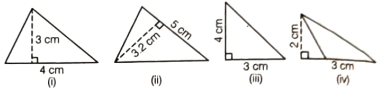
Find the area of each of the following triangles.
Image
Answer
(i) Given, base of a triangle $=4 cm$
and height of a triangle $=3 cm$
$\therefore$ Area of a triangle $=\frac{1}{2} \times$ Base $\times$ Height
$=\frac{1}{2} \times 4 \times 3=\frac{1}{2} \times 12=6 cm^2$
(ii) $8 cm^2$
(iii) Given, base of a triangle $=3 cm$
and height of a triangle $=4 cm$
$\therefore$ Area of a triangle $=\frac{1}{2} \times$ Base $\times$ Height
$=\frac{1}{2} \times 3 \times 4=\frac{1}{2} \times 12=6 cm^2$
(iv) Given, base of a triangle $=3 cm$
and height of a triangle $=2 cm$
$\therefore$ Area of a triangle $=\frac{1}{2} \times$ Base $\times$ Height
$=\frac{1}{2} \times 3 \times 2=\frac{1}{2} \times 6=3 cm^2$
View full question & answer
Question 75 Marks
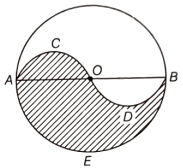
The boundary of shaded region in the given figure consists of three semi-circular areas, the small one being equal. If diameter of large one with centre $O$ is 30 cm , then calculate
(i) the length of boundary of shaded region.
(ii) the area of shaded region.
Image
Answer
(i) The length of boundary of shaded region
$=$ circumference of semi-circle ACO $+$ Circumference of semi-circle AEB $-$ Circumference of semi-circle BDO
$\text { Circumference of semi-circle } A C O=\pi r=\frac{22}{7} \times \frac{15}{2}$
Circumference of semi-circle BDO
$=\frac{22}{7} \times \frac{15}{2}=23.57 cm \quad\left[\because\right.$ radius $\left.=\frac{30}{4}\right]$
Circumference of semi-circle $A E B=\pi r$
$=\frac{22}{7} \times 15=47.14 cm$
Hence, the length of boundary of shaded region
$\begin{array}{l}=23.57+47.14-23.57 \\=47.14 cm\end{array}$
(ii) The area of shaded region
$=$ Area of semi-circle ACO $+$ Area of semi-circle AEB $-$ Area of semi-circle BDO
Now,
Area of semi-circle $A C O=\frac{1}{2} \pi r^2$
$=\frac{1}{2} \times \frac{22}{7} \times\left(\frac{15}{2}\right)^2$
$=88.39 cm^2$
Area of semi-circle $B D O=\frac{1}{2} \pi r^2$
$=\frac{1}{2} \times \frac{22}{7} \times\left(\frac{15}{2}\right)^2$
$=88.39 cm^2$
Area of semi-circle $A E B=\frac{1}{2} \pi r^2$
$=\frac{1}{2} \times \frac{22}{7} \times(15)^2$
$=353.57 cm^2$
Hence, the area of shaded region
$=88.39+353.57-88.39$
$=353.57 cm^2$
View full question & answer
Question 85 Marks
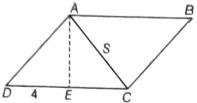
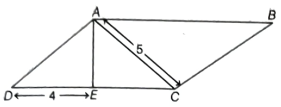
$A B C D$ is a parallelogram in which $A E \perp C D$ as shown in figure, also $A C=A D$ and $A C=5 cm, D E=4 cm$ and area of $\triangle A E D=6 cm^2$. Then, find
(i) area of $\triangle A D C$
(ii) area of parallelograr $A B C D$.
(iii) Perimeter of parallelogram $A B C D$
Image
View full question & answer
Question 95 Marks
The hour and minute hand of a clock are 4 cm and 6 cm long. Find the sum of distances travelled by their tip in 2 days.
Answer
The length of hour hand is 4 cm , which describe the radius of the path inscribed by the hour hand.
Length of minute hand is 6 cm , which describe the radius of path inscribed by the minute hand.
The circumference of the path inscribed by the hour hand $=2 \pi r$
$C_1=2 \times \frac{22}{7} \times 4=\frac{176}{7} cm$
The hour hand makes 2 revolution in one day.
Therefore, the distance travelled by hour hand in 2 days
$=\frac{176}{7} \times 2 \times 2=100.57$
The distance covered by the minute hand in 1 revolution $=2 \pi r$
$C_2=2 \times \frac{22}{7} \times 6=\frac{264}{7} cm$
As we know that the minute hand makes 1 revolution in 1 h.
$\therefore$ In 2 days, it makes $2 \times 24$ revolutions
The distance covered by minute hand in 2 days.
$=2 \times 24 \times \frac{264}{7}=\frac{12672}{7}=1810.28 cm$
The sum of distance travelled by hour and minute hand in 2 days
$
\begin{array}{l}
=1810.28+100.57 \\
=1910.85 cm
\end{array}
$
View full question & answer
5 Marks Questions - MATHS STD 7 Questions - Vidyadip