Question types

Symmetry question types

81 questions across 10 question groups — pick any mix to generate a MATHS paper with step-by-step answer keys.

81
Questions
10
Question groups
5
Question types
Sample Questions

Symmetry questions

One sample from each question group in this chapter. Select any group above to see the full set with answer keys.

Assertion (A) Out of the ten numerical digits from 0 to 9 , only two digits show rotational symmetry.
Reason (R) In a complete turn, the number of times, a figure coincides with its original position is called its order of rotational symmetry.
  • Both A and R are true and R is the correct explanation of A.
  • B
    Both A and R are true but R is not the correct explanation of A.
  • C
    A is true but R is false.
  • D
    A is false but R is true.

Answer: A.

View full solution
Assertion (A) E has an horizontal line of symmetry.
Reason (R) The symmetry of an object is defined as one half of the object is a mirror image of the other half.
  • Both A and R are true and R is the correct explanation of A.
  • B
    Both A and R are true but R is not the correct explanation of A.
  • C
    A is true but R is false.
  • D
    A is false but R is true.

Answer: A.

View full solution
Assertion (A) The letter O has many lines of symmetry.
Reason (R) Line passing through the centre of O, will be its line of symmetry.
  • Both A and R are true and R is the correct explanation of A.
  • B
    Both A and R are true but R is not the correct explanation of A.
  • C
    A is true but R is false.
  • D
    A is false but R is true.

Answer: A.

View full solution
Assertion (A) An equilateral triangle has three lines of symmetry.
Reason (R) The number of lines of symmetry in a regular polygon with side (n) is equal to n.
  • Both A and R are true and R is the correct explanation of A.
  • B
    Both A and R are true but R is not the correct explanation of A.
  • C
    A is true but R is false.
  • D
    A is false but R is true.

Answer: A.

View full solution
After rotating by $60^{\circ}$ about a centre, a figure looks exactly the same as its original position. At what other angles will this happen for the figure?
View full solution
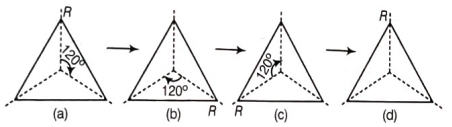
(i) In the given figure, can you now tell the order of the rotational symmetry for an equilateral triangle?
Image
(ii) How many positions are there at which the triangle looks exactly the same, when rotated about its centre by $120^{\circ} ?$
View full solution
Fill in the blanks.
ShapeCentre of RotationOrder of RotationAngle of Rotation
Square
Rectangle
Rhombus
Equilateral triangle
Regular hexagon
Circle
Semi-circle
View full solution
Some of the English alphabets have fascinating symmetrical structures. Which capital letters have just one line of symmetry (like E)? Which capital letters have a rotational symmetry of order 2 (like I)?
By attempting to think on such lines, you will be able to fill in the following table.
Alphabet LettersLine SymmetryNumber of Lines of SymmetryRotational SymmetryOrder of Rotational Symmetry
ZNo0Yes2
S
HYesYes
OYesYes
EYes
NYes
C
View full solution
State the number of lines of symmetry for the following figures.
(i) An equilateral triangle
(ii) An isosceles triangle
(iii) A scalene triangle
(iv) A square
(v) A rectangle
(vi) A rhombus
(vii) A parallelogram
(viii) A quadrilateral
(ix) A regular hexagon
(ix) A circle
View full solution
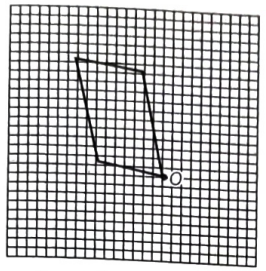
A quadrilateral is drawn on a square grid. $O$ is the dot marked on one vertex of the quadrilateral.
Image
Q. 1. How many lines of symmetry are there in this quadrilateral?
(a) 0 $\quad$ (b) 1 $\quad$ (c) 2 $\quad$ (d) 4
Q. 2. Draw three more congruent quadrilaterals around 0 so that the complete figure has rotational symmetry of order four.
Q. 3. Which of the following statements about a parallelogram's symmetry is true?
(a) A parallelogram has neither a line of symmetry nor rotational symmetry,
(b) A parallelogram has a line of symmetry but no rotational symmetry.
(c) A parallelogram has a point symmetry and rotational symmetry but no line of symmetry.
(d) A parallelogram has rotational symmetry but no point or line symmetry.
Q. 4. Jyoti claims that rotational symmetry of order 1 implies no rotational symmetry. Do you agree or disagree with her claim? Give reasons.
View full solution
View full solution
Match the Column A to Column B.
Column AColumn B
(i) A half-turn means rotation by(a) $180^{\circ}$
(ii) A quarter-turn means rotation by(b) sides and angles
(iii) A complete turn means rotation by(c) $90^{\circ}$
(iv) Regular polygon have equal(d) $360^{\circ}$
View full solution
Q 403 Marks Question3 Marks
Draw, wherever possible, a rough sketch of
(i) a triangle with both line and rotational symmetries of order more than 1.
(ii) a triangle with only line symmetry and no rotational symmetry of order more than 1.
(iii) a quadrilateral with a rotational symmetry of order more than 1, but not a line symmetry.
(iv) a quadrilateral with line symmetry, but not a rotational symmetry of order more than 1.
View full solution
Q 423 Marks Question3 Marks
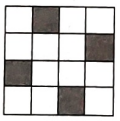
Copy the figure given here.
Take any one diagonal as a line of symmetry and shade a few more squares to make the figure symmetric about a diagonal. Is there more than one way to do that? Will the figure be symmetric about both the diagonals?
Image
View full solution
Q 433 Marks Question3 Marks
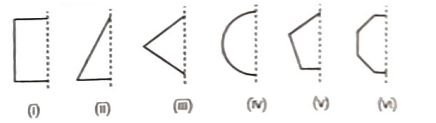
In the following figures, the mirror line (L.e. the line of symmetry) is given as a dotted line. Complete each figure performing reflection in the dotted (mirror) line. (You might perhaps place a mirror along the dotted line and look into the mirror for the image). Are you able to recall the name of the figure you complete?
Image
View full solution

Generate a Symmetry paper free

Pick question groups from the list above, set marks and difficulty, and export a branded PDF with step-by-step answer keys. First 3 chapters free — no signup.
Download App