Questions

5 Marks Questions

🎯

Test yourself on this topic

7 questions · timed · auto-graded

Question 15 Marks
Fill in the blanks.
ShapeCentre of RotationOrder of RotationAngle of Rotation
Square
Rectangle
Rhombus
Equilateral triangle
Regular hexagon
Circle
Semi-circle
Answer
A figure is said to have rotational symmetry, if it fits on to itself more than once during a full turn i.e. rotation through $360^{\circ}$.
The complete table is shown below:
ShapeCentre of RotationOrder of RotationAngle of Rotation
SquarePoint of intersection of diagonals4$90^{\circ}$
RectanglePoint of intersection of diagonals2$180^{\circ}$
RhombusPoint of intersection of diagonals2$180^{\circ}$
Equilateral triangle Point of intersection of medians3$120^{\circ}$
Regular hexagonPoint of intersection of diagonals6$60^{\circ}$
CircleCentreinfiniteAny angle
Semi-circleMid-point of diameter1$360^{\circ}$
View full question & answer
Question 25 Marks
Some of the English alphabets have fascinating symmetrical structures. Which capital letters have just one line of symmetry (like E)? Which capital letters have a rotational symmetry of order 2 (like I)?
By attempting to think on such lines, you will be able to fill in the following table.
Alphabet LettersLine SymmetryNumber of Lines of SymmetryRotational SymmetryOrder of Rotational Symmetry
ZNo0Yes2
S
HYesYes
OYesYes
EYes
NYes
C
Answer
We know that a figure has line of symmetry, if there is a line about which the figure may be folded, so that the two parts of the figure will coincide and a figure has a rotational symmetry if after a rotation, the figure looks exactly the same. Then, the complete table is shown below:
Alphabet LettersLine SymmetryNumber of Lines of SymmetryRotational SymmetryOrder of Rotational Symmetry
ZNo0Yes2
SNo0Yes2
HYes2Yes2
OYesinfiniteYesinfinite
EYes1No1
NNo0Yes2
CYes1No1
View full question & answer
Question 35 Marks
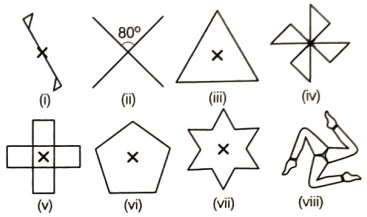
Give the order of rotational symmetry for each figure.
Image
Answer
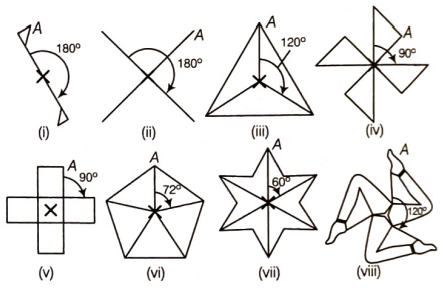
Let mark a point $A$ on each figure and also indicate the angle through which the figures are rotated as shown below:
Image
Now, to find the rotational symmetry, we proceed as follows:
For figure (i), it requires two rotations, each through an angle of $180^{\circ}$, about the marked point ($\times$) to come back to its original position. So, it has a rotational symmetry of order 2.
For figure (ii), it requires two rotations, each through an angle of $180^{\circ}$, about the marked point ($\times$) to come back to its original position. So, it has a rotational symmetry of order 2.
For figure (iii), it requires three rotations, each through an angle of $120^{\circ}$ about the marked point ($\times$) to come back to its original position. So, it has a rotational symmetry of order 3.
For figure (iv), it requires four rotations, each through an angle of $90^{\circ}$, about the marked point ($\times$) to come back to its original position. So, it has a rotational symmetry of order 4.
For figure (v), it requires four rotations, each through an angle of $90^{\circ}$ about the marked point ($\times$) to come back to its original position. So, it has a rotational symmetry of order 4.
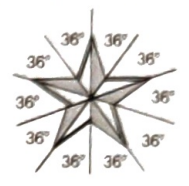
For figure (vi), it requires five rotations, each through an angle of $72^{\circ}$, about the marked point ($\times$) to come back its original position. So, it has rotational symmetry of order 5.
For figure (vii), it requires six rotations, each through an angle of $60^{\circ}$ about the marked point ($\times$) to come back its original position. So, it has rotational symmetry of order 6.
For figure (viii), it requires three rotations, each through an angle of $120^{\circ}$, about the marked point to come back to its original position. So, it has rotational symmetry of order 3.

View full question & answer
Question 45 Marks
State the number of lines of symmetry for the following figures.
(i) An equilateral triangle
(ii) An isosceles triangle
(iii) A scalene triangle
(iv) A square
(v) A rectangle
(vi) A rhombus
(vii) A parallelogram
(viii) A quadrilateral
(ix) A regular hexagon
(ix) A circle
Answer
Number of lines of symmetry for the given figures are as follows
FigureLines of symmetry
(i) An equilateral triangle3
(ii) An isosceles triangle1
(iii) A scalene triangle0
(iv) A square4
(v) A rectangle2
(vi) A rhombus2
(vii) A parallelogram
(not a special type of parallelogram e.g. square, rectangle, rhombus, etc)
0
(viii) A quadrilateral
(not a special type of quadrilateral e.g. square, rectangle, rhombus, etc.)
0
(ix) A regular hexagon6
(x) A circleInfinite
View full question & answer
Question 55 Marks
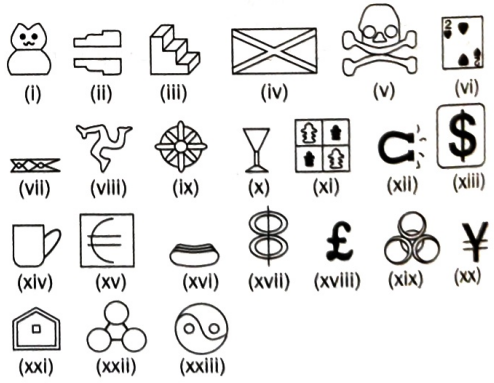
In each of the following figures, write the number of lines of symmetry and order of rotational symmetry.
Image
Answer
FigureNumber of lines of symmetryOrder of rotational symmetry
i.11
ii.11
iii.11
iv.22
v.11
vi.02
vii.11
viii.03
ix.44
x.11
xi.01
xii.11
Xiii.02
xiv.01
xv.11
xvi.11
xvii.22
xviii.01
xix33
xx11
xxi11
xxii33
xiii02
View full question & answer
Question 75 Marks
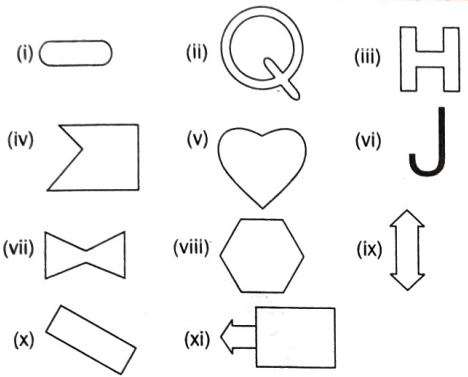
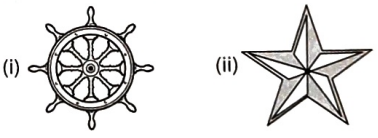
In the following figure, show if possible both line and rotational symmetry.
Image
Answer
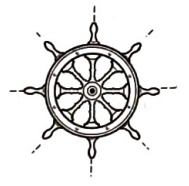
(i) In the given figure, line symmetry will be shown as
Image
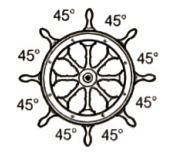
Also, rotational symmetry will be shown as
Image
$\frac{360^{\circ}}{8}=45^{\circ}$ i.e. rotational angle is equal to $45^{\circ}$.
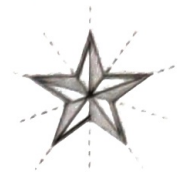
(ii) In the given figure, line symmetry will be shown as
Image
Also, rotational symmetry will be shown as
Image
$\frac{360^{\circ}}{5}=72^{\circ}$ i.e. rotational angle is equal to $72^{\circ}$
View full question & answer