Questions

3 Marks Question

🎯

Test yourself on this topic

8 questions · timed · auto-graded

Question 13 Marks
You are given six cells marked A, B, C, D, E, and F. Some of these are working and some are not. Design an activity to identify which of them are working.
(i) List the items that you require.
(ii) Write the procedure that you will follow.
(iii) With the items, carry out the activity to identify the cells that are working.
Answer
(i) Items Required:
1. Light bulb
2. Wires
3. Cells (A, B, C, D, E, F)
(ii) Procedure:
1. Connect the light bulb to one cell.
2. Check if the bulb glows. If it does, the cell is working.
3. Repeat the process for each cell (A, B, C, D, E, F).
(iii) Carrying Out the Activity:
1. Connect each cell one by one to the bulb.
2. The cells that make the bulb glow are working, and the ones that do not working.
View full question & answer
Question 23 Marks
An electric cell is a portable source of electrical energy. The positive terminal of the electric cell is marked with a + sign, and the negative terminal is marked with a – sign.
Q.1. What is the terminal marked with a “+” sign called?
Q.2. What happens when an electric cell is connected to a circuit?
Q.3. Which terminal of the cell does the electric current flow from?
Answer
1. Positive terminal
2. It supplies electrical energy to the circuit.
3. Positive terminal
View full question & answer
Question 33 Marks
A torchlight is a portable light source that runs on batteries. It uses electricity from the batteries to power an LED or an incandescent lamp, providing light in places without electrical outlets.
Q.1. What type of electricity powers a torchlight?
Q.2. What is the function of a torchlight’s LED or incandescent lamp?
Q.3. What is the main component in a torchlight that stores energy?
Answer
1. Current electricity
2. To produce light
3. Battery
View full question & answer
Question 43 Marks
Draw symbols for various electric circuit components.
1. Electric cell
2. Electric lamp
3. Switch in 'ON' position
4. Switch in 'OFF' position
5. Battery
6. Wire
View full question & answer
Question 53 Marks
Define the term battery. How is it formed?
Answer
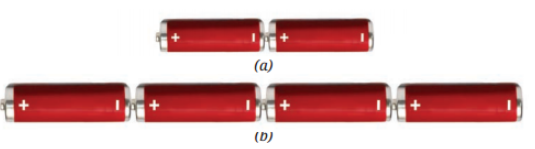
A battery is a device formed by connecting two or more cells together. To form a battery, the cells are placed in a cell holder so that the positive terminal of one cell is connected to the negative terminal of the next cell, and so on. A metal wire is connected to each of the two metal clips on the cell holder.
Image
View full question & answer
Question 63 Marks
Conduct a test on classroom materials and sort them into conductors and insulators.
Answer
→ To begin, set up a simple circuit using a battery, a bulb with connecting wires, and alligator clips (if available). The circuit should have a gap where different materials can be tested.
→ Next, take each classroom material—such as a metal ruler, plastic pen, wooden pencil, paper clip, rubber eraser, and piece of paper—and place it in the circuit gap. Observe whether the bulb lights up or not.
→ If the bulb lights up, the material is a conductor, allowing electricity to flow through it easily; examples include metal rulers and paper clips. Conversely, if the bulb does not light up, the material is an insulator, hindering the flow of electricity; examples include plastic pens, wooden pencils, rubber erasers, and paper. By testing various materials, you can effectively categorize them based on their ability to conduct electricity.
View full question & answer
Question 83 Marks
Read the passage and answer the questions :
Tanya connects an LED across a battery but it does not glow. She changes the direction and it works.
Q.1. Why did not the LED glow the first time?
(a) Broken battery$\quad$(b) Reverse connection
(c) High voltage$\quad$(d) Weak wire
Q.2. What nature does this show about LED?
(a) Can glow either way$\quad$(b) Needs heat
(c) Works only in one direction
(d) Emits heat
Q.3. Which wire is the positive terminal of the LED?
(a) Longer wire$\quad$(b) Shorter wire
(c) Any wire$\quad$(d) None of these
Answer
(b) Reverse connection
(c) Works only in one direction
(a) Longer wire
View full question & answer
3 Marks Question - Science STD 7 Questions - Vidyadip